|
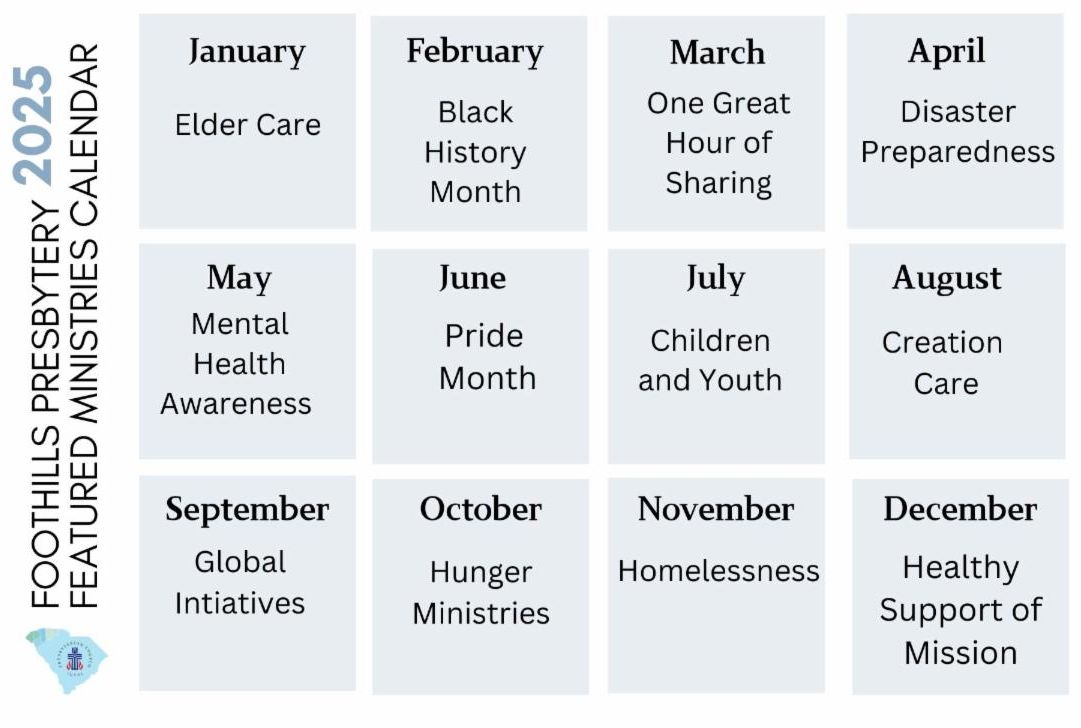
During 2025, the Mission and Outreach Nurture team of the Foothills Presbytery Committee on Shared Ministry will highlight partner ministries and mission opportunities every month. Each month's newsletter will include ways to engage in the featured ministry
on the calendar below.
| Please forward this email to church staff and members who are involved in mission and service. | |
DECEMBER
Cultivating Healthy Mission
| | |
|
There are a lot of good conversations happening these days around what it means to be a missional church (see the resource list at the bottom of this email). We care a lot about God’s world, and we long to partner with God in the work of reconciliation, healing, justice, and hope. All across our presbytery, there are many examples of ways we are living into God’s mission with intention, creativity, and dedication, and we’ve noticed a few hallmarks of the kind of missional engagement that leads to true transformation.
Hallmarks of Transformative Missional Engagement
-
Prioritize relationships over programs. Rather than launching mission projects because “that’s what churches do,” healthy missional engagement asks: What neighbors do we not know yet? How can we build trust without an agenda? What might we learn from forming new relationships?
-
Practice mutual transformation. Mission isn’t charity. It’s a journey where the church is changed as much as the people we serve. We bring our whole selves to missional engagement and stay open to learning, growing, and changing.
-
Create space for experimentation and reflection. Having a “laboratory mindset” opens up space for imagination, creativity, and learning. Try something small, reflect, adapt, and try again.
-
Ask God-oriented questions. Instead of church-centered metrics (attendance, giving), try asking: Where is the Spirit already at work in our neighborhood? How might we join in?
-
Redefine hospitality. Healthy missional engagement requires us to move from inviting people into our building and toward being present outside our walls, meeting neighbors where they are.
| |
Neighborhood Exegesis Exercise
If your congregation is ready to take a fresh, grounded look at mission, you might invite your Session, staff, and/or mission committee to try a “neighborhood exegesis.” In biblical interpretation, exegesis simply means paying close attention, honoring context, listening deeply, and allowing the Spirit to expand our imagination. We do this with Scripture because we trust it can reveal something true about God and about us.
We can approach our neighborhoods with that same sacred attentiveness. Our communities carry stories of resilience, beauty, inequity, diversity, and hope. By slowing down and paying attention, we begin to notice where liberation, healing, and connection are already taking shape. As Simon Carey Holt reminds us, our task is “to discern the truth of God’s presence where you live… reading your neighborhood as one of the primary texts of daily life—one through which God speaks.”
Our exegetical lens assumes this from the start: God is already at work in every neighborhood, among every culture, in every person. Our calling is not to bring God in, but to show up with humility, curiosity, and openness to mutual transformation.
|
Neighborhood Listening Exercise
Set aside at least an hour for this contemplative walk. Bring these guiding questions and something to write with. Move slowly, without an agenda other than to listen. Before you begin, pause to breathe and welcome the Spirit who is already present in this place.
As you walk, let all your senses engage. Pay attention to what feels alive, what feels wounded, and what feels sacred.
- Beginning where you are
- Standing outside your home, church, or office, what do you notice first? What sounds, movements, or energies are present? How does this place make you feel in your body?
- Structures, history, and story
- What does the architecture tell you about the neighborhood’s past? Who has been included here? Who has been marginalized? Does the physical environment feel cared for? Is it accessible to people of all abilities?
- Signs of stability or struggle
- Are buildings full or vacant? Do you notice new development, disinvestment, or gentrification? What does that say about who thrives here—and who is being pushed out?
- Gathering places and communal life
- Where do people naturally come together? Parks, porches, playgrounds, cafés, transit stops? Do these places feel welcoming? If comfortable, sit for a moment. Let yourself observe without judgment. Choose one person in your view and offer a quiet prayer of blessing for them—trusting that they are beloved of God.
- Local business, culture, and communication
- What kinds of businesses are here? What languages do you see? What cultures are reflected in restaurants, signs, and murals? What do advertisements communicate about values, priorities, or disparities?
- Spiritual presence
- Are there churches, mosques, temples, or sacred spaces? What do they communicate through their architecture, art, or messages? How might these communities be part of the spiritual ecosystem of the neighborhood?
- The people around you
- Who is out today? What diversity of age, race, gender expression, family structure, or economic situation do you notice? What stories might be unfolding in the lives of those you see?
- Life, hope, resistance, and beauty
- Where do you sense joy? Creativity? Mutual care? Where do you notice grief, injustice, or unmet needs? What glimpses of God’s dream for the world—justice, compassion, belonging—do you see?
- The Spirit’s invitation
- As you finish: Where did you feel stirred, challenged, or comforted? What questions emerged? What might the Spirit be inviting your congregation to learn, unlearn, or join in?
|
Resources
Books:
Articles:
|
| | |
|
The Committee on Shared Ministry would like to hear how your congregation is involved with homeless ministries.
Please share your stories here.
| | | | |