|
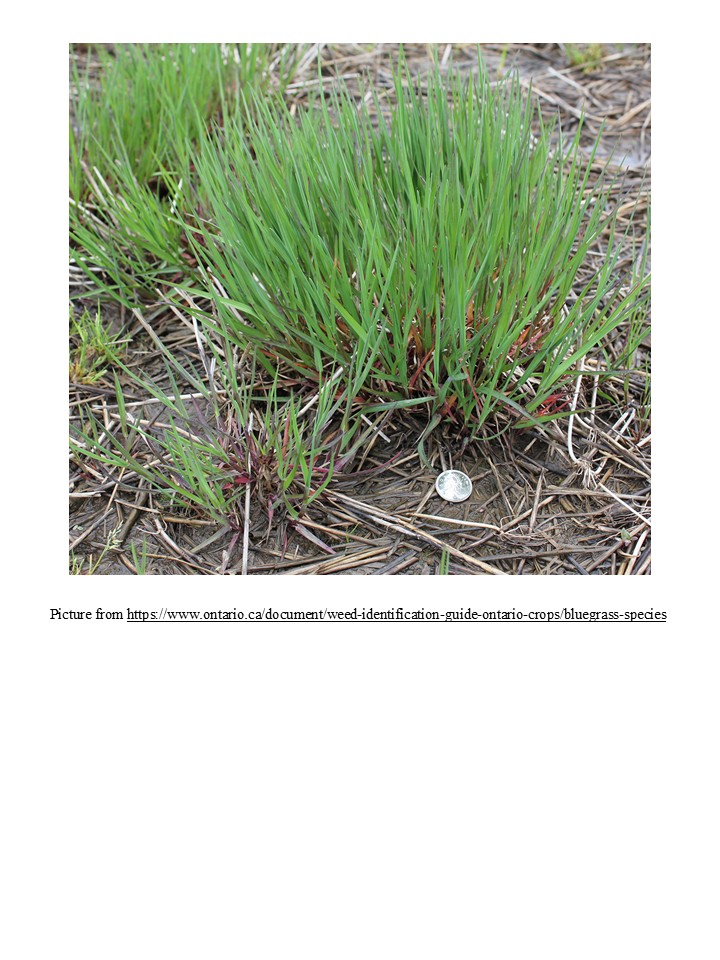
Canada bluegrass, (Flatstem bluegrass) Poa compressa, L. is a naturalized (introduced from Europe into Canada during the late 1700’s), long lived perennial, cool-season, mid grass, monocot, that is moderately tolerant of drought and saline soils, and shade intolerant.
Early season activity starts with regreening with active chlorophyll the portions of the carryover leaves that have intact cell walls from the previous growing season tillers. The green portions of the carryover leaves provides large quantities of carbohydrates with fixed energy for the production of new leaves.
Early aerial greenup consists of basal leaves arising from rhizome tiller buds towards late April or early May. Basal leaves are short about 1-4 in. long, bluegreen, with tip boat prow shaped. The split sheath is compressed, strongly flattened with translucent margins that overlap. The collar is narrow and yellow. The auricles are absent.
The rhizome systems has frequent branching with solitary or usually several tillers produced at each node at progressive intervals. The fibrous root system has fine branching main roots arising from stem crowns and rhizome nodes that extend deep into the soil.
Canada bluegrass has a similar appearance to Kentucky bluegrass except the flower stalks are hollow and a little shorter at about 16 in tall, and the stem is strongly flattened at the bottom with a reddish purple color kind of like little bluestem. The phenological growth stages occur about two weeks later than Kentucky bluegrass, with the flower period only four weeks long from early to late June.
We collected grass plant basal cover densities with the point frame method for 30 years from 1983 to 2012. The changes in grass density of Kentucky bluegrass and Canada bluegrass are different and quite interesting, with different results following the drought of 1988 and low water period through 1992.
During the 5 year period prior to the 1988 drought, Kentucky bluegrass had a mean annual density of 0.1% on ungrazed grasslands. Canada bluegrass had a mean annual density of 0.02% on ungrazed grasslands. During the drought neither Kentucky nor Canada bluegrass were present. Canada bluegrass came back in 1995 and developed a mean annual density of 3.47% on ungrazed grasslands over the next 18 years. Kentucky bluegrass did not come back until 1998 and developed a mean annual density of 0.36% on ungrazed grasslands over the next 15 years. Most of our bluegrass before the drought was Kentucky bluegrass but after the drought most of our bluegrass is Canada bluegrass.
The devastating effects from the drought conditions caused the density of native grasses to decrease that provided open spaces for the density of the bluegrasses to increase on the ungrazed grassland areas.
https://www.ndsu.edu/agriculture/ag-hub/publications/dickinson-rec-2018-annual-report
|