|
Background
- Aetna and Cigna have announced automatic downcoding policies for complex Evaluation & Management (E/M) services -- specifically, level 4 and level 5 office visits.
- Aetna and Cigna are using algorithms or claims data alone to automatically downgrade the codes physicians assign to cases -- without reviewing individual patients' medical records.
- The result is that claims for complex visits will be paid at a lower level. Physicians who disagree with this automatic downcoding will have to appeal.
○ That process will require submitting a significant amount of paperwork and patient case documentation -- something many practices will not have the capacity or wherewithal to do.
- This "deny first, pay later" system presumes physicians are guilty of "upcoding" until proven innocent.
Issues we are facing:
-
These new policies from Aetna and Cigna do not put patients first. They're not about catching bad actors. They're about boosting insurer profits at the expense of patient access and timely care.
-
These policies threaten the viability of independent physician practice. Automatic downcoding will accelerate the collapse of independent practices that communities rely on for accessible, affordable care.
-
Insurers are acting in bad faith. Aetna and Cigna are rewriting the rules of medical coding unilaterally, disregarding physician expertise and nationally recognized standards.
Potential Scope of the Policy
- Aetna and Cigna’s policies will have the potential to impact some of the most commonly billed codes
○ According to CMS data of Medicare Part B E/M codes by specialty in CY 2022, E/M CPT code 99214 was the most frequently billed E/M code (of 114 codes tracked), representing 25% of allowed E/M claims. E/M CPT code 99215 was the sixth most frequently billed E/M code in the same data set, representing 3% of all codes billed.
- Overcoding of CPT codes 99214 and 99215 is de minimis
○ According to a 2024 audit of Medicare FFS claims, CPT codes 99214 and 99215 overcoding represented 0.13% of paid Medicare FFS claims in 2024.
○ Cigna anticipates that this new policy will affect less than 3% of eligible claims.
* This is a significantly greater percentage of claims than CMS data would suggest are actually overcoded
- When you consider the high volume of claims this would affect, and the low likelihood that they are incorrectly coded, it is difficult to justify this policy as anything more than a way for insurers to erect even more barriers to paying physicians for the services they have already provided
Effect on Patients
- These policies will force physicians to spend even more time doing paperwork that would have been better spent treating patients.
○ Instead of treating patients, physicians will have to spend their time fighting the likes of Aetna and Cigna for just reimbursement.
- Aetna and Cigna are putting patients in the middle of a claims tug-of-war.
○ Aetna and Cigna are using mysterious, opaque algorithms to second-guess the clinical judgment of the physicians that patients trust -- and refusing to explain or justify their decisions.
Effect on Independent Physicians
- Independent practices lack the armies of coders and administrators that hospital systems have. They don't have the capacity to play insurers' bureaucratic games.
○ Downcoded claims necessitate time-consuming appeals and effectively force practices to beg for payment for the care they've provided.
- A policy of automatic underpayment strains independent practices' scarce resources.
○ And by threatening independent practices' financial viability, these policies hasten consolidation within the healthcare market.
- To avoid these administrative and financial headaches, independent practices accede to buyout offers from large hospitals and health systems.
- Such consolidation results in higher costs, fewer choices, and less personalized care for patients.
Backward Policy
- Both policies flout coding guidelines from the American Medical Association and the Centers for Medicare and Medicaid Services, which require review of medical records to determine visit complexity.
- Aetna and Cigna's approach is opaque. Physicians do not know the criteria or algorithms being used, leaving them unable to avoid downcoding even if they code correctly.
- These actions may even conflict with federal and state law, including prompt-pay requirements and fair claims review standards.
Please find policies linked below:
| | |
Bipartisan and bicameral bills have been introduced to extend telehealth access through fiscal year 2027.
Telehealth services have become a crucial part of modern medical practice, especially since the COVID-19 pandemic. They provide numerous benefits to patients, helping to address issues like transportation barriers, missed work for caregivers, and financial strains. Medicare has played a key role in expanding access to telehealth, benefiting not only rural Americans but also the broader population, as most insurers—except United Healthcare Commercial— have adopted these policies.
The Telehealth Modernization Act of 2025, led by Reps. Buddy Carter (R-GA) and Debbie Dingell (D-MI), ensures continued access to telehealth services for seniors and patients nationwide. A companion bill is being advanced in the Senate by Sens. Tim Scott (R-SC) and Brian Schatz (D-HI).
Lawmakers emphasized the critical role of telehealth in reducing barriers to care, improving access for rural and underserved patients, and modernizing healthcare delivery.
This legislation represents a major step toward securing long-term telehealth access for Medicare patients and strengthening its place in the U.S. healthcare system.
| | Stay up-to-date with news that impacts you - visit our website or follow us on these social media platforms: | | | |
ASIPP is advocating strongly on behalf of interventional pain physicians, sending letters to Congress urging revisions to the proposed 2025 Physician Payment Rule from the Centers for Medicare & Medicaid Services (CMS). While ASIPP supports CMS’s goals of reducing waste, improving quality, and strengthening chronic disease management, the current proposal would have devastating consequences for interventional pain practices. These sweeping cuts risk accelerating healthcare consolidation, reducing patient access to pain specialists, and worsening physician burnout, at a time when practice costs are soaring, staff wages are rising, and reimbursement rates continue to fall.
Since 2001, interventional pain physicians have experienced some of the steepest cuts across all specialties, 41% through 2025, projected to reach 45% with the new rule. Even with modest office-based payment relief projected for 2026, the cumulative losses remain unsustainable.
In addition, CMS is introducing an Ambulatory Specialty Model (ASM) that will begin a trial phase in select states starting January 2027 and continue for five years through December 31, 2031.
This pilot will focus on two chronic conditions, low back pain and heart failure, with the following objectives:
1. Prevent the worsening of chronic conditions
2. Identify risks and early signs of chronic conditions
3. Improve patient experience
4. Reduce unnecessary procedures and surgeries
The specialties included are interventional pain management, anesthesiology, neurosurgery, orthopedic surgery, and physical medicine and rehabilitation. During the first payment year, adjustments will range from -9% to +9%, with all participants subject to this risk. Participation is mandatory, not optional.
However, there is no established or evidence-based guidance for this model, which significantly increases the risk for pain specialists. Pain specialists do not manage acute pain and have no control over many of the associated costs, yet they would still be held accountable for overall patient spending. These payment adjustments may apply to all Medicare services.
ASIPP urges CMS to eliminate the ASM until appropriate criteria are established and the model’s effectiveness is demonstrated.
ASIPP is urging Congress to:
- Reverse the proposed 2.5% efficiency adjustment to work RVUs and stop the cycle of devastating cuts every three years.
- Promote equitable treatment of independent pain practices in practice expense allocations, especially for services provided in Ambulatory Surgery Centers.
- Ensure the permanent extension of telehealth access beyond 2025, critical for chronic pain patients in rural and underserved areas.
- Direct CMS to distinguish reimbursement reductions between hospital-employed and independent physicians, protecting small pain practices from disproportionate harm.
- Ask CMS to withdraw this provision pending the development of appropriate criteria and validation of the model's effectiveness.
Without these revisions, independent interventional pain practices, already under audit pressure and burdened by prior authorization requirements, face an uncertain future. Preserving their viability is essential to maintain patient access to timely, high-quality pain care and to prevent further healthcare consolidation that continues to drive up costs by 200–300%.
SAMPLE LETTER TO SEND TO REPRESENTATIVES IN CONGRESS
ASIPP has prepared a sample letter you can personalize and send to your representatives in Congress.
Click here to find your congressional members.
By speaking out, you can help stop devastating cuts, protect independent interventional pain practices, and preserve patient access to high-quality pain care.
Please click here for a sample letter to send to your representatives.
SAMPLE LETTER TO SUBMIT COMMENTS TO CMS
For your convenience, we are enclosing a sample letter for you to customize and send to CMS to express concerns with the 2025 Medicare Physician Fee Schedule.
Please click here for a sample letter to submit your comments to CMS.
INFORMATION FOR SUBMITTING YOUR COMMENT LETTER
In commenting, please refer to file code CMS-1832-P.
Comments must be received no later than 5 p.m. on September 12, 2025.
Click here to submit electronic comments on this regulation.
Please do not hesitate to contact us if you have any questions or would like additional information.
Thank you,
Laxmaiah Manchikanti, MD
Chairman of the Board and Chief Executive Officer, ASIPP and SIPMS
drcm@asipp.org
Mahendra Sanapati, MD
ASIPP President
drs@apccweb.com
| |
Join Us in New Orleans for ASIPP 2026
Earn CMEs, Expand Networks, and Explore the Future of Pain Management
| | JOIN or RENEW your ASIPP Membership for the best registration rates. | |
Neurologists are exploring medications that would help the brain recover after a stroke or traumatic injury.
The first thing Debra McVean did when she woke up at the hospital in March 2024 was try to get to the bathroom. But her left arm wouldn’t move; neither would her left leg. She was paralyzed all along her left side.
She had suffered a stroke, her doctor soon explained. A few nights before, a blood clot had lodged in an artery in her neck, choking off oxygen to her brain cells. Now an M.R.I. showed a dark spot in her brain, an eerie absence directly behind her right eye. What that meant for her prognosis, however, the doctor couldn’t say.
“Something’s missing there, but you don’t know what,” Ms. McVean’s husband, Ian, recalled recently. “And you don’t know how that will affect her recovery. It’s that uncertainty, it eats away at you.”
Click here to read the full article.
| |
Women with T2D had lower fracture risk with semaglutide versus other antidiabetics
GLP-1 receptor agonist use was tied with a reduced risk for fracture among older women with type 2 diabetes, a retrospective cohort study found.
Among over 350,000 GLP-1 users, there was a significantly lower risk for several different types of fractures compared with women with diabetes not using one of these agents, reported Jawaad Chaudhry, BS, MD candidate, of Penn State Milton S. Hershey Medical Center in Hershey, Pennsylvania.
At the 2-year follow-up mark, risk for all fracture types were significantly lower among GLP-1 agonist users (P<0.0001 for all):
- Vertebral wedge compression fractures: relative risk (RR) 0.84 (95% CI 0.78-0.90)
- Subtrochanteric fractures: RR 0.61 (95% CI 0.47-0.78)
- Intertrochanteric fractures: RR 0.77 (95% CI 0.67-0.87)
- Femoral neck fractures: RR 0.66 (95% CI 0.60-0.73)
- Distal radius fractures: RR 0.79 (95% CI 0.72-0.85)
- Periprosthetic fractures: RR 0.75 (95% CI 0.65-0.86)
Click here to read the full article.
| | |
A patient with diabetes may share that they’ve been experiencing persistent knee pain. Could this be an overlooked symptom of diabetes? Understanding more about knee pain can help you treat your patients with diabetes more effectively and holistically.
Ongoing knee pain can pose several issues for patients, including mobility struggles and quality-of-life concerns. Here are a few ways to provide comprehensive care to your patients.
The Lesser-Known Effect of Diabetes
Knee pain is a common symptom among individuals with diabetes that may be overlooked or thought to be unrelated to having diabetes, according to Scott Isaacs, MD, president of the American Association of Clinical Endocrinology and adjunct assistant professor at Emory University in Atlanta.
Click here to read the full article.
| | |
Mark your calendars!
September 27, October 25,
November 15, & December 13
Four (4) hour virtual exam
- ABIPP Path – Combined CCPM/ CSM Exam
For those with subspecialty in Pain Medicine
Two (2) hour virtual exam
- ABIPP Competency Exam in IPM
For those without primary board certification
Two (2) hour virtual exam
- ABIPP Competency Exam in Regenerative Medicine
Two (2) hour virtual exam
- Controlled Substance Management Competency Exam
Two (2) hour virtual exam
- Documentation, Coding, Compliance, Practice Management Competency Exam
Two (2) hour virtual exam
| | |
I feel somewhat hesitant to criticize the two authors of an opinion piece on physician burnout that I just read in the BMJ. One of them, Peter Brindley, MD, is a well-known Canadian intensivist, professor of intensive care, anesthesiology, and bioethics, and a science communicator who also hosts a podcast. The other, Matt Morgan, MBBCh, is also an intensivist, as well as a regular BMJ commentator, author, speaker, and consultant on various science outreach initiatives through theater and television, which earned him an honorary title of professor in the “Public Understanding of Medicine.”
Faith or Burnout
Two authoritative voices, then. Yet the premise from which they start — addressing colleagues who have lost “faith” in medicine — does not sit well with me. Their piece is indeed titled: “When doctors lose their faith in medicine.” I began reading it thinking it would address the many physicians who, unfortunately, abandon science to pursue alternative paths, similar to patients who lose trust in the preventive and therapeutic power of vaccines and conventional drugs and turn to the many gurus promoting other approaches on social media and beyond.
Instead, to my surprise, the article focuses on colleagues afflicted by burnout. The authors note that the definition of clinician burnout “is woefully imprecise but includes moral fatigue, lost meaning, and depersonalization and has been self-reported in around half of all practitioners,” according to a recent survey by the UK’s General Medical Council. But “burnout probably also equates with how often you greet the day thinking that you’re going through the motions and spend your shift asking what the point is.”
Click here to read the full article.
| | | |
We're excited to let you know that the new ASIPP Community, hosted by DocMatter, is now live!
The ASIPP Community on DocMatter will serve as a place for members to collaborate around clinical and research topics to advance the care of their interventional pain patients.
Click here to be a part of the conversation!
| | |
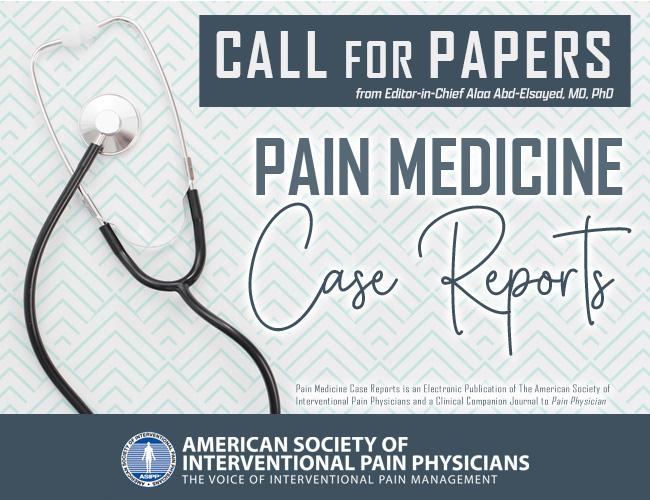
Pain Medicine Case Reports (PMCR) and Editor-in-Chief Alaa Abd-Elsayed, MD, PhD would like to invite you to submit case reports and case series to the PMCR journal. Your article will be published free of charge.
Open access journals are freely available online for immediate worldwide open access to the full text of published articles. There is no subscription fee for open access journals. Open access journals are no different from traditional subscription-based journals: they undergo the same peer review and quality control as any other scholarly journal.
Interested in becoming a member of the PMCR Editorial Board?
Editorial board members are asked to review 2-6 manuscripts per year. Please submit your most up-to-date CV to sgold@asipp.org for consideration.
For more information or to submit your articles, click here.
| | |
We are excited to announce that Pain Medicine Case Reports (PMCR) journal (eISSN 2768-5152) has been accepted for inclusion in MEDLINE and PubMed, the prestigious bibliographic database of the U.S. National Library of Medicine. PMCR, a companion publication to the prestigious Pain Physician journal by ASIPP, joins its counterpart in achieving indexing in both MEDLINE and PubMed, marking ASIPP’s dual presence in these renowned databases.
The inclusion of PMCR journal in MEDLINE signifies a higher level of selectivity, as MEDLINE consists of the top 5,200 biomedical journals. This indexing also means that articles from PMCR will be searchable using NLM Medical Subject Headings (MeSH terms) and other metadata.
The selection for MEDLINE follows a rigorous evaluation process by reviewers from the Literature Selection Technical Review Committee (LSTRC). According to their criteria, the scientific quality of a journal’s content is the primary factor considered for indexing.
We extend our congratulations to the Pain Medicine Case Reports Editor-in-Chief, Deputy Editor-in-Chief, Journal Team, and Editorial Board for this achievement, which underscores the significance and excellence of this esteemed journal.
| | | | |