|
|
Defending wildlife and habitat through:
Advocacy
Conservation
Education
|
|
|
News & Updates: March 2024 |
|
In this issue:
-
AOK Celebrates 25 years of Prairie Wings
- Nature Adventurepacks given to the Wamego Public Library
- Searching for Prairie Grouse
- What good is a yucca?
-
Philanthropy Corner: Double Your Donation for Earth Day
- AOK Events
- Sharp-tailed Grouse viewing at Hutton Sanctuary
- Public Talk in Ulysses
- Achterberg Work Day
- Big Kansas Road Trip in Lincoln County
-
Hutton
Work Fun! Weeks
-
Chapter Spotlight: Wichita Audubon has programs, field trips, and a nature center - oh my!
-
AOK Nature Spot Recommendations: Burnett's Mound in Topeka
|
|
|
AOK Celebrates 25 years of Prairie Wings
|
|
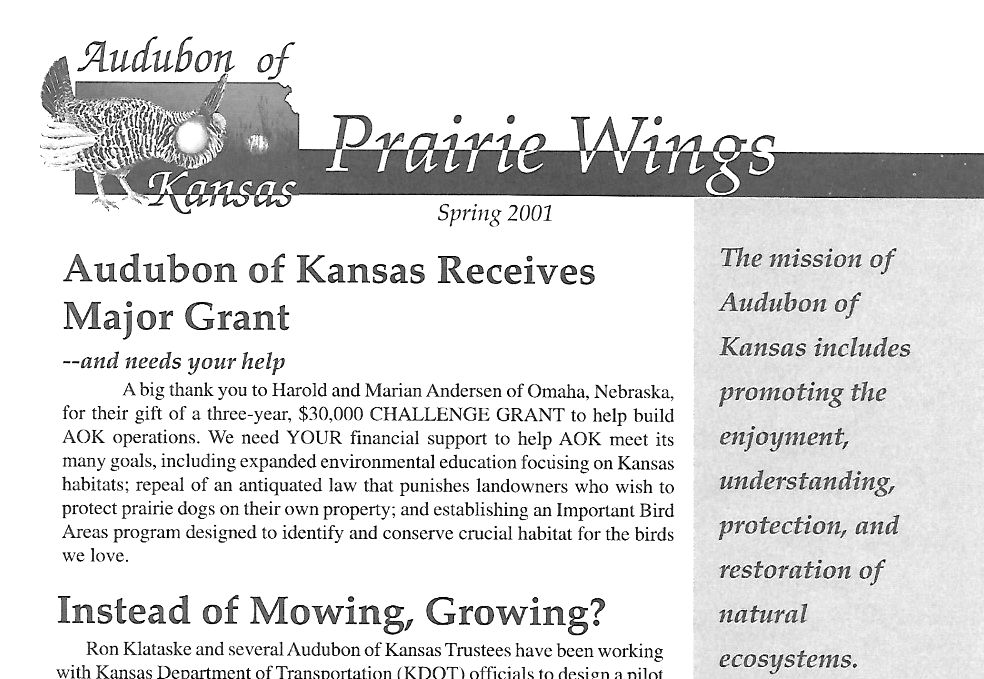
Audubon of Kansas is celebrating our 25th anniversary this year. One of the first things the newly formed organization did was start communicating with members through a Prairie Wings newsletter. The Spring 2001 edition was much more than a newsletter - it was 16 pages of short articles. What is surprising is that we are still talking about many of the same topics today - legislative updates, prairie dog persecution, historical and contemporary essays about experiencing nature, roadside vegetation management, birding festivals and events, and appreciation of volunteers and donors.
Today, Prairie Wings is a magazine delivered to members once a year. It is full of inspiring articles documenting the conservation impact of AOK, stirring colored landscape and wildlife photos, feature-length articles on various topics, and personal essays about experiencing nature.
This year's Prairie Wings will be coming out in the coming month. It will be mailed to libraries throughout the state and to everyone who has donated to AOK in the past couple of years. To update your address or to confirm that you will be receiving a Prairie Wings, contact Ellen, AOK Director of Philanthropy, at ellen@audubonofkansas.org or 316-247-1043.
|
|
|
Nature Adventurepacks given to
Wamego Public Library
|
|
Wamego Public Library is the latest library to receive a Nature Adventurepack. We hope that library patrons will check out the backpack and use the binoculars and field guides at Mount Mitchell Heritage Prairie, which is owned by Audubon of Kansas and the Mount Mitchell Prairie Guards. This historic site and prairie preserve is located south of Wamego on Highway 99. Visitors to Mount Mitchell should see meadowlarks year-round, and Dickcissels and Scissor-tailed Flycatchers in summer. It is also a great place to view prairie wildlflowers and butterflies in summer. |
|
|
Searching for Prairie Grouse |
|
In preparation for the Kansas Lek Treks Prairie-Chicken Festival, AOK Executive Director Jackie Augustine has been in the Hays area looking for Greater and Lesser Prairie-Chickens.
It is always a challenge to find prairie-chickens, but this year has been a bit more challenging than usual.
To find prairie-chickens, Jackie first looks at satellite imagery for large swaths of prairie. Then she zooms in and looks for things that prairie-chickens generally avoid like cedars, oil pumps, wind turbines, major roads, etc. If a site looks promising, she will plan on arriving 30 min before sunrise, the time when prairie-chickens start their display, and find the highest hill on the road to stop, listen, and scan the hilltops. Prairie-chickens display from hilltops to allow their love songs travel the greatest distance over the landscape as well as to see predators which might have other plans for the birds. She often sees the birds flying to a lek, or jumping as they fight or perform flutter jump displays.
The weather has to be cooperative in order to find prairie-chickens. Ideally, there is little to no wind, and it has been dry for several days before the search. Precipitation affects accessibility as many dirt roads become muddy pits that want to swallow tires and whole cars. Wind affects Jackie's ability to detect the birds.
When a lek is found, she uses property maps to determine who the landowner is. Then she searches phone books and the internet trying to find contact information for that landowner.
This season started out well - Jackie spent a week in Phillipsburg, KS and found several Greater Prairie-Chicken leks south of Kirwin National Wildlife Refuge on private land. Unfortunately, most landowners did not allow access to the property. The next week, Jackie was in the WaKeeney area looking for Lesser Prairie-Chickens. However, a blizzard prevented surveys from being conducted for two days, and the roads were still marginal on days 3 and 4.
If you know of willing landowners with prairie-chickens on their property that are within a 1-hour drive of Hays, please consider sharing that information with Jackie (jackie@audubonofkansas.org or 785-537-4385).
Thank you!
|
|
|
What good is a yucca?
As I’m traveling throughout western Kansas, I see landowners pulling up or poisoning yuccas. Cows won’t eat them (unless it’s winter and they are adventurous and realize they are packed with protein). Yuccas can tear up unprotected shins or the tires of 4-wheelers (don’t ask me how I know). So why keep them?
I asked this of a rancher once, who had an above average abundance of yuccas in his pasture. He said that his grandpa told him that during the dust bowl, the only grass that was available to the cattle was found in the shadow of a yucca. Knowing drought would come again, he tolerated them.
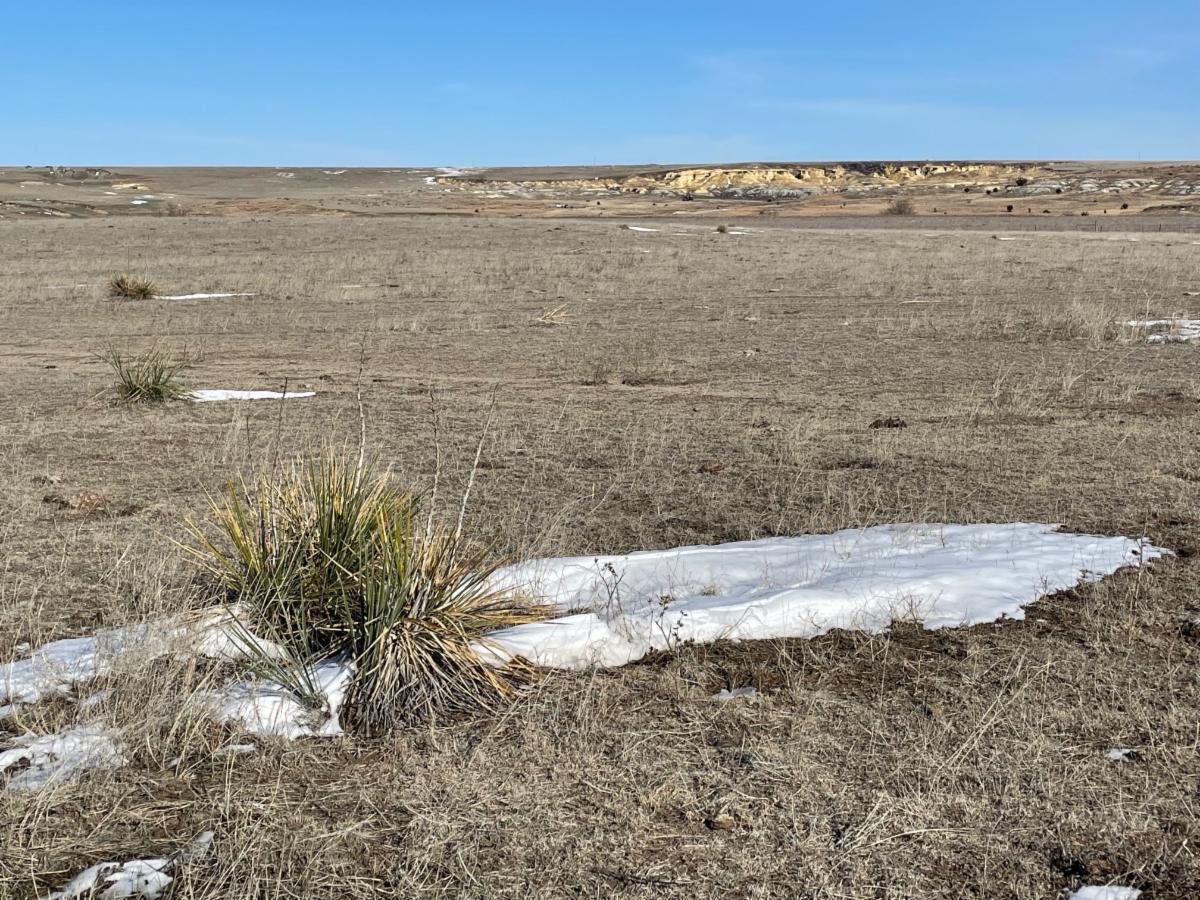
This photo shows how important yuccas (and other shrubby plants like buttonbush) are to the prairie. After this week’s blizzard, snow piled up behind the yuccas. That little bit of moisture will be invaluable to the grasses and wildflowers downwind.
Yuccas also have a myriad of other valuable qualities. They have a mutualistic relationship with a moth that pollinates the flowers in return for a place to raise its offspring. The growing flower stalks are edible (although I think they taste like soapy asparagus). They have a large taproot allowing them to flourish in dry environments.
We posted this essay on FaceBook this week and asked, "Who else thinks yuccas are great?" We received so many responses!
Alana responded, "Soap weed, used by the pioneers to make lye soap!"
Vanessa wrote, "Cottontails and jack rabbits use them as places to evade predators or hunker down! And i have seen huge packrat nests in clumps of yucca!"
Jeanette commented, "We had corrientes [cattle] at one time. They uprooted them and ate the roots helping to thin them out."
Others talked about how they used them for landscaping around their yard.
It was so great reading everyone's comments!
Essay and photo by JK Augustine. Photo taken in Trego County, KS, this week.
|
|
|
Philanthropy Corner:
Celebrate Earth Day by Doubling Your Impact at AOK!
|
|
As we look forward to celebrating the beauty and resilience of the Great Plains on Earth Day this April, we also recognize that habitat destruction and fragmentation raise urgent conservation issues that demand our attention and action today. Since 1970, we have lost 2.5 billion migrating birds in North America due to woody encroachment on our prairies and unsustainable groundwater pumping causing our wetlands to run dry. These are critical issues facing countless species, including the endangered Whooping Crane.
This year we are offering an incredible opportunity to double your donation with a 1 to 1 match up to $35,000. That means a gift of $50 unlocks an additional $50 for a total impact of $100; a gift of $500 is matched dollar-for-dollar and has a $1,000 impact! - Your opportunity to double your donation starts TODAY!
Thank you for considering generous support of our efforts to ensure a better future for people and wildlife in Kansas and beyond.
|
|
Now until April 28
Sunrise: Sharp-tailed Grouse Viewing
Hutton Niobrara Ranch Wildlife Sanctuary near Bassett, NE
April 5
12:30-1:30pm: Public Talk: 3 Billion Birds - Gone! And what to do about it
Grant County Senior Center, 117 E Grant Ave., Ulysses
A recent study revealed that we have lost one in four individual birds since 1970, amounting to nearly 3 billion birds. However, not all species declined and some habitats experienced more declines than others. Dr. Jackie Augustine, Audubon of Kansas Executive Director, will explain how this was estimated, describe trends in the data with respect to species and habitats, and share ways you can prevent further losses in your own neighborhood.
- Public talk starts at 12:30, no RSVP required.
- Come at noon for lunch, RSVP required. Call 356-2216 at the local area code (620).
April 11-14
Kansas Lek Treks Prairie-Chicken Festival
Event is full.
Plan on attending next year (April 10-13, 2025). Sign up for emailed updates.
April 18
9am-3pm: Work Day at Achterberg
Achterberg Wildlife-Friendly Demonstration Farm, 950 N 170 Rd, Lincoln, KS
Join the Fort Hays State University Wildlife Management class in helping maintain trails and remove invasive woody plants. Come for all or part of the day. Please contact Jackie to let her know you're coming and to receive updates on the day's tasks.
Thursday, May 2
8-10pm: Dark Sky Viewing
Achterberg Wildlife-Friendly Demonstration Farm, 950 N 170 Rd, Lincoln, KS
Kansas has some of the best night sky viewing in the country. Join astronomers in viewing the night sky. It will be an excellent night for observation as the moon will not rise until after midnight. We will look at constellations and observe planets and other astronomical features through telescopes.
Friday, May 3
8am: Migration Bird Hike
Achterberg Wildlife-Friendly Demonstration Farm, 950 N 170 Rd, Lincoln, KS
May is the height of songbird migration through Kansas. Audubon of Kansas' Connie Achterberg Wildlife-Friendly Demonstration Farm has a mix of habitats that attracts a wide variety of birds, including grassland and riparian woods. Executive Director, Jackie Augustine, has been a birdwatcher and ornithologist (a scientist that studies birds) for over 25 years. She will lead you on a short hike through the sanctuary and help you identify birds by both sight and sound. If you have them, bring binoculars
3pm: Managing for Quail and other wildlife
Achterberg Wildlife-Friendly Demonstration Farm, 950 N 170 Rd, Lincoln, KS
Audubon of Kansas' Achterberg Wildlife-Friendly Demonstration Farm hosts two coveys of bobwhite quail. Executive Director, Jackie Augustine, will talk about recent habitat improvements aimed at removing woody species and making the area more suitable for Connie Achterberg's favorite bird, the bobwhite quail.
8pm: Owl Hike
Achterberg Wildlife-Friendly Demonstration Farm, 950 N 170 Rd, Lincoln, KS
Owl Hike - Whooooo's awake? The Connie Achterberg Wildlife-Friendly Demonstration Farm is home to both Barred and Great Horned Owls. Audubon of Kansas Executive Director, Jackie Augustine, will discuss owl biology and lead participants in a hike through the sanctuary to listen for owls. You will learn to identify owls by their calls. As owls are wild animals, viewing owls is not guaranteed, but there is a good chance to see them.
May 20-24
Work Fun! Week at Hutton Niobrara Ranch Wildlife Sanctuary, Bassett, NE
October 3-7
Work Fun! Week at Hutton Niobrara Ranch Wildlife Sanctuary, Bassett, NE
October 6
Open House at Hutton Niobrara Ranch Wildlife Sanctuary, Bassett, NE
November 1-2
Celebration of Cranes at Sterling/Quivira National Wildlife Refuge
|
|
Chapter Spotlight:
Wichita Audubon Society has programs, field trips, and a nature center - oh my!
|
|
Wichita Audubon has it all! They have monthly programs from during most of the year (they take a break in summer). The next program starts at 7pm on April 16 at the Great Plains Nature Center (6232 E 29th St N, Wichita). Chuck Otte, a well-known Kansas birder and retired Geary County Extension Agent, will talk about 'Bird Distributions in Kansas: Dynamic or Stable?' Chuck will explain the history of the Kansas checklist project and show some of the patterns we are seeing in bird occurrence within Kansas, as well as discuss how eBird is impacting our knowledge of bird distributions.
They host field trips near and far. A recent field trip successfully located American Woodcocks in Chisholm Creek Park. This bird displays at dusk by making 'peenting' calls on the ground before performing huge spirals in the air while making a 'twittering' sound with specialized wing feathers. Their next field trip is April 6, and will be traveling to Chautauqua County and the unique and scenic Cross Timbers region. More information can be found HERE.
Wichita Audubon even has its own nature center and wildlife sanctuary. Chaplin Nature Center is located near Arkansas City, and offers various programs for adults and children. More information can be found HERE.
|
|
|
AOK shares favorite birding spots! |
|
Burnett's Mound in Skyline Park in Topeka
3511 SW Skyline Parkway
Topeka, KS 66614
39.00382, -95.73729
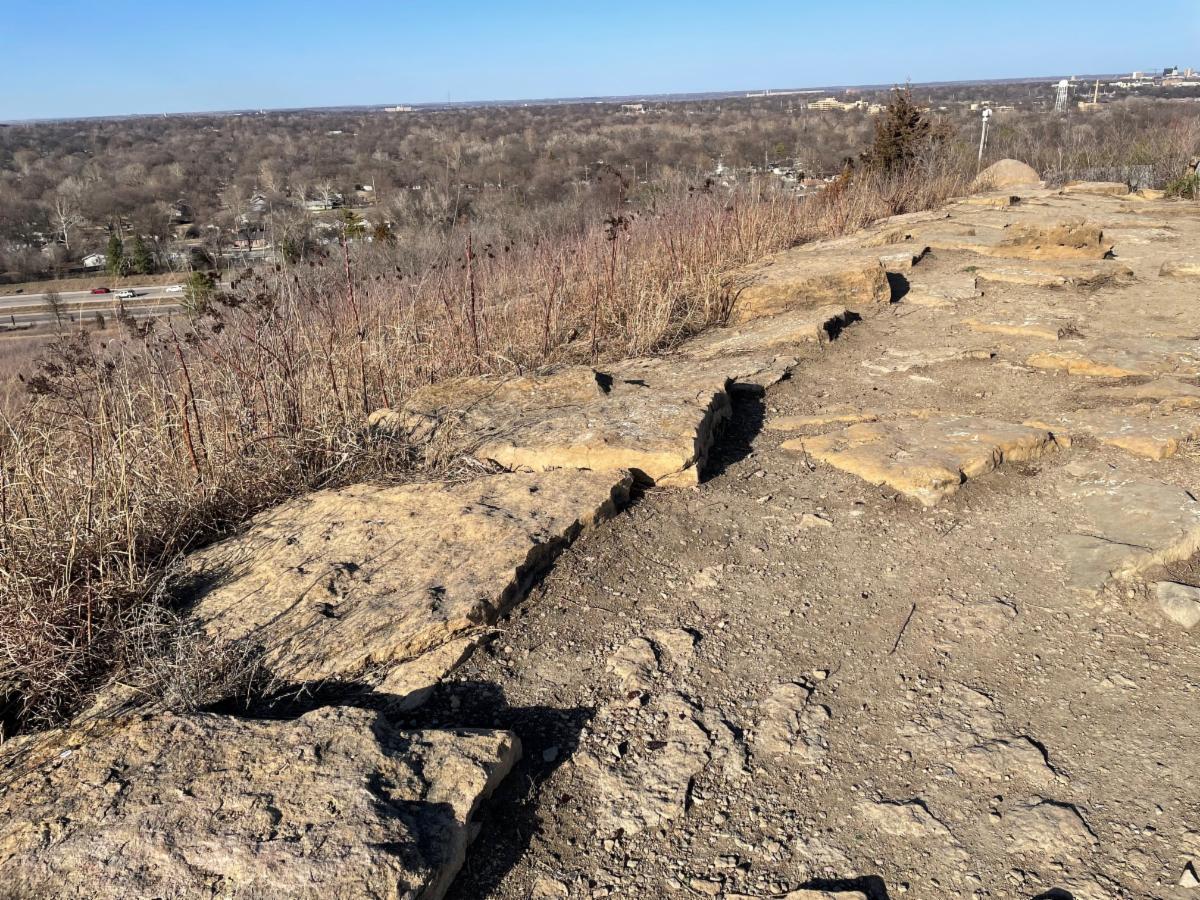
The 106-acre Skyline Park features Burnett's Mound, where visitors can enjoy panoramic views of Shawnee County. The park features over 4 miles of trails, divided into multiple ~1 mile loops which wind through wooded areas and restored prairie in the higher elevations. The sunrise (blue) trail features interpretive signage describing the wildilfe and flora and fauna in the park. Near the park entrance are interpretive signs telling the history of the Citizen Potawatomi Nation how the Potawatomi people came to settle in northeast Kansas.
Photo by JK Augustine showing the view from the top of Burnett's Mound
|
|
|
Ellen Johnson Mosley - Director of Philanthropy - Gift Planning, Membership, Endowments, Events Management - ellen@audubonofkansas.org
Amy Kucera - Sanctuary Manager - Questions about AOK sanctuaries and habitat management amy@audubonofkansas.org
Audubon of Kansas
PO Box 1106 - Manhattan, KS 66505
785-537-4385
|
|
|
|
|
|
|