Weekly update from the National Housing Conference | |
News from Washington | By Brittany Webb
| |
|
Fannie Mae and Freddie Mac partner with FHLBanks to expand housing opportunities for Native communities
The Federal Housing Finance Agency (FHFA) announced a new combined initiative to expand housing access for tribal communities through programs administered by Fannie Mae and Freddie Mac (the Enterprises) and the Federal Home Loan Banks (FHLBanks). The initiative streamlines efforts to boost awareness, credit access, and liquidity for programs for tribal communities through partnerships between the Enterprises and the FHLBanks. Fannie Mae will purchase loans originated through the FHLBank Mortgage Partnership Finance (MPF) program, administered by the FHLBank of Chicago on behalf of six Federal Home Loan Banks, to increase liquidity for tribal communities. Under Fannie Mae’s Native American Conventional Lending Initiative, loans will provide an additional financing option for Native American borrowers to purchase homes on tribal trust lands.
"We appreciate our partnership with the Federal Home Loan Bank of Chicago's MPF Program as we expand opportunities for conventional mortgage lending and sustainable access to homeownership for Native American consumers on tribal trust lands," said Laurel Davis, Senior Vice President of Environmental, Social, Governance & Mission, Fannie Mae.
Freddie Mac will partner with the Federal Home Loan Bank of Des Moines through an awareness campaign to inform the Bank’s network of financial institution members about Freddie Mac's mortgage offering. The campaign will highlight Freddie Mac's HeritageOne mortgage offering, as well as financial counseling and other resources for Tribal members with a focus on first-time homebuyers.
"FHLB Des Moines recognizes and celebrates the strength and self-determined spirit of Native communities throughout our district," said Kris Williams, President & CEO of FHLB Des Moines. "We are pleased to support Freddie Mac in its efforts to showcase ways its HeritageOne product may be leveraged by our financial institution members to create pathways of opportunity for informed and sustainable homeownership for tribal members.”
| | |
|
Hurry - only 50 seats remaining!
On Dec. 4, the National Housing Conference will host its Solutions for Affordable Housing convening at the National Press Club in Washington, DC. Join Congresswoman Debbie Dingell (D-Mich.) and affordable housing stakeholders as they discuss today’s most pressing housing issues and focus on solutions that are tangible, impactful, and achievable.
NHC members can take advantage of excusive member rates by using the following discount codes.
| |
|
In-Person Tickets
$175
Use Code: Member2024
| |  |
|
Virtual Tickets
$125
Use Code: MemberVirtual2024
| |
|
CDFI Fund and FHFA partner to support housing investment
The U.S. Department of the Treasury's Community Development Financial Institutions Fund (CDFI Fund) and the Federal Housing Finance Agency (FHFA) announced the formation of a new working group to increase capital for affordable housing lending through the Federal Home Loan Banks (FHLBanks). This initiative focuses on Community Development Financial Institutions (CDFIs) that serve distressed communities. CDFIs have been a frequent and prominent topic in the FHFA’s review of the FHLBank system, featuring ways the FHLBanks can work more effectively with CDFIs through their Affordable Housing Programs. The working group will focus on developing innovative programs that enable non-depository CDFIs to tap into affordable capital sources, enhancing their ability to finance housing projects. Key priorities for 2024-2025 include improving property appraisal processes, refining collateral mechanisms, and data-sharing on CDFI activities and performance.
“The Biden-Harris Administration is focused on using every tool at its disposal to increase the supply of housing and lower costs for American families,” said U.S. Deputy Secretary of the Treasury Wally Adeyemo. “Critical to our efforts is working to ensure that the Federal Home Loan Banks fulfill their statutory mission of supporting affordable housing. Helping lenders expand their sources of financing and access capital from the Federal Home Loan Banks will help these community banks support a range of projects that can lower housing costs in communities across the country for years to come.”
The CDFI fund also recently released new Frequently Asked Questions (FAQs) and recorded webinars.
| | |
|
Fed cuts rates by quarter point
The Federal Reserve Board of Governors Federal Open Market Committee (FOMC) announced a cut to the target federal funds rate by 0.25 points to 4.5%-4.75%, the second time the rate has been cut since March 2020. In September, the FOMC cut rates by half a point. During a press conference, Federal Reserve Chair Jerome Powell noted the continuous goal to return inflation to 2%, and that the labor market has cooled with notably higher unemployment but also easing inflation. He also discussed how rent prices, although still showing high inflation, are decreasing in pressure as newly signed leases are not reflected in the data being analyzed. Despite this, mortgage interest rates have not decreased as many groups and prospective homeowners have hoped to see.
“We know that reducing policy strength—restraint too quickly could hinder progress on inflation. At the same time, reducing policy restraint too slowly could unduly weaken economic activity and employment,” said Powell.
| | |
|
FDIC launches new tool for minority banking opportunities
The Federal Deposit Insurance Corporation (FDIC) is launching an online tool designed to assist financial institutions and investors in identifying neighborhoods that could benefit from enhanced banking services. The tool, called the Minority Banking Opportunity Explorer, supports the FDIC's mission to encourage the establishment of new minority depository institutions (MDIs) by helping organizing groups explore potential business opportunities in areas that may qualify for MDI designation. Additionally, it can aid existing MDIs in their growth efforts by pinpointing new branch locations or advertising opportunities.
“As part of the FDIC’s ongoing commitment to support mission-driven banks, we are pleased to share a tool designed to assist those interested in creating new mission-driven banks or expanding the reach of other institutions,” said Betty Rudolph, the FDIC’s Director, Office of Minority and Community Development Banking. “The insights from leaders in the mission-driven banking community remain invaluable and we look forward to working to ensure that the tool remains effective and responsive to their priorities and needs.”
| | |
|
Ginnie Mae allows risk-based capital relief for issuers hedging MSRs
Ginnie Mae announced that it will allow issuers who have a track record of managing their interest rate exposure through Mortgage Servicing Rights (MSR) hedging can potentially qualify for Risk-Based Capital Ratio (RBCR). According to the announcement, MSRs are generally a large portion of issuer assets with fluctuating values due to changes in interest rates. Issuers can consequently reduce their interest rate exposure by hedging MSRs on their books and reducing fluctuation in MSR values. The announcement came in an All Participants Memorandum that outlined requirements for eligibility, with at minimum an issuer hedging at least one of the most recent four quarters, and at least four of the most recent 12 quarters. The changes come into effect on December 31.
“As we have said previously, Ginnie Mae will continue to look for ways to adjust our RBCR, where industry practice reflects demonstrable risk mitigation,” said Acting Ginnie Mae President Sam Valverde. “With RBCR set to go into effect at the end of the year, we are pleased to provide this relief for proven hedging strategies.”
“CHLA commends Ginnie Mae for allowing eligible issuers to qualify for RBCR and creating more flexibility for IMBs in the face of Risk-based Capital requirements,” said Community Home Lenders of America executive director Scott Olson. “This initiative will not only increase access to Ginnie Mae for nonbanks, but will also increase access to credit for first-time, minority, and other underserved borrowers.”
| | |
Renew your NHC membership today! | |
Watch this video to learn more about how NHC represents diverse leaders across the housing spectrum, including lenders, homebuilders, affordable housing advocates, real estate professionals, housing development corporations, housing finance agencies, and more, to address today's pressing housing issues. | |
|
Your involvement is essential to addressing today’s housing challenges, and NHC relies on active members to maximize our impact and remain a leader in tackling today’s housing issues.
NHC membership offers exclusive networking opportunities, access to our weekly Member Brief, and other key housing resources such as our Housing Resource Center, Paycheck to Paycheck database, and Employer Assisted Housing Toolkit. We look forward to working with you to address America's housing challenges.
| |
|
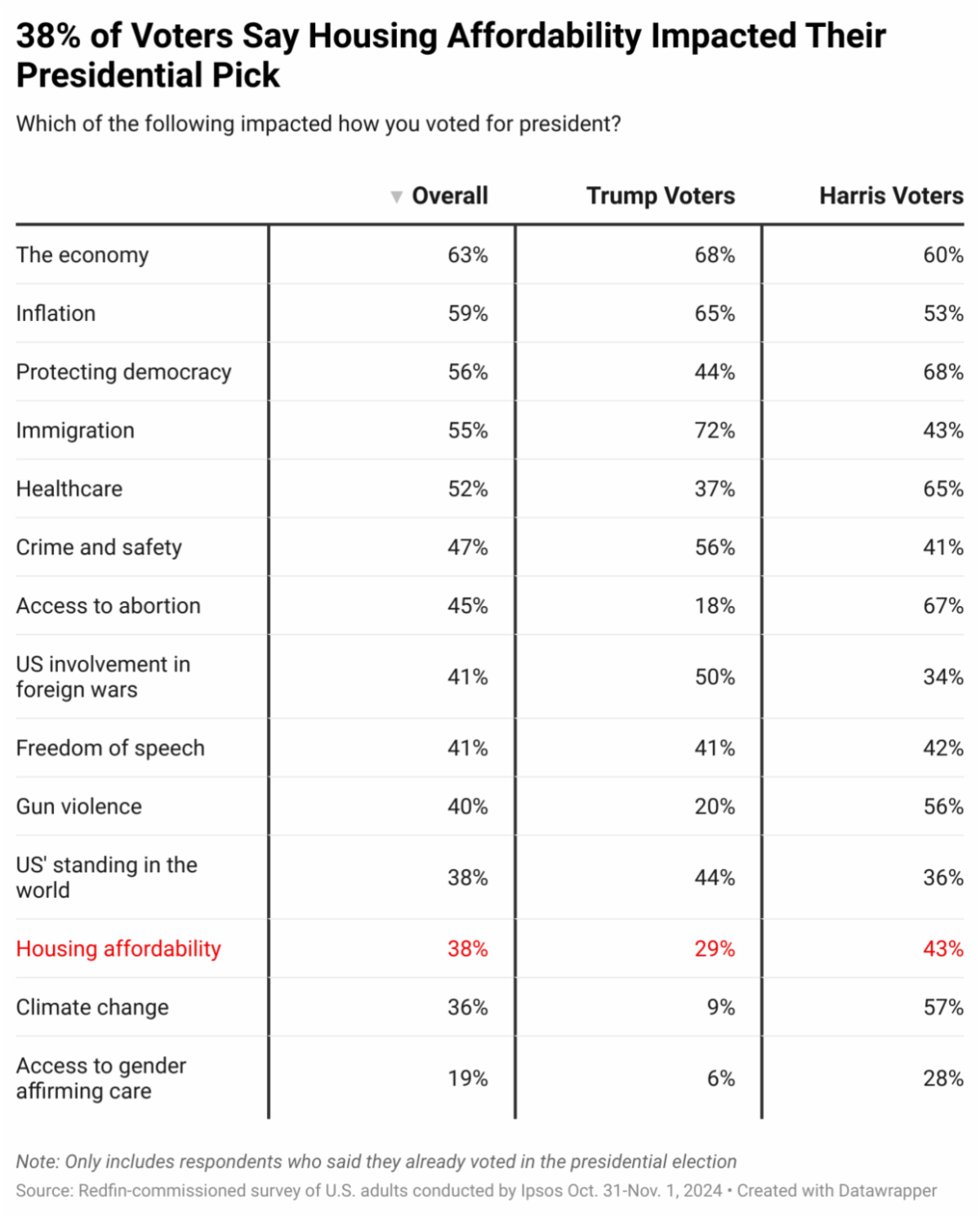
Voter priorities in 2024 shaped by economy, inflation and democracy. Housing affordability ranked twelfth.
A recent Redfin-commissioned survey leading up to the election sheds light on how housing affordability influenced voters’ decisions in the 2024 elections. Nationally, housing affordability ranks lower as a deciding issue for presidential candidates, with only 38% of early voters saying it impacted their choice. In contrast, issues like the economy (63%), inflation (59%), and protecting democracy (56%) are more pressing concerns.
However, housing affordability plays a more prominent role in local elections. Two in five (40%) of early voters reported it as a key factor in their local race decisions, ranking just below crime and safety (50%) and the economy (46%). When it comes to local ballot measures, housing affordability again was a priority for 37% of voters, though economic concerns dominated local ballot choices, with 47% prioritizing the economy.
| |
|
A report by the U.S. Government Accountability Office examined the impact of the increasingly competitive housing market on military service members and families. Despite providing housing allowances, the Department of Defense (DOD) does not track the full impact of housing shortages and affordability issues on personnel, with some service members reporting long commutes or taking on additional jobs to make ends meet. The report recommends that DOD develops a comprehensive list of critical housing areas, better assess the financial and quality-of-life impacts on service members and improve coordination with local communities to address housing challenges.
HousingWire reported that former President Donald Trump’s return to the White House is expected to usher in a new regulatory era for the mortgage industry, with potential shifts towards less oversight and more market-driven policies. Analysts anticipate the release of Fannie Mae and Freddie Mac from conservatorship and a leadership overhaul at key agencies like FHFA and the Consumer Financial Protection Bureau. The full article explores how these changes could bring a deregulatory boost, reducing capital requirements, fees, and regulatory risks for financial institutions.
A new study from the Mortgage Bankers Association highlights the growing challenge of housing supply as older Americans age in place. The report updates a 2022 study, showing a significant increase in homeownership among those aged 70 and older since 2015, with nearly two million more homeowners in this age group by 2022. The report also shows that older Americans are holding onto their homes longer, contributing to a projected shortfall in housing supply as Baby Boomers age and pass away. Over the next decade, while an estimated 8-9 million homes may be released by older homeowners, the demand for homes will exceed supply, creating potential housing shortages.
| |
Your go-to resource for housing policy | |
|
Tuesday, November 12
What happened on Nov. 5: A deep dive into the results of the presidential and congressional races | Brookings, 10-11:30 AM ET
Prioritizing Access to Education and Supportive Services for Parents of Infants and Toddlers Experiencing Homelessness | Housing Matters, 3-4 PM ET
Next City’s Solutions Fest 2024, November 12-15
Wednesday, November 13
Climate Risk & Insurance: Is the global real estate sector entering an insurability crisis? | ULI Americas, 10-11 AM ET
What’s Next for Housing? NAHB to Host Post-Election Webinar | NAHB, 12 PM ET
45th Anniversary Celebration: Honoring 25 Outstanding Professionals | Women in Housing and Finance, 6-9 PM ET
2024 CRE Private Credit Finance Summit | MBA, November 13-14
National Communities Council Fall Leadership Forum, November 13-15
Thursday, November 14
Housing Update from Washington: Post-Election Analysis | NAHRO 1:30-2 PM ET
Understanding AI and AI Policy in 2024 and Beyond | Cato Institute, 4-5 PM ET
Friday, November 15
The Dual Burden: Making Housing and Long-Term Care Affordable for Older Adults | Housing Matters, 12:15-1:15 PM ET
| |
The National Housing Conference is a diverse continuum of affordable housing stakeholders that convene and collaborate through dialogue, advocacy, research, and education, to develop equitable solutions that serve our common interest. | |
Defending Our American Home since 1931 | |
Copyright © 2024. All Rights Reserved. | | | | |