Looking Across the Atlantic: Connecticut’s Opportunity in Ireland | | |
Paddi LeShane, Co-Founder & CEO
As a member of the Connecticut–Ireland Trade Commission, I recently traveled to Northern Ireland and the Republic of Ireland with a delegation to attend the 2nd Annual American Irish Summit. Our delegation met with government, business, and higher-education leaders to explore how Connecticut and Ireland can build stronger economic, educational, and cultural ties.
| | |
One of my lasting impressions was how closely people in Ireland are watching the United States and the respect they have for Connecticut's higher education landscape. They remain interested in doing business here, educating their students here, and developing relationships with American institutions. Their perspective is broader than any one administration or moment in our politics. They see the United States as an important economic and educational partner—and they are considering which states offer the greatest possibilities.
Connecticut has a compelling case to make.
| | | |
Our state has outstanding colleges and universities, a highly educated workforce, and strong industry clusters in advanced manufacturing, aerospace, biotechnology, healthcare, financial services, clean energy, cybersecurity, and emerging technologies such as quantum computing. Ireland is investing in many of these same areas.
That creates opportunities extending well beyond traditional trade missions. Our colleges and universities can become a bridge connecting research, talent development, innovation and commerce.
It also creates an opportunity we should consider essential for Connecticut students: meaningful global experience.
Artificial intelligence and the worldwide reach of the internet are changing where and how people work. Today’s graduates will collaborate with colleagues, clients, and competitors they may never meet in person and whose cultures and experiences may be very different from their own. Technical knowledge will remain important, but so will curiosity, adaptability and the ability to understand another person’s perspective.
AI can instantly translate a document or provide information about another country. It cannot, however, replace the experience of entering an unfamiliar environment, listening carefully and learning how trust is built across cultures. That experience helps young people become more confident and thoughtful professionals—and better prepared for leadership in a workplace that is no longer limited by geography.
Student exchanges are an obvious starting point, but we should think more broadly. Connecticut and Irish institutions could develop faculty exchanges, joint research projects, shared courses, short-term study programs, and industry-sponsored learning experiences. Students could work together on real challenges facing employers in both countries. Professors and researchers could bring different perspectives and expertise to their work.
These relationships could be especially valuable to smaller colleges and universities that may not have the resources to establish a significant international presence on their own. Several Connecticut institutions could collaborate around a shared area of strength, creating a more ambitious partnership than any one school might pursue independently.
We should also make global experiences practical and accessible. Not every student can spend a semester abroad. Two-week programs, summer research opportunities, virtual international classrooms and faculty-led projects could open the door to many more young people. Our goal should be to give every Connecticut student some opportunity to learn and work with people beyond our borders.
The benefits would flow in both directions. Connecticut students would gain international experience without losing sight of the industries and career opportunities here at home. Irish students and faculty would become more familiar with Connecticut—our companies, research institutions, and quality of life. Those relationships could eventually lead to business partnerships, investment, and new talent choosing to study, work, or build a company in our state.
Connecticut also offers something Ireland understands well: the advantages of being small enough to build relationships and move ideas forward. Decision-makers in government, higher education and business are accessible. Our institutions are geographically close, and our location between Boston and New York connects us to two major global markets.
But opportunity does not become a partnership simply because the pieces fit. Someone must connect the institutions, identify shared interests, and keep the work moving after the meetings and welcoming remarks are over.
Our trip helped begin that process. Now that we have participated in a coordinated effort to identify Connecticut and Irish institutions with complementary strengths, the next step is to select several realistic pilot projects and establish timelines for moving them forward.
In a world connected by AI and the internet, Connecticut’s students will be competing and collaborating globally whether they leave the state or not. We should make sure their education gives them the experience, confidence, and perspective to do it well.
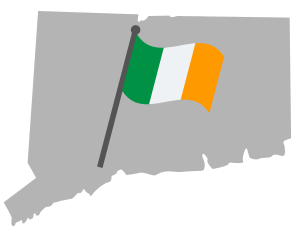
With Connecticut‘s portion of “direct descendants “ in our population of 3.6 million, we beat the national average with over 4%. This could be a match made in heaven!
| | Meet the Media: Q&A with Savannah Fesquet of iHeart Media | | |
Dan Tapper, Senior Director
Savannah Fesquet is a radio personality and national media talent with iHeart Media, who loves pop culture, fashion, travel, and a good conversation. She can be heard every morning on "Courtney and KISS in the Morning" on KISS 95-7 in Hartford, and as a national talent for iHeartMedia, where she has shows in more than 30 different markets, including Boston, Denver, and Minneapolis.
As a morning personality on the very popular WKSS 95.7 FM radio show, what is it you enjoy the most about what you do?
| | | |
What I love most is making people smile and helping them start their day with something lighthearted, fun, and positive. There’s so much doom and gloom in the world, and we all have our own day-to-day challenges and problems. So, if I can give someone a little moment of joy and send them off to work with a smile, that genuinely makes my day.
I think the other thing I love is that I get to talk about one of my favorite things: pop culture. I love staying on top of what’s happening, having conversations about it, and getting to share that excitement with listeners.
What made you want to choose media as your career?
I chose to go into media because I’ve always loved storytelling. I’ve also always been very outgoing (I was constantly getting in trouble in school for talking too much). So, in a lot of ways, media felt like a natural fit for me.
I actually studied journalism in college, but I fell into radio almost completely by accident. One of my mentors, who has since become a great friend, gave me my first opportunity to go on the air when I was just an intern at iHeart. I fell in love with it immediately, and the rest is history!
Your role seems to be a very successful convergence of entertainment, news and branded storytelling. In an age where information is so readily available in so many different places, how do you work to make what you do compelling for listeners?
I think being relatable is incredibly important. I’ll be the first to admit that I’m not sending rockets to the moon, curing cancer, or saving lives every day, but I do think we have a real responsibility to our listeners. Whether we’re there to entertain them during their morning commute or report on something more serious, people trust us to show up and do our jobs well.
We live in a world where we’re constantly being bombarded with information, and where everyone seems to have an opinion on everything. There’s also so much misinformation out there, which makes being accurate and responsible even more important.
For me, the key is finding that balance: being fun and entertaining while also being accurate, timely, informed, and, most importantly, relatable. If people feel like they can connect with you and trust you, that’s what makes the relationship with a listener so special.
A good amount of media seems to be trending towards what you do, with branded content and integrated marketing strategies used to drive engagement. What do you try and make sure listeners learn from you?
I think when it comes to branding and integrated marketing, it’s really important to stay authentic to who you are. I work with brands, but at the same time, I am my own brand, and I always keep that in mind when I put out branded content.
I want my listeners to know that they can trust me. I firmly believe in working with and promoting brands that I genuinely believe in and would actually recommend myself, because you’re constantly building a relationship with your audience. You wouldn’t keep asking a friend for advice if they always gave you bad advice, and I think the same thing applies to the relationship you have with your audience.
So, whether I’m talking about a brand, sharing a story, or simply having a conversation on the air, I want people to feel like they’re hearing from someone who is authentic, honest, and genuinely has their best interests in mind.
Finally, can you share your favorite types of stories you like to tell in your role? What really speaks to you?
I think my favorite stories to tell are the personal ones. I talk a lot about pop culture on the air, what celebrities are doing, what’s trending, and everything happening in that world, but there’s something much more meaningful about sharing pieces of my own everyday life and finding those moments that listeners can see themselves in.
| | Tips and Tricks: Building the Essential “PR Pro’s Go Kit” | | Brian Flaherty, Executive Vice President | | |
Last month I found myself standing in the middle of an open field, waiting for a minibus carrying Connecticut’s governor and a handful of reporters to emerge from... somewhere.
I had a retractable banner with my client’s name to mark the tour’s final stop, but the wind had other plans for it. Twice it went down. Hard. So I did what any PR pro does under pressure: I raided my car.
Out came two bungee cords, which solved the banner problem. Next emerged a reflective vest, which I put on for reasons that had nothing to do with safety and everything to do with psychology.
| | | |
My hypothesis: When nobody knows what’s happening, people default to trusting whoever looks like they’re supposed to be there. That vest, a remnant from my running days that I keep on hand in case I have to change a flat tire, says “official.” I figured the odds of this “Jedi mind trick” working was about one in five. Twenty minutes later, the bus rolled up … from a direction I hadn’t anticipated at all. Yet there I was, sign upright, vest gleaming in the sunshine, looking exactly as official as I’d hoped.
Did it work? A PR pro never tells.
This month’s tip: It pays to have a Go Kit. A small, unglamorous stash of items that live in your trunk for the day everything goes sideways.
- Bungee cords, for anything that blows or refuses to stand up straight.
- A staple gun, a remnant from my political past, for last-minute signage that has no business being last-minute but often is.
- Sharpies, because someone will need to relabel something along the way.
- Index cards, for the note you scribble and hand to a client mid-event, or the quote you need to get down word for word.
- And yes, a vest, or a lanyard, badge, or whatever prop that will read as “in charge” to a crowd that has no idea who’s actually in charge.
Half of this job is logistics, the other half is theater, and the best PR pros know the difference and pack for both. For me, it was literally the difference between being outstanding in my field and being left out standing…well, you know the rest.
| | |
Sullivan & LeShane Public Relations, Inc. | (860) 560-0001 | www.ctpr.com | | | | | |