NEMWI Weekly

Update 

July 13th, 2026

https://www.nemw.org/wp-content/themes/NEMW_ATTCK/images/nemw_logo.png
 

Final BUI Removed at Black River AOC 


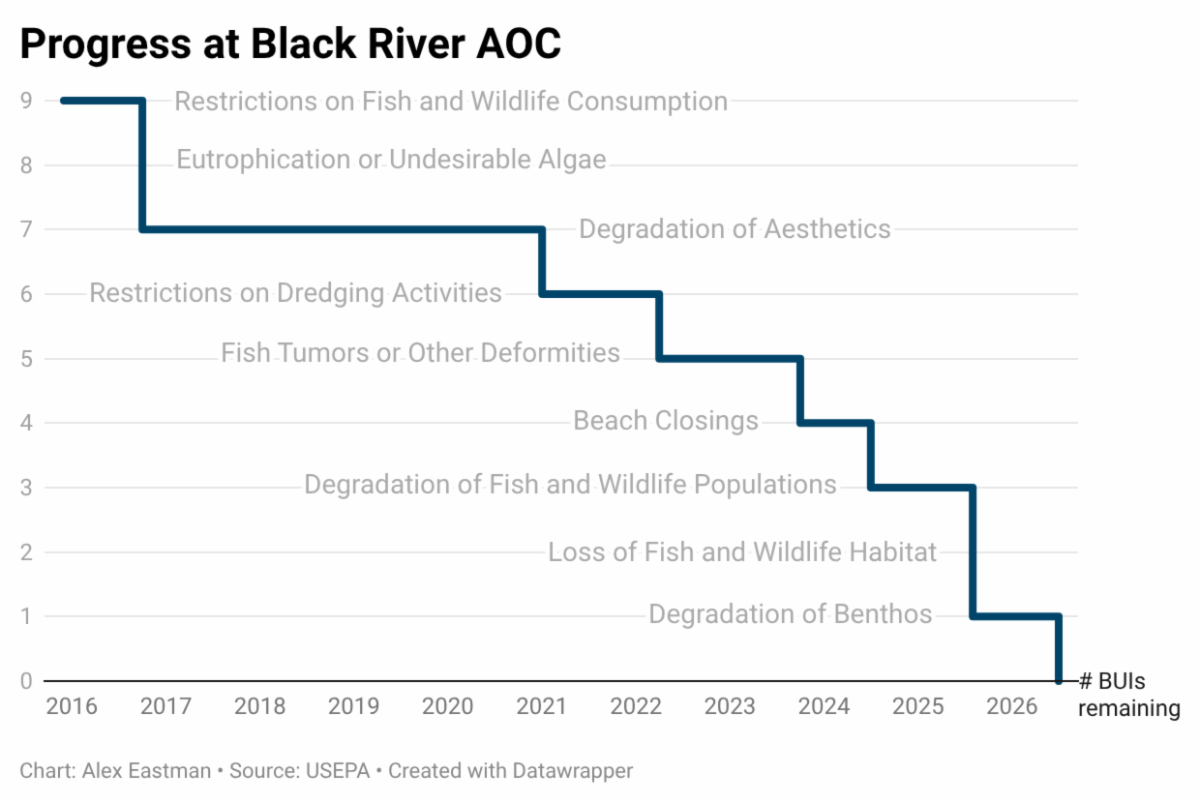
The EPA announced last week that the last of the nine beneficial use impairments (BUIs) at the Black River Area of Concern (AOC) has been removed, putting Black River on course to be delisted. All management actions at the site were completed by May 2024, and since then, environmental conditions have improved enough to remove the final five BUIs, most recently Degradation of Benthos, which describes inadequate conditions for ecosystem-critical benthic organisms. Removal of this BUI means that the once-contaminated sediment at Black River has recovered enough to support these organisms. 


“This is a major milestone for the Black River and the communities that have worked for years to restore it,” said Ohio Governor Mike DeWine. “Today’s announcement shows that long-term investments in water quality and habitat restoration make a real difference. Together, we’ve transformed the river into a healthier place for wildlife, recreation, and the people who call this region home.”   

Progress has been fueled by the Great Lakes Restoration Initiative, which has invested $26 million cleaning up Black River since 2010. The federal government, Ohio EPA, and Ohio Lake Erie Commission, alongside other state, local, and tribal partners, have worked collaboratively to rehabilitate the site. In 2024, restoration work was completed at a 260-acre former steel mill that had been a source of water contamination. The City of Lorain, Ohio, capped and covered steel slag to prevent runoff and restore natural habitat. 


With its BUIs removed, The Black River AOC could be delisted (have the AOC designation removed) as soon as 2027, following a public comment period later this year. It would become the ninth AOC to be delisted, and the eighth since the start of the GLRI in 2010. 

GLFC Advisors Pass Resolution in Support of Save Great Lakes Fish Act  


The Joint U.S.–Canadian Committee of Advisors to the Great Lakes Fishery Commission last month passed a resolution in support of the Save Great Lakes Fish Act of 2025, a bipartisan bill sponsored by Michigan lawmakers Rep. Debbie Dingell (D-MI) and Rep. Tim Walberg (R-MI). The bill would authorize $500 million over 10 years for the U.S section of the Great Lakes Fishery Commission “to develop, in coordination with Federal agencies, interstate compacts, and Tribal, State, and local governments, efforts to combat invasive species of mussels.” 


The bill would amend the Great Lakes Fishery Act of 1956, which coordinated efforts to combat sea lamprey. The results have been extraordinary: lamprey populations have declined 90% from their historical peak. With support from Congress, the GLFC intends to expand their research to combat invasive mussels, and attempt a moonshot aimed at a problem that has plagued the Great Lakes for decades. The GLFC would lead a team of partners conducting mussels research to develop better methods of removal than currently exist. 


“Just as coordinated binational action helped reduce the devastating impacts of sea lamprey, a similarly ambitious effort is needed to confront invasive mussels,” the resolution states. “The scale of the challenge demands a sustained commitment to scientific research, innovation, and international cooperation.” 


Zebra and quagga mussels were first discovered in the U.S. on the shores of the Great Lakes. Since their introduction in the 1980s, these invasive mussels have spread to all five lakes and all eight Great Lakes states. Zebra and quagga mussels rapidly filter feed on microorganisms in the water, contributing to a significant depletion in phytoplankton. This strains the food supply for native aquatic organisms, which wreaks havoc on the food web and threatens the entire ecosystem. The elimination of plankton also makes the waters clearer. As a result, UV rays now reach greater depths, killing embryonic and baby fish and further disrupting whitefish populations, which have dropped by as much as 80% since the 1990s. Invasive mussels also damage water infrastructure such as intake pipes and are difficult and costly to remove. Some estimates place economic damage of invasive mussels at more than $1 billion per year. 

Connect With the Northeast-Midwest Institute

on Social Media


The Northeast-Midwest Institute is on social media with new updates and information on its regional research and policy education program and with announcements for upcoming briefings and events. NEMWI is posting our research reports on current regional issues and ongoing policy education on the page to make keeping up with our policy work easier than ever. The Institute also is updating the page with announcements of upcoming policy briefings and webinars. NEMWI is excited for the opportunity to connect with as many people as possible. 


Please check out our LinkedIn here, our Twitter/X here, our Facebook here, and our Bluesky here. Be sure to like and follow us to keep up to date with NEMWI!


On Bluesky, also check out our Great Lakes feed at "NEMW Great Lakes Feed" and if you are a Great Lakes organization on Bluesky, contact Great Lakes Program Manager Alex Eastman at aeastman@nemw.org so that we can add your posts to the feed!


Great Lakes Events
(all times Eastern)


What role can businesses play in reducing plastic pollution? 

Thursday, July 16 | 1:00 PM | Virtual | Register here

Host: Alliance for the Great Lakes

 
This Week in Washington

In the House:


Markup: Subcommittee Markup of Six Pieces of Nuclear Energy Legislation

Tuesday, July 14th | 10:15 AM | 2123 Rayburn HOB

Host: Committee on Energy and Commerce | Subcommittee on Energy


Business Meeting: Subcommittee Markup of Seven Pieces of Vehicle Emission Legislation

Tuesday, July 14th | 2:00 PM | 2123 Rayburn HOB

Host: Committee on Energy and Commerce | Subcommittee on Environment


In the Senate:


Business meeting to consider the Water Resources Development Act of 2026.

Wednesday, July 15th | 10:00 AM | SD-406

Host: Committee on Environment and Public Works


Hearings to examine geothermal legislation

Wednesday, Jul 15, 2026 | 2:30 PM | SD-366

Host: Committee on Energy and Natural Resources | Subcommittee on Public Lands, Forests, and Mining

Northeast-Midwest Institute | nemw.org

Facebook  LinkedIn  X