The Miles Franklin Newsletter
|
|
From The Desk Of David Schectman
|
|
David's Commentary In Blue:
The weather is perfect here in Boca Grande where Susan and I are enjoying a brief winter break from the Minnesota tundra. But I feel compelled to publish something this week, vacation or not. It’s like a game of musical chairs and there are only a couple of chairs left to fight over.
Lately, there is never a dull moment between the impeachment folly and the constantly changing headlines on the Coronavirus outbreak. Opinions on where the stock market and gold are headed are all over the place. In the end, there is only one opinion that counts; yours.
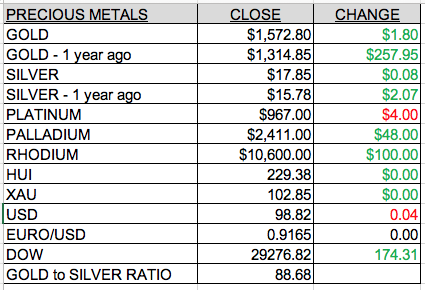
The dollar is rising again – as it is usually deemed to be an island of safety in times of uncertainty and the Coronavirus is causing a lot of uncertainty. In spite of the rising dollar, gold is still creeping up. My view is that gold is now in a bull market and will perform well regardless of the outside events.
In the following article, it is suggested that the stock market could crash sometime this year. Yes, it could. “Could” is the operative word. But the stock market is not functioning in a normal manner, based on rational thinking. It is reacting to huge doses of additional money that is being provided by the Fed.
|
|
|
|
When investors buy stocks, stock prices rise. That is the immutable law of the market. It doesn't matter if the money comes from big financial institutions, Mom and Pop day-traders or Central Banks. The same rule applies: Buy more stocks and prices go higher.
So, when the Federal Reserve launched its recent "repo rescue" operation, which provided a whopping $60 billion of additional liquidity per month plus billions more in cash-for-collateral, naturally, stock prices rose quite sharply.
Of course, the financial media is not going to admit that the Fed's intervention is pushing stocks higher, but that is, in fact, what's happening. The Fed is expanding its balance sheet, boosting reserves at the banks and providing hundreds of billions in low interest short-term loans to repo participants. The extra liquidity is pushing stocks higher just as it did when the Fed implemented QE.
According to an article at the financial blog, Wolf Street: From "mid-September, 2019, (to) January 1, 2020, the Fed added nearly $410 billion to its balance sheet" which is an astronomical amount of money. The Fed purchased mainly T-Bills in order to build up reserves at the banks so repo transactions could take place without pushing up interest rates. Some readers may recall how this same policy, Quantitative Easing, was used during the financial crisis. The Fed launched 3 rounds of QE, purchased trillions of dollars of U.S. Treasuries and Mortgage-backed Securities (MBS) which, in turn, sent stocks into the stratosphere.
This time, the Fed doesn't want the media to refer to QE as QE because they're afraid that people will figure out that (a) the crisis never ended and (b) the Fed is once again jacking-up stock prices.
Not surprisingly, the servile media has complied with the Fed's request, but that doesn't change what's really going on. The Fed has lowered rates to their emergency setting and is hosing down the entire repo market with hundreds of billions of dollars to forestall another system-wide meltdown. And the funny thing is, the Fed hasn't the slightest idea of what the problem is. That might sound unbelievable, but I assure you, it's true. We are spending a half a trillion bucks on a glitch that has not yet been identified and could be nothing more than a manipulation of liquidity by one of the big banks with the intention of forcing the Fed to restart QE. In other words, one of the big boys could be just pulling the wool over the Fed's eyes. The link to it is
here
.
|
|
The Fed does not want to see the market crash and will do just about anything to avoid deflation. Non-stop massive money creation ultimately leads to a loss of purchasing power so fighting deflation by printing should end up in inflation – or loss of purchasing power in the dollar. That is gold friendly.
|
|
|
|
Financial analyst and cycle expert Bo Polny called for a big market crash by the end of 2019. It did not happen. There was a good reason why. Polny says, “Billions and billions of dollars were pumped into the market at the end of the year to not let the crash happen.
That is the number one reason the markets did not crash in December. That takes us to the second point, and that is the cycle is not over yet. . . . That is still pointing to a very big event in the first or second quarter of this year and the latter part of the year, too. This is not over. We are not out of the woods.”
Bo also says, “We have seen the highs in the stock market . . . and come this Wednesday, it will be the start of something not so nice in the markets. We have a down cycle that began on Friday February 7
th,
and the markets are expected to continue down all of next week.”
Polny thinks this down cycle for the markets will not stop until late April and forecasts there could be a “35% correction.”
So, will this sink President Trump’s chances for a second term? Polny, who has coined the term “God’s Trump Cycles,” says, “Absolutely not, according to Daniel’s timeline. It is two cycles of 1,260 days. This April 21
st
is only the completion of the first half of the cycle of 1,260 days. Then we have the second cycle of 1,260 days taking us into the end of 2023.
So, Trump’s election is this November, and he’s going to continue to be President, and the cycle doesn’t end until December of 2023. Does that mean you don’t need to vote for Trump? The answer is 100% you must go vote for Trump. Here’s the thing you must understand whether you like Trump or not. The bottom line is the math calculations I present to you in my PDF (found for free in the “After the Interview” section) presentation is beyond any form of mathematical luck. It’s impossible for this to be luck.”
|
|
I imagine that most Americans are not (yet) overly concerned over the outbreak of a virus that is causing havoc half way around the world. Rest assured, this will be a global problem. Until a vaccine is developed and produced in sufficient quantities to protect the population, the risk is very real – even here in the U.S. And when people start getting sick and dying in your town, will you go out to dinner, to a concert, a sporting event, shopping – or even to work? What will that do the economy and the stock market? The answer to that question is too obvious to need elaboration.
|
|
|
|
J. Johnson
Also of note, I had forgotten to post the
Velocity of Money chart
during yesterday’s missive when I wrote … “What’s worse (maybe) is the Velocity of Money, which has made a New All Time Low (since the first quarter of 1959) and while we’re observing the Federal Reserve print machines churning in overdrive at the same time the 2 other most populated nations are doing the same….”
|
|
This is my favorite article. It is exactly the kind of article you could send to your buddies who are all-in on stocks and have no interest, or understanding of gold. Of course, it won’t change their views, but it should.
|
|
|
|
Egon von Greyerz
YOU CANNOT GO WRONG WITH GOLD
This is probably the most important article I have penned. It is about the destiny of three individuals who all followed different tides. We are today at the point when the consequences of taking the wrong tide will be ruinous whilst the right one will be extremely propitious.
I have quoted Brutus’ speech in Shakespeare’s Julius Caesar many times in the last twenty years. But I believe that it is today more relevant than at any time in history, when it comes to economic affairs.
|
|
This is significant. Very significant. At minimum, one would think that JPMorgan will back off of their manipulation of the paper silver market, at least while they are under investigation. It’s probably hoping for too much, but I would love to see some of these upper management types spend time behind bars. The usual wash and rinse cycle of a slap on the wrist and a fine is not sufficient.
|
|
|
|
Zero Hedge
J
PMorgan Criminal Case Coming for Silver Manipulations
By Jhanders
This week we learned that U.S. authorities at the DoJ, who have for years not only accused various JPMorgan Chase & Co. employees of rigging precious-metals futures but also got many to plead guilty. The US Department of Justice (DoJ) is now, more importantly, building a criminal case against America's biggest bank itself.
The previously unreported investigation of the global bank’s parent company, part of a wide-ranging attempt by the Federal government to maintain shreds of its former financial market credibility, raises the now new prospect of criminal charges against higher up executives within the United States’ largest bank.
And perhaps even larger implications are coming to this once considered too big to fail, therefore we must bail them out bank.
One which today in 2020, and seemingly year after year the Bank for International Settlements’ Financial Stability Board ascribes as being the #1 Global-Sytimatic Important Bank (G-SIB). In terser terms, JP Morgan’s stability is consistently ranked by the central bank of central banks, as being the largest threat to our global financial system functioning smoothly (new
Bank Bail-In Laws on the books
still).
Today we will dig into some details about this coming criminal case against JP Morgan Chase.
And too, we will have a brief look back at what happened the last time entities this powerful were in the business of suppressing precious metals prices both for-profit and power.
For the past dozen years investing and working in the bullion industry, I can humbly say that I have a pretty sharp understanding of the sentiment that many precious metals interested investors have out there.
They range of our perspectives is wide and colorful with delusional bulls to the world’s going to end bears.
But this week’s news builds burgeoning hopes that our financial markets might one day see some criminal higher-up market rigging bankster prosecutions once and for all.
Cynics will rightly claim our financial markets have for some time been acting under shades of criminality, with anti-competitive behaviors, and crony capitalism runs amok.
It is too exhaustive to even recount all the evidence those cynics have for making such points, but we’ll cover a few here.
To begin we have a quick clip from a channel whose program I was humbled to be on this past week.
The
Kennedy Financial hour
today published a live roundtable with other precious metals analysts discussing their thoughts on this newest JP Morgan criminal bank probe news.
We’ll begin with the close of a somewhat broken-hearted cynical take by Chris Marchese, only to be followed up by Rob Kirby rattling some off potential fraud as a business model evidence at hand.
Swinging back and forth from the optimistic to the cynical camp we have a couple of financial tweets for the week.
Given that nothing of any substance has happened yet, I found this back and forth interesting and telling, you might too.
Pam and Russ Martens over at
WallStreetOnParade.com
have some interesting points regarding JP Morgan’s seemingly endless alleged financial criminality.
They wrote this week some of the following points to consider,
Yesterday, Bloomberg News reporters Tom Schoenberg and Liam Vaughan broke the story that JPMorgan Chase is under a criminal probe by the U.S. Department of Justice (DOJ) over charges of rigging gold, silver and other precious metals markets. Six traders who worked on the precious metals desk at JPMorgan Chase have been indicted thus far but this is the first report that the bank itself is also under a criminal investigation. This marks the fourth criminal probe of the bank in the past 8 years by the U.S. Department of Justice with the bank pleading guilty to three felony counts in two of the prior criminal investigations.
There was a time in America when a criminal probe of the nation’s largest bank, which holds $1.6 trillion in the life savings of moms and pops at more than 5300 bank branches across the country, would have been worthy of a front-page headline. Not today. Crime and fraud are so de rigueur at the bank led by Dimon that not one major newspaper ran the headline on the front page or anywhere else in the paper.
… in August, September and again in November of last year (2019), the Board of Directors of JPMorgan Chase were put on notice that the bank they were overseeing under their designated leader, Jamie Dimon, was accused of running a criminal enterprise out of its precious metals desk. They were also aware that at least two of those indicted are cooperating with the DOJ in the ongoing investigation. And yet, they still awarded Jamie Dimon a pay package of $31.5 million and allowed him to announce that he planned to remain at the bank for another five years.
This is demonstrably a criminal recidivist bank. Dimon and the Board need to be removed. The bank needs to be broken up with the federally-insured bank placed under a sane, ethical, competent Board of Directors.
It’s debatable when was the last time we had this much financial chicanery and criminality. I presume if we asked those who had to sober up during the great depression, they might admit that things got a little crazy and over-leveraged during the Glass-Steagall-less 1920s Wall Street era.
For anyone who has bothered to look at the current US car loan debt bubble, perhaps similar deals measured in gold will be rhyming to in time.
This current stock bubble by some massively important far-reaching measures is now more extended than ever before.
The trouble for higher bullish stock values on that chart is the rolling over and the likely return beyond 5 and perhaps to parity again one day to come.
Regarding the last time forces at large tried to fix and rig precious metals at artificially low values, history shows us the
inevitable results which follow
.
|
|
Private Safe Deposit Boxes
|
|
Unencumbered / Segregated Storage
|
|
About Miles Franklin
Miles Franklin was founded in January, 1990 by David MILES Schectman. David's son, Andy Schectman, our CEO, joined Miles Franklin in 1991. Miles Franklin's primary focus from 1990 through 1998 was the Swiss Annuity and we were one of the two top firms in the industry. In November, 2000, we decided to de-emphasize our focus on off-shore investing and moved primarily into gold and silver, which we felt were about to enter into a long-term bull market cycle. Our timing and our new direction proved to be the right thing to do.
We are rated A+ by the BBB with zero complaints on our record. We are recommended by many prominent newsletter writers including Doug Casey, Jim Sinclair, David Morgan, Future Money Trends and the SGT Report.
For your protection, regardless of where you live, we are licensed, regulated, bonded and background checked per Minnesota State law.
|
|
Miles Franklin
801 Twelve Oaks Center Drive
Suite 834
Wayzata, MN 55391
1-800-822-8080
|
|
Copyright © 2020. All Rights Reserved.
|
|
|
|
|
|
|