CalOptima Health Invests $429.6 Million in Rate Increases for Hospitals and Specialists | |
The CalOptima Health Board of Directors has approved using $429.6 million from reserves to increase rates for hospitals and specialists over the next 30 months, which will improve access to care for members and support hospitals in the wake of federal and state Medi-Cal changes. With this funding, the health plan has invested nearly $1 billion in provider rate increases since 2024.
Recent policy changes have led to the loss of Medi-Cal coverage for thousands of Californians, including many Orange County residents. This is predicted to hit hospitals particularly hard, as they will be forced to provide uncompensated care to individuals who are no longer covered, resulting in reduced financial margins and a strain on the local health care safety net. Facilities serving large numbers of former Medi-Cal recipients will see a reduction in funding, which is often used to cover operating costs.
In making this significant move, Board members stated that increasing specialty provider rates keeps CalOptima Health competitive, helps retain existing doctors and entices others in difficult-to-recruit specialties to contract with the health plan. This, in turn, means greater access to care for CalOptima Health members, more geographic coverage by contracted specialists and stronger regulatory compliance. The new rates take effect July 1, 2026, and will run through December 31, 2028.
“As a Board, we made a concerted effort to increase our reserves in anticipation of growing pressures on our health care system, knowing we would need the flexibility to support the providers and hospitals who serve CalOptima Health members every day,” said Vicente Sarmiento, CalOptima Health Board Chair and Orange County Supervisor. “This investment reflects our commitment to our medical partners and our confidence in their vital role in serving our communities. I know this won’t solve all the issues they are facing, but it will offset some of the reductions, impacts and challenges affecting the health care industry right now.”
Few Medi-Cal health plans in the state are in a financial position to boost provider rates in this manner. CalOptima Health has exercised careful fiscal stewardship over the past several years, planning for this unprecedented time when additional resources are needed, according to the organization’s executive leaders. Approved in June 2024, a prior large-scale rate increase of $526.2 million boosted funding for health networks, hospitals, physicians, community clinics, behavioral health providers and ancillary services providers for a 30-month period from July 2024 to December 2026. These two investments combined represent a historic level of nearly $1 billion in funding to promote the financial stability of Orange County’s provider community.
“Nearly half of the Orange County hospitals were operating at a financial loss even before recent Medicaid cuts and coverage losses,” said Sara May, Regional Vice President of the Hospital Association of Southern California. “We thank CalOptima Health for taking action that supports hospitals and protects access to emergency and specialty care for Orange County residents.”
| New Website Page Details Changes to Medi-Cal | |
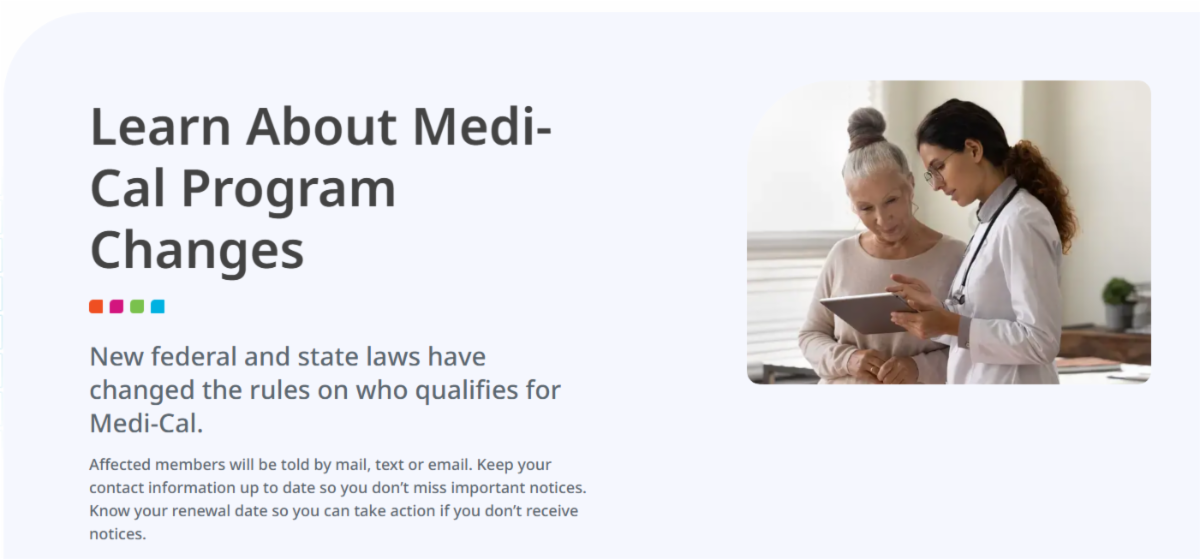
With significant changes to Medi-Cal from H.R. 1 and California’s budget taking effect over the next two years, it’s important for providers to help their Medi-Cal patients navigate these changes and answer any questions.
To that end, we’ve added a new Learn About Medi-Cal Program Changes page to our website, www.caloptima.org. This landing page summarizes the changes to Medi-Cal, the dates they take effect, the Medi-Cal populations affected and how members can ensure they keep their coverage.
Some of the changes to Medi-Cal include:
- Asset limits for older adults and individuals with disabilities
- An enrollment freeze, a monthly premium and changes to dental coverage for adult immigrants
- New work requirements, six-month eligibility checks and copayments for adults ages 19–64
We encourage providers to review this page and help their patients take proactive steps to either keep their Medi-Cal or transition to other health coverage if they are no longer eligible.
| 2027 CalOptima Health Covered Enrollment Period Extended | |
We continue to prepare to launch our new Covered California plan, CalOptima Health Covered, on January 1, 2027. As part of our preparations, we recently announced that the open enrollment period has been extended by a month and will now run from November 1, 2026, until January 31, 2027.
We are pursuing a Covered California line of business to better serve individuals who often transition in and out of Medi-Cal. Without this option, they may face challenges that lead to gaps in care and unexpected medical expenses. Additionally, CalOptima Health Covered can help households that have both Medi-Cal and other coverage to have access to the same provider network for all family members. The CalOptima Health Board of Directors will vote on final approval at its August 6, 2026, meeting.
We will release more information about how your patients can benefit from CalOptima Health Covered as the enrollment period draws closer.
| | | Providers Can Find Member ECM Authorizations on the Provider Portal | |
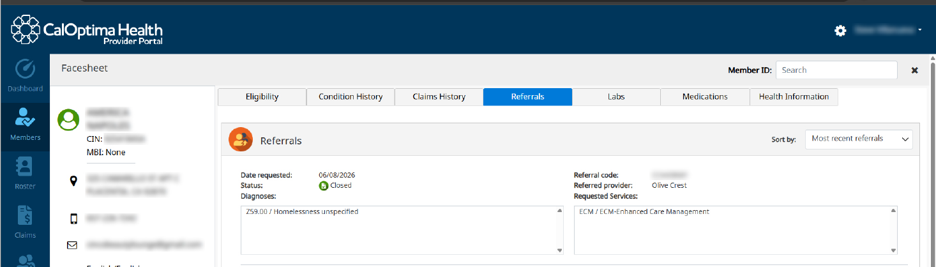
We are reminding our contracted primary care providers (PCPs) and specialists that they can find their CalOptima Health patients who are enrolled in Enhanced Care Management (ECM) by using the CalOptima Health Provider Portal. To find ECM patients, please use the following steps:
-
Log in to the Provider Portal at providers.caloptima.org/#/login
- Search for members using their member ID
- Select View Members 360
- Click on the Referrals tab
- Find the ECM-referred provider name, member’s diagnosis and referral status
| Cancer Screening Texting Campaigns Launching in July and August | |
We and our partner, mPulse Mobile, a Cancer Screening and Support Program grantee, are launching two-way texting campaigns for Breast Cancer Screening (BCS) and Colorectal Cancer Screening (COL) for our Medi-Cal members. The BCS campaign launched on Wednesday, July 1, 2026, and the COL campaign is planned to launch on Wednesday, August 5, 2026.
The goal of these campaigns is to increase awareness of cancer prevention, assess member barriers to screening, provide support and resources, and focus on early cancer detection. We hope members will be encouraged to call their health plans or PCPs to schedule screening appointments as needed. Please expect an influx of member calls to your office during these campaigns.
Once the campaign concludes, we will compile a list of your patients who indicated they need help scheduling an appointment or a callback and share it with you via the Provider Portal. Once you’ve received your list of patients, please reach out to your CalOptima Health Community Network (CHCN) members and provide additional support as needed. Members with assigned health networks have been delegated to their respective networks for follow-up.
If you would like a copy of the texting script for reference or have any other questions, please contact the CalOptima Health Cancer Screening and Support general inbox at CancerScreen@caloptima.org.
| 2026 Timely Access Survey Launches | |
We launched the 2026 Timely Access Survey on July 1. This required annual survey monitors provider compliance with timely access standards outlined in CalOptima Health contracts and supports state and federal regulatory requirements from the California Department of Managed Health Care (DMHC), the Department of Health Care Services (DHCS) and the Centers for Medicare & Medicaid Services (CMS).
Our contracted vendor, ATTAC Consulting Group (ACG), will conduct the survey using the Provider Appointment Availability Survey (PAAS) methodology. Outreach will occur by fax, phone and email. Selected providers are required to participate.
Survey Phases and Timeline
Phase 1: Initial Survey (June–July)
Phase 2: Education and Noncompliance Notices (July–September)
- Courtesy noncompliance notices sent
- Health networks notified
- ACG will conduct educational calls to providers not meeting standards
Phase 3: Resurvey (September–October)
- Noncompliant providers resurveyed on all access standards
- Corrective Action Plans (CAPs) issued for noncompliance
- Health networks notified of CAPs
- Escalation of persistent noncompliance
- Health network compliance determined
If you have any questions regarding this process, please email us at QIP@caloptima.org.
| Review Our Claims Process for Timely Filings and Reimbursement | |
We recognize that a key component of quality health care is timely and efficient medical claims processing. To ensure that our contracted providers have a clear understanding of our claims process, we are sharing this overview.
Our Claims department processes certain types of claims for services provided to Medi-Cal members, specifically:
- CalOptima Health Direct (COD) fee-for-service claims (professional and facility)
- CalOptima Health Shared Risk Group (SRG) health network facility claims, as well as some SRG ancillary service claims
SRG health networks are responsible for paying professional claims. For more information on claims billing, see CalOptima Health Provider Manual Section H1: Determining Which Claims Process Applies. Physician Hospital Consortium (PHC) and Health Maintenance Organization (HMO) health networks are responsible for payment of professional, facility and ancillary claims.
We process medical claims primarily in accordance with Medi-Cal guidelines and use key industry-standard codes and guidelines to ensure timely, efficient processing of paper and electronic claims. Below is a summary description of our claims processing steps.
-
Reimbursement — Claims that successfully pass the processing cycle will be adjudicated primarily per Medi-Cal guidelines and will be listed on a Remittance Advice indicating payment or the contested/denied reason.
-
Claims Filing Time Frames — A provider will submit a claim for covered services provided to a COD-A member, CHCN member or a member enrolled in an SRG within 365 calendar days after the month of the date of service. Please refer to CalOptima Health Policy FF.2001, Section E Claim Filing Deadlines.
OneCare
The CalOptima Health OneCare (HMO D-SNP), a Medicare Medi-Cal plan, department is responsible for processing claims for facility services rendered to OneCare members. OneCare’s health networks are responsible for the payment of professional claims for OneCare members.
OneCare processes facility claims according to Medicare guidelines and also uses industry-standard guidelines to promote timely, efficient processing of both paper and electronic claims.
Claims Filing Time Frames — OneCare follows CMS guidelines for the timely filing of claims. Providers should file claims within the applicable time frames. Claims not submitted within the appropriate time frame will be denied.
Reimbursement — Claims that successfully clear the processing cycle are adjudicated based on reimbursement guidelines contained in the provider’s contract with OneCare or on Medicare reimbursement guidelines for noncontracted providers.
- If a claim is paid by OneCare, the Remittance Advice indicates the payment status. If a claim is denied or contested by OneCare, the Remittance Advice contains the reason for contesting or denying the claim.
- Claims requiring medical judgment are reviewed by a physician or other qualified medical professional in accordance with the provisions of CMS and policies established by the DHCS.
| | | CMS Expands GLP-1 Bridge Program | |
Starting July 1, CMS is expanding its Medicare GLP-1 Bridge Program. Under this short-term demonstration program, eligible Medicare Part D beneficiaries may have access to certain GLP-1 drugs exclusively for weight management with prior authorization. If approved, members will have a $50 copayment for a single-month supply.
Covered drugs include:
- Foundayo tablets
- Wegovy injection
- Wegovy tablets
- Wegovy HD injection
- Zepbound Kwikpen
Please note, CMS will be the primary payer for products under the GLP-1 Bridge program and will not coordinate benefits with other payers. Coupons and discount programs may not be applied to these claims. The GLP-1 Bridge program will run through December 31, 2027.
For more information, please see this CMS flyer or visit CMS' GLP-1 Bridge program website here.
| | | New Flyer Lays out Important TCM Information for Providers | |
We continue to encourage providers to provide transitional care management (TCM) services to their CalOptima Health patients discharged from an inpatient or similar setting. The goal is to prevent poor outcomes, specifically those associated with gaps in the transition of care.
To help providers, we have created this TCM Services flyer. Please take some time to review this flyer for important information on covered TCM services and the correct billing codes to use.
| Q3 CHCN Meeting Happening on August 6 | |
The Q3 CHCN Meeting (formerly CHCN Lunch and Learn) webinar will happen at Noon on Thursday, August 6.
Our Provider Relations team uses these Zoom webinars to keep providers informed about important regulatory updates, CalOptima Health news and other relevant information.
To register in advance, please click here. After registering, you will receive a confirmation email with information about how to join the webinar.
| Trainings on Disabilities and GLP-1 Therapies Happening in July | |
We invite providers to attend two Continuing Medical Education/Continuing Education (CME/CE) trainings we are hosting in July. The trainings are:
- Disability: History, Advocacy and Independent Living (Part 1) — An in-person training that introduces participants to the historical foundations of the disability rights movement and its impact on inclusion and access to care.
- Date: Tuesday, July 21, 2026
- Time: 11:30 a.m.–1:30 p.m. (lunch provided at 11:30 a.m.)
- Location:
CalOptima Health
Room 109N (First floor)
505 City Parkway West
Orange, CA 92868
-
To register for this in-person training, please use this link.
- Optimization of GLP-1-Based Therapies: Clinical Applications, Safety and Barriers to Access — This training will focus on an evidence-based overview of GLP-1-based therapies and the FDA-approved indications.
- Date: Wednesday, July 29, 2026
- Time: Noon–1:30 p.m.
-
To register for this Zoom webinar, please use this link.
| Help Your Patients Reduce Their Risk of Skin Cancer During UV Safety Awareness Month | |
July is Ultraviolet (UV) Safety Awareness Month, and with summer in full swing and outdoor activities at their peak, this is an ideal time for providers to help members reduce their risk of skin cancer. Prolonged sun exposure is especially common this time of year, making evidence‑based photoprotection counseling especially important.
Skin cancer is the most common cancer in the United States, according to the Centers for Disease Control and Prevention (CDC). An estimated 93% of cutaneous melanoma cases are attributable to UV exposure, making UV radiation the leading preventable cause, according to the Melanoma Research Foundation. Because routine visual screening in asymptomatic individuals has not shown a clear benefit, prevention remains the most effective way providers can help reduce risk.
The United States Preventive Services Task Force (USPSTF) recommends behavioral counseling for:
Major dermatology and cancer organizations also reinforce several core behaviors:
- Seeking shade between 10 a.m. and 4 p.m.
- Wearing wide-brimmed hats, UV-blocking sunglasses and long-sleeved clothing
- Apply broad-spectrum SPF 30+ with reapplication every two hours
-
Avoiding indoor tanning — one tanning session increases melanoma risk by 75%, according to the Melanoma Research Foundation.
Evidence supporting the use of sunscreen continues to grow. A landmark Australian randomized trial demonstrated that daily sunscreen use significantly reduced the risk of invasive melanoma over 10 years. Research also highlights that childhood UV exposure carries the strongest lifetime risk, reinforcing the importance of early family‑centered counseling. For high‑risk adults, such as those with a history of keratinocyte carcinoma, nicotinamide (Vitamin B3) may lower the risk of future skin cancers (Cancers Journal, 2026).
How Providers Can Support Members
- Integrate brief UV-safety counseling into summer and pediatric visits
- Encourage daily sunscreen use across all skin tones
- Provide culturally and linguistically appropriate education
- Discuss risk-reduction strategies for high-risk patients
- Reinforce lifelong sun-protective habits early in childhood
| ABA Services Do Not Require Rediagnosis | We are reminding our contracted providers that CalOptima Health does not require rediagnosis for pervasive developmental disorder or autism to maintain coverage for behavioral health treatment, per Health and Safety Code § 1374.73. Applied Behavior Analysis (ABA) services also do not require rediagnosis, in alignment with the provisions of Assembly Bill 951. Providers may reevaluate a member for purposes of determining the appropriate treatment. They are also not prohibited from prescribing a rediagnosis at their discretion. | New Provider Contract Templates Coming in 2027 | |
We have developed new provider contract templates for professional, ancillary and hospital providers. Historically, CalOptima Health’s provider contract templates have undergone multiple updates via amendment. The new templates will incorporate the previously approved operational and regulatory contract language consistently to achieve uniformity in language, structure and format, where possible.
We will present the new provider contract templates at a future Board of Directors meeting and file them with DHCS for review and approval. Upon those approvals, we will use the new contract templates with new providers and begin issuing new contracts with existing providers beginning in the first quarter of 2027. The updated contract templates will not amend or update contracted rates.
If you have any questions or need additional information, please feel free to contact the Contracting Department at contractingmailbox@caloptima.org.
| SUN Bucks Summer Food Program Returns | |
California’s Summer EBT program, known as SUN Bucks, has returned. SUN Bucks helps families with school-age children buy groceries during the summer months when kids might not have access to school meals.
A federal law, called the Consolidated Appropriations Act passed in December 2022 and created Summer EBT across the country. California passed a law in July 2023 to join the program. The California Department of Social Services (CDSS) is the lead agency implementing the program, in partnership with the California Department of Education. This food program provides families with $40 per month for food in June, July and August ($120 total) when children do not have access to school meals. Children can get SUN Bucks if they qualify for free or reduced-price school meals through a school meal application or Universal Benefits Application, or if they get CalFresh, CalWORKs, and/or Medi-Cal (certified at or below 185% of the Federal Poverty Level), including homeschooled children ages 6–18 years. Participating in SUN Bucks does not affect a family’s immigration status.
We are sharing this information broadly on social media throughout the summer, and encourage providers to let their patients know about this program. Additional information can be found on the CDSS website.
| DHCS Reminds MCPs of Documentation Requirements for Doulas | |
On June 19, 2026, DHCS sent a reminder to managed care plans (MCPs) to clarify the documentation requirements for covered doula services, consistent with the policy outlined in the Doula Services section of the Medi-Cal Provider Manual.
Under current Medi-Cal policy, doula providers are required to maintain documentation of services rendered in their own records for each Medi-Cal member, which must be accessible to DHCS or the Medi-Cal member’s MCP upon request and in the event of a state or federal audit. This documentation should include:
- Dates of service
- Time or duration of each service (or multiple services)
- Documentation that reflects the nature of the care and services provided, sufficient to support the time spent with the Medi-Cal member that day.
- For example, a doula may write the following in their own records: “Discussed childbirth education with member and discussed and developed a birth plan for one hour.”
To support consistent application of the documentation requirements outlined in Medi-Cal policy and reduce unnecessary administrative burdens for doulas, MCPs should consider the following:
-
Ensure that your requirements align with the Doula Services section of the Medi-Cal Provider Manual, including not requiring doula providers to submit documentation for claims adjudication, utilization management or encounter reporting beyond the Medi-Cal policy requirements unless voluntarily agreed to as part of a negotiated contract or it is necessary for an operational business purpose (such as responding to a state or federal audit)
- Allow doula providers flexibility in the methods and format they use to maintain documentation of services rendered to Medi-Cal members, provided it meets Medi-Cal’s policy requirements.
| | |
-
On June 1, 2026, DHCS distributed All Plan Letter (APL) 26-009: Private Duty Nursing Case Management Responsibilities for Medi-Cal Eligible Members Under the Age of 21 to MCPs, clarifying obligations to provide case management services to members under the age of 21 for whom private duty nursing (PDN) services have been authorized pursuant to the federally mandated Eary and Periodic Screening, Diagnostic, and Treatment (EPSDT) available under Medi-Cal.
-
On June 10, 2026, DHCS distributed Revised APL 26-010: Skilled Nursing Facilities – Long Term Care Benefit Under Managed Care to MCPs, providing requirements to MCPs on the Skilled Nursing Facility (SNF) Long-Term Care (LTC) benefit standardization provisions of CalAIM, including the coverage for Medi-Cal members under managed care.
-
On June 10, 2026, DHCS distributed Revised APL 26-011: Subacute Care Facilities – Long-Term Care Benefit Under Managed Care to MCPs, which provides requirements to MCPs on the Subacute Care Facility LTC benefit standardization provisions of CalAIM, including the coverage for Medi-Cal members under managed care.
-
On June 10, 2026, DHCS distributed Revised APL 26-012: Intermediate Care Facilities for Individuals with Developmental Disabilities – Long Term Care Benefit Under Managed Care to MCPs, which provides requirements to MCPs for the LTC Intermediate Care Facility/Home for Individuals with Developmental Disabilities (ICF/DD) services provisions of the CalAIM benefit standardization initiative.
| |
Based on Medi-Cal Bulletins and NewsFlashes, CalOptima Health has updated the procedure codes and other relevant information for the subjects listed below:
- Justice-Involved (JI) Reentry Initiative: Provider Types Updated for General and Care Management Services
- Justice-Involved (JI) Reentry Initiative: Telecommunications Modifier GQ Is Reimbursable
- COVID-19 PHE Audits for Free-Standing Skilled Nursing Facilities
- Family PACT HCPCS Code Rate Update for 2026 Quarter 2
- HCPCS Code G0328 Added as a Medi-Cal Benefit
- UB-04 Claim Form Required for HCPCS Codes J3392 and J3394 Under CGT Access Model
- Reminder: Importance of Fostering a Doula-Friendly Environment
- Clinical Laboratory Rates Updated Effective July 1, 2026
- PAD Rates 2026 Quarter Two Update
- CPT Code 66174 Reimbursement Rates Updated
- Taxonomy Code Requirements Added to Claim Form Examples
- New RAD Codes 0982 and 0983 Added
- Provider Manual Revisions
- Policy Clarified for Occupational, Physical and Speech Therapies
- October 2026 Deletions to the List of Contracted Advanced Wound Care Products
- Hospital Presumptive Eligibility Program Update
- FQHC or RHC Providers: Updates to Psychological Associate Services Billing and MFT CSOSR Requirements
For detailed information regarding these changes, please refer to General Medicine Bulletin 624, Audiology and Hearing Aids Bulletin 609, Durable Medical Equipment and Medical Supplies Bulletin 609, and Medi-Cal NewsFlashes from May 22 and June 3.
To access the updated Physician Administered Drug Prior Authorization List (PAD PA List), please refer to: www.caloptima.org/en/ForProviders/ClaimsandEligibility/PriorAuthorizations.aspx.
| Policies and Procedures Monthly Update | |
Click on the link below to find an outline of changes made to CalOptima Health policies and procedures during June 2026. The full description of the policies below is available on CalOptima Health’s website at:
www.caloptima.org/for-providers/provider-resources/manuals-policies-and-guides
Policies and Procedures Monthly Update
| | |
- CalOptima Health Board of Directors: August 6 at 2 p.m.
- Joint Meeting of the Provider and Member Advisory Committees: August 13 at Noon
All meetings have an option for virtual attendance. Visit the CalOptima Health website for more information.
| | | Follow Us on Social Media | | | CalOptima Health regularly posts on social media to engage members with health tips, community resources, event dates, program updates and other pertinent information. Follow us on Facebook, Instagram, X and LinkedIn. | | |
CalOptima Health, A Public Agency www.caloptima.org
| |
| | | |