|
Bus Service Swings Hot & Cold + Holiday Updates
Intercity Bus E-News, November 2026
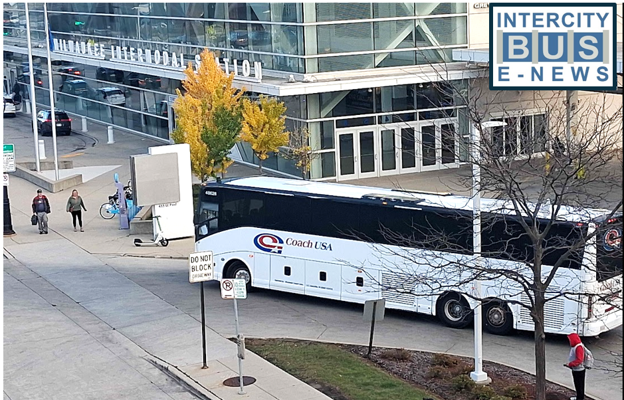
November 19, 2026 | Above: A Coach USA departure in Milwaukee, November 6, 2026. Full caption below
| |
Editor’s Perspective
Get ready for the holiday bustle—with a remarkable twist: AAA’s Thanksgiving travel forecast anticipates air and auto travel will be down 0.2% and 0.3%, respectively, versus last year, while other modes—mostly buses and trains—are up an impressive 8.3%. This projection was made without proprietary booking data, so its not definitive. However, with fuel prices so much higher this year, there is good reason to expect buses and trains to outshine other modes this holiday season.
| |
FlixBus-Greyhound reports that bookings are up 17%. The headline grabber will likely be the softness in air travel. Not only is airline capacity down slightly, but fares have also skyrocketed, driven by rising jet-fuel costs. Hopper's 2026 Holiday Travel Index estimates that domestic round-trip fares over Thanksgiving will average $402, around 31% higher than last year. Bus fares are up, too, but the increases are small compared to airline flights. On top of this, Amtrak capacity is tight (see our analysis below), which will push more travelers to buses.
Shifts between modes on short-distance intercity routes have been a major theme of Intercity Bus E-News. Travelers respond dynamically to price and service changes when they have multiple options, a theme pervasive in the four feature articles in this edition:
|
-
Why the Midwest swings "hot and cold" this time of year for bus service, and why higher-quality bus stations are improving the region's outlook.
-
Philadelphia's winning formula for revamping its bus station, including my observations during a bus trip to the upgraded facility last month.
-
Thanksgiving's budget-friendly bus fares, compared to air and rail travel, for those booking in advance. Last-minute buyers, however, face more complexity.
-
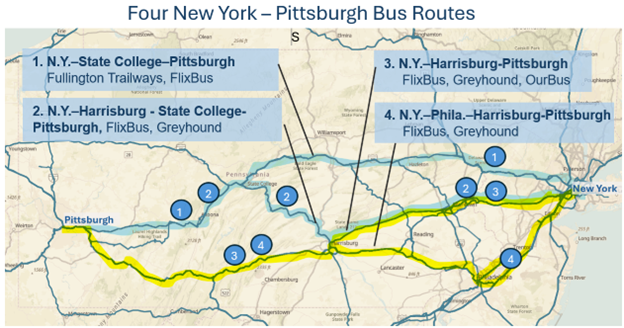
Surprises in New York–Pittsburgh service, where buses and trains cover five different routes with remarkably little overlap. Bus travel will remain popular despite Amtrak launching a second daily Pennsylvanian train.
| |
We also welcomed more than 40 new subscribers to Intercity Bus E-News, many in the Eastern states. Our October edition generated 1,370 opens, moving us closer to our goal of 1,600.
Safe travels over the Thanksgiving holiday. It will be an extraordinarily busy time—despite widespread “pain at the pump.”
| |
Joseph Schwieterman, PhD
Intercity Bus E-News Editor | Professor and Director, Chaddick Institute at DePaul University
| Philadelphia Bus Station: A Winning Formula | My visit to Philadelphia Intercity Bus Station on Sunday, October 18, 2026, offered pleasant surprises, especially the upgraded customer experience resulting from the operator’s attention to detail. Seeing this station up close, after reading so many headlines since its spring reopening amid municipal improvements, reaffirms that older, architecturally challenged stations can get an extreme makeover without lavish capital spending. | |
If you haven’t followed the story, this city's long-distance bus service was relegated to multiple curbside stops after the city shuttered its Greyhound station in 2023. One report after another described the headaches customers faced. The City of Philadelphia, however, took notice and methodically sought solutions while contending with NIMBYs who seemed to lurk around every corner. The city ultimately leased, refurbished, and reopened the old Greyhound station and made its Philadelphia Parking Authority (PPA) the operator, with the first buses departing in May.
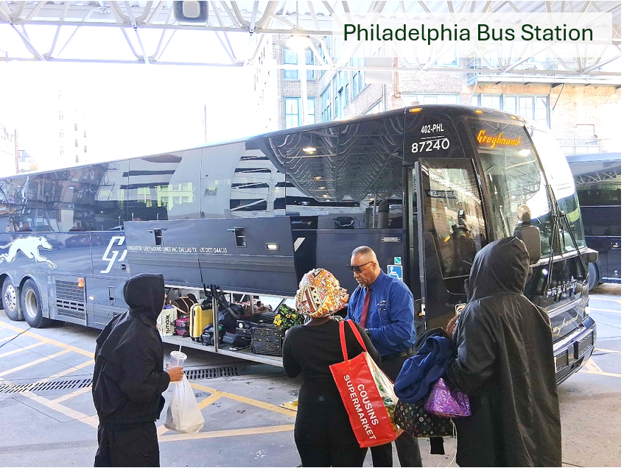
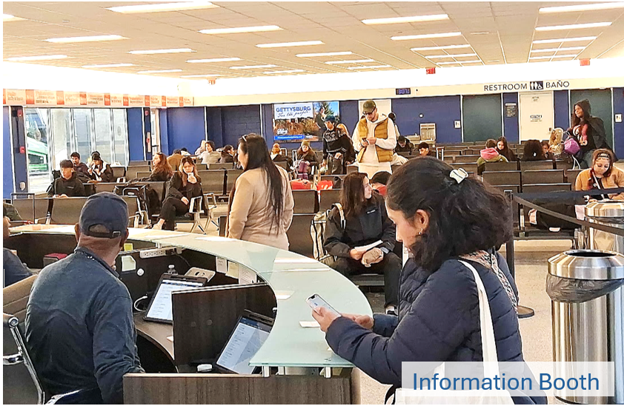
This has been a winning formula. Upon arriving on a nearly full FlixBus service from New York Midtown, I was struck by how much brighter and more pleasant the station had become. Barren concrete walls now boast artwork and murals, and a well-staffed circular information desk creates a welcoming mood. Professional departure announcements mirror those of airports.
| |
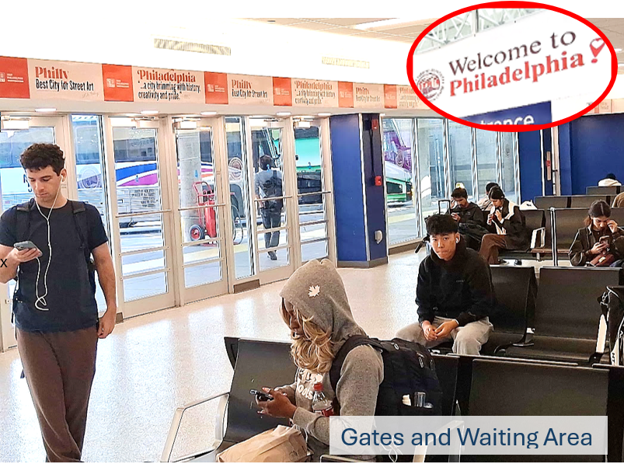
All three ticketing counters, those for Peter Pan, Flix-Greyhound, and niche-player Wanda (which has a branded New York–Philadelphia Express service), were staffed; passengers were using two on my arrival. Four coaches occupied the sawtooth bus bays, and, on my count, around 60 people were waiting, mostly in seats that seemed new or recently refurbished (see photo above). The station is officially the PPA Transportation Center but listed as the Philadelphia Bus Station on most bus tickets. Several New Jersey Transit bus routes use the station as part of a one-year trial lease.
The location at the heart of Center City is outstanding. SEPTA’s Jefferson Station, Philadelphia’s principal commuter-rail hub, is across the street. I was worried about my flight connection, so I left to catch my train at Jefferson far too early and reached the platform in less than a minute!
| |
Among the biggest missed opportunities was the absence of digital departure/arrival boards. The ticket counters had screens, but they weren’t displaying schedules. There was also no retail shop (only vending), which, unfortunately, is to be expected at stand-alone intercity bus stations around the country outside of New York.
Municipal leaders deserve tremendous credit for the upgrades. I saw college-age travelers and young professionals traveling solo—the mainstays of bus travel—as well as couples and small groups waiting for departures. Among them were well-dressed seniors and families apparently vacationing; one even was taking selfies. The high cost of train travel is partially the reason: Amtrak’s one-way fares to New York that day were generally $140+, compared to $30–$40 by bus.
Philadelphia and its parking authority have set a precedent for other cities to follow. I took notes to share with those working on Chicago’s station-- Joe Schwieterman
| Swinging "Hot and Cold" in the Heartland | Like Chicago’s notorious weather, the Midwest’s bus network swings between hot and cold in seemingly unpredictable fashion. Winter is around the corner, and slow-season bus schedules are in effect. Unlike during the summer, winter bus service varies sharply by route and day of the week. | |
The Midwest's hot markets include Chicago to Des Moines and the Twin Cities, with four and five trips each way daily, respectively, and both Flix/Greyhound Lines and Jefferson Lines serving them. State support is helping expand options and ensure attractive departure spacing throughout the day. There are also attractive options from dawn to dusk from Chicago to Cleveland, Columbus, OH, Indianapolis, and Madison, WI.
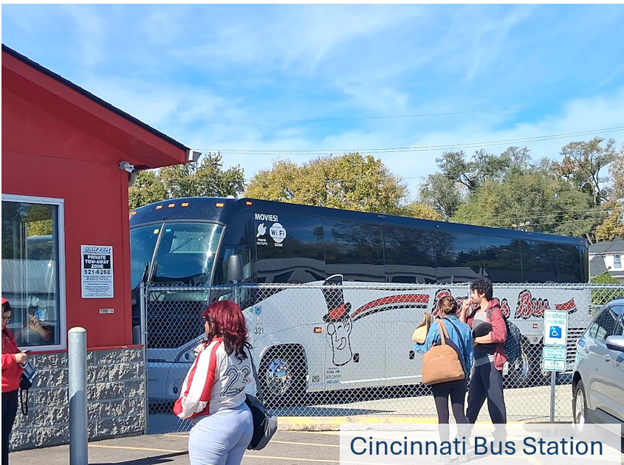
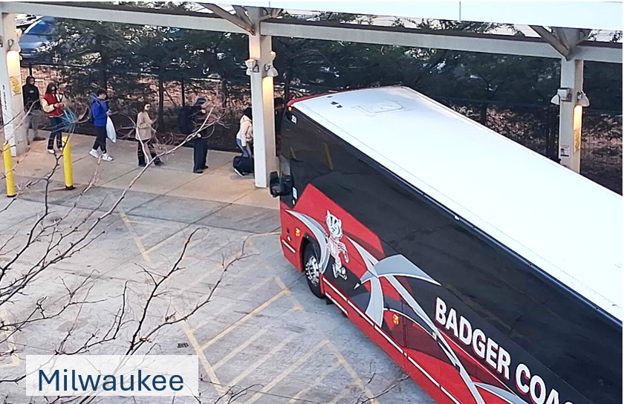
Cleveland’s new station is helping fire up the market (see our recent feature), as are high-quality stations in Cincinnati, Milwaukee, and St. Paul, the latter two shared with Amtrak. Cedar Rapids’ station has been successfully relocated from the airport to Lindale Mall.
| |
Chicago is finally emerging from the ice, with a station now under municipal ownership. The former Greyhound station has become dreary, and the cafeteria has closed, but public upgrades are likely to begin within a few months. Municipal governments in Columbus and Dayton, OH; Indianapolis; and Louisville, KY should take note and consider similar investments.
Another hot Midwestern trend is the recent expansion of publicly funded intrastate services, particularly in Ohio and Wisconsin, a shift that is enticing travelers who haven’t ridden an intercity bus service in years to try it again. This month, Iowa announced a new round of funding, showing how states are stepping up to support bus travel.
| |
Midweek service is surprisingly weak on numerous routes. On Tuesday and Wednesday, those looking for a direct bus from Chicago to Cincinnati, Green Bay, and St. Louis, and daytime service from Chicago's Loop to Memphis are frozen out this time of year. The Cincinnati situation is surprising given that Amtrak’s lone train from Chicago arrives at 3 am and doesn’t run daily. Some gaps will disappear during the holidays and again during the spring thaw, but they show how much more work is needed to make high-quality bus service universal.
The Chicago-to-Detroit route, with just three departures—all by Flix/Greyhound—is also feeling the chill this time of year on Tuesday and Wednesday, a paucity considering that three trains and 25+ flights operate daily. Chicago’s investment and Detroit’s plans for a new station (the latter, unfortunately, still several years away) could break the spell. Chicago-Grand Rapids has no direct buses any day this time of year, except a once-daily Tornado Bus from an outlying neighborhood. Tornado caters heavily to Spanish-speaking travelers.
| The cold reality is that improving service will require more hard work by carriers, local governments, and states. The outlook is favorable, but station upgrades are critical. Stay tuned for E-News coverage from its home region. | Photos: Top: Cincinnati Bus Station, October 25, 2026, Above: Badger Bus at Milwaukee Intermodal Station, November 6, 2026 | Ride Buses, Avoid Gobbling up Your Budget | Holiday travel is shaping up to be stressful for operators and travelers alike. Strong demand coupled with sky-high fuel costs has pushed fares considerably higher than last year. Capacity on peak days will be limited, in part because bus lines appear to be playing it safe by avoiding adding seats in response to sky-high diesel prices. Expect many sold-out departures. | |
Buses will nonetheless ease the budgetary pain. We tracked air, bus, and train fares on 16 major routes between 100 and 400 miles, including numerous state-supported Amtrak routes, such as Charlotte to Raleigh, Chicago to St. Louis, Oakland to Bakersfield, CA, and Portland, OR to Seattle. We excluded the Northeast Corridor, where buses are nearly always the least expensive. Additionally, we considered only direct-travel departures on Sunday, November 29, between 9 am and 6 pm—prime-time holiday returnees.
| |
Six weeks out, we found:
-
Intercity buses were priced far lower than trains on 12 of the 16 routes, higher on two, and essentially the same (within $2) on two.
-
The median bus fare was $42 versus $54 for trains, and a whopping $250 for flights.
-
The two routes with higher bus fares, Chicago to St. Louis and Boston to Portland, ME, have trains with extensive state financial support that helps keep fares low.
| |
Bargain hunters were also rewarded for considering buses, finding fares $40+ less than trains on six routes, but trains never undercut buses by this margin. New York–Pittsburgh (see feature below) had an extreme difference: $62 by bus versus $162 by train.
As the holiday approached, however, travel costs surged on all three modes. Last Tuesday, five days out, median bus fares reached $136---more than three times the earlier level--and airfares hit $332. Trains on six of the 16 Amtrak routes were completely sold out, but those with seats left were surprisingly priced similarly to, and sometimes lower than, buses. N.Y. – Pittsburgh train fares, however, jumped to $403, versus $164 for buses. Unlike years ago, most bus fares are dynamically priced, with fares rising sharply in response to demand. At the same time, the lack of seats on trains appears to be pushing many travelers to bus service.
Image Credit: Lars A, David, Olivier Guin, Jule Steffen & Matthias Schmidt (image cropped and recolored). CC BY-SA 4.0. Link.
| New York - Pittsburgh: Keystones for Mobility | The New York–Pittsburgh (NY–PIT) route shows how bus lines can differentiate their service to attract travelers. Rail service has been in the news because Amtrak launched a second Pennsylvanian train yesterday, with support from the State of Pennsylvania. Roughly a dozen buses run in each direction on peak days. Bus lines will feel the stepped-up competition, but our analysis shows that the whole is often far greater than the sum of its parts. | Using the Intercity Bus Atlas and other sources, we found that buses and trains operate over five different routes. Four are served by buses, with some of the fastest trips taking only around eight hours and passing through State College, PA, home of Penn State University, a city that Amtrak trains do not serve. FlixBus and Fullington Trailways both run direct to State College via Interstate 80. Some express runs get riders to Pittsburgh about 90 minutes faster than the train, partly because trains make far more stops. | Another route, used by Flix/Greyhound, is slightly less direct, running via Harrisburg before State College. These buses mostly run straight to the state capital on Interstate 78, with some stopping in Allentown or Reading, PA, places that trains don’t serve. This adds about an hour to travel time and can get riders to Pittsburgh about a half-hour faster than the train. Fullington has a separate Philadelphia–Harrisburg–State College service with a well-timed connection to its once-daily NY–PIT bus. All tap into the Keystone State’s large campus-travel market. | |
The final two routes head straight west across the Alleghenies beyond Harrisburg. These routes, however, compete with Amtrak less than you might expect. One, used by Flix/Greyhound and OurBus (primarily during college breaks and holidays), runs express from New York to Harrisburg, while the other, like the train, runs via Philadelphia. Buses on the latter often stop in Norristown, PA, or Cherry Hill, in southern New Jersey, which aren’t on Amtrak and are convenient for Philadelphia's suburbanites. West of Harrisburg, these buses sidestep Amtrak competition in Altoona, Johnstown, and other points in favor of a faster, more southerly route via the Pennsylvania Turnpike. One Greyhound trip even runs all the way from Philadelphia to Pittsburgh without an intermediate stop, making it around 90 minutes faster than the train. It runs overnight, however, so it is only for night owls.
| Since most passengers choose planes and trains when bus lines don’t offer unique advantages, bus lines constantly experiment. Creating niche routes helps avoid going head-to-head with competitor modes. OurBus provides campus drop-offs for Pittsburgh’s two largest universities, avoiding the need for travelers to double back from downtown or the airport, which is about 22 miles away. Less well known, Agee Bus, sold on gotobus.com, generally runs just once a week between New York's Chinatown and the campuses. Bus lines prioritize lower fares and express schedules, with some having only three or four stops, compared to Amtrak's 12+. Bus fares are typically around half as expensive as trains a day or two before departure. | Offering customers earlier or later options is also an advantage. Even with the new Pennsylvanian, the last westbound train leaves New York’s Penn Station at 12:25 pm. There typically are four or five later buses. Such variety encourages many travelers turn to meta-booking sites like Busbud.com and Wanderu.com to find the best option. We thank Brian Antolin for assistance with this article. | |
FlixBus continues to add niche routes, with a Columbus–Buffalo–Toronto route running via Cleveland and Erie, PA, among its most recent. The trip takes around 9.5 hours, several hours faster than connecting services. Cleveland is served from Flix’s downtown curbside stop. Flix still offers Detroit–Toronto service, which, along with the new Columbus routes, creates a bevy of connecting options from the Midwest to Ontario.
| |
Amtrak is moving away from the Amtrak Thruway moniker to brand bus service operated in conjunction with its trains. Many such services are now marketed as Amtrak Connect. Our analysis suggests the older moniker is now largely absent from some schedules and Amtrak.com. Some states use separate branding. For example, in California, the “Gold Runner” brand is now standard throughout the San Joaquin Valley,
| |
Greyhound has launched a twice-daily service from Boston to Nashua and Keene, NH, with financial support from New Hampshire's transportation department. The service stops in Petersburg, NH, which Greyhound has never served before. Separately, Greyhound senior regional vice president Evan Burak has been appointed by U.S. Secretary of Transportation Sean P. Duffy to the training and awareness subcommittee of the USDOT Advisory Committee on Human Trafficking.
| |
Landline has launched a first-of-its-kind service from Santa Rosa’s Sonoma County Airport (STS) to San Francisco International (SFO). Passengers can check their baggage and pass through security at STS before being brought directly behind security at SFO to catch flights on five airlines: Alaska, American, Hawaiian, JetBlue, or United. Eight coaches operate daily over the roughly 75-mile route. A notable innovation is a Landline website feature that directs you to a specific shuttle when you enter your flight information.
| Less favorably, American Airlines has dropped its Landline partnership at Chicago O’Hare, which had included short-hub service to Rockford, IL, and South Bend, IN. The O’Hare move may have been precipitated by expressway backups, particularly to and from South Bend. Plus, American and United are battling for more O’Hare space. Motorcoach departures, even when using regular airport gates, don’t count in gate allocation formulas. American recently lost several gates to United. American still heavily uses Landline at Philadelphia International. | Eno Center Webinar, December 8 | |
The Eno Center for Transportation’s “Intercity Buses at a Crossroads” free webinar will examine trends and opportunities for expanding service, attracting passengers, and improving the travel experience on Tuesday, December 8, 1–2 pm ET (12–1 pm CT). The panel will include Fred Ferguson, president and CEO, American Bus Association; Nina Stocker, manager of the Travel Washington Intercity Bus Program, Washington State; and Joseph Schwieterman, professor at DePaul University and Intercity Bus E-News editor. Philip Plotch, principal researcher and senior fellow at Eno, will moderate. Presentations will be brief to allow for extensive Q&A.
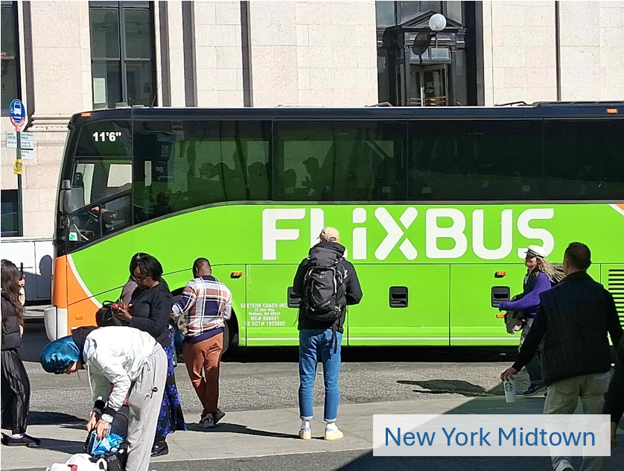
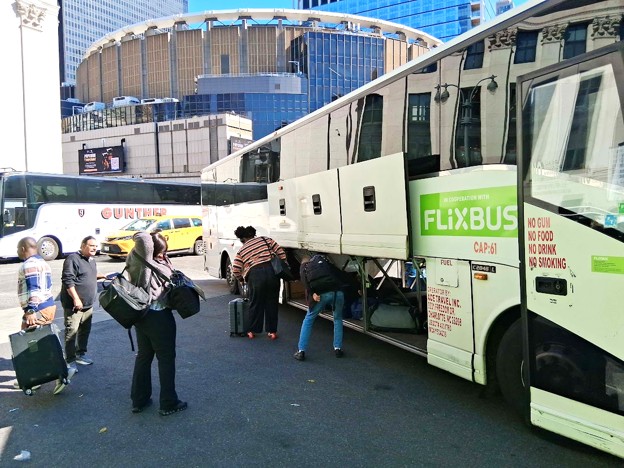
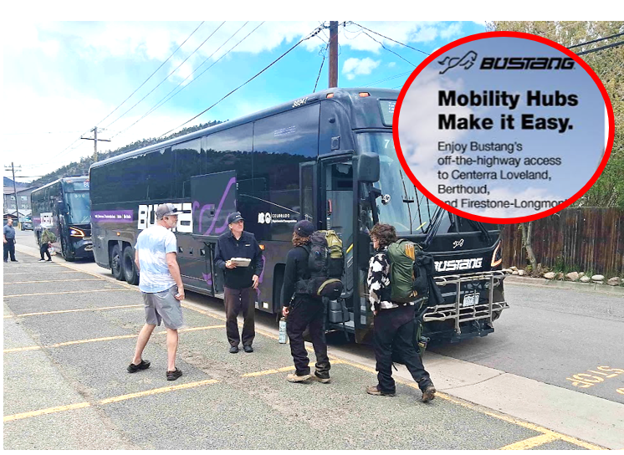
| News Photos from Around the US | Charlotte, North Carolina | A passenger at the Charlotte Intercity Bus Station, shown on October 23, 2026, holds the door for an arriving backpacker. The station sees heavy use, with numerous routes operated by Greyhound and Sunway Charters, supported by the state government. Charlotte Gateway Station, which is being built primarily for the state’s NC by Train service, is nearby but only partially complete. Whether intercity buses ultimately move to the Gateway facility remains to be seen. A Barons Bus service from Charlotte to Columbus, OH (inset photo) will soon depart. | A FlixBus service boards at its Midtown New York stop at 31st St & 8th Avenue on October 18, 2026, with Madison Square Garden looming above. This heavily used surface lot, with several staff members present, is extraordinarily well located, sitting next to Penn Station, numerous subway stops, and Manhattan amenities. The edifice partially visible on the far left is the Moynihan Train Hall, with an entrance to the left (just out of view) of the Gunther Charters coach in the distance. Gunther is known for its day trips to New York. | Passengers in Idaho Springs, CO prepare to board a coach for Denver on Bustang’s West Line on May 22, 2026. Bustang operates 15 buses daily in each direction on this line between the Mile High City and Glenwood Springs (the coach in the distance is a westbound run). In September, the state-managed line celebrated the opening of the Thornton–Broomfield Mobility Hub, which became a stop on its North Line between Denver and Fort Collins. Four of Colorado’s mobility hubs (see inset) provide Bustang with high-quality stops while reducing the need to divert from expressways for local pickups and drop-offs. | Masthead (top) photo caption: A Wisconsin Coach Lines (Coach USA) bus for Kenosha slows as it leaves the Milwaukee Intermodal Station on November 6, 2026. The Terminal has extensive commercial intercity bus service, with numerous buses operating as part of Wisconsin’s state-supported network, along with frequent train service. This network includes seven daily Amtrak trains to Chicago and two trains to the Twin Cities. The state-operated station also has a Flix/Greyhound ticket counter, a convenience store, and a restaurant. Milwaukee’s streetcar, The Hop, stops in front of the main entrance. | | |
Invite others to join Intercity Bus Listserv
For a link to past newsletters and reports, click here
Invite your colleagues to join our Intercity Bus Listserv. To join our Intercity Bus Listserv and receive 8–10 emails per year, email Hannah by replying to this email. No spam. Free. Also, check out our recent studies, briefs, and podcasts below. The Intercity Bus E-News team is Joe Schwieterman and Hannah Hatfield. Our email, address: chaddick@depaul.edu
-
For a link to our September Intercity Bus E-News, click here. Features on Putting Intercity Buses On the Map & Multiple Routes between Metros
-
Our brief "Sky-High Expectations," released last week on the need for upgraded terminals at Chicago O'Hare, covered extensively by media outlets. Available here.
-
Reimagining the Chicago Intercity Bus Station, policy brief, click here.
This independently produced e-newsletter brief has been shared with our Intercity Bus (IB) and Transportation listservs. The Chaddick Institute does not receive funds from transportation companies or related industries.
| | | | |