WEL NEWSLETTER April 2026, Vol. 16, No. 1 | | |
Hello,
Happy Spring! The spring blossoms have finally arrived! It seems to me like these past few years we are having more like 6 months of winter having had snow in November and in April. Yes, I know we live in Canada and for better or worse we must be resilient and take the good with the bad, but I am now seeing the merits of snowbirds! Nevertheless, warmer weather will prevail eventually….I hope!
Since our last newsletter, I attended STEP Worldwide Council in London. Exciting changes and developments respecting the future initiatives of STEP were addressed by the Board and Council with our new CEO, Emma Lovell. It’s an active time of progress and change, with initiatives in maintaining competence, presence, and future growth. I joined STEP in 2002 and became a TEP in 2007. I was on the executive of the Toronto Branch for 8 years and then chair and past chair. Our executive founded the Toronto section newsletter. I have been on the National conference committee. I have authored articles, worked on committees, including the Mental Capacity and Vulnerable Persons working group. I have been a member of the Mental Capacity Special Interest Group (SIG), and have been on Worldwide Council now in my 4th year, I have written for the journals, have spoken at conferences across the globe and am now Chair of Worldwide Global Congress, 2026, and have thoroughly enjoyed every minute of it. STEP is a wonderful organization bringing together qualitative expertise essential to serving our clientele. If you have not volunteered your time, I encourage you to do so and become involved. Indeed, if you have not joined-do so! STEP is an inclusive organization and dependent on its hard-working volunteers, and is a mutually rewarding forum for career professionals. I enjoy having a forum to meet other professionals and to learn and to service my clients’ needs through networking and connections worldwide.
On another note, for those interested in establishing new STEP chapters or branches, STEP have now published guidance to support members through the process. You can find these documents in the Branch Portal, under ‘Support and Contacts’ and also under the Membership tab ‘get involved’, for members that won’t have access to the branch portal.
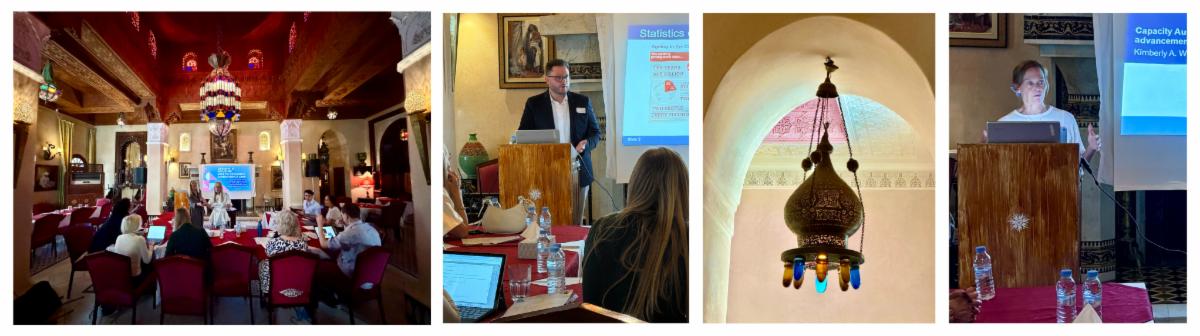
Dr/Prof. Carmelle Peisah invited Bryan and I to speak at Capacity Australia’s 9th International Conference in Marrakech, Morocco. The theme of the conference, Human Rights in the advancement of older persons’ health and wellbeing. Carlos De Mendonça’s work was honoured at this conference held at Palais Donab. We heard from doctors and academics on fascinating issues such as, surgical consent in older populations, cross-cultural autonomy, coercive control and trauma coerced attachment, human rights within global ageing, shared decision making for vulnerable surgical patients, romance scams, disability and discrimination, and more. We even enjoyed some of our local medical local talent, Dr Jocelyn Charles and Dr. Aliya Hirani from Toronto who spoke on combatting ageism. If you want to find out more about Capacity Australia: https://capacityaustralia.org.au/
| |
Journal Publication Opportunity ALERT: The newly re-named Estates & Trusts Journal (ETJ) (formerly the Estates, Trusts & Pensions Journal (ETPJ)) is actively seeking article submissions for consideration. Please submit your scholarly and academic articles to Ian Hull (ihull@hullandhull.com), Suzana Popovic-Montag (spopovic@hullandhull.com), and me (kim@welpartners.com) for consideration.
This month I had the pleasure of presenting at the LSO 6-Minute Lawyer on Standing in Estate Litigation (link to paper). I also chaired Osgoode Professional Programme on Fiduciary Accounting with presenters Nick Esterbauer, Heather Hogan, Ian Hull, Professor Albert Oosterhoff, Tracey Phinnemore, Ambie Edgar-Chana, and Radhika Sharma.
Our WEL TEAM is excited to attend the Estates & Trusts End of Term dinner on June 9, to celebrate our colleagues’ achievements and recognitions. Congratulations to Kathryn Balter, who will be presented with th OBA Hoffstein Book Prize; Bryan Gilmartin, who will be presented with the OBA Foundation's Wolfe Goodman Award, and to the still unknown recipient of the Widdifield Award. A big shout out to recognize the talents of Karon C. Bales who will receive the 2026 OBA Award of Excellence in Trusts and Estates Law.
On a final note, this month, we would like to bring to your attention some encouraging news about medical experts and corresponding resources in our estate litigation practices.
As many of you may have experienced, it is difficult sometimes to source, find, and obtain timely expert medical assessments involving capacity within our practices. This is because there are unfortunately relatively few court qualified experts and few experts that do this specific and focused work. Medical Experts are however frequently required in the court adjudication of our client matters.
We have found in our experience, that expert opinions are extremely probative early on in contentious estate matters involving capacity issues. An assessment and expert opinion/report can go a long way to resolving disputes at early mediation, sometimes even before proceedings have commenced and too, during the currency of active litigation involving capacity issues.
We are often looking at capacity contemporaneously and retrospectively regarding decisonal capacity to retain a lawyer; to instruct a lawyer; to grant powers of attorney for personal care and/or property; to gift/execute a deed of gift; to transfer real property; to make a will; to create a trust; to make beneficiary designations; to manage property; to manage personal care; to marry; to divorce; to separate; to reconcile; to consent to various choices, activities, decisions, tasks, and more.
Expert opinions, done well can effectively promote settlement and resolution and notably assist a Judge in court proceedings. To this end, in June 2022, and again in the Fall of 2025, Ian Hull, Suzana Popovic-Montag, Bryan Gilmartin and I (faculty) were invited to assist in the formal teaching and training of medical experts alongside doctor experts in this domain. There was a selection of other lawyers that participated and provided input and assisted in break out learning groups, and who provided insights-John Poyser, Rebecca Kennedy, Nick Esterbauer, Anne Posno, Jan Goddard, Holly Cunliffe, Nathan Spaling, Jasmine Sweatman, Melanie Yach, Ljiljana Stanic, Rebecca Ernst, Andrea McEwan, Stephen Halas to name a few.
The University of Toronto in partnership with Sunnybrook Health Sciences Center administered the course entitled, The Role of the Medical Expert in Estate Litigation, led by Doctors/Professors, Ken Shulman, Carole Cohen, Julia Kirkham, Sarah Mitchell, Jocelyn Charles, Nathan Herrmann, Robin Jakoby, and Carmelle Peisah (faculty).
The course involved Judicial oversight and guidance from members of our Ontario Superior Court of Justice Bench, namely, now, the Honourable Susan Himel and the Honourable Justice Fred Meyers. The course involved an intensive and substantive review of legal principles associated with these matters including the process, protocol and legislated duties of experts replete with hands on break-out working group participation demonstrating and practicing examinations-in-chief, examinations, and cross examinations, tips, traps and takeaways. The course is designed to assist medical professionals to become experts and gain competence and confidence in the court process and their role and duty within that forum.
With this in mind, we offer up a list of doctors that has been shared with us through the course faculty leaders of those medical professionals who have participated in this training and who have expressed an interest in being retained to do this work. By sharing this information with you, you will be in a position to access a resource in what we hope will be a growing list of medical experts we will have access to. View list.
The course will likely run again in 2028, and we hope by continuing this training we will have a larger pool of experts to draw from and correspondingly a consistent pool of tools and resources to help our clients now and in the future. The medical professionals who lead the course are engaged in a mentorship initiative designed to support and encourage potential interested medical professionals to gain experience and confidence in doing assessments. If you have any questions in this regard the legal faculty are happy to field them.
As Ever, Enjoy the Read!
Kim
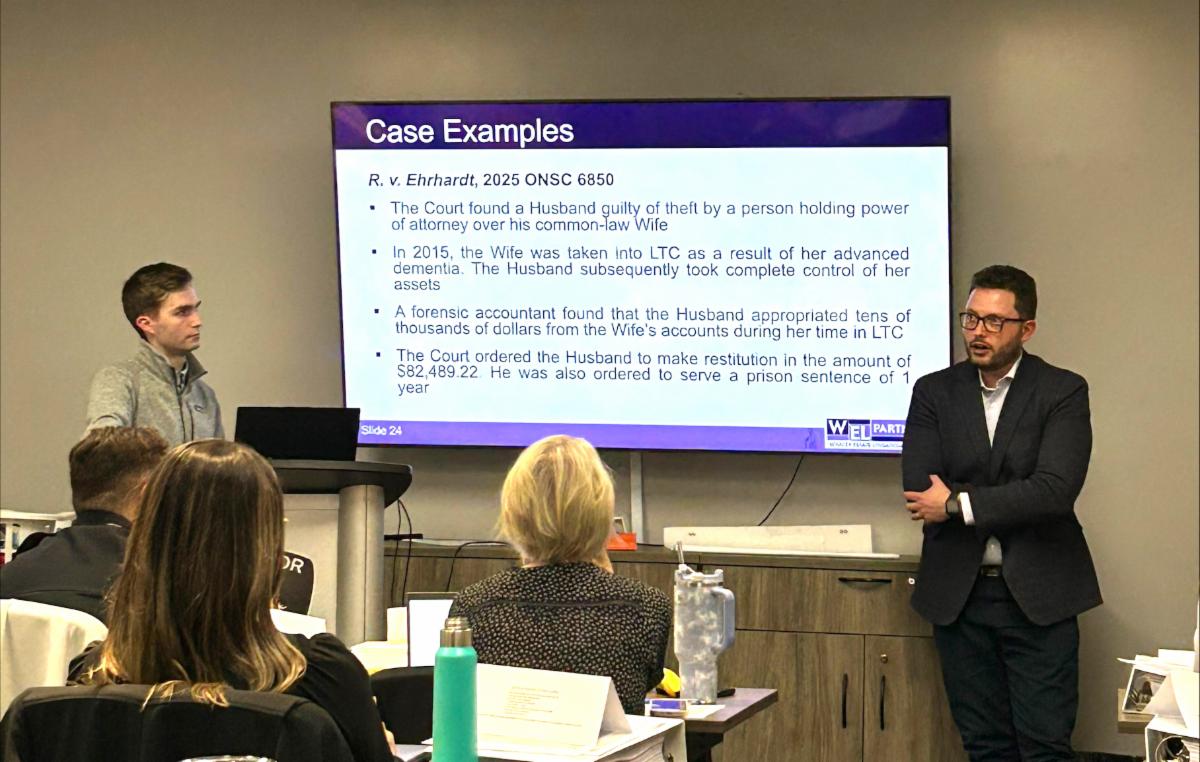
| | 1. ONTARIO POLICE COLLEGE ELDER ABUSE COURSE | | On March 26,2026, WEL Partners’ Bryan Gilmartin, Joanna Weiss, and Oliver O’Brien led sessions on capacity (including in respect of testamentary capacity, capacity to grant and revoke Power of Attorney documents, capacity to manage property, and capacity to marry), and the civil and criminal remedies available in instances of elder abuse as a part of the Ontario Police College’s Elder Abuse Course in Windsor, Ontario. As always, WEL Partners appreciates the opportunity to engage with the Ontario Police College’s students on such important and timely issues. | | 2. CAPACITY AUSTRALIA 9TH INTERNATIONAL CONFERENCE: MARRAKECH, MOROCCO | | |
On April 6th Kimberly Whaley and Bryan Gilmartin spoke on predatory marriage solutions from a lawyer’s perspective and ageism at Capacity Australia’s international conference in Marrakech, Morocco. Capacity Australia is a not-for-profit charity led by a group of dedicated experts from the medical, legal, ageing, and disability fields with experience in capacity, guardianship, disability, mental health, and old age psychiatry, that champions autonomy of decision-making.
https://capacityaustralia.org.au/product/capacity-australia-9th-international-conference/
| | 3. EMILY CAZA QUOTED IN THE GLOBE AND MAIL | |
Emily Caza is quoted in the April 16, 2026, Globe and Mail article: Power of Attorney Receives Rare Jail Sentence for Stealing from Common-Law Partner with Dementia, by Rudy Mezzetta.
Read article:
https://www.theglobeandmail.com/investing/globe-advisor/advisor-news/article-power-of-attorney-receives-rare-jail-sentence-for-stealing-from-common/
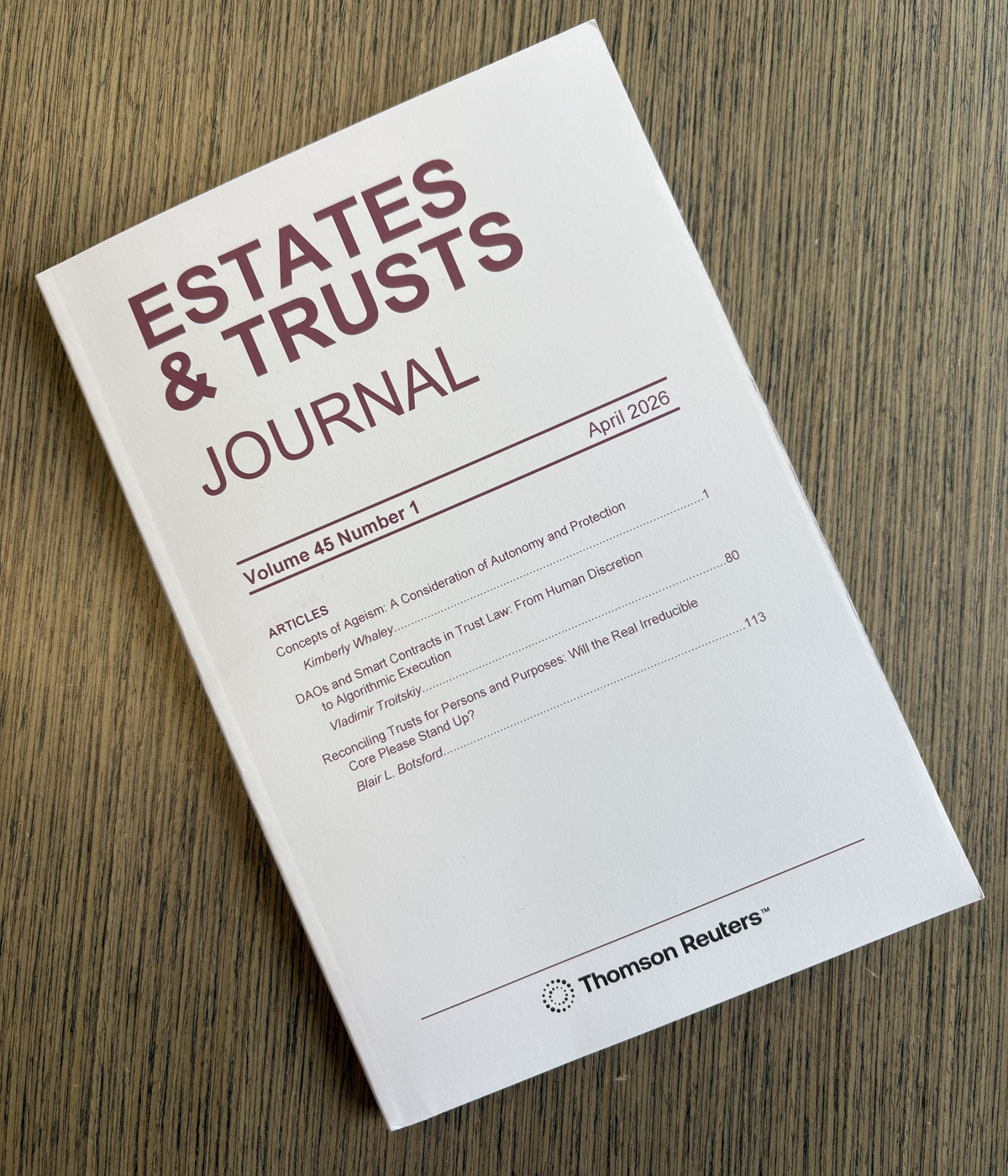
| | 4. ESTATES & TRUSTS JOURNAL VOLUME 45, NUMBER 1, APRIL 2026 | Kimberly Whaley's paper, Concepts of Ageism: A Consideration of Autonomy and Protection, is published in the new issue of the Estates & Trusts Journal, 45 ETJ 1 (April 2026). | | 5. OBA CONDOMINIUM LAW ADVISORY GROUP’S ELDER LAW PROGRAM | |
On Wednesday, May 13, 2026, Nima will be speaking at the OBA Condominium Law Advisory Group’s Elder Law Program. This panel will discuss issues with management strategies, long-term accessibility planning, and essential considerations for communicating with substitute decision-makers in accordance with the Substitute Decisions Act.
The Canadian Bar Association: Aging in Condominiums: Critical Governance and Legal Considerations
| | 6. OTTAWA ESTATE PLANNING COUNCIL ON MEDICAL ASSISTANCE IN DYING: KEY CONSIDERATIONS FOR ESTATE PLANNING PROFESSIONALS | |
On May 6, 2026, WEL Partners’ Joanna Weiss will be going to the nation’s capital to present to members of the Ottawa Estate Planning Council on Medical Assistance in Dying: Key Considerations for Estate Planning Professionals. Joanna will address the current legal landscape of Medical Assistance in Dying in Canada and will explore key considerations for estate planning professionals to keep in mind when advising clients on this sensitive, complex, and timely issue.
https://www.oepc.ca/council-events-in-ottawa/
| | WEL Partners takes great pleasure in congratulating our colleagues on their achievements, and to our delight there are many accomplishments of note this month. | | ONTARIO BAR ASSOCIATION AWARD OF EXCELLENCE IN TRUSTS AND ESTATES LAW | | |
WEL Partners wishes to extend our congratulations to Karon Bales, recipient of the 2026 OBA award of excellence in trusts and estates law. We look forward to celebrating this win with you on June 9th! Karon Bales is a founding partner of Bales Beall LLP. Her practice is centered on family law, wills, and estate issues, and her experience in trial and appellate advocacy in family law and estate matters is extensive. Karon is a specialist certified by the Law Society of Ontario in the areas of Estates and Trusts Law, and Family Law. Too, she is a great colleague, collaborative and helpful, a wonderful mentor, and friend.
Event Details: OBA Award of Excellence in Trusts and Estates Law
Karon Bales: Bales Beall LLP
| | ONTARIO BAR ASSOCIATION HOFFSTEIN BOOK PRIZE | | |
WEL Partners would like to congratulate Kathryn Balter, recipient of the 2026 Hoffstein Book Prize! Kathryn is a partner at Fogler Rubinoff LLP, where she focuses on helping clients achieve estate-planning goals by providing advice on wills, trusts, the transfer of assets, powers of attorney, and estate administration. Congratulations Kathryn, we look forward to celebrating with you!
Hoffstein Book Prize | Ontario Bar Association
Kathryn Balter - Fogler, Rubinoff LLP
| | ONTARIO BAR ASSOCIATION FOUNDATION’S WOLFE GOODMAN AWARD | | |
WEL Partners is proud to congratulate our very own Bryan Gilmartin, recipient of the 2026 OBA Foundation’s Wolfe Goodman Award! The Wolfe Goodman Award is an annual recognition of the best article or case comment published in the Estates, Trusts and Pensions Journal by a Canadian lawyer who has been called to the Bar for six years or less. Bryan Gilmartin is a co-managing partner at WEL Partners. His articles have been featured in the Globe and Mail, he regularly presents at Continuing Legal Education programs, and has been named in Best Lawyers since 2022. Bryan, we will be cheering you on June 9th!
Wolfe Goodman Award | Ontario Bar Association
Bryan Gilmartin - WEL Partners
| | ONTARIO BAR ASSOCIATION AWARD OF EXCELLENCE IN CONSTRUCTION AND INFRASTRUCTURE LAW | | ONTARIO BAR ASSOCIATION AWARD OF EXCELLENCE IN THE PROMOTION OF WOMEN’S EQUALITY | | |
WEL Partners wishes to congratulate Christine Davies, recipient of the 2026 OBA Award of Excellence in the Promotion of Women’s Equality! This award recognizes significant contributions made by feminist lawyers promoting equality rights in Canadian society, through their work for social justice, advancement of substantive law, or women’s advancement in the legal profession. Christine Davies is a partner at Goldblatt Partners, where she specializes in labour law and civil litigation. Christine has acted in several prominent public interest matters under the Canadian Charter of Right and Freedoms, including cases addressing freedom of expression, freedom of association, voting rights, and equality rights.
OBA Award of Excellence in the Promotion of Women's Equality
Women Lawyers Forum | Ontario Bar Association
Christine Davies - Goldblatt Partners LLP
| | ONTARIO BAR ASSOCIATION ABDALLA BARQAWI BRIDGE BUILDER AWARD | | |
WEL Partners would like to congratulate the winners of the Abdalla Barqawi Bridge Builder Award, Shayna Horvath, JD ’25, Ferdous Hasan, JD ’25, Hanaa Ameer-Uddin, JD’25, and current University of Ottawa JD candidate Arjun Gupta. This group of student leaders has been recognized with this award for their joint unity statement after the October 7, 2023 terrorist attacks in Israel, highlighting a shared commitment to fostering an inclusive community. The Abdalla Barqawi Bridge Builder Award was established in honour of OBA Equality Committee Chair Abdalla Barqawi. The award will be presented annually in recognition of contributions to reducing polarization in the profession or in broader society.
uOttawa News: Student leaders honoured with inaugural OBA Bridge Builder Award
Abdalla Barqawi Bridge Builder Award | Ontario Bar Association
| | ONTARIO BAR ASSOCIATION HEATHER MCARTHUR MEMORIAL YOUNG LAWYERS AWARD | | |
WEL Partners congratulates Brandon Chung, recipient of the 2026 Heather McArthur Memorial Young Lawyers Award. This award recognizes exceptional contributions and achievements by a young lawyer in the field of continuing legal education or development of the law for the benefit of the profession or citizens of Ontario. Brandon Chung is an associate at Henein Hutchison Robitaille LLP, where he practices criminal and regulatory defence, constitutional law, and administrative law litigation. Brandon acts as duty counsel with the Pro Bono Ontario’s Supreme Court of Canada Leave to Appeal Assistance Project, as a coach for the Laskin moot team at Queen’s University, and as an adjunct professor teaching Charter litigation at Osgoode.
The Heather McArthur Memorial Young Lawyers Award | Ontario Bar Association
Henein Hutchison Robitaille LLP - Brandon Anand Chung
| | (i) RULE IN SAUNDERS v VAUTIER | | |
By Albert H. Oosterhoff
1. Introduction
Some time ago, I read a letter from a lawyer who seemed not to have a clear understanding of the Rule in Saunders v Vautier.[1] On the assumption that this lack of understanding may be more widespread, I determined to write a blog describing the basics of the Rule in summary form.[2]
2. Origin and Development of the Rule
The rule obviously derives from the eponymous case. The facts are these: A testator left £2,000 stock in trust for his great-nephew, Vautier, with directions to accumulate the interest and dividends until he should reach age 25. When he reached that age, the whole amount should be paid to him. When Vautier reached the age of 21, which was then the age of majority, he demanded to be paid the stock plus the accrued interest and dividends. The court allowed his claim. It found that the will gave Vautier the full and exclusive right of enjoyment of the property and that the equitable title vested in him. Therefore, when he reached the age of majority and was otherwise capacitated, he was entitled to possession of the property. The right to the premature distribution of the trust property is based on the view that, since equitable ownership of the trust property is held by the beneficiaries, they are entitled to decide what to do with it.[3]
In due course the rule was extended to apply also to a trust in favour of more than one beneficiary, whether successively or concurrently. In that case, so long as the beneficiaries together have the full beneficial interest among them, they can terminate the trust. Note that, even in its extended sense, the principle is referred to as the rule in Saunders v Vautier.
Therefore, there are two aspects to the rule. First, the beneficiary (or beneficiaries) must be sui juris, that is, adult and of full mental capacity. And, in the case of more than one beneficiary, the beneficiaries must all agree to terminate the trust. Second, the beneficiary (or beneficiaries) must be absolutely entitled to the trust property. That means that they must be ascertained, and together, their interests must account for all the interests in the trust property.[4] Moreover, the court cannot consent on behalf of non-consenting sui juris beneficiaries.
The rule enables beneficiaries, since they are the owners in equity, to terminate a trust without court approval, except in Alberta[5] and Manitoba,[6] where judicial approval is required. For the same reason, the beneficiaries can terminate the trust prematurely contrary to the wishes of the creator of the trust. And finally, when beneficiaries terminate a trust under the rule, they can compel the trustees to transfer the property to themselves or to the person or persons they direct.
There are two other important points. First, while the beneficiaries can terminate a trust if they satisfy the requirements of the rule, they cannot direct the trustees to exercise their powers in a particular way or interfere with the trustees’ exercise of their power. In other words, they must choose between terminating the trust or abiding by its terms.[7] Second, although the beneficiaries are all sui juris, according to Waters they are not able to vary the trust.[8] However, various editions of Underhill on Trusts and Trustees stated that the rule permits a trust to be ‘modified or extinguished’ by sui juris beneficiaries (emphasis supplied). Hence, Deschamps J, writing for the majority in Buschau v Rogers Cablesystems Inc,[9] said, quoting Underhill, ‘According to that rule [viz Saunders v Vautier] the terms of the trust can be varied or terminated if all the beneficiaries of the trust, being of full legal capacity, consent’.[10] In any event, the Uniform Trustee Act,[11] promulgated by the Uniform Law Conference of Canada in 2012, permits both termination as well as variation of a trust if all the beneficiaries are sui juris and consent to an arrangement.[12]
3. Circumstances That Trigger the Application of the Rule
The following are some examples of gifts that will trigger the rule. For the sake of convenience, they involve interests under testamentary trusts, but of course similar interests under inter vivos trusts would also attract the rule. The examples require some knowledge of the law of future interests. I do not apologize for that, although I believe that this law may no longer be covered as well in the standard property course as it was formerly. I have tried to describe its intricacies in the examples.
(1) ‘To A at age 25’. The gift confers a contingent interest on A. He must satisfy the age contingency in order to take an absolute, vested interest. Until he does, he does not own the complete interest in the property and therefore he cannot terminate the trust. The estate holds an interest under a resulting trust. That interest will end when A turns 25, at which time his interest vests and becomes absolute and he can terminate the trust. But if he dies before age 25, his contingent interest ends and the estate’s interest becomes absolute.
(2) ‘To B to be paid to her at age 25’. These are the facts of the Saunders case. B’s interest is vested absolutely as of the testator’s death. Hence, B can terminate the trust as soon as she reaches the age of majority (and is otherwise fully capacitated). The interest is vested and not contingent because, (a) it is not actually postponed to age 25; it is hers immediately. The only thing that is postponed is enjoyment; and (b) the law favours early vesting[13] and will therefore treat an interest as vested rather than contingent if either interpretation is possible.
(3) ‘To C at age 25, but if C dies under age 25, to D’. This is like example (1), except that the testator has added a condition subsequent that will have the effect of taking away C’s interest if she dies under age 25 and giving it to D. The ‘but if’ clause creates what is called a ‘gift over’, which means that the gift passes from C to D or shifts from C to D in the stated event. You would think that C’s interest is still contingent, but under the old rule in Phipps v Ackers[14] it is interpreted as vested subject to divestment.[15] The rule was designed to avoid the destruction of contingent remainders but now extends to all gifts like it. Note that, although C’s interest is vested subject to divestment, D’s interest is contingent because it is subject to the condition precedent of C dying under age 25. However, C and D together now own the complete interest between them, and so if they are both sui juris and agree, they can terminate the trust. If the testator wants to avoid that, she can also require D to reach a specified age or else replace D with a number of minors under the gift over, such as ‘the children of X’. By wording the gifts properly, and by choosing D’s age carefully, or if the children of X are unborn or very young, the testator can postpone termination of the trust to a time desired.
(4) ‘To E when she marries, but if she dies without having married, to F’. You would think that the same result would obtain as in example (3), but it does not. The rule in Phipps v Ackers applies only when the gift over is on failure to reach a specified age. This means that the gifts of E and F in this example are both contingent, E’s on marrying and F’s on E dying without marrying. Of course, you can make F’s interest subject to a second contingency, such as those described in example (3).
(5) ‘To G to be paid to him at age 25 and if he fails to reach that age, to H at age 30’. This is like example (2), but with a gift over. G’s interest is vested subject to divestment. It will become absolute when G turns 25, but it will divest if he fails to reach that age. In that case the interest shifts to H. H’s interest is doubly contingent: (a) on G failing to reach age 25; and (b) on H reaching age 30. H’s interest will only become vested if H satisfies both contingencies. Note that if G dies under age 25 and the interest shift to H before he has reached age 30, H does not yet own the full interest. The estate has an interest under a resulting trust, which will become absolute if H dies under age 30, but it will end when H turns 30.
It will be apparent from these examples that to prevent a beneficiary from terminating a trust, the grantor or testator must ensure that the beneficiary does not have a vested interest that would permit her to terminate the trust when she reaches the age of majority and is otherwise sui juris. Rather, the grantor must either make the gift vested subject to divestment with a gift over, or contingent with or without a gift over. What the grantor should aim for is to include beneficiaries who are either minors, unborn, or unascertained, for then it is unlikely that the trust can be terminated before the first named beneficiary (or the next in line as the case may be) satisfies the stated contingency. Minors are of course persons under the age of majority. Unborn beneficiaries are persons who will qualify as beneficiaries if they are born after the date of the gift. Unascertained beneficiaries are people who are named, but of whom it is unknown at the time of the creation of the gift whether they will in fact qualify as beneficiaries eventually. An example of an unascertained beneficiary is a gift ‘to A and B for their joint lives, with remainder to the survivor of them’. The survivor is not known at the time of the gift; it may be A or B. In any event the remainder is contingent.
4. Some Circumstances in Which the Rule Cannot Be Invoked
4.1 Pension Trusts
The question whether the Rule applies to pension trusts arose in Buschau v Rogers Cablesystems Inc.[16] It was a case involving conflicting claims to a pension surplus. The British Columbia Court of Appeal held that the rule in Saunders v Vautier could be applied if it was shown that all persons with a claim under the pension plan had consented, but that the court cannot consent on behalf of non-consenting sui juris beneficiaries. The Supreme Court of Canada did not disagree with that point but reversed on the ground that the rule in Saunders v Vautier is incompatible with modern pension plans, since the statutes that apply to such plans govern their termination and the distribution of pension assets.
4.2 Charitable Trusts
The Rule does apply to charitable trusts, but only if the charity is the beneficiary of a trust and it is solely and absolutely entitled to the property. In that case the charity can collapse the trust.[17] If a charity is named as the trustee of a charitable trust, and the trust creates an endowment and permits only the income to be used for charitable purposes, the charity cannot terminate the trust. It is not solely and absolutely entitled to the property.
4.3 While Parties Are Engaged in Litigation
Pitt v Beattie[18] concerned a will in which a testator named his brother executor and left the residue of the estate in trust for the plaintiff until she attained age 25. When she brought the action, she was 23 years old. Thus, she was of age, and she was not otherwise under any disability. Hence, she was entitled to the property under the rule in Saunders v Vautier. She brought the action alleging that the executor sold a major asset of the estate to his two children in an improvident sale and at an undervalue. The executor admitted her entitlement to be paid before age 25 and made a partial payment to her but sought a release from the plaintiff concerning his management of estate funds. The court held that the rule does not trump the discretion of an executor who exercises his discretion reasonably and where the amount of the residue remains uncertain.
--
[1] (1841), 4 Beav 115, 49 ER 282 (Rolls Ct), affirmed (1841), 1 Cr & Ph 240, 41 ER 482 (Ch Div), [1841] EWHC Ch J82.
[2] My comments are based largely on Oosterhoff on Trusts, 10th ed by Albert H Oosterhoff, Robert Chambers, and Mitchell McInnes (Toronto: Thomson Rogers: 2024) §6.5. I refer the reader to that section for further and more detailed information.
[3] CIPC (Ocean View) Ltd v Churchill International Corp (2006), 26 ETR 3d 146 (BCSC). In passing, note that the law in the United States is quite different. The law in most states emphasizes the right of the settlors or testators to dispose of their property as they see fit, so long as the disposition is not illegal or contrary to public policy, and thus in most states the beneficiaries are unable to terminate a trust even though they are all sui juris. See Waters’ Law of Trusts in Canada, 5th ed by Donovan WM Waters, Marc R Gillen, and Lionel D Smith (Toronto: Thomson Reuters: 2021), pp. 1341-1343.
[4] Rose v Rose (2006), 81 OR 3d 340, 24 ETR 3d 217 (SCJ).
[5] Trustee Act, SA 2022, c T-8.1, Part 5 (see s 65(b)(i)), and see the former Trustee Act, RSA 2000, c T-80, s 42.
[6] Trustee Act, CCSM c T160, s 59(2).
[7] See Re Brockbank, [1948] Ch 206.
[8] Donovan WM Waters, ‘Does the Rule in Saunders v Vautier Include the Power of the Beneficiaries to Vary the Terms of the Trust?’ But see Joel Nitikman, ‘Variation under the rule in Saunders v Vautier: Yes or No?’ (2015), 35 ETPJ 1 for a contrary view.
[9] 2006 SCC 28, para 2.
[10] In fact the quoted language was not carried forward into the 19th edition. See Underhill and Hayton Law of Trusts and Trustees, 19th ed by David J Hayton, Paul Matthews, and Charles Mitchell (London: LexisNexis Butterworths, 2016), §66.1.
[11] https://www.ulcc-chlc.ca/Civil-Section/Uniform-Acts/Uniform-Trustee-Act, ss 57(a) and 59, read together.
[12] The Uniform Act, including the substance of these provisions has been adopted by Alberta and New Brunswick. See Trustee Act, SA 2022, c T-8.1, s 67; Trustees Act, SNB 2015, c 21, s 59.
[13] See Oosterhoff on Wills, 9th ed by Albert H Oosterhoff, C David Freedman, Mitchell McInnes, and Adam Parachin (Toronto: Thomson Reuters: 2021), §17.3.2.
[14] (1842), 9 Cl & Fin 583, 8 ER 583 (HL), also known as the rule in Edwards v Hammond (1864), 3 Lev 132, 83 ER 614.
[15] Cf Re Barton, [1941] SCR 426.
[16] 2004 BCCA 80, additional reasons 2004 BCCA 282, further additional reasons 2004 BCCA 289, appeal allowed 2006 SCC 28.
[17] See Wharton v Masterman, [1895] AC 186 (HL). See also Re Beresford Estate (1966), 57 DLR 2d 380 (BCSC).
[18] 2025 ONSC 5654.
| | |
By Albert H. Oosterhoff
1. Introduction
Lewis v Jack[1] is an odd case. It concerns the entitlement of a beneficiary to one-half of the residue of an estate. The beneficiary survived the testator, but died before the executor distributed the estate. My concern about the decision is that the court failed to discuss or even mention the law of assent. In my opinion it should have done so.
2. Facts
The testator, Kenneth Jack, died in October 2018, leaving a Will in which he names his two adult sons, Travis and Jason, as beneficiaries, (a) of the contents of his home, and (b) of the residue. He names Travis his executor and Travis was granted probate in May 2019. The most significant asset of the estate is a ranch property. It was run by Travis and Jason, and both lived there when Kenneth died and had done so for many years.
Clause 3 of the Will leaves all the estate to the executor in trust. Subclause (a) contains the standard discretionary provision for the realization of the estate; subclause (b) contains the standard direction to pay debts, funeral and testamentary expenses, taxes, and fees. Subclauses (c) and (d) are somewhat unusual. They provide (with emphasis supplied):
(c) To divide the contents of my home between my children then alive as they may agree and in default of agreement as my Trustee may decide.
(d) To divide the residue of my estate then remaining into as many equal shares as there shall be children of mine then alive and to give absolutely one (1) such equal share to each child.
Jason died on 24 February 2023, intestate and without children. At that point, Travis had not distributed the assets. Cecelia Miller, the ex-wife of Kenneth and the mother of both Travis and Jason, was granted administration of Jason’s estate in July 2023. She brought an application for a declaration that, properly construed, the Will provides that the residue of Kenneth’s estate vested immediately on Kenneth’s death, and that Jason’s share was not divested when he died.
The chambers judge dismissed Cecelia’s application.[2] The judge recognised that under the ‘usual rule’ the class of beneficiaries is determined at the death of the testator. However. the judge concluded that the language of the Will, specifically the use of the word ‘then’, means that this determination must take place at the time of distribution because it is then that the division of the property and the gift to Kenneth’s children ‘then alive’ takes place. The judge also took the view that the phrase ‘then remaining’ is consistent with a sequential interpretation of all the subordinate clauses, including subclause (d). In the judge’s opinion, the division of the residue into equal shares to the children ‘then alive’ can only happen once there is a residue of the ‘then remaining’ estate, and the residue only exists after payment of all debts, taxes, and expenses. Since Jason was not alive at that point in time, the judge held that his estate was not entitled to share in the residue. Cecelia appealed.
The Court of Appeal allowed the appeal. Madam Justice Fisher, who wrote the judgment for the court, paid particular reference to cases[3] which emphasize the presumption of early vesting and hold that a testamentary gift is presumed to vest on the testator’s death unless the will clearly shows a contrary intention. Thus, for example, if the gift is to a life tenant and then to a remainderer,[4] and if the remainderer dies during the life tenancy, his interest is not lost but remains effective, absent a contrary intention in the will. Justice Fisher held that the chambers judge erred in the interpretation of clause 3(d) and in holding that the executor was required to exercise his powers sequentially. In her opinion, the chambers judge ignored the context of the Will as a whole. She held that the testator intended to make provision for all his children who survived him. Consequently, she held that Jason’s estate was also entitled to his half of the residue.
3. Discussion
I take no issue with the court’s interpretation of the language of the Will, but I have a concern with its conclusion that the interests of both sons ‘vested’ on the testator’s death. I do not doubt that the law prefers (and I agree) that testamentary interests of the beneficiaries should be determined as soon as possible. But it is the word ‘vested’ that is the problem because it fails to take account of the law of assent.
These are my reasons. The law is very clear that when a person dies, whether testate or intestate, her assets vest in her personal representative (‘PR’). In other words, the PR receives the full unbifurcated title so that he can properly administer the estate. The PR must have full title to the estate to pay debts, expenses, taxes, fees, and other liabilities. Only when he has done that can he begin to distribute the assets as the will directs. But in paying all the liabilities, he is entitled to resort, if necessary, to all the assets. It is true that the PR resorts first to non-specifically given assets, then to legacies, then to bequests, and finally to devises of real property. But clearly, in an insolvent estate, all of the assets may have to be used to pay the liabilities.
What this means is that beneficiaries under the will, whether of specific gifts or of the residue cannot claim to be entitled to the gifts left to them in the will until all the liabilities have been satisfied and the PR assents. And therefore, in my opinion, it is wrong to say that their interests are ‘vested’ on the testator’s death.
I have written at great length about the PR’s title in my article, ‘Locus of Title in an Unadministered Estate and the Law of Assent,[5] and shall not rehash that topic here. Instead, I refer the reader to my article. However, I draw attention to the fact that the article discusses a large number of cases which recognize the PR’s title. The leading modern case discussed is Commissioner of Stamp Duties (Queensland) v Livingston.[6]
But the question then arises, how do the beneficiaries acquire the property left to them by will, assuming that they have not been used to pay the liabilities. This is where the law of assent comes into play. In discussing this law, I shall draw on my article just mentioned, but I also refer the reader to it for further detail.[7]
So, what is ‘assent’? The word can be either a noun or a verb. As a noun it refers to a statement or act of a PR by which she indicates that certain property which forms part of the assets of the estate is not, or is no longer, needed to discharge the estate’s liabilities. The assent can be formal such as a signed document or it can be informal, such as an oral statement by the PR. However, in England an assent with respect to real property must be made in writing.[8] Whether that is also the case in Canada is unclear.[9] The effect of the assent is to release the property to the beneficiary to whom it was left in the will. It is only at that point that the beneficiary can get his hands on the property. An assent will be unnecessary if the PR transfers the property to the beneficiary. And an alternative to an assent is an ‘appropriation’. That occurs when the PR sets aside a specific portion of the estate so satisfy an absolute devise, bequest, or legacy. Justice Gillese referred to it in the following passage from 909403 Ontario Ltd v DiMichele:[10]
104 A contingent beneficial interest in an estate does not give rise to a property interest in any specific asset of the estate, prior to or absent an appropriation of such asset to the beneficiary by the trustee.
Note that, strictly speaking, an assent is not made to a named beneficiary. Rather, the PR assents to a gift in the will, so that it can take effect as intended by the will.[11]
I mentioned that an assent refers to a statement or act of the PR. However, an assent can also be implied. In fact, much of the case law on assent is concerned with circumstances in which there has not been a formal or informal assent. This typically happens when the PR has fully paid the estate’s obligations and then holds the assets in his capacity as trustee for the beneficiaries. If that took place some time ago, the court is likely to infer that an assent has taken place. The leading case is Attenborough v Solomon.[12] Fourteen years after the testator’s death, and after the two executors paid all the debts and passed their accounts, one of them, without the other’s knowledge, improperly pledged some silver plate. The house of Lords found that there had been an implied assent. And since the executors then held title as trustees, both of them would have had to make the decision to pledge the plate. Since that did not happen, the other executor and a successor executor were able to recover the plate. For another recent case of an implied assent, see Seo Teong Kang v Seah Yong Chwan.[13]
In my article I discuss a large number of Canadian cases that address the issue of assent.[14] Some of those were early cases, but there are also more recent cases,[15] including a Supreme Court of Canada case.[16] Indeed, the law of assent formed part of the former British Columbia Estate Administration Act.[17]
What does all this mean for the nature of the beneficiary’s property? I have argued that it is wrong to say that, absent a contrary intention in the will, title to specific gifts ‘vests’ in the beneficiaries at the time of the testator’s death. Nonetheless, they have some kind of interest in the property. In Livingston[18] Viscount Radcliffe calls the right ‘a chose in action, capable of being invoked for any purpose connected with the proper administration of his estate’. In other words, a beneficiary has a right against the PRs to have the estate properly administered, and that right is transmissible to another on the beneficiary’s death.[19] Further, this right is coupled with the right to have the moneys or other property left to the beneficiary in the will paid or transferred to her when the administration is complete.[20] Particularly in respect of specific gifts it might, therefore, be best to describe such a beneficiary’s interest as inchoate, for she does not yet have the equitable title to the property. Indeed, an early text stated:
The bequest of a legacy, whether it be general or specific, transfers only an inchoate property to the legatee; to render it complete and perfect the assent of the executor is required.[21]
What this means is that the assent does not confer a new title on the beneficiary, because she takes her title from the will. Rather, the assent makes her inchoate title absolute and ends the executor’s title to the property. The executor then holds title to the property as trustee for the beneficiary and she can bring proceedings against the trustee for a transfer of the property to her.
Since an assent perfects the title of a specific beneficiary, his title relates back to the death of the testator.[22] That means that he is then entitled to all profits generated since the testator’s death, but he is also liable for any expenses incurred after the assent, and possibly also for costs associated with the property incurred since the testator’s death.[23]
The situation may be different for gifts of residue, since the residue does not exist at the testator’s death. On this issue I refer to Nitikman’s argument discussed below.[24]
But the question is, how does all of this affect the claim of Jason’s estate to one-half of the residue. It is clear that Travis did not make an assent before Jason died. However, he had about four years to administer the estate. The case does not make clear whether Travis had paid all the estate’s liabilities by the time Jason died. Could it be argued that Travis was dilatory in his duties? The law is clear that a PR cannot withhold his assent without good reason, and if he does withhold it unreasonably, the court can compel him to make his assent.[25]
If Travis’s actions are not improper, it would thus seem that Jason’s estate would not be entitled to one-half of the residue, contrary to the holding of the Court of Appeal. But query whether the court could nonetheless direct Travis to assent on the ground that Jason’s right to one-half of the residue, albeit subject to the payment of liabilities, was determined at the time of the testator’s death? And thus, the assent could be made subject to a charge for any money that Travis has to pay to satisfy liabilities. It is of interest that section 79 of the former Estate Administration Act[26] makes provision for an assent in respect of a devise of real estate, and subsection (4) provides:
At any time after the end of one year from the death of the owner of any real estate, if the person’s personal representatives have failed on the request of the person entitled to the real estate to convey the real estate to that person, on the application of that person and after notice to the personal representatives, the court may order that the conveyance be made.
Can this be extended also to a transfer of the residue? In this regard, I note that Nitikman makes a strong argument to the effect that although residue does not exist at the testator’s death, ‘it is the Will that is the operative instrument to confer beneficial ownership of the residue’, and therefore ‘an assent to residue should operate retroactively to the date of death to confer a proprietary interest on the residual legatee’.[27]
Although the Estate Administration Act was repealed by the Wills, Estates and Succession Act,[28] (‘WESA’) Nitikman notes that section 162(3) of the latter Act provides that all common law rules that apply to the administration of personal property by an executor apply to land. Thus, although WESA does not mention assent, he concludes that an assent will be required of land as well as of personal property.[29]
---
[1] 2026 BCCA 18.
[2] 2025 BCSC 343.
[3] E.g., Duffield v Duffield (1829), 3 Bli NS 260 4 ER 1334 (HL); Bullock v Downes (1860), 9 HL Cas 1 (QB); Brown v Moody, [1936] AC 635; National Trust Co Ltd v Fleury, [1965] SCR 817, as well as a number of legal treatises.
[4] This term may strike the reader as odd, but I proposed it an earlier article to replace the former term, remainderman. In that article, ‘The Discrete Functions of Courts of Probate and Construction’ (2017), 46 Adv Q 316, footnote 13, I said:
Remainderman is clearly no longer appropriate in 2016; the circumlocution, ‘the persons entitled to the remainder’ is awkward; and one certainly doesn’t want to employ the silly remainder person, although I have seen it used. Moreover, the suffix –er (or –yer in some cases) is a very convenient one, with strong Anglo-Saxon antecedents, to convert inanimate objects into animate ones involving human actors, e.g., park/parker, hunt/hunter, law/lawyer, farm/farmer, etc. And we already have a well-known cousin of remainderer that employs that suffix, namely, reversioner. Quod erat demonstrandum.
[5] (2018), 48 Adv Q 41.
[6] [1965] AC 694 (PC).
[7] I also refer to the following helpful sources: WJ Williams, The Law Relating to Assent (London: Butterworth & Co (Publishers) Ltd, 1947), (‘Williams, Assent’), and Joel Nitikman, ‘The forgotten law of assent’ (2012), 18 Trusts & Trustees, No 7, 672 (‘Nitikman’).
[8] Administration of Estates Act 2025, 15 & 16 Geo 5, c 23, s 36(4).
[9] But see text at footnote 29, infra.
[10] 2014 ONCA 261.
[11] Williams, Assent, supra, footnote 7, p 97.
[12] [1913] AC 76 (HL).
[13] [2015] SGCA 48 (Singapore CA).
[14] See footnote 5, supra, pp 68-70.
[15] Dushinsky Estate v MNR, [1990] @ CTC 2012; Re Assaly, 2022 ONSC 2219, citing my article
[16] Fitzgerald v MNR, [1949] SCR 453, para 4, where Justice Rand stated, ‘At common law a legatee could not bring an action against an executor before at least the executor assented to the legacy; and a fortiori that rule is applicable where the bequest is residual and unascertained’.
[17] RSBC 1996, c 122, s 79.
[18] Footnote 6, supra, p 717.
[19] On this point, see Re Leigh’s Will Trusts, Handyside v Durbridge, [1970] 1 Ch 277, at 281-82, per Buckley J.
[20] See Dr Barnado’s Homes National Incorporated Association v Commissioners for Special Purposes of the Income Tax Acts, [1921] 2 AC 1, p 8.
[21] Toller, Law of Executor, 6th ed (1827, p 306, quoted in Williams, Assent, footnote 7, pp 2 and 21.
[22] Saxer v Saxer, 2011 BCSC 584, para 35.
[23] Ibid.
[24] See text at footnote 27, infra.
[25] Reznick v Matty, 2013 BCSC 1346.
[26] Footnote 17, supra.
[27] Nitikman, footnote 7, supra, p 676.
[28] SBC 2009, c 13, s 191.
[29] Nitikman, footnote 7, supra, p 682, footnote 55.
| | (iii) COURT ORDERS PLAINTIFF TO UNDERGO A CAPACITY ASSESSMENT IN BEAULNES ET. AL. v PRATT, 2026 ONSC 1722 | | |
By Gabriella Banhara
In Beaulnes et. al. v. Pratt, 2026 ONSC 1722, the Superior Court of Justice granted a defendant’s motion compelling a capacity assessment of a self‑represented plaintiff.
Background Facts
Jean‑François B. (“Jean-Francois") and his parents, Pierre B.(“Pierre") and Marie B. (“Marie") (collectively the “Plaintiffs") were the plaintiffs in this proceeding. Jean-Francois described himself as severely disabled for nearly five years, despite being extremely active and healthy prior to the start of his disability.[1] Jean-Francois suffered from a maxillofacial condition that made it difficult for him to talk and could only whisper when communicating. He had been diagnosed with anxiety as well as chronic pain, amongst other things.[2]
On September 17, 2024, a Statement of Claim (the “Claim”) was issued by Jean-Francois as the sole plaintiff against Dr. Pratt (the “Defendant”). The Defendant was a practicing dermatologist in Ottawa who provided Jean-Francois with care beginning in September of 2022. The Claim described Pierre as Jean-Francois’ representative. The Defendant’s counsel informed Pierre that he could not act as Jean-Francois’ representative unless he was court appointed. As a result, Jean-Francois filed a Fresh as Amended Statement of Claim proposing to add his parents as additional plaintiffs and described them as his primary “caregivers”.[3]
Counsel for the Defendant informed Jean-Francois that his parents could not be added to the proceeding without consent or leave of the court. The Defendant’s counsel also questioned Jean-Francois’ ability to represent himself in the proceeding given his alleged need for caregivers. [4]
As a result, the Plaintiffs served a Notice of Discontinuance in the Action and did not provide a response to the Defendant’s concern regarding the Plaintiff’s capacity.
The Plaintiffs filed a second Statement of Claim (the “Second Claim”) that named Pierre and Marie as Plaintiffs. It alleged various claims for damages, including punitive damages against the Defendant.[5]
The Defendant brought a cross-motion seeking an order to compel Jean-Francois to undergo a capacity assessment pursuant to Section 105 of the Courts of Justice Act.[6]
Jean-Francois was not attending any part of the proceedings on his own, including case conferences or motions, amongst other things. Instead, Pierre was attending and making submissions on behalf of all the Plaintiffs.
The main issue for the court was whether Jean-Francois should be ordered to undergo a virtual capacity assessment. Jean-Francois contended a capacity assessment was unnecessary, as he had already been established as disabled according to the Government of British Columbia, as well as his physician.[7]
The Law and Analysis
The court in Abrams v. Abrams, [2008] O.J. No. 5207, determined that in order to compel a psychological assessment on an individual, the court should consider the following non-exhaustive list of factors:
i. The threshold requirements of s. 105(3), namely that the subject’s capacity is in issue and that there are good reasons to believe the subject lacks capacity;
ii. The nature and circumstances of the proceedings in which the issue is raised;
iii. The nature and quality of the evidence before the court as to the person's capacity and vulnerability to exploitation;
iv. Whether the assessment will be necessary in order to decide the issue(s) before the court;
v. Whether any harm will be done if an assessment does not take place;
vi. Whether there is any urgency to the assessment; and
vii. The wishes of the person sought to be examined, taking into account his or her capacity.[8]
The party seeking the capacity assessment has the burden of providing why it is necessary that an assessment take place.[9] The court went on to state the following:
[18] In considering whether to order an assessment, whether on motion or on its own initiative, a court must balance the affected party's fundamental rights against the court's duty to protect the vulnerable. The appointment of an assessor to conduct what is essentially a psychiatric examination is a substantial intervention into the privacy and security of the individual. See Abrams v. Abrams, [2008] O.J. No. 5207 (S.C.J.) at para. 50.[10]
The court asserted that there must be a genuine concern that the litigant “may not be able to understand the litigation and make necessary decisions to move it forward”.[11] The self-represented litigant must also be able to participate in the litigation on their own.
The court expressed concerns that Pierre was making submissions on behalf of Jean-Francois without the appropriate legal appointment, and without a court appointed legal guardian pursuant to Rule 7 of the Rules of Civil Procedure.[12]
The court determined that the Defendant successfully proved that Jean-Francois was unlikely to be able to manage the litigation on his own due to the physical and mental limitations he expressed in his Claim.[13] The court asserted that Jean-Francois had conflated being disabled with his capacity to litigate.
[42] However, the Plaintiffs appear to conflate disability with litigation capacity. A person may be disabled yet still have the capacity to understand and instruct in litigation and therefore may not be “a party under a disability” within the meaning of the Rules.[14]
Furthermore, the court emphasized that individuals with disabilities may be vulnerable to undue influence or exploitation. A capacity assessment can help protect them from such risks. Although no evidence was presented that Pierre or Marie were influencing Jean-Francois, the capacity assessment would provide confirmation that the matter was proceeding in Jean-Francois’ best interest.[15]
The court concluded that an assessment was necessary to move the case forward, to protect Jean-Francois’ interests, and to determine whether safeguards such as a litigation guardian was required. The court asserted that the matter would be paused until Jean-Francois underwent a capacity assessment.
---
[1] Beaulnes et. al. v. Pratt, 2026 ONSC 1722 at para 4
[2] Ibid at para 6
[3] Ibid at para 28
[4] Ibid at para 28
[5] Ibid at para 32
[6] Ibid at para 7
[7] Ibid at para 65
[8] Ibid at para 17
[9] Ibid at para 19
[10] Ibid at para 18
[11] Ibid at para 37
[12] Ibid at para 51
[13] Ibid at para 55
[14] Ibid at para 42
[15] Ibid at para 77
| | (iv) ALLISON v MCBRIDE: THE “WILLS EXCEPTION” AND LAWYER-CLIENT PRIVILEGE | | |
By Jessica Homer
Judith Allison (the “Applicant”), sought an order (among others) for the production of the estate planning file of the deceased’s lawyer, Mr. Michael McBride.[1] Mr. McBride was not a party to the proceedings but asserted his deceased client’s claim of privilege on their behalf.[2]
Notably, this case did not involve a will challenge but instead was an application to have a document of the deceased’s validated under section 21.1 of the Succession Law Reform Act, R.S.O. 1990, c. S.26 (the “SLRA”).
Facts
It was well known and undisputed that in the fall of 2023, the deceased visited a lawyer about executing a new Last Will and Testament.[3] Further, the Applicant was informed by the deceased in the summer of 2023 that he would have a new Will in the coming weeks. As a result, the Applicant pled that a document that would satisfy section 21.1 existed – however, no evidence was provided to support this claim.[4]
In November 2023, the deceased did in fact execute power of attorney documents appointing the Applicant as attorney for property and personal care.[5] The deceased visited Mr. McBride again in December, this was before the deceased’s hospital admission, towards the end of December, and he passed away shortly after.[6]
Analysis
Lawyer-Client Privilege
The Court began by assessing the “Wills Exception” to lawyer-client privilege. The Court identified that “ascertaining the deceased’s true testamentary intentions furthers the interests of the deceased person”.[7] Additionally, the Court stated that an assumption could be made where a testator’s documents are challenged. That assumption being, that the deceased would want their intentions to be ascertained in order for them to be fulfilled.[8] These principles were further articulated by Justice Wilson in Geffen v Goodman Estate, 1991 CanLII 69 (SCC), [1991] 2 SCR 353 at page 387:
In my view, the considerations which support the admissibility of communications between solicitor and client in the wills context apply with equal force to the present case. The general policy which supports privileging such communications is not violated. The interests of the now deceased client are furthered in the sense that the purpose of allowing the evidence to be admitted is precisely to ascertain what her true intentions were. And the principle of extending the privilege to the heirs or successors in title of the deceased is promoted by focusing the inquiry on who those heirs or successors properly are. In summary, it is, in the words of Anderson Surr. Ct. J. in Re Ott, supra, "[i]n the interests of justice" to admit such evidence.
To be determined by the Court was to what extent the “Wills Exception” to lawyer-client privilege applied.
Section 21.2 SLRA
Section 21.2 of the SLRA outlines the following:
Court-ordered validity
21.1 (1) If the Superior Court of Justice is satisfied that a document or writing that was not properly executed or made under this Act sets out the testamentary intentions of a deceased or an intention of a deceased to revoke, alter or revive a will of the deceased, the Court may, on application, order that the document or writing is as valid and fully effective as the will of the deceased, or as the revocation, alteration or revival of the will of the deceased, as if it had been properly executed or made.
The Court clarified that case law has interpreted such “testamentary intention”, in accordance with section 21.1 of the SLRA, to be an intention which is fixed and final, such as a will.[9] Whether a draft will meets this requirement was an issue previously before the Honourable Justice Myers in White v White, 2023 ONSC 7286 (“White”).
In White, His Honour allowed for the production of a lawyers file on a narrow basis, where evidence of a final document existed to determine a fixed and final intention.[10] However, the Court noted that White was distinguishable from the present case - such that evidence existed showing the deceased expressed that a draft was final and attempts were made for the will to be signed.[11]
In the within Application, the Court contended that the requirement of a “final” intention necessitated a finished product, and that a draft will does not meet that definition - as the ability to change it exists up until the moment it is signed.[12] Further, the Court questioned whether section 21.1 of the SLRA even gives judges the ability to determine “when someone who sat with a lawyer but did not sign a will should be taken to have intended that an unsigned draft is to be given effect”.[13]
Court’s Reasoning
Counsel for Mr. McBride asserted that if a Last Will and Testament of the deceased existed in his file, he would have produced it in accordance with section 9 of the Estates Act, R.S.O. 1990, c. E.21 and Geffen.[14]
The Court held that where the deceased did not sign a will, as in this case, an assumption regarding ascertaining the deceased’s intentions could not be made.[15]
Given the fact that no signed will was produced, the Court reasoned that the likelihood of the deceased being able to get down his intentions on paper, but simply not execute the document in time, were low.[16]
Importantly, the Court highlighted that lawyer-client privilege works to uphold public-confidence in the profession and the administration of justice.[17] The intimate and sensitive nature of estate planning conversations with one’s lawyer, and the assurances made more often than not as to the privileged nature of such conversations were vital reasons to uphold such privilege.[18]
Accordingly, the Court held that the circumstances did not justify applying the “Wills Exception” to lawyer-client privilege in this case.[19] Given no Will was executed, no assumption about the deceased wanting his intentions to be ascertained, in order for them to be fulfilled, could be made.
Takeaways
This case reiterates that except in narrow circumstances, a draft Will does not meet the requirements for a deceased’s fixed and final testamentary intention. Furthermore, when it comes to the “Wills Exception” to lawyer-client privilege, where no testamentary document exists, an assumption as to the intentions of the testator being carried out cannot be made.
--
[1] Allison v. McBride, 2025 ONSC 2828 (CanLII), at para 1.
[2] Ibid at para 2.
[3] Ibid at para 20.
[4] Ibid at para 21.
[5] Ibid at para 24.
[6] Ibid at paras 24-26.
[7] Ibid at para 4.
[8] Ibid at para 4.
[9] Ibid at para 10.
[10] Ibid at para 17.
[11] Ibid at para 47-48.
[12] Ibid at para 13.
[13] Ibid at para 14.
[14] Ibid at para 28.
[15] Ibid at para 35.
[16] Ibid at para 36.
[17] Ibid at paras 40-41.
[18] Ibid at para 39.
[19] Ibid at para 46.
|
| (v) KROEGER v BUSH: FIDUCIARY INVOLVEMENT AND THE PERILS OF A DRASTIC WILL CHANGE | | |
By Mark Polese
When considering changes to a will, and particularly where a named beneficiary also holds a power of attorney, the legal and ethical landscape becomes complex. Such situations invite close scrutiny for undue influence, capacity concerns, and conflicts of interest, including whether the attorney’s fiduciary duties have been respected and appropriate safeguards observed. This is especially prominent when the new will differs drastically from the substance of the previous will. Practical risk management includes independent legal advice, clear documentation of the testator’s instructions, and avoiding attorney involvement in the retainer or drafting process where their interests may be engaged. Courts assess these dynamics carefully, and allegations can give rise to costly, protracted disputes over a will’s validity. A recent illustration of these principles in action was heard in the British Columbia Court of Appeal in Kroeger v. Bush Estate.[1]
Background
The Deceased, Helen Bush (the “Deceased”) was born in 1929 and passed away in 2021 at the age of 92. Her husband had predeceased her in 2018 and had left the entirety of his estate to her. At the time of death, her estate was valued at around $5 million (the “Estate”). Many of the assets at the time of death were tied up in various investments.
The Deceased had prepared and executed a will in 2001 that left the residue of her estate to be equally divided and administered between her 18 nieces and nephews equally (the “2001 Will”). In early 2018, following her husband’s dementia diagnosis, the Deceased, along with her husband, granted powers of attorney to their niece, Sandra Rodrigues (the “Respondent”) who is a Certified Professional Accountant.
Three months after the Deceased’s husband’s passing, the Respondent contacted Ketherine Manvell (“Ms. Manvell”), a notary public who had acted for the Deceased since 2006 and had prepared the powers of attorney documents. The Respondent asked Ms. Manvell to prepare a new will for the Deceased, sending along a copy of the 2001 Will with a handwritten list of changes to be made. This handwritten list was written by the Respondent but signed by the Deceased.
The new will prepared by Ms. Manvell in 2018 (the “2018 Will”) drastically differed from the 2001 Will, which left the residue of the Estate to be divided equally among the Deceased’s 18 nieces and nephews. The 2018 Will made specific bequests of $5,000 to each of the Deceased’s nieces and nephews, other than the Respondent and her three siblings, who were to divide among themselves the residue of the Estate. As a result, whereas each of the nieces and nephews were to receive roughly $275,000 under the 2001 Will, they would only receive $5,000 under the 2018 Will, with the Respondent and her three siblings receiving close to $1.2 million each.
The Lower Court Proceedings
The Deceased’s sister, Irene Kroeger (the “Appellant”), filed a notice of dispute challenging the 2018 Will’s validity, leading to the Respondent filing an application to prove the 2018 Will.
The Chambers Judge found that the 2018 Will had been executed in compliance with the Wills, Estates and Succession Act, [WESA][2] in that there was no undue influence or suspicious circumstances, and that the deceased had sufficient knowledge of the extent and value of the Estate. Notably, despite this finding, the Chambers Judge awarded special costs to be payable by the estate, finding that the significant differences between the two wills made the dispute over the validity a reasonable one.
The Appellant subsequently launched an appeal of the Chambers Judge’s decisions on the following grounds:
- Whether the Chambers Judge erred in concluding that there were no suspicious circumstances; and
- Whether the Chambers Judge erred in concluding that the deceased had sufficient knowledge of the extent and value of her estate when she executed the 2018 Will.
Analysis
Justice Fenlon, writing on behalf of the BCCA, found that, although the Chambers Judge correctly identified the relevant legal principles, they erred in their application. This error was made at least in part due to the fact that the Chambers Judge blended his assessment of undue influence, suspicious circumstances, and capacity, observing that the issues were interrelated. The BCCA found that such an approach to an analysis of a will’s validity should be avoided, with each individual issue being addressed step by step, giving the shifting burden of proof.
Issue 1: Suspicious Circumstances
The Appellant, in the initial hearing, had identified a number of suspicious circumstances in relation to the creation of the 2018 Will. These suspicious circumstances included:
a. The marked departure from the Deceased’s prior expressed intentions in the 2001 Will;
b. The absence of any explanation offered by the Respondent or otherwise as to how the Deceased’s decision to change the will came about;
c. The fact that the Respondent was instrumental in the preparation of the 2018 Will;
d. The fact that the changes greatly benefitted the Respondent and her siblings; and
e. The fact that when the Respondent applied to probate the 2018 Will, she advised the beneficiaries that she was unaware of the existence of an earlier will, when she had in fact provided a copy of the 2001 Will to Ms. Manvell when preparing the 2018 Will.
The Chambers Judge found that the Respondent’s role in the preparation of the 2018 Will was not suspicious given the limited technical abilities of the Deceased, specifically that the Deceased did not have access to email or a cell phone to instruct Ms. Manvell. That, coupled with the Deceased’s affirmative testamentary capacity, resulted in what the Chambers Judge found to be not even a “miasma of suspicion.”[3]
The BCCA found that here the Chambers Judge made a number of palpable and overriding errors in his assessment of the evidence provided by the Appellant. First, he only focused on the logistics in communicating instructions given that the Deceased did not have email or a cell phone. In doing so, the BCCA found that the Chambers Judge failed to consider the involvement of the Respondent in conjunction with her role as a person in a position of trust who benefitted significantly from the changes to the will. Citing the BC Supreme Court decision of Laszlo v. Lawton,[4] the BCCA found that such circumstances are a common basis for establishing suspicious circumstances.
Additionally, the BCCA found that although the Chambers Judge correctly observed that the evidence must raise a specific and focused suspicion rather than a “general miasma”,[5] he failed to grapple with the specific suspicion raised by the appellant – that being the instrumental role of a trusted attorney in the preparation of a will that significantly increased bequests to herself to the detriment of the other beneficiaries.
While the presence of suspicious circumstances alone is not sufficient to prove undue influence such that a will shall be found invalid, it can be sufficient to set aside the presumption of validity of a given will. Here, the BCCA found that the specific circumstances involved in the preparation and execution of the 2018 Will did in fact rise to the level that would rebut the presumption of validity, and therefore the Respondent should have had the burden of proving the Deceased’s testamentary capacity, knowledge, and approval of the 2018 Will. This did not occur, and as such was a palpable and overriding error.
Issue 2: the Chambers Judge’s assessment of capacity, knowledge, and approval
As set out in Banks v. Goodfellow,[6] a will-maker has testamentary capacity if they:
a) understand what a will is—that it disposes of the will-maker’s property on death;
b) understand the extent of the property being disposed of;
c) have in mind family and others who would be the natural objects of the will-maker’s bounty; and
d) are suffering no disorder of the mind that would poison their affection, pervert their sense of right, or prevent the exercise of their natural faculties—that no insane delusion shall influence their will in disposing of their property.
The Chambers Judge found that the Deceased had the sufficient mental acuity to make a will in 2018, and the BCCA found no error in that conclusion on review of the evidence. The issue on appeal is whether the Deceased was aware of the magnitude of the Estate and therefore did not appreciate the size of the residue and the effect of dividing that residue among the beneficiaries. On the point, the Chambers Judge found that, given the Deceased’s previous dealings with Ms. Manvell and her prior knowledge of the extent of her estate, that at the time of the 2018 Will’s creation, the Deceased had sufficient knowledge of the extent and value of the Estate.
The BCCA held that this reliance on her prior knowledge was an error, and that relying on that evidence alone was insufficient to prove that the Deceased had sufficient knowledge at the time of the 2018 Will’s creation. The BCCA, citing Russell v. Fraser,[7] found that it must be shown that a testator is aware of the approximate value of the residue of their estate at the time of a will’s execution.
Given that a number of the Deceased’s assets were tied up in various investments, there was insufficient evidence provided to suggest that she was aware of the extent of her estate. Simply writing cheques and doing limited banking fell short of evidence that the Deceased had the sufficient knowledge required. As such, the BCCA found that the Respondent failed to meet the burden of proving the 2018 Will, and the 2018 Will was found to be invalid. An order was therefore made for the estate to be distributed in accordance with the 2001 Will.
Final Thoughts
A key aspect of this decision ultimately became the fact that Ms. Manvell did not confirm with Deceased that she was aware of the extent of her estate when executing the 2018 Will. In fact, it was Ms. Manvell’s testimony that it was not her regular practice to do so. Often, certain formalities such as this can easily go unattended. However, in this case, the absence of this step led to a difference of millions of dollars. Although suspicious circumstances alone cannot overturn a will, it is important to be wary of them, as their presence can open the door to a will being overturned on formalistic oversights, as evidenced by this decision. As an attorney, it is important to understand your role as a person in a position of trust and be vigilant about preventing even the appearance of suspicious circumstances. As evidenced by this decision, failing to do so may result in a vast departure from a testator’s stated intention.
---
[1] Kroeger v. Bush Estate, 2026 BCCA 16
[2] Wills, Estates and Succession Act, S.B.C. 2009, c. 13
[3] Supra note 1 at para 26
[4] Laszlo v. Lawton, 2013 BCSC 305 at para 207
[5] Clark v. Nash (1989), 61 D.L.R. (4th) 409 at 425, 1989 CanLII 2923 (B.C.C.A.)
[6] Banks v. Goodfellow (1870), L.R. 5 Q.B. 549 at 565, 39 L.J.Q.B. 237 (U.K)
[7] Russell v. Fraser (1980), 118 D.L.R. (3d) 733, 1980 CanLII 737 (B.C.C.A.) at para 744
|
| (vi) ABITBOL v ABITBOL: ONTARIO COURT RECOGNISES FOREIGN GUARDIANSHIP ORDER MARKING FURTHER DEVELOPMENT IN SDA JURISPRUDENCE | |
By Oliver O’Brien
In the recent decision of Abitbol v. Abitbol,[1] the Court recognised a foreign guardianship order made in Israel, marking a welcome development in the case law.
Background
Abitbol concerned the property of Joseph Abitbol (“Joseph”). Joseph is 82 years of age, presently resides in Israel, and is considered a person under disability. He has a daughter, Vivane Esther Abitbol (“Vivane”), who was the applicant in the Ontario proceeding.[2]
On April 10, 2024, Judge Anat Alfassi of the Israeli court handed down an Order declaring Joseph incapable of managing his property, and appointed Vivane as his guardian of the property (the “Israeli Order”).[3]
The majority of Joseph’s assets are situated in Israel. He does, however, hold various bank and investment accounts in Ontario. As Joseph’s Israeli guardian, Vivane could not access these funds to provide for his ongoing care.[4]
Accordingly, Vivane brought an application in Ontario seeking a re-sealing of the Israeli Order or in the alternative, an Order recognising the Israeli Order as a valid foreign order pursuant to the common law.[5]
Recognition of Foreign Guardianship Orders in Ontario
Legal Principles
Section 86 of the Substitute Decisions Act,[6] applies to any court order from outside of Ontario that appoints a person to have “duties comparable to those of a guardian of property or guardian of the person,” and for another person who is at least 16 years old.[7]
Orders of this nature can be resealed on application to the court if the order was made in another province or territory of Canada, or, if the order was made in any other jurisdiction prescribed by the government of Ontario.[8]
Importantly, section 86 provides that once an order has been resealed, it has the same effect in Ontario as a guardianship order made under the SDA, and is subject to any SDA provisions or court-imposed conditions with respect to an Ontario guardianship order.[9] Section 90(g) of the SDA authorizes the Lieutenant Governor in Council of Ontario to make a list of prescribed jurisdictions for the purposes of section 86.[10] However, currently there are no prescribed jurisdictions.
Because of this, section 86 has historically been of limited use in addressing contentious guardianship proceedings which involve orders from outside of Canada.
This position changed with the 2025 decision of Fisher v. Danilunas (“Fisher”),[11] where the Court recognised a foreign guardianship Order made in England. The Honourable Justice Myers noted that foreign guardianship orders—which are orders in rem affecting a person's status—can be recognized at common law provided the foreign court order is final, was made with a real and substantial connection to the parties and issues, was not obtained by fraud or breach of natural justice, and would not violate Canadian public policy.[12]
Justice Myers found the UK system sufficiently protective, noting the specialized Court of Protection, vetting and approval of deputies (guardians) by regulators, the requirement for personal undertakings mirroring Ontario obligations, and annual accounting requirements.[13]
Analysis in Abitbol
In Abitbol, the court found a real and substantial connection to Israel, noting that Joseph:
(i) Lived in Israel since 1993;
(ii) The bulk of his assets are in Israel;
(iii) He currently lives in Israel; and
(iv) The original application where the Israeli Order was granted was commenced where he resided (Israel).[14]
The Court further found that there was no evidence before it that the Israel Order was obtained “by fraud or a breach of natural justice”, using the analytical framework used in Fisher. In this regard, the Israeli system mirrored the provisions of the SDA, with guardians having similar duties, filing requirements for management and guardianship plans, and oversight by the Israeli Guardian General with functions similar to Ontario's Public Guardian and Trustee - providing further oversight through mandatory annual reporting.[15]
For these reasons, the Court recognised the Israeli Order such that Vivane had full authority as Joseph’s guardian to access his funds in Ontario.
Concluding Comments
Abitbol affirms that Ontario courts may recognise foreign guardianship orders at common law where there is a real and substantial connection, procedural fairness, and no conflict with Canadian public policy. For many years, academics and practitioners have highlighted the legislative gap posed by section 86 of the SDA.[16] As such, the decisions in Fisher and Abitbol are welcome developments.
In light of our current global landscape, where cross-jurisdictional ownership of property is common, and with an increasingly aging population, these issues are likely to become more pronounced such that legislative and litigation-based solutions are required.
--
[1] Abitbol v. Abitbol, 2026 ONSC 1636 (“Abitbol”).
[2] Abitbol at paras 3 – 5.
[3] Abitbol at para 4.
[4] Abitbol at para 5.
[5] Abitbol at para 6.
[6] Substitute Decisions Act, 1992, SO 1992, c 30.
[7] Ibid. at section 86(1).
[8] Ibid. at section 86(2).
[9] Ibid. at section 86(4).
[10] Ibid. at section 90(g).
[11] Fisher v. Danilunas, 2025 ONSC 4359.
[12] Ibid. at para 97.
[13] Ibid. at paras 98 – 100.
[14] Abitbol at para 22.
[15] Abitbol at paras 23 – 24.
[16] See Bryan Gilmartin’s paper on the subject – “Recognition of Foreign Guardianship Orders in Ontario: Addressing the Legislative Gap” (WEL Partners) <accessible at: https://welpartners.com/resources/WEL-Foreign-Guardianship-Orders.pdf >.
| | (vii) THE LIMITS OF THE STATUTE OF FRAUDS: JEFFREY v JEFFREY, 2026 ONSC 1959 | | |
By Emily Caza
In Jeffrey v. Jeffrey[1], the Ontario Superior Court of Justice was asked to determine whether an oral agreement concerning an interest in land could be enforced in the absence of written documentation. The case offers a clear and practical application of the doctrine of part performance and serves as a reminder that equity will intervene where strict reliance on the Statute of Frauds would produce an unjust result.
Background
The applicant, Robert Jeffrey, and his wife Glenda had owned and resided in their Niagara-on-the-Lake home for decades.[2] In 2018, facing financial strain in retirement, they entered into an arrangement with their son, Matthew.[3]
Under the oral agreement, Robert and Glenda transferred title to their home to Matthew, along with a substantial portion of the equity, calculated at approximately $175,000.[4] In exchange, Matthew agreed to assume responsibility for the mortgage, taxes, insurance, and upkeep, and to permit his parents to live in the home rent-free for the remainder of their lives, and they would receive approximately $70,000 to assist with expenses.[5]
The agreement was never reduced to writing, though Matthew, Robert, and Glenda retained a lawyer to complete the transfer of the home to Matthew.[6] The transfer was registered in October 2018.[7]
Matthew unexpectedly died in 2021.[8] His widow, who was also the estate trustee of Matthew’s Estate (the “Estate Trustee”), did not respond to requests to honour the arrangement and eventually ceased making mortgage payments.[9] Robert and Glenda were forced to cover these costs themselves.[10] In 2024, the Meridian Credit Union indicated it was not prepared to renew the mortgage. As a result, the Estate Trustee paid the mortgage in full.[11] She also threatened to sell the house as soon as possible.[12]
Robert now seeks an order for the court to validate and enforce the oral agreement, pursuant to its equitable jurisdiction.
Analysis
The Statute of Frauds and Equity’s Intervention
The Court began by affirming that agreements relating to interests in land must generally be in writing pursuant to the Statute of Frauds.[13]
However, relying on the Court of Appeal’s decision in Erie Sand and Gravel Limited v. Tri‑B Acres Inc.,[14] the Court emphasized that equity will not permit the statute to be used as an “engine of fraud.”[15] Where there has been part performance, the strict requirements of the statute may give way to prevent an unconscionable result.[16]
The court affirmed that the doctrine of part performance comprises two distinct requirements[17]:
-
Detrimental reliance, which obliges a party to prove acts of performance. Absent such reliance, there is no inequity in permitting reliance on the Statute of Frauds.
- Equity’s requirement, namely, that the acts of part performance must sufficiently indicate the existence of the alleged agreement.
Part 1 – Detrimental Reliance
The Court found clear evidence that Robert and Glenda acted to their detriment in reliance on the agreement.
They transferred legal title to their home, relinquished significant equity, and accepted only a fraction of the property’s value in cash.[18] These actions were not consistent with a gratuitous transfer, but rather with an agreement that they would retain a lifetime right to occupy the property.[19]
This detrimental reliance was central to invoking the doctrine of part performance.
Part 2 – Part Performance
The Court identified numerous acts of part performance that were unequivocally referable to a dealing with the land, including[20]:
- the transfer of title to Matthew;
- the parents’ receipt of independent legal advice;
- the continued occupation of the property rent-free;
- Matthew’s assumption of mortgage obligations during his lifetime.
These acts satisfied both the evidentiary and substantive requirements of the doctrine.
Importantly, the Court held that it would be unconscionable to permit Matthew’s estate to rely on the Statute of Frauds in these circumstances.[21] Equity therefore intervened to validate and enforce the agreement.
Damages and Unjust Enrichment
The Court awarded damages to Robert for the mortgage and insurance payments he was forced to make after the estate ceased performing its obligations.
In doing so, the Court found both[22]:
- a breach of the enforceable oral agreement; and
- unjust enrichment, as the estate benefited from payments it was obligated to make without any juristic reason.
Conclusion
The Court declared that the oral agreement was valid and enforceable and granted Robert and Glenda a life interest in the property to reside in there rent-free.[23] It further ordered that this life interest be registered on title and awarded damages to Robert in the amount of $22,047.94.[24]
Costs were awarded in the amount of $43,245.44 on a partial and substantial indemnity basis.[25]
Final Thoughts
Jeffrey v. Jeffrey is a compelling reminder that while the Statute of Frauds imposes formal requirements, it is not absolute. Where parties act in reliance on an agreement and alter their position to their detriment, equity will intervene to prevent injustice.
For estates practitioners, the case underscores both the risk of informal family arrangements involving land and the continued importance of equitable doctrines in resolving disputes where formalities have not been observed.
--
[1] 2026 ONSC 1959.
[2] Ibid at para 9.
[3] Ibid at paras 11, 15.
[4] Ibid at para 15.
[5] Ibid at para 16.
[6] Ibid at paras 17-18.
[7] Ibid at para 18.
[8] Ibid at para 2.
[9] Ibid at para 22.
[10] Ibid at para 23.
[11] Ibid at para 25.
[12] Ibid at para 24.
[13] Ibid at para 26.
[14] 2009 ONCA 709.
[15] Jeffrey, supra note 1 at para 28.
[16] Ibid at paras 28-29.
[17] Ibid at para 29.
[18] Ibid at paras 32-33.
[19] Ibid at para 40.
[20] Ibid at para 46.
[21] Ibid at para 51.
[22] Ibid at paras 53-58.
[23] Ibid at para 59.
[24] Ibid.
[25] Ibid at para 60.
| | (viii) TO BE OR NOT TO BE A DEPENDANT - A RETROSPECTIVE ANALYSIS ON SHAKESPEARE’S LAST WILL | | |
By Grant Swedak
From the "second-best bed" to the "armchair rule," William Shakespeare’s final exit from the stage left behind a legal puzzle that still resonates centuries later. This post examines how the Bard’s 17th-century estate would hold up under modern scrutiny, specifically regarding spousal support claims and the resolution of latent ambiguities in property devises.
Introduction
The month of April is dense with historical and culturally significant events. While it is often known as the month of rebirth, for literature’s most famous playwright, William Shakespeare, April marked his final exit from the stage of life.
Beyond the timeless sonnets and tragedies Shakespeare left behind, the Bard also left a Last Will and Testament that remains a fascinating relic. From the infamous "second-best bed" bequest to the complex devises, we’ll explore how Shakespeare’s 17th-century intentions would fare under the scrutiny of Ontario’s legislative framework and the rigorous application of Canadian "armchair rule" interpretations.
Facts
On April 23, 1616, William Shakespeare died in Stratford-upon-Avon leaving behind a relatively substantial estate comprised of real property, chattels, and various income-generating interests associated with his theatrical career. At the time of his death, he was married to Anne Hathaway and had two surviving children: Susanna and Judith.
Shakespeare’s last will and testament dated March 25, 1616,[1] was executed approximately one month before his death. Scholars have suggested that the will was initially drafted in January, then revised, and partially redrafted to reflect the change in marital status of his daughter Judith who married in or around February.[2]
The Preamble & Dispositive Provisions
The dispositive scheme favoured his daughter, Susanna, and her descendants as primary beneficiaries. His surviving spouse received a notably limited bequest (to be discussed further below) with no residuary entitlement.
The relevant dispositive provisions are as follows:
- He left money and clothes to his sister Joan Hart and her three sons;
- He left his “plate” to his grand-daughter Elizabeth Hall, whom he refers to as his niece;
- He bequeaths a large silver gilt bowl to his daughter Judith;
- A sword to Thomas Combe, the nephew of his friend John;
- His clothing to his sister Joan; and
-
His “second best bed with the furniture" (valance, hangings, linen, etc.) to his wife.[3]
His monetary bequests add up to roughly £350 and Shakespeare left a charitable legacy of £10 to the poor of Stratford.[4]
He left 26 shillings and 8 pence each to his theatrical fellows Richard Burbage, John Heminges, and Henry Condell, as well as to Hamnet Sadler, William Reynolds, and Anthony and John Nash, to buy mourning rings.[5]
His various properties were devised as follows:
- The New Place – the principal residence in Stratford-upon-Avon was left to his elder daughter, Susanna Shakespeare (Hall), and the heirs of her body;
- The Henley Street property (the Shakespeare birthplace property) – was left to his sister, Joan Hart, together with a life interest or limited estate reflecting family provision rather than primary succession;
- The tithes purchased in 1605 (Old Stratford, Bishopton, and Welcombe) – were also devised to Susanna Shakespeare (Hall), reinforcing her position as principal residuary beneficiary of the estate’s income-producing assets;
- The Combe property interests (associated land and financial interests) – were likewise directed to Susanna Shakespeare (Hall), consolidating her inheritance of the estate’s more valuable holdings;
- The cottage near New Place – was left within the Stratford family circle, typically understood as part of the broader provision for Susanna and her household line, depending on the specific interpretation of the will’s overlapping grants; and
-
The Blackfriars gatehouse in London – was devised to Susanna Shakespeare (Hall), further extending her entitlement to urban commercial property interests.[6]
Potential Claims
Dependant’s Support – Anne Hathaway
At first glance, the testamentary scheme leaves the surviving spouse with a markedly constrained provision, limited to the bequest of “the second best bed with the furniture.” This has long been interpreted as symbolically significant but economically modest when compared to the bulk of the estate, which is directed to the testator’s daughter, Susanna Hall, and her descendants.
Under today’s modern legislative framework, namely Part V of the Succession Law Reform Act,[7] a testator’s freedom to distribute their assets is curtailed by a moral and legal obligation to provide "adequate support" for their dependants. Accordingly, if such a will with a corresponding provision were executed today, Anne would have a strong claim for dependant’s support pursuant to section 58 of the SLRA.[8]
If challenged today, a court would first assess whether Anne satisfies the definition of a dependant within the meaning of section 57 of the SLRA.[9] Being Shakespeare’s surviving spouse, she would likely satisfy this first hurdle with ease. Next, the Court would have to determine whether Anne received adequate support from the estate. Given the dispositive provisions of the will outlined above, it is clear that Anne received no interest in the residuary estate and no life interest in the family’s principal residence, New Place.
In determining a quantum of support, the Court would then examine Anne’s economic reality. The Court evaluates several factors in this regard, as contained within section 62 of the SLRA;[10] namely, Anne’s means, her age, the duration of the marriage, and the standard of living she enjoyed during the testator’s lifetime.
Accordingly, while assessing the exact quantum in dependant support claims is a notoriously imprecise task even in the best of circumstances, it is relatively clear that a singular bequest of a bed, would likely be viewed as a failure to make "adequate provision".
Interpretation - The Cottage Near New Place:
The "cottage near New Place" presents a classic interpretation challenge. While the dispositive scheme clearly establishes Susanna as the primary successor to Shakespeare’s landed wealth, the specific treatment of this cottage clashes with the broader, more generalized grants made to the household line.
Where a court is asked to interpret such a provision, the primary goal is to determine the "subjective intention" of the testator by looking at the will as a whole.[11] This is known as the "armchair rule," where the court sits in the position of the testator at the time the will was drafted.[12]
If the grant of the cottage overlaps with the devise of New Place itself, or if the boundaries between the properties are poorly defined in the instrument, a latent ambiguity arises. Litigation would focus on whether the cottage was intended to be an independent life interest for a specific family member, or if it was merely a component of the larger New Place estate intended to vest entirely in Susanna to prevent the fragmentation of the family’s real estate holdings.
Ultimately, even when applying the armchair rule to the evidence at hand, extracting a singular subjective intention from such an imprecise instrument remains a precarious task. Without more robust extrinsic evidence to settle the latent ambiguity, the Court would be required to choose between two equally viable interpretations.
Final Remarks
Ultimately, the Bard’s estate serves as a timeless case study in the evolution of testamentary freedom versus statutory obligation. The primary legal takeaway is that modern legislation, such as the SLRA, has effectively ended the era of "second-best" treatment; today’s courts prioritize the moral and legal duty to provide adequate support for dependants over a testator’s idiosyncratic whims. Furthermore, Shakespeare’s imprecise property devises underscore the enduring relevance of the "armchair rule".
---
[1] William Shakespeare, "Last Will and Testament of William Shakespeare" (25 March 1616), Kew, United Kingdom, The National Archives (PROB 1/4) online .
[2] Ibid., At the top of the first page “January” is crossed out and replaced with “March”. On the same page, a reference to Shakespeare's son-in-law is altered to his daughter, Judith. Further, on the second page a section making provisions for Judith "until her marriage" is deleted.
[3] Ibid.
[4] Ibid.
[5] Ibid.
[6] Ibid.
[7] Succession Law Reform Act, R.S.O. 1990, c. S.26 (“SLRA”).
[8] Ibid, at section 58
[9] Ibid, at section 57.
[10] Ibid, at section 62.
[11] National Trust Co. Ltd. v. Fleury et al., 1965 CanLII 18 (SCC), at page 829; Singer v. Singer, 1931 CanLII 12 (SCC), at page 49.
[12] Dice v. Dice Estate, 2012 ONCA 468, at para 38.
| | |
2026 Cambridge Forum on Estate Planning & Litigation
April 26 – 28, 2025, Kimberly attending.
Cambridge, ON
https://www.cambridgeforums.com/forums/eplf/
Osgoode Professional Development on Incapacity Planning and Powers of Attorney
April 30, 2026
Speaking: Bryan Gilmartin, Kimberly Whaley
https://osgoodepd.ca/professional-development/short-courses-and-conferences/powers-of-attorney-and-guardianship-non-contentious-and-contentious-matters-2026/
Fireside Chat with RBC
Kimberly joining Leanne Kaufman
May 7, 2026
Institute of Law Clerks of Ontario (ILCO) Annual Conference
May 11-13, 2025
Speaking: Kimberly Whaley, Tracey Phinnemore
https://www.ilco.on.ca/
New Brunswick Wills, Estates & Trusts Section Elder Law
May 29, 2026
Speaking: Kimberly Whaley
Osgoode Hall Law School Certificate in Consent, Capacity & Substitute Decision Making – Interpersonal Relationships
June 2, 2026
Speaking: Kimberly Whaley with Jane Meadus
Consent, Capacity and Substitute Decision Making - OsgoodePD
Law Enforcement Agencies & Partners Protecting Seniors (LEAPPS) Conference
June 3, 2026
Ajax, ON
Speaking: Bryan Gilmartin
Law Enforcement Agencies and Partners Protecting Seniors (LEAPS) Conference 2024 - Elder Abuse Prevention Ontario
Elder Law Day
June 16, 2026
Toronto, ON
Speaking and co-chair: Nima HojjatiThe Canadian Bar Association : Elder Law Day 2026
ACTEC Fall Meeting
October 15-18, 2026
Denver, Colorado, USA
Attending: Kimberly Whaley
Thunder Bay Law Association Continuing Education Program
October 29, 2026
Thunder Bay, ON
Speaking: Kimberly Whaley
Details: TBA
STEP Global Congress
November 17-18, 2026
Dubai, UAE (to be confirmed)
Conference Chair: Kimberly Whaley
https://congress.step.org/
| | V. IN CASE YOU MISSED IT - RECENT BLOG POSTS | | |
Failed Will Challenge in Fehlberg Estate (Re)
An Introduction to Constructive Trusts
Summary Judgment & Partition & Sale of Family Property: Poole v. Poole
Smith v Bechtel: How a Draft Will Failed the “Fixed and Final Intention” Test – The Limits of Will Validation Under Section 21.1
Testamentary Capacity, Suspicious Circumstances, and Undue Influence
Anroop v. Naqvi: Will Challenge Goes to the Court of Appeal
Cohabiting “As a Couple”: Defining Common-Law Spouse in the Yukon’s Estate of Salomon
Dixon v. Maynard: Court Voids Contingency Fee Arrangement and Analyses Client’s Lack of Capacity to Instruct Counsel
Costs Awarded Against The Successful Party: Hernandez v. Hernandez, 2026 ONSC 1136
Zhang Et Al. v. Zhang: Writs Of Possession and ‘Estate Property’
Unwritten Promises, Unproven Trusts: Lessons from Todd v. Todd (2026 Onsc 968)
From Joint Tenancy to Tenancy in Common – Severance in Property Law: Unilateral Acts, Mutual Agreements, and Course of Dealings
When “Shared Family Living” Becomes Rental Income: ODSP, Ownership, and Informal Housing Arrangements
Testator’s Armchair Yet Again
Unpaid Demand Loans, Unjust Enrichment of Resulting Trust?
Saint Patrick and The Laws of Inheritance In His Day
Alternative Testamentary Intention to Determine Beneficiary Class at a Time Other than Time of Death? Lewis v. Jack
CIBC Trust v. Szewczyk: Court Affirms Trustee Discretion to Determine Annuity Payable from Testamentary Trust
Contempt to Enforce Production Orders? Muddiman v. Muddiman et al
Estate Planning Council of Canada – Fiduciary Accounting And Passing of Accounts On-demand Course
Gebremariam v. Menghesha: Departing from Prior Jurisprudence on Section 21.1(2) to Permit the Validation of an Entirely Digital Testamentary Documents
Limitation Periods and Equitable Claims in O’Neill Estate v. Cahill
Savage v Duvall: Resulting Trusts and Family Financing – When Parents are on Title for Financing Purposes, Who is the True Beneficial Owner?
Childs v. Childs: Passing Over Estate Trustees & Deeply Rooted Familial Conflict
Ward v. Ward: Court Weighs in on Terms of a Last Will and Testament and Right to Purchase Real Property Belonging to the Estate
Two Sisters in Bitter Battle Over Control of Alleged Incapable Person’s Assets, Licursi v. Bank of Montreal
A New Understanding of the Legal Nature of Joint and Mutual Wills: Aulinger v. Oda
Court Declines to Order a Certificate of Pending Litigation: Binio v. Kotarak
Power of Attorney Part 2: Duties and Abilities
| | WEL NEWSLETTER April 2026, Vol. 16, No. 1 | | | | |