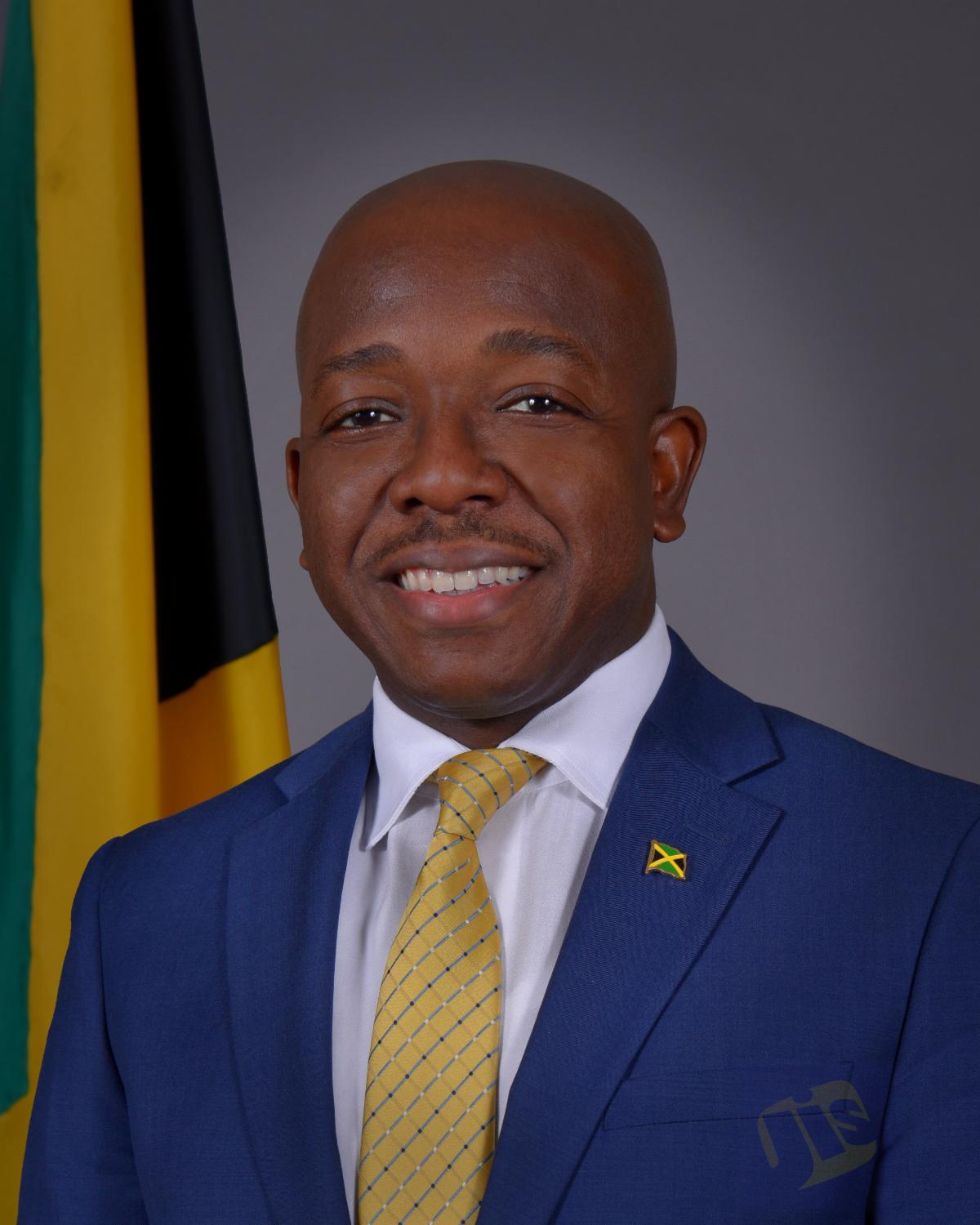
Honorable Pearnel Charles, Jr., Jamaica's Minister of Agriculture and Fisheries will be live on Capitol Hill for the 24th Annual Invest SMART Caribbean Conference on November 17th to discuss Zero Hunger: Driving Recovery and Resetting the Future on behalf of the Caribbean region. Across the table from him will be USAID Deputy Administrator Honorable Tina Balin. The event is being held in the Rayburn House Office Building under the auspices of Congressman Gregory Meeks, Chair of the House Foreign Affairs Committee.
Recently Pearnel Charles Jr. led Jamaica’s delegation to the CARICOM Agri-Investment Forum and Expo where he represented Prime Minister Holness at the Heads of Government of CARICOM meeting in Port of Spain, Trinidad.
|
|
Honorable Pearnel Charles, Jr. |
|
Honorable Pearnel Charles, Jr., MP, was appointed Minister of Agriculture and
Fisheries on January 11, 2022. Prior to that, he was Minister of Housing, Urban
Renewal, Environment and Climate Change. He is also a two-time Member of
Parliament, currently serving in South East Clarendon.
Minister Charles is a former Government Senator and Member of Cabinet where he served as Minister without Portfolio in the Ministry of Economic Growth and Job Creation with responsibility for Water, Housing, and Infrastructure. Prior to this appointment, he served as Minister of State in the Ministry of Foreign Affairs and Foreign Trade with responsibility for Diaspora Affairs and the National Council for Coastal Zone Management, among other areas.
|
|
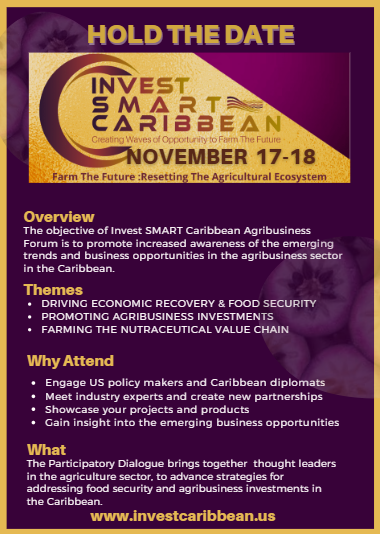
The Institute of Caribbean Studies (ICS) will organize the 24th Annual Invest SMART Caribbean Conference, November 17-18th in Washington DC. The Forum will address Agribusiness, the Blue Economy, and Climate Resilience.
|
|
RATIONALE:
The overall objective of Invest SMART Caribbean 2022 is to address the ongoing and emerging challenges facing the agribusiness sector in the region. This annual forum organized under ICS ‘FARM THE FUTURE’ initiative launched in 2013 aims to promote inclusive prosperity for the Caribbean region, through increased attention to and action for SMART policies, programs and projects that address the challenges and advance the opportunities that impact the long-term success of the agribusiness sector in the Caribbean. ICS’ SMART ecosystems design approach considers, all the business activities and nature-based services that are performed by the agriculture and fisheries sector -- from ‘farm to food’, ‘farm to fuel’, ‘farm to 'farmaceutical’’, ‘farm to forestry’ and ‘farm to fiber’, and includes fisheries, aquaculture, and agroforestry.
It is vital that the post Summit of Americas focus on Zero Hunger Caribbean and the Partnership Alliance for Climate Change build on the foundation set by US–Caribbean Strategic Engagement Act (HR-4939) which identified the Agricultural sector for support with respect to compliance with regulations and standards to increase agricultural trade and improve food safety for U.S. consumers. The promotion of sustainable economic policies, private sector-led growth and job-creation are also among the key areas identified under the Prosperity agenda of the strategy.
|
|
The vision of the forum is to identify improvements to be made in agribusiness value chains to foster sustainable economic development, creating policies and strategies to boost backward and forward linkages; as well as promoting linkages between sectors e.g., between agriculture and tourism, or water, or transportation, or the financial sector, or energy and agriculture. |
|
WHAT IS INVEST SMART CARIBBEAN:
The two-day forum brings together thought leaders from US agencies, private sector companies, academia, and development practitioners, to discuss strategies, and options for energizing agribusiness in the Caribbean. It will provide a learning space where participants, share experiences and best practice information on programs, methodologies, strategies and tools, and network to build partnerships that can help enhance the agribusiness value chain in the Caribbean. Participants will share their insights on how to create, align and leverage financial, technical, policy and market-expanding resources to develop game-changing and inclusive agribusiness models for the Caribbean Region through Roundtables and networking opportunities over the two-day period. The first day focuses on policy
issues and barriers that impact development of the agribusiness ecosystem, while the second day focuses on leveraging existing business opportunities, while diminishing challenges.
THEMES:
The topics to be discussed are:
- Governance & Supplier Chain Development Issues in the Specialty Food and Niche e.g. Herbs, Spices, Natural Foods and Organics
- Emerging Opportunities: Linkages and Lessons Learned e.g., Agroforestry, Marine Farming, Carbon Finance,
- Recovery and Resilience e.g. Access to Investment Finance, Working Capital, Transport Logistics
|
|
Given the recent announcement of the US government to support Food Security (Zero Hunger Caribbean) and Climate Change (PACC 2030), we believe it vital that the leaders in the ecosystem meet to provide an ecosystem framework that will enable the synergies of these overlapping areas of interest to be explored as well as to deepen engagement between Civil society actors in the Caribbean diaspora and US NGOs and SMEs interested in these areas of opportunity. |
|
Through the Caribbean Community (CARICOM), the Caribbean countries have a framework for regional cooperation. In order to handle shared issues, strive toward climate resilience, manage disasters, and increase food security, a regional approach is crucial. It also serves as a crucial entry point for influencing national policy and strategy creation. The CARICOM Office on Agriculture has been engaged with establishing the agenda for this year's forum which builds on the advancements made by ICS over the past two years of virtual forums and design labs during the height of the COVID Pandemic.
|
|
Regional institutions such as Caribbean Agriculture Research and Development Institute (CARDI), Caribbean Community Climate Change Centre (CCCCC), Caribbean Export, Caribbean Agriculture Health and Food Safety Agency (CAFHSA), CRIF Information Bureau Jamaica, Caribbean Associate of Investment Promotion Agency (CAIPA), Caribbean Development Bank (CDB) and Caribbean Regional Fisheries Mechanism (CRFM) all of which have responsibility for the food-climate energy nexus are also invited to bring their concerns in order to gain support for the post Summit of the Americas agenda. |
|
ABOUT THE POST-SUMMIT OF THE AMERICAS AGENDA |
|
The Biden-Harris Administration is working with Caribbean nations to promote energy security, access to finance, and food security in the Caribbean—three areas that Caribbean leaders identified as their top priorities—as a follow-up to their commitments made during their meeting with Caribbean leaders at the Summit of the Americas in June 2022. At the summit, President Biden and Vice President Harris decided to create three High-Level Action Committees, each of which will be co-chaired by Caribbean and American representatives, to create immediate, practical answers to these three urgent problems in the area.
|
|
Actions to Promote Energy Security:
· The U.S. government will send a multi-agency delegation to the region in October 2022 to develop technical assistance packages and prepare viable energy projects that are attractive to investors.
· The U.S. Trade and Development Agency (USTDA) will host an energy procurement orientation visit for Caribbean officials in October 2022 to share best practices with key stakeholders and support the region’s energy infrastructure development goals.
Actions to Promote Access to Finance:
· During Fall 2022, the Administration will continue work to expand access to U.S. International Development Finance Corporation (DFC) financing for private sector-led projects in the Caribbean.
· The U.S. Treasury Department will explore U.S. membership in the Caribbean Development Bank (CDB), including through consultations with the U.S. Congress and discussions with the Office of Management and Budget and consistent with U.S. standards for membership in multilateral development banks, in Fall 2022.
Actions to Promote Food Security:
· USAID launched a project in August 2022 and for the next five years will work with Caribbean officials to address non-tariff barriers that restrict the movement of food and exacerbate food insecurity in the region.
· USAID is actively collaborating with CARICOM and the Dominican Republic to develop the medium- and long-term action plan that will guide ongoing efforts to enhance food security in the region.
|
|
Vice President Harris also announced the U.S.-Caribbean Partnership to Address the Climate Crisis 2030 (PACC 2030). PACC 2030 is the Biden-Harris Administration’s new initiative involving fresh commitments to — and integration of — climate adaptation and resilience and clean energy programs across the Caribbean region. The climate catastrophe is particularly acute in the Caribbean, where rising sea levels endanger low-lying islands and aggravate storm surge from hurricanes. The difficulties that Caribbean countries are experiencing because of COVID-19-related economic disruptions are being made worse by the climate issue. Taking care of energy security and enhancing climate resilience can open new possibilities and protect communities.
The multi-country strategic plan for the Caribbean for 2022–2026 covers 22 countries and overseas territories, all of which are classified as small island developing States. In addressing vulnerabilities related to the economy, finances, geography, and climate that affect the food and nutrition security of the most vulnerable, particularly during crises, these Caribbean countries and territories face similar difficulties. The multi-country strategy assists governments through both regional and national initiatives, enabling more coordinated, targeted strategies and more durable results.
|
|
LIMITED SPACE... RESERVE YOUR SEAT NOW |
|
About Institute of Caribbean Studies: The Institute of Caribbean Studies (ICS) is a non-partisan, non-profit organization established in 1993, dedicated to education, advocacy and action on issues that impact on Caribbean -Americans. The purpose of the Institute is to provide a forum for the public and private sector, the non-government organization community, scholars and others interested in promoting a dialogue; and assist in the execution of actions that result from that dialogue. Since its inception, ICS has been on the forefront of the challenge to bring attention to the issues of critical importance to the Caribbean American community,
|
|
|
|
|
|
|