|
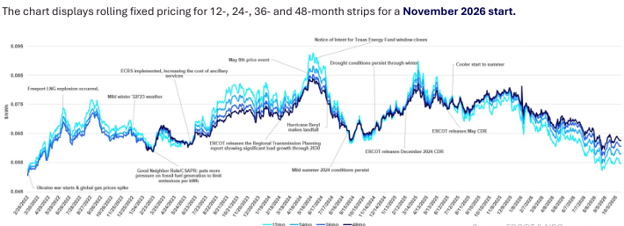
ERCOT forward prices have declined, creating an opportunity to evaluate future electricity purchases. Calendar years 2027 and 2028 are trading near the bottom of their historical ranges, offering attractive options for properties with upcoming renewals.
Meanwhile, anticipated electricity demand from data centers could put upward pressure on future prices and increase volatility in the real-time market. The timing of that demand remains uncertain, making today’s lower prices worth reviewing.
Forward Price Snapshot
Delivery Year Current Price Change
2027 $39.85/MWhDown $2.20/MWh
2028 $45.81/MWhDown $2.02/MWh
2029 $50.06/MWhDown $1.32/MWh
2030 $52.83/MWhDown $0.18/MWh
The largest declines occurred in 2027 and 2028, while prices for later years remained comparatively stable. Relative to the past three years of trading history, 2027 pricing ranks in the 2nd percentile, and 2028 pricing ranks in the 19th percentile—placing both toward the lower end of their observed ranges.
What This Means for Your Portfolio
You may have an opportunity to secure future pricing before additional demand changes market conditions. We can review your contract expirations and evaluate whether purchasing now, or staggering purchases over time, aligns with your budget and goals.
Prices reflect the market snapshot used for this update and are subject to change. Wholesale forward prices are not all-inclusive retail electricity rates.
PJM -Regional Energy Update:
-
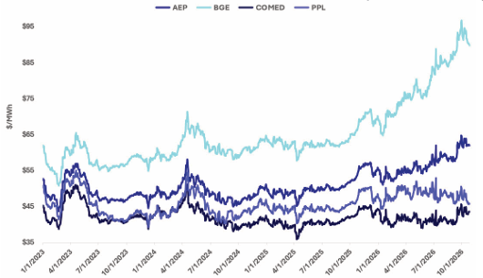
Maryland—BGE & PEPCO: Projected growth in electricity demand from data centers continues to support elevated forward prices. Although calendar-year 2027 pricing has eased from its late-September peak, it remains near the 95th percentile of its historical range.
- Illinois—ComEd: Calendar-year 2027 pricing is trading near the 80th percentile of its three-year range, while remaining below comparable PJM hubs.
- New England: Forward energy prices rebounded from a six-week low last week, rising approximately 2% across calendar-year 2027–2030 contracts.
|