Rail Workers Weekly News Digest
Number 30 - July 28th, 2020
|
|
Below is a series of articles compiled over the previous week.
They are of interest to railroad workers and activists.
|
|
ARTICLE #1 - AMTRAK NEWS
As House Approaches Finish Line, Senators Wait for the Starting Gun
|
|
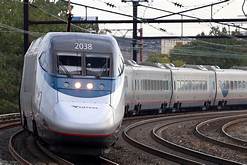
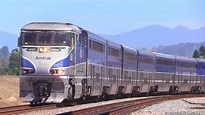
Democratic House leadership has announced they will finish a seven-bill spending package next week, including the Fiscal Year 2021 Transportation, Housing and Urban Development (T-HUD) budget. The T-HUD bill includes $10 billion for Amtrak and $24 billion for transit systems—funds that will be critical to avoiding service reductions and continuing infrastructure investment programs in the face of the economic downturn. The Senate, meanwhile, has yet to start the appropriations process for transportation, but will begin considering the next coronavirus relief package next Monday - a bill which could include money for Amtrak and transit systems.
The House Rules Committee on Rules announced it will meet on Monday to set the terms for floor debate and accept amendments for the seven appropriations bills. The package is expected to pass along party lines.
Passengers will still have to wait for what counterproposals, if any, come out of the Senate. It is unlikely that the Senate will fund Amtrak at the $10 billion level set by the House bill. However, based in large part
the work our association
and allied organizations have done to shape support among Amtrak-served senators, there have been clear requests for enhanced funding coming out of the Senate. Three separate groups of Senators issued letters to Amtrak’s President William Flynn asking hard questions about the railroad’s plan to reduce service to three days per week on most long-distance routes
This week, a group of eleven northeastern Democratic Senators issued a letter directly to Senate Majority Leader Mitch McConnell (R-KY) and Democratic Leader Chuck Schumer (D-NY) calling for “substantial funding for Amtrak in any future pandemic relief bill.” U.S. Senators Chris Murphy (D-CN), Richard Blumenthal (D-CN), Kirsten Gillibrand (D-NY), Bob Casey (D-PA), Chris Van Hollen (D-MD), Elizabeth Warren (D-MA), Chris Coons (D-DE), Sheldon Whitehouse (D-RI), Ben Cardin (D-MD), Ed Markey (D-MA), Bob Menendez (D-NJ), and Cory Booker (D-NJ) signed onto the letter, which calls for additional funding to continue critical capital work on the Northeast Corridor and prevent layoffs and service reductions:
Rail Passengers will continue to work to secure concrete funding to prevent layoffs, continue daily service, and support desperately needed infrastructure upgrades across the NEC and the National Network.
You can
join our campaign
to insist that Amtrak receives emergency financial support, tied to certainty for workers and Amtrak-served communities.
|
|
ARTICLE #2 - FREIGHT RAIL NEWS
Despite Lower Volumes, Class One Railroads Profit
|
|
(Editor's Note: Despite the dramatic decline in freight shipments in the Second Quarter, the rail industry continues to rake in the profits. Nevertheless, the industry would have us all believe that the only way for it to maintain profitability ios to reduce train crew size from two to one. The numbers below make it clear that this is sheer nonsense.)
|
|
ARTICLE #3 - RAIL EMPLOYMENT NEWS
Class Is Employed Fewer People in June
|
|
Class Is employed 116,128 workers in mid-June, down 2.31 percent from May's employment levels and down 17.99 percent year over year, according to
Surface Transportation Board
(STB) data.
All employment categories logged month-to-month decreases. They were maintenance of equipment and stores, down 6.13 percent to 19,985 people; transportation (train and engine), down 2.57 percent to 42,536; transportation (other than train and engine), down 1.36 percent to 5,135; professional and administrative, down 0.77 percent to 10,512; executives, officials and staff assistants, down 0.46 percent to 7,591; and maintenance of way and structures, down 0.45 percent to 30,369.
Year over year, all categories showed decreases. They were transportation (train and engine), down 28.63 percent; maintenance of equipment and stores, down 21.22 percent; professional and administrative, down 8.22 percent; transportation (other than train and engine), down 7.63 percent; maintenance of way and structures, down 4.69 percent; and executives, officials and staff assistances, down 2.13 percent.
|
|
ARTICLE #4 - DERAILMENT NEWS
Train Derailment Near Tuscaloosa Causes Vegetable Oil Spill, Possibly Leaving Damage to Wildlife
|
|
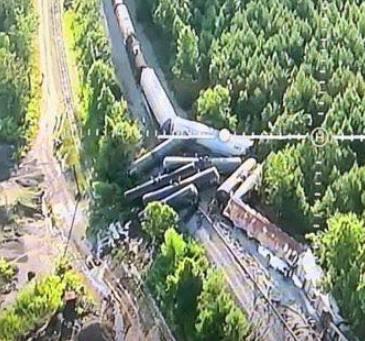
A train derailment in Coaling led to a vegetable oil spill into a branch of the Little Hurricane Creek Saturday afternoon.
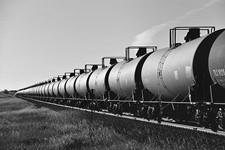
Seventeen cars on a Norfolk Southern train derailed at 4:45 p.m. Saturday; one car was breached, according to Tuscaloosa Fire Rescue. This caused an undetermined amount of vegetable oil to spill, fire authorities said.
Fortunately, vegetable oil is much less toxic than crude oil or petroleum. But Hurricane Creekkeeper John Wathen said that doesn’t mean this spill is harmless.
“But in this quantity, it is still toxic to the environment, it’s toxic to the fauna and flora that live there,” Wathen said.
The affected area is a small branch of Little Hurricane Creek, alongside I-20. That small area is called a tributary, which is a smaller river or stream that leads into a larger one. Being that the area is a tributary, Wathen is concerned about the impact.
“The more oil that’s introduced to a smaller tributary, the greater the impact,” Wathen said.
“Vegetable oil, I don’t know much about it. But the sheer bulk can contaminate the sediment bed, which is where the macro-vertebrate feed and breed. It could choke out the oxygen, change the pH [levels], the acidity in the water,” Wathen said. “It is not as hazardous as crude oil, but in this quantity it will have some pretty dire impact.”
|
|
ARTICLE #5 - AMTRAK NEWS
Legislation Would Provide Permanent Funding
|
|
Intercity passenger rail is currently the only major type of transportation without a dedicated funding stream
U.S. Senators Richard Blumenthal (D-CT) and Tom Udall (D-NM) and U.S. Representative Danny Davis (D-IL) introduced the Intercity Passenger Rail Trust Fund Act to permanently fund Amtrak. The bicameral legislation would create a dedicated fund to help Amtrak invest in major improvement projects, increase passenger rail’s efficiency, and help provide safer, more reliable service. Intercity passenger rail currently relies on the often unpredictable and limited annual appropriations process for funding, making it difficult to plan long-term, comprehensive investments needed to improve the system.
“This measure envisions a milestone, major commitment to rail transit in real money, for now and future generations,” said Blumenthal. “We must make a long-term, steady commitment to our nation’s intercity passenger rail system to ensure its safety and reliability for passengers. This legislation puts Amtrak on the right course to continually invest in and improve its operations. By establishing this fund, we are simply catching up with the longstanding investment in improving other critical American transportation infrastructure. This action is long overdue and we must pass this legislation immediately for the sake and safety of our traveling public.”
“Passenger rail represents opportunity for our nation on so many levels: as an economic engine, as a part of our transformation to cleaner, more efficient transportation infrastructure, as a solution to ground and airport traffic congestion while incorporating rural America into a national transportation system,” said Davis. “We have seen the consequences of postponing investments in this critical infrastructure. This bill recognizes the necessity of sustaining passenger rail with a dedicated funding stream.”
“Amtrak is an economic engine for communities in New Mexico and across the nation,” said Udall. “We need to invest in passenger rail to ensure that routes like the Southwest Chief – which connect rural communities throughout our state and bolster local economies – can stay running long into the future.”
|
|
ARTICLE #6 - CORONAVIRUS PANDEMIC NEWS
Rail “Commuting” in the “New Normal”
|
|
As the COVID-19 virus began to sweep across the nation in March, everybody seemed to cling to the hope that it would do its damage and move on quickly, so life could return to “normal.” Rail transit in most cities switched to weekend schedules on weekdays. Most of the country’s commuter rail providers did that, too.
Now, transit service is beginning to recover, and some local railroads are returning to the weekday “commuter-peak” schedules that abruptly ended almost four months ago. Under the circumstances, however, such a return could prove costly, if many of the former commuters who left that ridership segment do so permanently, or at least will ride less often during traditional commuting hours, given flexible schedules and now-well-established working remotely (from home).
In this article, we will look at changes in commuting patterns brought by the COVID-19 virus, and how they could affect demand for seats on our regional rail lines, which have become more than merely commuter railroads in a number of metropolitan areas. We will focus mainly on the legacy systems in the Boston, Philadelphia, Chicago and New York areas.
The coronavirus has changed American lives in many ways, some only for this year (we hope, or as long as the acute crisis lasts), and others permanently. That happens during wars and other periods of upheaval, and it is happening now. Transit as an industry must now fight for its life and its own relevance in a way it has not been forced to fight since almost a century ago, when General Motors head Alfred P. Sloan began his mostly successful campaign to destroy rail transit in the nation.
|
|
ARTICLE #7 - OIL BY RAIL NEWS
Why The Bakken May Not Come Back
|
|
The Bakken shale is already declining because of financial struggles and the oil market downturn, but the potential shuttering of the Dakota Access pipeline could close off the possibility of a rebound.
The 570,000-barrel-per-day oil pipeline carries Bakken oil to the Midwest. On Monday, a federal judge
ordered the pipeline to shut down
within 30 days after vacating authorization for the project. Energy Transfer immediately appealed for a “provisional stay,” but on Tuesday, U.S. District Court Judge James Boasberg shot down that request.
Energy Transfer will still file a conventional appeal to stay the judge’s order, and surely the company will follow through on that as quick as possible. But it’s not clear how quickly the judge will respond to that; meanwhile he ordered Dakota Access to be drained by August 5.
Assuming that Dakota Access goes offline and undergoes an environmental assessment, which could take the better part of a year, the process will drag on into a potential Joe Biden administration. At that point, the Army Corps, under a new direction, may change its stance, killing off the pipeline.
Time will tell, but in the interim, the temporary closure is an enormous victory for the Standing Rock Sioux Tribe. “This pipeline should have never been built here. We told them that from the beginning,” the Tribe’s Chairperson Mike Faith said.
If Dakota Access is forced to shut down for good, it could head off any hopes on the part of the oil industry to revive production in the Bakken. Without the pipeline, a large portion of Bakken production would need to return to the practice of moving large volumes by rail.
|
|
ARTICLE #8 - RAIL SAFETY NEWS
FRA Reorganizes Rail Safety Office
|
|
(Editor's Note: This is the same FRA Administrator who jettisoned previous FRA attempts to mandate two-person crews, ECP brakes, and LNG regulations. It is hard to imagine Ron Batory - a lifelong rail CEO appointed by Trump - improving the regulation of railroad safety. But given that the last ten years have been mostly static" on safety in the last decade - and given the outright decline in safety in recent years - the Agency had to be seen as doing something.)
The
Federal Railroad Administration
's (FRA) Office of Railroad Safety has completed a yearlong reorganization to improve the regulation of railroad safety, regulators announced in the agency's newsletter.
Two key aspects of the reorganization are the creation of safety management teams (SMTs) for Class Is, short lines and commuter railroads, and the "re-alignment" of safety inspectors' reporting responsibilities, the newsletter states.
The reorganization was the "most significant" since the FRA was established, FRA Administrator Ronald Batory wrote in a column included in the newsletter.
"I believe this organization will usher in a new era in railroad safety oversight that will lead to improved safety throughout the national railroad network," Batory wrote.
Although railroad safety improved dramatically from 2000 to 2010, the past 10 years have been mostly "static," he said.
"I don't believe we have reached the point where safety cannot improve, but I do believe we need new ideas and a bold approach," Batory added.
The reorganization, which went into effect June 8, is the agency's answer to the plateau in safety statistics, as well as to significant changes in railroad operations, including the implementation of safety management systems; emerging and evolving technology; and efforts to improve data quality and use.
|
|
|
|
|
|
|