Weekly Digest Number 22 - May 31st, 2022 |
|
Welcome to the RWU Rail & Labor News! This news bulletin is produced and emailed out each Tuesday morning. We hope you find each week's news and information useful. If so, please share with co-workers, friends, and colleagues. If you like, you can sign them up to get all the news from RWU HERE. Or forward them the link. Note: If you read over this news bulletin each week, you will be sure to never miss the important news of what is going on in the railroad world from a worker's perspective!
|
|
(Editor's Note: The unconscionable actions by the nation's rail carriers continues, leaving the rail unions to push for the NMB to find them at impasse in the bargaining process. Will there be a national rail strike for the first time in more than 30 years? Are railroad workers equipped for the showdown? All of us need to prepare and be ready!) |
|
Rail Unions Again Press for National Negotiations to be Declared at Impasse |
|
WASHINGTON — Rail unions are again seeking to declare an impasse in negotiations with U.S. railroads, a move which could eventually lead to intervention by President Joe Biden and Congress.
Bloomberg reports that three days of meetings between the two sides with the National Mediation Board will conclude today, with labor unions renewing a request for a declaration of impasse first raised in January [see “Unions declare impasse …,” Trains News Wire, Jan. 20, 2022].
“We met 14 times and we’re getting nowhere,” Dennis Pierce, national president of the Brotherhood of Locomotive Engineers and Trainmen, told Bloomberg in a May 20 interview. “And it wasn’t until two years into the round that they finally decided they would make a proposal on wages.”
Negotiations for a new contract began in 2020; railroads’ desire to enact one-person crews is a major point of contention.
Negotiations are a complicated process governed by the Railway Labor Act.
If an impasse is declared, the next step would be for mediators to offer arbitration; if one side rejects arbitration, which Pierce told Bloomberg the unions would do, Biden could form a Presidential Emergency Board after a 30-day cooling off period; that group would make recommendations to resolve the dispute. If the board’s recommendations are rejected by either side, the House and Senate would have to pass legislation to settle the matter. Failure to pass legislation would allow unions to strike.
|
|
(Editor's Note: This is a surprisingly diverse grouping of representatives - liberal and conservative - that are demanding something be done to reign in the Class One rail carriers. The pressure is building from all sides.) |
|
Senators Demand Regulators Take Action on Freight Rail Service Disruptions |
|
A bipartisan group of U.S. senators representing major agricultural and energy-producing states is demanding that the Surface Transportation Board take action on inadequate freight rail service.
A Monday letter addressed to STB Chairman Marty Oberman comes as four U.S. Class I railroads submit details to the board about what service metrics they will provide over the next six months (see below). It also follows a recent hearing by the U.S. House Subcommittee on Railroads, Pipelines and Hazardous Materials in which Oberman and the board fielded questions about how STB plans to address deteriorating service.
“We are very concerned over the significant rail service disruptions occurring throughout the U.S. freight rail network. Reports from rail customers, including our manufacturers, farmers, ranchers and energy producers, indicate reliable rail service is not being provided in many situations. Similarly, shippers have little recourse or alternative options to get their goods to market,” the letter said, adding that some producers have had to curtail or temporarily stop production because of lengthy delays or unpredictable service.
The letter noted the role that domestic production of agricultural and energy products has in responding to global demand, especially in light of recent geopolitical tensions.
“American industries rely heavily on freight rail to get commodities, parts, and products to market, not just in the U.S. but also globally. Rail transportation plays an integral role in our supply chain, and consistent service is vital to preventing further disruptions across the network. It is also critical for mitigating global food insecurity,” the letter said.
“If these problems persist into summer and fall, significant portions of the world’s breadbasket could be cut off from assisting those most in need, yielding waste rather than solutions. The same applies to the transport of critical energy supplies in high demand across the United States and the globe. Each day, the refining and electricity sectors rely on rail to provide shipments of fuel sources from all across the continent. At a time when global demands are high, domestic supplies must not be constrained by these hurdles and shortcomings.”
|
|
Railroads Outline Six-Month Service Recovery Plans for Federal Regulators |
|
WASHINGTON – The four largest U.S. Class I railroads have told federal regulators that their conductor training programs and hiring pipelines are full as they try to restore service to normal levels amid widespread crew shortages.
The railroads’ service recovery plans, submitted to the Surface Transportation Board on Friday as required, outlined the steps BNSF Railway, CSX Transportation, Norfolk Southern, and Union Pacific are taking to unclog their networks over the next six months.
In its order issued earlier this month, the board asked the railroads to include just two key performance indicators in their service recovery plans: local spot and pull performance, as well as on-time performance within 24 hours of the original estimated time of arrival for carloads and intermodal trains.
But the STB encouraged the railroads to share information on any other key performance measures that would help track the railroads’ service improvements for the rest of the year.
The board also asked the railroads to report whether they have any throttle setting, locomotive power, or train velocity restrictions currently in place – and to explain why [see “Federal regulators order railroads to provide more service data …,” Trains News Wire, May 6, 2022]. Various restrictions on train speed, along with low horsepower-per-ton ratios and use of energy management systems, were contributing factors to congestion, rail labor leaders claimed during the STB’s rail service hearings last month [see “STB seeks ways to quickly ease railroad service problems,” News Wire, April 27, 2022].
|
|
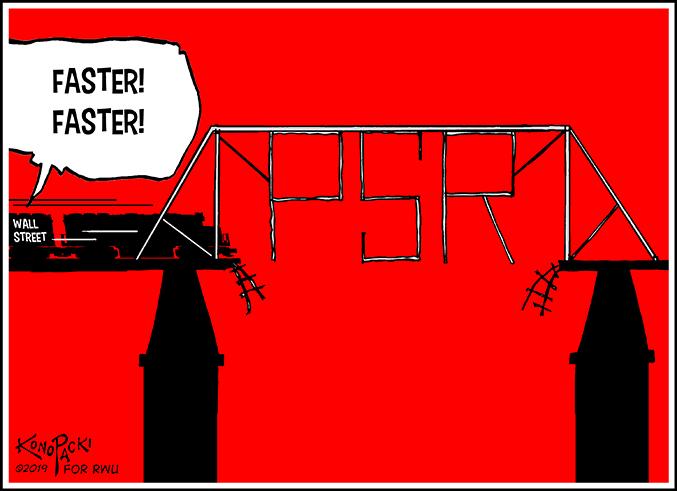
(Editor's Note: You know that the farce known as PSR is discredited when mainstream rail columnists are making statements like this. Despite the opposition, the stock holders still own the Class Ones and they are still reaping record profits. There is little to no incentive for them to change course as long as there is money to be made. We need an all-out push from all sectors to topple this monster and restore some sanity to freight rail operations in North America.) |
|
Clear Evidence: Near-Zero PSR Service Improvements |
|
Let’s admit it, and fix the expectation: U.S. Class I railroads have not experienced robust service recovery. Yet railroad optimism and expectations of satisfied customers persists. Why?
If you examine the simple shipper service report cards, there is zero evidence of continuing quality improvement from the so badly misnamed Precision Scheduled Railroading model. There is no defect-free scheduled customer benefit from the touted PSR model. Not across the U.S. And if the railroad boards of directors and senior executives had recognized it and just challenged themselves as to a fix, there would been no need for the current Surface Transportation Board oversight hearings in Washington. But there are hearings, set up because of clear service failures by the carriers.
Here is a core problem: Asking regulators to adjudicate a solution for railroad company failures is a bad formula. Why bad? Because regulatory requirements when promulgated set at best “minimum standards.” Regulators don’t try in most instances to even pretend that their regulatory orders are best-of-class solutions. They articulate that, as a group, the STB Commissioners are nervous about issuing such rules, asking the carriers instead to dig deep for a company set of solutions.
Need a raw example? FRA safety regulations for track structure set minimum construction and geometry tolerances for poor track. Anybody who builds or maintains the tracks to those minimum defect requirements is a poor planner or engineer. The same is true for buying tires. Who buys a brand that advertises minimum tread depth?
Fundamentally, the promotional language about the value of E. Hunter Harrison’s advanced marketing slogan business model name (admitted to several years ago by the CEO of the first PSR advocate, CN) continues to suggest near-zero-defect deliveries of railroad cargo. Precision is a classic misnomer. It ought to be trashed.
|
|
(Editor's Note: One of a number of groups popping up around the country that are concerned with rail safety. As the average length of freight trains grow under PSR, more and more communities are becoming alarmed by blocked road crossings and the threat and danger that this phenomenon poses.) |
|
Coalition Against Longer Trains |
|
The Coalition Against Longer Trains (CALT) is concerned that longer trains can create lengthy delays at grade crossings, and may pose safety risks to the public, railroad workers, and the environment.
More than a decade ago, Railroad Workers United began to sound the alarm about these trains. To see more information including a bifold flyer, press release, resolution and numerous articles from the previous decade warning about this scoiurge, go to the RWU webpage Opposition to Long & Heavy Trains.
|
|
Ignoring Employee Mental Health Can Wreck Your Business
The nation’s railroads seem to be learning this lesson the hard way
|
|
In our current era, supporting the mental health of employees has become as vital to the success of a business as is assuring their physical health and safety. Employers have become increasingly aware of the costs that can arise from the stress and strain growing out of the societal and personal responses to a worldwide pandemic as well as working conditions they are forced to navigate on a daily basis.
One problem for corporate leaders seeking to economically justify and then create a mental health program for their workplaces is that while it’s relatively easy to define mental illness, it is almost impossible to find agreement on what mental health consists of. On the other hand, business executives have easy access to other measures that can be relied on to support these programs, ones that they have been relying on for years, including cost analyses, productivity measurements and customer service responses.
You cannot find a more stark example of this in today’s America than by casting a quick glance of what has been happening in the freight railroad industry. This was thrown into high relief by recent hearings held by the Surface Transportation Board (STB) exploring the devastating economic effects of a severe cost-cutting operations model called Precision Scheduled Railroading (PSR).
The top leaders and several front-line members of all of the rail unions testified before the board and the picture their testimony painted was not pretty. Slashing thousands of employees from their payrolls, most of the Class 1 railroads also closed railyards and mothballed rolling stock to pare operating costs to the bone in order to squeeze out more dollars for investors and the hedge fund managers who drove adoption of the PSR model.
|
|
FRA Issues FY21 Safety Enforcement Report |
|
The Federal Railroad Administration (FRA) has released its annual enforcement report summarizing the regulatory compliance inspections and audits conducted in the past fiscal year by FRA or state inspectors participating in FRA’s rail safety program, as well as the civil penalty enforcement actions arising from them.
FRA reported on May 19 that more than 70,000 inspections were conducted in FY 2021 to assess railroad compliance with regulations and laws that govern track, motive power and equipment, operating practices, signal and train control, hazardous materials, grade crossing signal system safety, industrial hygiene, and safety management systems.
Federal and state rail safety inspectors have several enforcement tools at their disposal, according to FRA.
FRA inspectors and managers, the agency said, “consider the inherent seriousness of the condition or action; the kind and degree of potential safety hazard the condition or action poses; any actual harm to persons or property already caused by the condition or action; and the offending entity’s general level of compliance as revealed by the inspection.”
Enforcement actions may be against a railroad (such as Class I’s and Amtrak), a railroad contractor, a hazardous material shipper, a tank car manufacturer, or an individual.
|
|
(Editor's Note: The railroads were granted millions and millions of acres of land to build the nation's rail right-of-ways. The understanding was always that therefore the rail carriers had an obligation to the public and to the nation as a whole. Are they reneging on this obligation? Are they in violation of the public trust?) |
|
What Does the Common Carrier Obligation Mean for US Railroads? |
|
When a U.S. freight railroad engages with a rail shipper of bulk commodities to haul goods, the railroad must abide by terms expressed in federal code. That federal code is known as the common carrier obligation.
According to the definition for common carrier obligation, “a rail carrier providing transportation or service subject to the jurisdiction of the [Surface Transportation Board] under this part shall provide the transportation or service on reasonable request.”
But the recent service issues of the Class I railroads have called some — especially shippers and those representing shippers — to question whether the common carrier obligation needs to be redefined. They argue that clarifying what “reasonable” means could help ensure that the regulation compels adequate rail service.
Currently, “reasonable” has been defined by precedent and by how STB has reviewed past cases.
“At the very heart of the common carrier obligation is the belief that railroads are in a position of unique public trust. They are therefore held to higher standards of responsibility than other private enterprises,” Dan Elliott told FreightWaves for this AskWaves article. Elliott is a former STB chairman who recently served as legal counsel for rail shippers at STB hearings in March and April.
|
|
(Editor's Note: It was a long time coming - more than a decade - but the shippers get a victory. Perhaps the Class One's are finally getting their wings clipped.) |
|
Rail Shippers Applaud Federal Appeals Court Ruling on Alleged Price Fixing |
|
Attorneys representing shippers in litigation involving four Class I railroads praised a federal appeals court decision this week that clarified what evidence can be submitted in two cases involving alleged price fixing in the early 2000s.
Stephen Neuwirth, an attorney with Quinn Emanuel Urqhuart & Sullivan, said in a statement that the “opinion will greatly assist the shippers in making their antitrust case against the railroads.”
Dozens of global companies representing chemical, automotive and energy interests, among others, have been embroiled in litigation for well over a decade with Union Pacific (NYSE: UNP), BNSF (NYSE: BRK.B), Norfolk Southern (NYSE: NSC) and CSX (NASDAQ: CSX) over allegations that the four railroads conspired to fix the fuel surcharges levied on customers while determining interline traffic rates. These actions, said to have occurred between 2003 and 2008, violated antitrust laws, the shippers contend. Shippers have also alleged that the fuel surcharges and a fuel cost recovery program were efforts to generate additional revenue.
But the four railroads argue that their discussions among themselves about interline rates are exempt from antitrust laws, according to a provision in the U.S. Code. The existing laws enable the railroads to collaborate with one another about their shared interline traffic.
|
|
(Editor's Note: Unless and until strict regulation are placed upon movement, RWU has opposed LNG by rail since it s banning was overturned in 2018. See the RWU Public Comment to the Pipelines and Hazardous Materials Safety Administration in 2019 HERE. )
|
|
Environmental Groups, States Sue Feds Over LNG by Rail |
|
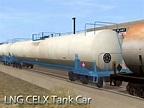
Environmental groups last week delivered petitions to the Pipeline and Hazardous Materials Safety Administration in opposition to the transportation of liquefied natural gas (LNG) by rail.
The petitions call on PHMSA to adopt the Biden administration's proposed rule that would suspend the Trump administration’s 2020 rule that lifted the ban on LNG by rail. The petition also calls for special permits to allow LNG-by-rail to be denied before the ban is adopted.
Although rail industry officials have said LNG can be safely transported by rail, the petitioners claim the process is a threat to public safety and the environment.
The following environmental advocacy groups issued the petitions: Berks Gas Truth, Clean Water Action, Clean Air Council, Delaware Riverkeeper Network, Earthworks, Food & Water Watch and League of Women Voters of Delaware.
"The recent push to increase the export of LNG by rail due to the Ukraine crisis has heightened community concerns that the desires of the gas and oil industry will overwhelm government’s responsibility to protect the public and replace dirty, fracked gas with truly clean, renewable energy," the environmental groups stated in a press release.
|
|
(Editor's Note: In both the US and the UK, rail workers are poised for a national strike. While there are many differences, the similarities in the two situations are remarkable. What can we learn from our fellow workers in the UK that might assist us to win? All North American rail workers are encouraged to follow the situation in both countries closely.) |
|
Railway Workers Vote Overwhelmingly in Favor of National Strike |
|
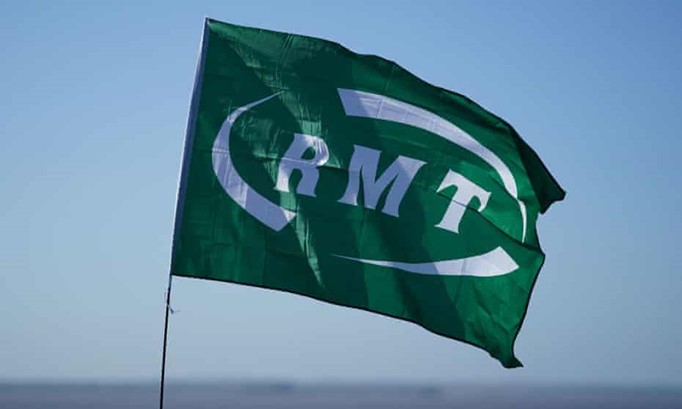
A summer of rail strikes across Britain moved a significant step closer after the Rail, Maritime and Transport (RMT) union announced an “overwhelming” vote in favour of industrial action.
Its ballots of more than 40,000 railway workers closed on Tuesday evening, and 89% voted in favour of a strike, the RMT said, on a turnout of 71%.
The votes took place across 15 train operating companies and most significantly includes Network Rail, whose signallers could halt the railway if they walk out. The RMT said it was the biggest endorsement for industrial action by railway workers since privatisation.
However, the union is unlikely to call strikes immediately, but will use the mandate to strengthen its hand in talks with Network Rail and the train firms as it seeks to mitigate the effect of significant cost cutting on the rail network.
Pay has been frozen since 2020 for most staff and the union has warned that 2,500 jobs could be lost as Network Rail seeks to save more than £100m a year by reforming maintenance work.
Industry bosses appealed for continued negotiations, saying a strike would cost the industry around £30m a day, when revenues are already well below pre-Covid levels.
The Network Rail chief executive, Andrew Haines, said the union had “jumped the gun”, and that strikes would be disastrous for the railway’s recovery, as well as hugely affecting vital supply and freight chains.
|
|
Lawmakers Push for High-Speed Rail Funding |
|
The federal budget process is underway, which will determine funding levels for passenger rail for Fiscal Year 2023. A group of 75 lawmakers are urging a key Congressional committee to allocate $3.5 billion for high-speed rail corridor development in the FY2023 budget. This push is being led by House members Seth Moulton, Suzan DelBene, and Jim Costa, and Senator Jon Ossoff.
While the federal infrastructure bill, the Infrastructure Investment and Jobs Act (IIJA), authorized record funding for trains over the next five years, Congress still needs to appropriate much of this funding every year so the money can be put to use. Also, notably absent from the IIJA was a pot of dedicated funding for high-speed rail. We are encouraged that federal lawmakers are working to address this issue.
The letter requests that the Transportation, Housing and Urban Development (THUD) Committee include $3.5 billion for high-speed rail corridor development, with at least $350 million set aside for planning grants, in the FY23 THUD appropriations bill. The goal of this funding is to build a pipeline of high-speed rail projects and to direct funding to true high-speed rail systems. Investing in these advanced and proven transportation systems will support long-term economic growth, quality of life, and sustainability.
|
|
(Editor's Note: Once again, not a good week for the Class One railroads keeping their trains on the tracks. Once again, no one was killed ... but in the NS wreck the crew were injured and taken to the hospital.) |
|
UP Coal Train Derails in Nebraska |
|
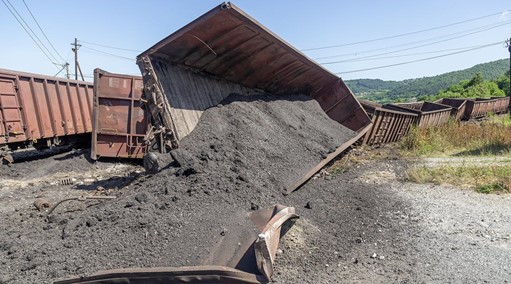
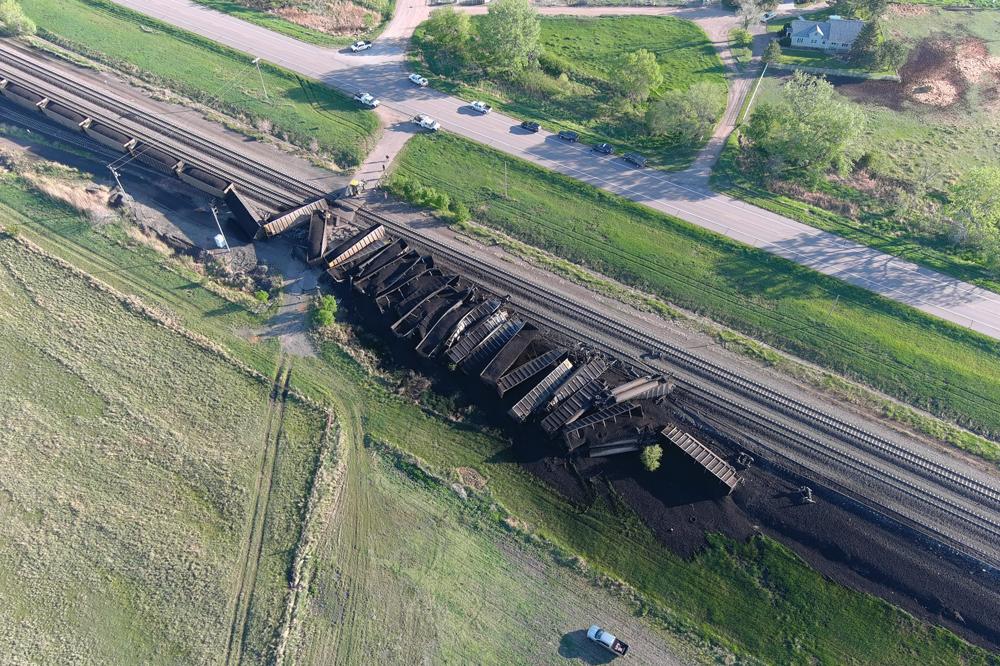
GOTHENBURG, Neb. — An estimated 30 cars of a Union Pacific coal train derailed Thursday morning two miles southeast of Gothenburg, KOLN/KGIN radio reports.
The accident about 7:30 a.m., involving a train eastbound from Wyoming, blocked all three tracks of the UP main line about 35 miles southeast of North Platte, with the railroad working quickly to clear one main. As of Thursday evening, work to clear the other two tracks continued.
Oil Leak from Derailment Near Pittsburgh Closes River
|
|
HARMAR TOWNSHIP, Pa. — An oil spill from a Norfolk Southern derailment on Thursday has led to the closure of the nearby Allegheny River to boating for the Memorial Day weekend as well as an ongoing road closure.
The Pittsburgh Post-Gazette reports that Thursday afternoon’s derailment in Harmar Township, on the northwestern edge of Pittsburgh, derailed 17 cars, nine of which ended up in Deer Creek about 100 yards from the Allegheny River.
The derailment occurred about 3:15 p.m. when the NS train struck a dump truck carrying stone at a grade crossing for a sewage plant. Two train crew members and the driver of the truck were taken to the hospital with non-life-threatening injuries. NS says its crew members have been released from the hospital.
|
|
|
|
|
|
|