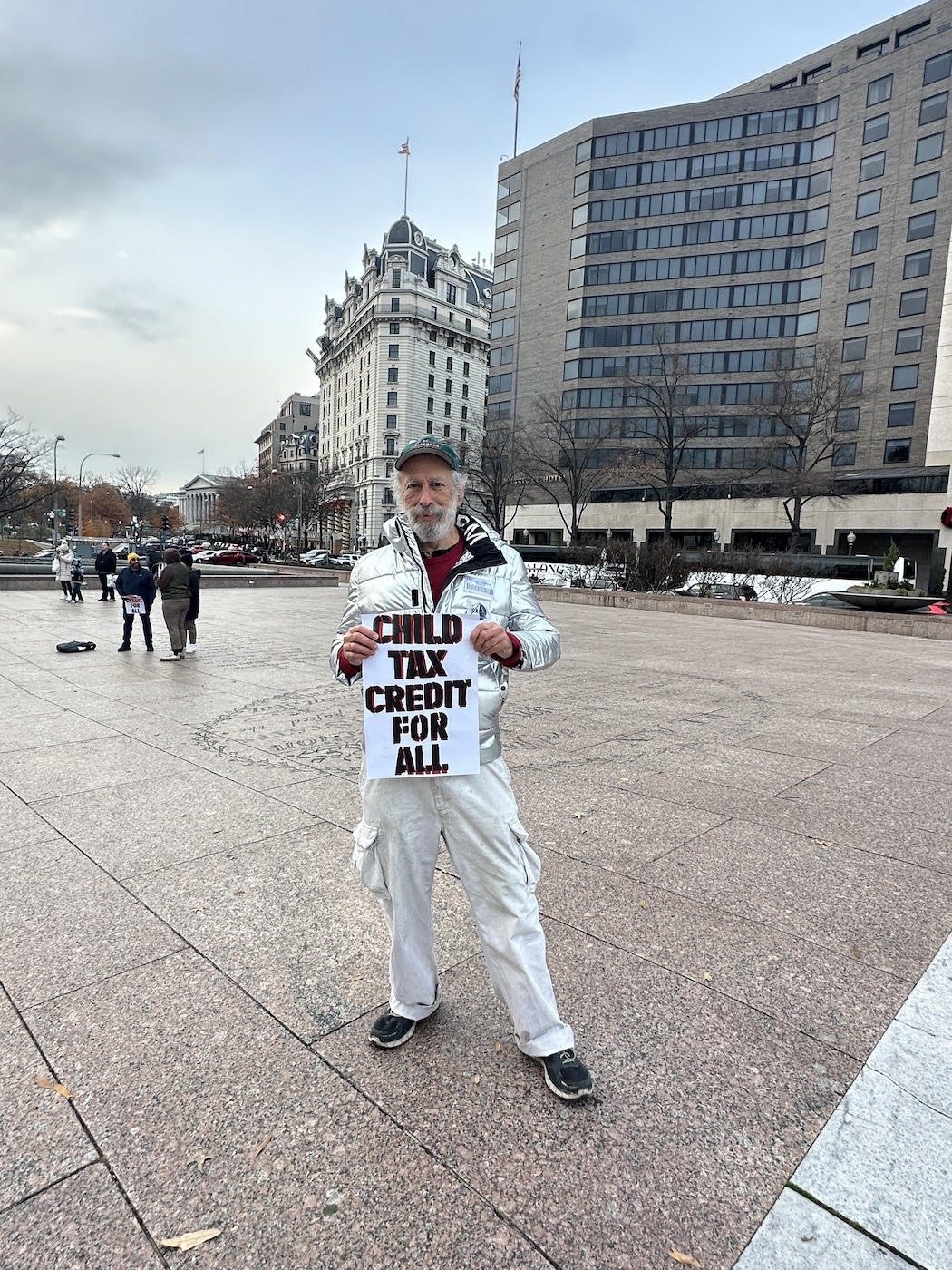
|
Consequences of the 2024 Elections: For Democracy, Racism, Workers, War, the Environment, Healthcare, Patriarchy and Cultural Diversity
January 22, 2024
9 pm Eastern
| |
 | |
Committees of Correspondence for Democracy and Socialism
CCDS's Socialist Education
Project's 4th Monday
CCDS and other socialists, progressives, labor and environmental, peace, and women’s organizations are watching and organizing around the 2024 elections.
Most regard the outcome of these elections at local, state, and national levels as pivotal for the survival of any semblance of democracy.
Given the centrality of 2024 for the future of democracy we are asking CCDS members from around the country to report on election prospects, kinds of organizing, candidates and issues
being addressed in the East, the Midwest, the South, and the
West.
All webinar attendees will then be invited to briefly discuss their experience and approaches to practice.
See the registration below and the zoom link will follow:
https://us02web.zoom.us/meeting/register/tZErceGtrjMuHNYZBKAo0a2HVxvBn1NbPDp4
After registering, you will receive a confirmation email containing information about joining the meeting.
This will aldso be livestreamed at OULeft facebook sight: https://www.facebook.com/OULeft.org
| |
 | |
The Committees of Correspondence for Democracy
and Socialism
ON THE IMMIGRATION “PROBLEM”
Immigration is a Global Issue
Woody Guthrie wrote his famous song “Deportees” in 1948 decrying that “All they will call you will be‘deportees.’” And “they chase us like outlaws, like rustlers, like thieves.” He wrote at a time when the US political economy depended upon temporary immigrant labor.
Since the 1940s particularly, the globalization of the economy, increased violence and repression within countries (largely involving United States interference), growing income and wealth inequality and poverty, climate catastrophes and the rise of repressive regimes everywhere, emigration has increased. The United Nations has estimated that “the number of international migrants has been robust over the last two decades, reaching 281 million people living outside their country of origin in 2020, up from 173 million in 2000 and 221 million in 2010. Currently, international migrants represent about 3.6 per cent of the world’s population.”
One of the ironies of world history is that capital in the form of investments, trade, the purchase of natural resources, the globalization of production, and military interventions have been common and necessary features of capitalism since its emergence in the sixteenth century. But, paradoxically, and except for the global slave trade, the movement of people has been “illegal.” The idea of national sovereignty is mostly used to justify branding some human migrants as “illegal.” If capital is and has been legal, the movement of people should be legal as well. It makes no sense, nor is it humane, to brand any human beings as “deportees.
A Left Response
What about migration as the immediate problem, the one where we can find more immediate
solutions? First, we should be welcoming. To take away profits of ‘coyotes’ in illegal crossings, we need more proper legal points of entry, and we need to welcome those who arrive there. We need not be ‘open’ without limits. Health checks should be required, along with IDs, if possible, and information concerned relatives here who might care for them. Asylum seekers need to be assigned court dates. Anti-trafficking queries need to be made regarding young women and children.
Another truth often overlooked is a sector of our capitalist and farm owners are in dire need of
immigrant labor. If migrants at our ports of entry are seeking work, we need to determine their skills,offer temporary work permits and EIN numbers on the spot. If they don’t have a host family, we can offer a list of places in need of workers like them. If they need help getting there, offer a bus ticket voucher. They can pay later via taxes.
Finally, our stand as a left, and as a progressive workers movement, is we want to bring these workers into our fold on the basic of solidarity and democracy, into our unions and community organizations. It not only helps the immigrants, it’s the key to curbing abuse, wage theft, undue child labor and their deployment as strike breakers. If we look to our own history on these matters, nearly every wave of migration, apart from those that served to exterminate the Native Peoples, worked in various way to
improve the lot of all.
| 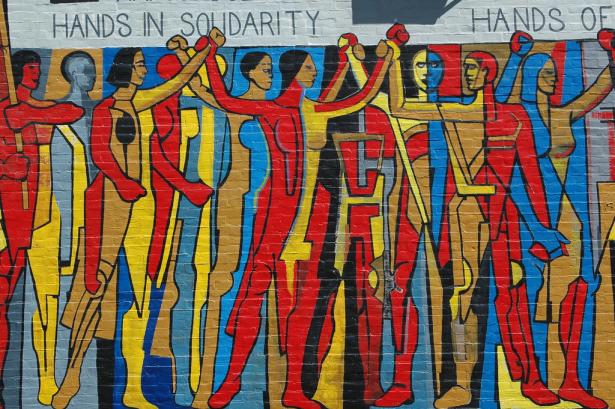 | |
Solidarity Mural, by Atelier Teee (CC BY-NC-ND 2.0)
by Max Elbaum
The people-power, energy, and savvy exist to regain the initiative. Different parts of the social justice movement will contribute in different ways. Here are six challenges that I think progressives must take on if we are to emerge from 2024 stronger than we are today.
1. Hammer home the danger—and look to what we can gain.
Keep sounding the alarm about the danger of MAGA while giving every component of the anti-MAGA majority a positive reason to vote against Trump.
-
gnore all the pseudo-scientific polls—they are really just “punditry in disguise.” Instead, follow Michael Podhorzer’s lead and look at the results of the 2018, 2020, and 2022 elections to understand the behavior of the Trump-era electorate. The key takeaway is that there is an anti-MAGA majority in this country that wins elections when it is motivated to turn out.
One part of providing that motivation is hammering home the nature and danger of the MAGA agenda: The GOP “Mandate for Leadership” plan promises to overhaul government policy across the board to serve an agenda of “all wealth to the wealthy”; to-do lines include plans to expand use of fossil fuels, and to use the Justice Department against political opponents (which includes rounding up leftists). It’s not just Trump: Liz Cheney’s new book reports in detail on the depth and breadth of the Republican drive to break laws and overturn what remains of US democracy.
But fear of MAGA will not be enough. We will also need to convey what can be gained by a Democratic victory over MAGA and the ways defeating MAGA can increase the clout of grassroots-based and progressive organizations. To be effective, this kind of messaging must be focused and specific, sector by sector. For example, for winning workers of all racial backgrounds to vote against MAGA, stressing the pro-worker nature of the current NLRB and the prospect of it becoming an even more powerful defender of union organizing can be an important tool and something for other sectors to learn from.
On some issues, we can only make a strong case that there are gains to be made with a Democratic victory if we can push the Biden team to the left. Immigration policy, where the administration is considering caving to Republican pressure, and Biden’s “bear hug” backing of Israel (see next section) must be a focal point of progressive attention in the coming days and weeks. These issues are of special concern to constituencies that have made decisive contributions to the anti-MAGA front in the last few elections: Arabs and Muslims, youth and especially Black youth, peace and immigrants’ rights advocates. Only a broad progressive movement that throws down in the spirit of “an injury to one is an injury to all” can move the Democratic leadership on these issues, and thus help bring the energy of these too-often-marginalized sectors into the high-stakes 2024 electoral battle.
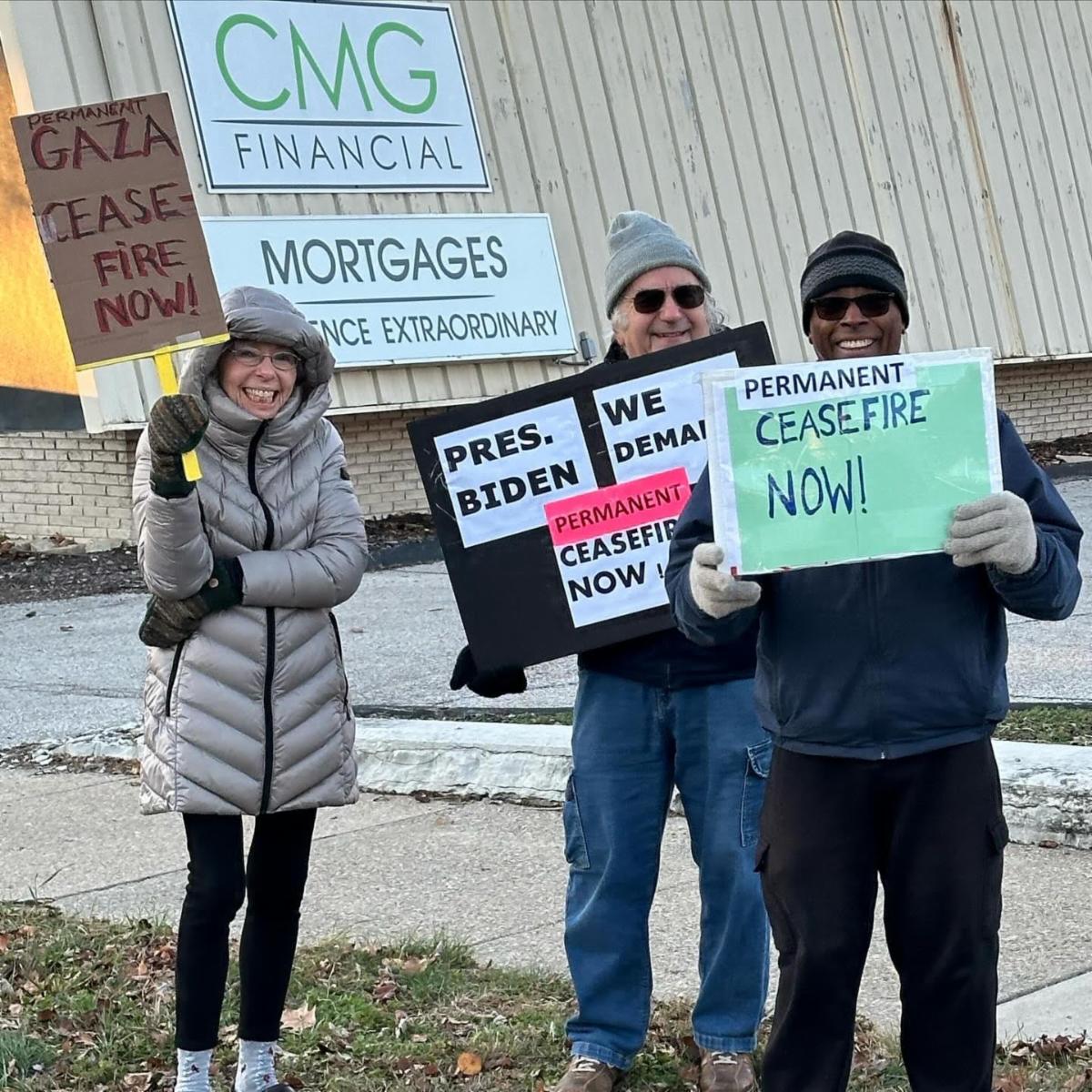
2. Ceasefire now!
Intensify the fight for a ceasefire and re-elect every pro-ceasefire member of Congress.
Intensifying pressure on Biden to join the rest of the world in demanding that Israel halt all military operations—with consequences if they don’t—is imperative. The pro-ceasefire movement continues to shift public opinion, and new initiatives such as the January 12-13 Emergency Summit for Gaza initiated by Jesse Jackson will squeeze the administration further.
Stepping up for elected officials who have come out for a ceasefire will be an essential piece of this fight. As of this writing, 56 representatives and four senators—all Democrats—have defied the administration and embraced the ceasefire demand. AIPAC and other Israel Lobby organizations, fearful that they are losing the “bipartisan consensus” that has long sustained blank-check-for-Israel policies, plan to spend over $100 million to defeat the most outspoken of these (Rashida Tlaib, Cori Bush, Jamaal Bowman, Summer Lee, Ilhan Omar) in Democratic primaries. As primary season comes closer, we can expect other pro-ceasefire representatives to be targeted too.
These primary battles will be the next major test of strength for the Palestine solidarity movement. If AIPAC’s assault can be beaten back, it will undermine the “fear factor” that is largely responsible for the big disconnect between sentiment at the base of the Democratic Party and the majority of its congress members. Such a victory would not just defend the foothold pro-Palestine sentiment already has in Congress, but provide a springboard to taking the offensive.
Gains in this battle would also bolster the case being made by this writer and others that our chances of beating MAGA are diminished unless Biden either changes course or steps aside in favor of a nominee not complicit in Israel’s genocide.
3. Don’t cede the fight against anti-Semitism.
Go on the offensive in fighting anti-Semitism.
Apologists for Israel—realizing that defending the country’s actions is a losing proposition—are steadily amplifying charges of anti-Semitism against the Palestine solidarity movement. In beating back those attacks, the Left has necessarily spent a lot of time and energy debunking the charge that anti-Zionism is anti-Semitic. In doing so, however, we have too often let ourselves get locked into purely defensive posture, which has made it easier for the apologists to advance the false charge that anti-Zionists care about what happens to Palestinians but don’t care about what happens to Jews.
We need to break this dynamic and go over to the offensive, making the case that the forces who are backing Israel today include the most diehard and dangerous anti-Semites: Christian Zionists who see Israel as prelude to a “rapture” when Evangelicals will go to heaven and Jews to hell, and white nationalists who see Jews as part of a “globalist” conspiracy to destroy America via “great replacement” through immigration. Further, the program of even the most liberal elements in the Zionist camp—a state in which Jews have special privileges and exclusive control the military and police—is inherently flawed.
It is the anti-Zionist Left—we who fight for equal rights for all in racially, ethnically, and religiously diverse societies—who are the most consistent opponents of anti-Semitism. It is our program, not theirs, that in actual practice as well as in theory means more safety for Jews. The Israeli ethno-state —supposedly a guarantee of Jewish safety—provides no such thing, as its dispossession and oppression of the Palestinians is a recipe for constant violence and war. Diverse societies where fights for racial, gender, and religious equality have made even incomplete breakthroughs are safest for Jews. And it is these very gains that are now under attack in the US by white Christian nationalists who boast of how pro-Israel they are, as if this immunized them from being anti-Semitic
A lot more work is required to turn these thoughts into a coherent program and, more important, an action strategy. But now is the time to get serious about it.
4. Build internationalism.
Beef up our internationalism and rebuild an antiwar, antimilitarist movement.
The unprecedented upsurge of pro-ceasefire activism does even more than create conditions for a major leap forward in building a more unified and broad-based Palestine solidarity movement.
As the first sustained movement at scale with internationalism at its center in more than a decade, it underscores both the need and the potential to make an internationalist vision and practice integral to the life of progressive groups focused on domestic issues. It also has thrust the militarist and anti-human rights character of US foreign policy in general into the spotlight, spurring discussions of how to revitalize peace and anti-militarist activism in general.
Again, a lot of thought and work will be required to take advantage of these opportunities. But the door is open at this moment in a way that it has not been for many years.
5. Seize history to explain our present and light our future.
Popularize a narrative about US history that explains how we got to our current circumstances and points to the social forces that can drive a Third Reconstruction.
The capacity to “shape people’s conscious and unconscious understandings of the world, of what is politically possible, and of their own place in the world” is integral to the fight for political power. Developing and popularizing a compelling narrative about this country’s past, present and future—one that “makes meaning” out of people’s disparate experiences and points in a liberatory direction—is imperative for a Left that aims to lead a coalition that can govern the country.
The rise of MAGA has led to new experiments in crafting such a narrative, often building on W.E.B. DuBois’ work centering the experience of the post-Civil War Reconstruction, and on lessons from the Second Reconstruction embodied in the 1950s-‘60s Civil Rights breakthroughs. Peniel Joseph’s book, The Third Reconstruction: America’s Struggle for Racial Justice in the Twenty-First Century, makes a major contribution. A new effort directly tied to grassroots activism, Two Americas on Contested Terrain: Constructing a White Supremacist Nation vs. Reconstructing a Rainbow Democracy, comes from Carl Davidson.
As we work towards strategic clarity and engage in the battle over the story of this country and its future, work in this direction has a lot to offer.
6. Keep hope alive: courage is contagious!
It will be difficult to meet all the challenges flagged here as well as others that face us in the tough year ahead. We will have to be real about the power of our enemies while remaining confident that appealing to the majority’s “better angels” can create a force that overcomes that power. In this effort, stories of what individuals can do in the face of adversity tend to have more power than even the most insightful analysis of each side’s strengths and weaknesses. We are in a moment when such stories abound:
-
Palestinian journalists working in Gaza are paying “a staggeringly high price these last two months for the twin perils of being Palestinian and covering the war. Those who have dedicated their lives to uncovering and sharing the stories of people who have suffered a 16-year blockade and have seen their Western and Palestinian colleagues killed, maimed, and imprisoned by the Israeli military and censored by its tech allies…‘It’s time for Gaza’s Journalists to be treated like the heroes they are.’”
-
“A young Israeli man was sentenced Tuesday to 30 days behind bars for refusing to enlist in the Israel Defense Forces as it wages a genocidal assault on Gaza, a war the teen condemned as ‘a revenge campaign… not only against Hamas, but against all Palestinian people.’“
-
“Black mother-daughter Georgia election workers Ruby Freeman and Shaye Moss stood strong against the most vile life-threatening danger” after Trump toady Rudy Giuliani and a host of right-wing media outlets falsely accused them of ballot tampering. “People called for the two to be hung at the Capitol where witnesses could ‘hear their necks snap.’” They may never receive any of the $148 million the jury awarded them, but they faced down their defamers and won.
These stories gain even more power in the context of the collective courage being displayed week after week by people standing up, sitting in, speaking out, risking their comfort and careers—and in Gaza simply struggling to keep their families, neighbors and themselves alive. All these stories bring our inspiration and hope. Let’s lift them up.
Max Elbaum is a member of the Convergence Magazine editorial board and the author of Revolution in the Air: Sixties Radicals Turn to Lenin, Mao and Che (Verso Books, Third Edition, 2018), a history of the 1970s-‘80s ‘New Communist Movement’ in which he was an active participant. He is also a co-editor, with Linda Burnham and María Poblet, of Power Concedes Nothing: How Grassroots Organizing Wins Elections (OR Books, 2022).
Convergence is a magazine for radical insights. We work with organizers and activists on the frontlines of today’s most pressing struggles to produce articles, videos and podcasts that sharpen our collective practice by lifting up stories from the grassroots and making space for reflection and study. Our community of readers, viewers, and content producers are united in our purpose: winning multi-racial democracy and a radically democratic economy.
|
OpEdNews Op Eds 11/16/2023 at 6:46 PM EST
Is it Hair Trump or Herr Trump? Redux
By Steven Jonas
URL: https://www.opednews.com/articles/Is-it-Hair-Trump-or-Herr-T-Fascist_Trump_Trump-Against-Democracy_Trump-Dangerous-231116-203.html
"Either this nation shall kill racism, or racism shall kill this nation." (S. Jonas, August, 2018)
-----------------------------------------------------------------------------
The Rage of Trump, with which most readers of these pages (as well as the majority-of-tuned-in U.S.) are (too) familiar, has become all the rage for front page and front-of-your-screen news for the past several weeks. Trump, in talking ever-more openly about: the "vermin" who constitute his opposition, locking up (presumably without trial, although on what grounds they might be tried is an open question) enemies of his in the legislative and judicial branches, at the Federal, state, and local levels, is sounding evermore fascist. (Do see the definition of "fascism" which I use, at the end of this column.) To say nothing about how he would transform the Federal government (apparently without seeking legislative authority to do so).
And then, of course, there is his grand plan for illegal immigrants, even ones who have been in the U.S. for quite some time, obey the law and pay their taxes, as well as for "birthright citizens" (a legal category established by the 14th Amendment to the Constitution) which would involve arbitrary arrest, imprisonment in "camps," and arbitrary deportation. (By the way, literally on the night of the day they took power [Jan. 30, 1933] the German Nazis began rounding up perceived enemies of their incoming regime and put them into already prepared camps. They came to be called "concentration" camps, because the prisoners were packed in so tightly.) And so on, and so forth. And so, an increasing number of people who pay any attention to politics and government in the United States are becoming increasingly concerned (or in the case of those who like the Trump-approach to government and governing, increasingly joyful/supportive).
Not that Trump's clearly fascist tendencies (that is they are clear to anyone with any knowledge of the history of 20th century European fascism) were not seen fairly early on. For example, in a New York Times review of Ruth ben-Ghiat's very important book "Authoritarians from Mussolini to Trump" Francis Fukuyama noted that:
"Ever since the 2016 election, observers like Timothy Snyder, Steven Levitsky and Daniel Ziblatt speculated that Donald Trump could undermine American democracy and move the country in an overtly authoritarian direction. That possibility grew more plausible over the years of the Trump administration, as he sought to undermine a growing list of American institutions that stood in his way, including the intelligence community, the F.B.I. and Justice Department, the courts, the mainstream media (which he branded "enemies of the American people") and of course the integrity of elections themselves. Trump made his authoritarian instincts clear by refusing to commit to a peaceful transfer of power should he lose the 2020 election."
(Well, Francis, it looks like history has not come to an end after all. [Couldn't resist.]) As it happened, Prof. ben-Ghiat wrote one of the early warnings against Trump-the-fascist, after the 2016 election. As it happened, in October, 2015, I published a column entitled "Is it Hair Trump or Herr Trump." Given the increasing amount of, to be sure very frightening speculation on this subject, and the appearance of more and more evidence that it is indeed the latter of the suggested titles above, I thought to reproduce that column again here.
That is even though I have already re-published it a couple of times. As the Trump-fascist danger gets ever closer and closer, I don't think that the warning, even one from eight years ago, can be repeated too many times. And so, here is substantial excerpt from that column from 2015.
---------------------------------------------------------------------------------------
"The Web is suddenly crawling with images of Trump as Hitler the idea has apparently caught on. To what extent this is the weight of the establishment attempting to quash Trump as an unwelcome messenger is anybody's guess at this time.
"In America anything goes, given the appalling level of political illiteracy in the political class and media, not to mention in the masses, so you can believe that, yes, there is now an increasing amount of speculation the new "buzz "that Donald Trump has one or more characteristics in common with the German Nazi Chancellor/President/Dictator (yes, he was all of those things) Adolf Hitler: Click Here; Click Here; Click Here, ; Click Here, Click Here.
"And there has been at least one plea to stop doing so: Click Here).
"So, I thought, I might as well enter the game.
"First, the similarities. There's the racism, the xenophobia, and in Trump's case substituting for Hitler's extreme prejudice against one religious grouping, the Jews, it's another, the Muslims, and adding on of course the "illegal aliens." There's the speaking style and with it the ability to whip up the right audiences into a frenzy. (One difference: Hitler's was apparently well-practiced, while Trump's apparently isn't.) There's the frequent name-calling in re opponents.
"There's the "our nation must be great again." Germany had lost the last big war it fought. Now while the U.S. cannot be said to have "won" the last big one it engaged in, the War on Iraq, while millions of people on the region have clearly lost much, starting with their lives, militarily at least the U.S. did not lose. (However, the U.S. may actually be on the verge of losing militarily in Afghanistan, joining a long line of foreign forces, from Alexander the Great to the Soviet Union that failed there, militarily.) But that doesn't stop Trump from trumpeting on the "great again" theme, just like Hitler did.
"For Hitler, after the Jews, the Great Enemy was "Soviet Bolshevism." For Trump it seems to be Russia (although I do think that bunches of U.S. persons are confused on the point of whether the U.S. enemy is Russia or the Soviet Union, especially with the constant demonization of Russian President Putin who is the new 'Stalin,' of course. And yes folks, on a newscast on MSNBC on the morning of October 1, 2015 I actually heard a reporter refer to Russia as 'the Soviet Union,' not once but twice, before she caught herself. Further, you know there's that new Steven Spielberg movie about Gary Powers and the spy swap just out. Certainly some viewers are going to be confused about which country is which in that one.
"Then there are the vague promises of a great future from both, without telling much about exactly how they planned/plan to get there. There's the ample use of the Big Lie Technique, like Trump's describing the supposed 9/11 bombers as "illegal aliens," except that they were all in the U.S. on visas. (But that sort of thing is common to all of the current crop of Republican leaders, and most of the rest of the political class in America.) There are other similarities too, but among the most important, a characteristic that kept/keeps both men going is that they didn't/don't embarrass. They never had/have to apologize, explain, defend. They were/are the prefect avatars of Lee Atwater's consummate principle of politics: "Always attack; never defend." (Would that the Democrats would learn this principle, but that's another story.) Finally, it is clear that Trump just loves personal power, just like Hitler did.
"Now for the differences, and they are important, historically. First, Trump does not have nearly the mass following that Hitler had. [Remember: this was written in 2015. Now he has got a mass following in spades, even though they only have a cap, not a Storm-Trooper's uniform (yet).] While before the functional coup d'etat of January 30-31, 1933, Hitler's Nazi Party never did command more than about 37% of the vote (in a country where most people voted), Trump has only gotten into the 30's, of Republican voters, which amounts to about 15% of the total. Of course, we do have to remember that in a Presidential election, only about 50% of the eligibles vote and in 2016, Republican voter suppression will begin to exact a major impact on the number of Democratic votes recorded.
"Second, Trump does not have a mass, very well-organized political party behind him, personally. For Hitler the National Socialist German Workers Party. (Yes, it is hard to believe, but that was indeed the literal translation of what "Nazi" in German stood for, a calculated move to steal some wind from the Socialist Party of Germany's [SPD] sails, and from other genuine workers' formations, including the Communist Party of Germany [KPD].) The Nazi Party provided huge electoral clout in the localities in which it was powerful). If Trump does get the Repub. nomination, we really don't know what the National Republican Party will do for him. But whatever that would be, it could not compare to the personally loyal Nazi Partei Deutschland.
"Third, Hitler had a huge (up to three million part-timers strong) private army, the 'Sturmabteilung,' the SA, the Storm Division, the much feared and despised, and in other quarters admired, Brownshirts." They were his enforcers, frequently engaging in violence against his primary opponents, the Communists, the Socialists, the trade unions, and the liberal-to-Left press. As documented by numerous historians and journalists, the NSDAP was cradled from inception by the Reichswehr (the German Army under the post-World War I Weimar Republic) and paid for from the beginning by major members of the German ruling class, led by the steel magnate Friedrich "Fritz" Thyssen. (An early [1923] foreign supporter of the Nazis was a U.S. person named George Herbert Walker. [Sound familiar?].) Trump has nothing like this. But since there is no organized resistance at present to the kind of long-term authoritarian threat that Trump might become or suggest to better skilled politicos in the future, that is immaterial.
"Fourth, one huge (huuuuge [!]) difference in practice is that while Hitler was arguably the world's greatest Keynesian political economist, in terms of his vision of the government's role in making the economy hum, Trump would likely get as far away from that as he possibly could. The one exception might be the U.S. massively crumbling infra-structure, which might be as big a focus for Trump as it was for Hitler (except that Trump would likely attempt to privatize any major expansion).
"Fifth, as far as we can tell so far, Trump has no Thyssen equivalents. He is wealthy (although it is not known for sure just how wealthy he is). And he seems, as part of his calculated appeal of being "un-bribable," not to be seeking outside ruling class money. So we don't know how much he could attract.
"Finally, and this is certainly another major difference, obvious to many here but important to note for the record: Trump seems to have no firm belief system. Presently, he is of course riding racism of two types: a) no one who supports him has forgotten his racism-based, dog-whistled "birtherism," you can count on that, and b) of course the anti-Latino (especially Mexican for some unknown reason maybe because they are the closest ones) variety. His tax plan clearly benefits the wealthy (including himself) even more than they are already benefited by it. His xenophobia is right out front see his attack on the Syrian refugees. As noted, he has grandiose ideas for "making America great again" (as if it were not, militarily at least, right now). But characteristically, he has given no clear details on how he would do that, on either the financial or the military side. And so on and so forth.
But Trump has moved around on the ideological side of things. He has in the past been rather a liberal, endorsing a single-payer health care payment system and freedom of choice in the outcome of pregnancy, being some sort of friend of the Clintons, and was certainly not until 2012 an outspoken Republican. Hitler, in contrast, had his malignant political philosophy --- a very firm belief system --- based on the relatively new political anti-Semitism that was first formed in his native Austria in the 1870s, as well as his xenophobia, probably based in part on the fact that he was not a German himself, but an Austrian. For Hitler, this was all firmly wrapped around his messianic ego (in that sense like Trump, who appears to be a raging megalomaniac). Just read Mein Kampf.
"But Hitler was not an anti-Semite in the first instance for electoral purposes (although he used it in that way). He really believed that 'The Jews' were not only the cause of every single problem facing Germany, but the rest of Europe as well. He really believed that if 'The Jews" were all killed, the world would be a much better place. He really believed that the "Aryan" German people (you know, blond like Hitler, slim like Goering, and tall like Goebbels, as the old joke goes) amounted to a 'race,' were superior to everyone else, and deserved to rule the Earth. He really believed that 'The Slavs' were also an inferior people (a belief that may well have remained with him even when the Red Army was closing in on the entrance to his Berlin bunker). Trump does not seem to have that level of racialism or even that degree of intellectualism. In that area, Trump is a likely midget.
"And so, do I think that 'Trump' equals 'Hitler?' Well, not yet [that is, from the perspective of 2015]. But hey, you never know in a land as benighted as America. And remember: international events always play a big role in how the capitalist ruling class plays its cards at home."
------------------------------------------------------------------------------------------
The definition of "fascism" that I use is: "There is an all-powerful executive, which has total control of all of the functions of government. It is in the service of a capitalist ruling class. There are no independent judicial or legislative branches, at any level. Of course, there is no Constitution, that is a body of law standing above and controlling the actions of any of the three branches of government. There is no independent media. There is a single national ideology, based on some combination of: racism, misogyny, homophobia, xenophobia, religious bigotry and authoritarianism, ultra-nationalism, and in some, but not all, cases imperialist expansionism. There is a State propaganda machine, massively using both the Big and Little Lie Techniques. There may be: a full-blown dictatorship, a charismatic leader, engagement in foreign wars, the use of the mob/private armies for the maintenance of domestic power. There may be transitional forms.
---------------------------------------------------------------------------------
Steven Jonas, MD, MPH, MS is a Professor Emeritus of Preventive Medicine at StonyBrookMedicine (NY). As well as having been a regular political columnist for over 20 years, he is the author/co-author/editor/co-editor of 37 books. In addition to his current position on OpEdNews as a “Trusted Author,” he is a regular contributor to From The G-Man. In the past he has been a contributor to, among other publications, The Greanville Post, The Planetary Movement, and Buzzflash.com (the latter two are no longer active). He was also a triathlete for 37 seasons, doing over 250 multi-sport races. He has published 37 books, mainly in the health-promotion, sports/athletics, and health care delivery-systems-analysis fields.
He has published three books on politics and government. They are: 1. “The 15% Solution: How the Republican Religious Right Took Control of the U.S., 1981-2022; A Futuristic Novel” (3rd version, Trepper & Katz Impact Books, Punto Press Publishing, 2013, Brewster, NY. The first version was published in 1996; the primary story remained unchanged and, sadly, is beginning to come true. The book is advertised on OpEdNews.com and available on Amazon.com. 2. Ending the ‘Drug War:’ Solving the Drug Problem: The Public Health Approach, Brewster, NY: Punto Press Publishing, 2016, is available on Amazon. 3. Trump's Presidential Years: As They Happened, 2015-2021, in six volumes, consisting of 219 of my columns, on several different publications, totalling 315,000 words, on Trump, the Republican Party, and the ever-increasing fascist danger for the U.S. created by the combination of the two. This book is also advertised on OpEd News, and is available on Kindle@Amazon.com.
| |
Happy New Year
Last night they dropped a great big ball,
The crowd let out a roar.
It was goodbye to ’23,
Hello to ’24.
It’s customary on this day —
The first day of the year —
To wish each other happiness,
Free of dread and fear.
And so I wish the best for you,
and for the country too.
That means we make sure Donald Trump
Is tried and goes skidoo.
Seymour Joseph
| |
Happy Holidays and Have a Progressive New Year
CELEBRATING PROGRESSIVE CULTURE (a repost)
(Racism, misogyny, poverty, war, environmental disaster, and extraordinary military waste make this new year difficult for many of us to celebrate. However, we too have our history and our promise for a better future. HT)
Harry Targ
Creator: Carolyn Kaster | Credit: ASSOCIATED PRESS
Social movements are defined in several ways; their leadership, their membership, their vision, their strategies, their resources, and their successes and failures. We often forget, however, that each of these elements are woven together by a culture. This culture can be poetic, dramatic, pictorial, or musical, or some of each. The culture provides a way for people in all different places, engaged in all different parts of the mass movement, to experience a common sense of themselves and what they share with others. It may be the case that a movement without a culture is a movement without a sense of vision, of shared purpose, of passion.
It is these thoughts that come to mind this week as we remember Pete Seeger, a man who brought song to our hearts and minds for 70 years. Pete and those musicians who were inspired by him helped influence many of us to join the great twentieth century movements for social change: labor, civil rights, feminist, ecology, anti-war. It was through his practice, getting sometimes thousands of fans to sing together in unison about building a better world, that people learned that working together is how change occurs.
And when progressives look back at the twentieth century and see a very mixed record of successes and failures, glorious victories and tragic defeats, it is the culture that reminds people of the nobility of the goals that social movements pursued and what still needs to be achieved. And no greater symbol of redemption of twentieth century progressive movements and cultures was evidenced than Pete’s leading 500,000 people in front of the Lincoln Memorial two days before the inauguration of President Barack Obama in singing Woody Guthrie’s “This Land is Your Land.” Pete included the verses that delegitimized private property and celebrated the continued struggle for fundamental social change.
That performance reminded older people of the fundamental justice of the old movements and the need to create new movements with new cultures in the 21st century. Vital to that brief sing out also was the message that the old political culture should not be forgotten even as new politics and culture is created. The old and the new are like links in a chain.
A few additional words:
Paul Robeson: “Continued study and research into the origins of the folk music of various peoples in many parts of the world revealed that there is a world body-a universal body-of folk music based upon a universal pentatonic (five tone) scale. Interested as I am in the universality of (hu)mankind-in the fundamental relationship of all peoples to one another-this idea of a universal body of music intrigued me, and I pursued it along many fascinating paths.”
Woody Guthrie: “I hate a song that makes you think that you are not any good. I hate a song that makes you think that you are just born to lose. Bound to lose. No good to nobody. No good for nothing. Because you are too old or too young or too fat or too slim. Too ugly or too this or too that. Songs that run you down or poke fun at you on account of your bad luck or hard traveling. I am out to fight those songs to my very last breath of air and my last drop of blood….”
Malvina Reynolds:. “God Bless the grass That grows through the crack They roll the concrete over it To try and keep it back The concrete gets tired Of what it has to do It breaks and it buckles And the grass grows through. God bless the grass”
Pete Seeger: “Imagine a big see-saw, with a basketful of rocks sitting on one end. That end is down on the ground. At the other end, up in the air, is a basket half full of sand. Some of us are trying to fill it, using teaspoons. Most folks laugh at us: “Don’t you know the sand is leaking out even as you put it in?” We say that’s true, but we’re getting more people with more teaspoons all the time. One of these days that basket of sand will be full and you’ll see this whole see-saw just tip the opposite way. People will say, “Gee how did it happen so suddenly?” Us, and our goddam teaspoons.”
| |
|
Move the Money NYC: A Season of Firsts
submitted by Tom Gogan
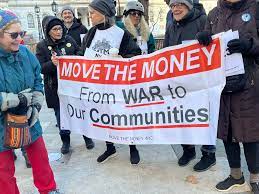
Move the Money campaigners in New York forged ahead in recent months. Centered on a Resolution 23, we want our City Council -- our most local representatives -- to speak up in opposition to runaway military spending and to do their part to hold Congress accountable.
The current Pentagon budget has skyrocketed to $886 billion, and analysts say its true cost is easily over a trillion dollars. The harm caused both at home and abroad by this massive military outlay of our tax dollars is hugely destructive to all but the war profiteers, and buys no sustainable security for our working and middle classes.
Autumn 2023 was a season of firsts for our campaign, even as the wars raged on. For the first time ever a majority of NYC Council Members co-sponsored Res. 423, calling on the Federal government to significantly reduce military spending and to redirect those tax dollars to our local communities.
And for the first time in our campaign, we moved from one-on-one lobbying / “bird-dogging” individual Council Members to direct action, pressing the entire Council for a hearing on the resolution. With a majority of 27 out of 51 Council members (plus the Public Advocate), we showed up at the Council’s meeting in late November and briefly disrupted the proceedings from up in the City Hall visitors’ gallery, loudly chanting to “pass 423!” until we were ushered out.CCDSers Ted Reich and myself both took part in this modest but effective action.
\We soon got our answer. The Speaker finally allowed a first-ever Committee hearing on our resolution to go forward, setting it for December 13 th . On very short notice, we mobilized some 30 people to testify, with others present as witnesses. .All of us are volunteers, mostly retirees: including nurses, veterans, teachers, labor, peace and environmental activists. The Committee Chair -- previously somewhat cool to our efforts -- was visibly moved, surprised by our solid turnout and the wealth of experience we shared in our testimony.
This was the first public hearing in a city government forum ANYWHERE in the USA, on the subject of US military spending’s negative local impacts. True, some city councils – including in Philadelphia and Milwaukee -- have voted for similar resolutions, but with no public hearing and thus little public involvement.
We still want larger, in-depth public hearings to take place in NYC, sponsored by local government. We hope to spur others, in the spirit of the US Conference of Mayors’ 2017 resolution calling for such hearings in every US city.
What’s next
This year we will push for a full Council vote, one that would put the entire NYC City Council on the record against such profligate war spending. Greater efforts at publicity for this campaign --- we got some in 2023, in the independent press and on radio so far – will be required. Possibly a big conference(or some such large gathering) on the subject will be held, in an effort to further involve the over sixtygroups that have signed on as organizational supporters. Ultimately we want in-depth hearings here inNYC that go into the very many harms to our communities – including our public and non-profit sectors. We hope to build a strong antiwar/fund-our-communities base here in NYC that will press on for peace and justice for all.
| |
|
I wish to welceme a new member from LA
!!! Leah Rae Finn !!!
| |
In her own words:
"I’ve been a licensed marriage and family therapist for over a decade now. I specialize in working with people who are queer, Kinky, non monogamous, and /or dealing with chronic pain or chronic illness. Those are my specialties.
"I love the work! My clients are amazing. I work online using telehealth, mostly video sessions, and some telephone sessions. I live in Los Angeles, In Hollywood."
Leah is also activity with the Disability Justice Movement (see below)
She aslo states that The disability justice movement is led by queer people of color.
10 PRINCIPLES OF DISABILITY JUSTICE
1. Intersectionality
2. Leadership of Those Most Impacted
The disability justice movement is led by queer people of color.
3. Anti-Capitalism
4. Cross-Movement Solidarity
5. Wholeness
6. Sustainability
7. Cross-Disability Solidarity
8. Interdependence
9. Collective Access
10. Collective Liberation
INTERSECTIONALITY “We do not live single issue lives” –Audre Lorde. Ableism, coupled with white supremacy, supported by capitalism, underscored by heteropatriarchy, has rendered the vast majority of the world “invalid.”
LEADERSHIP OF THOSE MOST IMPACTED “We are led by those who most know these systems.” –Aurora Levins Morales
ANTI-CAPITALIST POLITIC In an economy that sees land and humans as components of profit, we are anti-capitalist by the nature of having non-conforming body/minds.
COMMITMENT TO CROSS-MOVEMENT ORGANIZING Shifting how social justice movements understand disability and contextualize ableism, disability justice lends itself to politics of alliance.
RECOGNIZING WHOLENESS People have inherent worth outside of commodity relations and capitalist notions of productivity. Each person is full of history and life experience.
SUSTAINABILITY We pace ourselves, individually and collectively, to be sustained long term. Our embodied experiences guide us toward ongoing justice and liberation.
COMMITMENT TO CROSS-DISABILITY SOLIDARITY We honor the insights and participation of all of our community members, knowing that isolation undermines collective liberation.
INTERDEPENDENCE We meet each others’ needs as we build toward liberation, knowing that state solutions inevitably extend into further control over lives.
COLLECTIVE ACCESS As brown, black and queer-bodied disabled people we bring flexibility and creative nuance that go beyond able-bodied/minded normativity, to be in community with each other.
COLLECTIVE LIBERATION No body or mind can be left behind – only moving together can we accomplish the revolution we require.
| |
|
Civil rights groups denounce Donald Trump's comment
that Civil War could have been negotiated'
By Sudiksha Kochi & David Jackson
USA TODAY
WASHINGTON — Former President Donald Trump at a campaign stop in Iowa
said America's Civil War could have been “negotiated,” a comment that
drew immediate backlash from civil rights groups and historians alike.
On the third anniversary of the Jan. 6, 2021, Capitol riot, Trump on
Saturday called the Civil War, which began in 1861, “fascinating” and
“horrible.”
“So many mistakes were made,” Trump said. “See, there was something I
think could have been negotiated, to be honest with you. I think you
could have negotiated that. All the people died. So many people died."
“Abraham Lincoln, of course, if he negotiated it, you probably
wouldn’t even know who Abraham Lincoln was,” he added.
Trump’s remarks come just weeks after former South Carolina Gov. Nikki
Haley failed to mention slavery as a cause of the Civil War in a town
hall. At a different rally in Iowa, Trump attacked Haley over the
response, saying “I’d say slavery is sort of the obvious answer.”
But Trump's suggestion that the war could have been avoided sparked
immediate criticism. Charles V. Taylor Jr., executive director of the
Mississippi NAACP, told USA TODAY that “there is no negotiation with
slavery.”
“Civil rights, human rights should never be negotiable,” Taylor Jr.
said. “When Trump says things that are racially charged, and he says
things that are polarizing, when he says things that are obviously
offensive… what he says is just so egregious, but he is absolutely
talking to a specific group of people and alienating another.”
'These are not just dog whistles'
Svante Myrick, the president of People For the American Way, a
progressive advocacy group, told USA TODAY Trump's comments
demonstrate a “glaring ignorance of American history."
“By the time the Civil War broke out, there had been literally
hundreds of years of negotiations around how, when and where to end
slavery, and the southern states that seceded are what triggered the
Civil War,” Myrick said. “And it seems like President Trump was
implying that some sort of failure of diplomacy on behalf of Abraham
Lincoln is what caused the Civil War.”
Myrick accused Trump’s comments of being “extremely appealing to
Confederate sympathizers and white supremacist folks," risking dialing
up divisions across the country.
LaTosha Brown, co-founder of Black Voters Matter, agreed, saying
Trump's comments appeared aim at downplaying the enslavement of Black
people in America's history.
“We know the history of the South. We know that part of the elements
of the South was centered around the institution of slavery and in
maintaining that people of color would be in a permanent social
status,” said Brown, accusing Trump of speaking "to those that still
feel like their only advantage is white supremacy."
Trump’s rhetoric on the campaign trail has grown more inflammatory as
he seeks to clinch the Republican nomination and win back the White
House from President Joe Biden. He said last month immigrants are
“poisoning the blood of the country,” remarks Biden's campaign likened
to dictator Adolf Hitler.
Trump also drew comparisons to dictators last year when he described
his political opponents as "vermin," reminding many of Hitler and
Italy's Benito Mussolini.
“He’s getting more desperate and because he's more desperate, I think
he's getting more bold,” said Brown. “He uses lies, he uses fear. He
uses this insane concept of white superiority. He uses all of those
things as a toolkit in his arsenal.”
Andrea Young, executive director of the American Civil Liberties Union
of Georgia, said some of Trump's comments have pointed to “the worst
parts of our history.” She noted that Trump has promoted the false
conspiracy theory that former President Barack Obama was born in
Kenya, rather than Hawaii.
Taylor Jr. said 2024 will be a “crucial year” as the election will
“chart a course in this country.”
“Black voters absolutely know the dangers of what Trump says and
because he has been in office, we also know that these are not just
dog whistles or just words to excite a particular group of voters,”
Taylor Jr. said. “These are things that he believes and we know the
consequences of him believing these ridiculous notions have a very
negative impact on our democracy.”
What do historians say about the Civil War?
Historians told USA TODAY it's absurd to blame Lincoln for not
negotiating a preemption of the war.
By the time Lincoln took the oath of office on March 4, 1861, southern
states had seceded from the country. Lincoln would never negotiate an
agreement that included separation of the states, which he refused to
accept or recognize.
Lincoln also made the decision to resupply federal facilities in the
southern states, including Fort Sumter in the Charleston, South
Carolina, harbor. South Carolina's decision to attack the federal
garrison at Fort Sumter on the early morning of April 12, 1861, little
more than a month after Lincoln took office, triggered the military
conflict.
David Blight, a Yale University history professor and author of "Race
and Reunion: The Civil War in American Memory," rejected Trump's
comments.
"It is really nothing more than fantasy with dark political aims -
it's history as bad, vicious entertainment," said Blight, the Pulitzer
Prize-winning biographer of abolitionist leader Frederick Douglass.
Historians also questioned how anyone could have negotiated with,
essentially, a newly declared nation determined to maintain a slave
economy.
Harold Holzer, a Lincoln scholar and the author of a forthcoming book
titled "Brought Forth on This Continent: Abraham Lincoln and American
Immigration," said "no historian and no reader of history believes
that a compromise could have reversed secession or averted a civil war
over- yes - slavery."
Holzer noted that, before Lincoln took office, "he was willing to
guarantee the survival of slavery where it already existed, as long as
the Union was restored and the extension of slavery forbidden."
Regarding Trump’s lack of historical knowledge, Holzer said: “It’s not
surprising that someone who encouraged insurrection lacks
understanding of insurrection. When it occurs it has to be
repudiated."
The South refused, he added: "The slave states would not return under
a Republican president. Six weeks after Lincoln took office
Confederate troops opened fire on the federal fort at Charleston."
|  | |
|
Kissinger left trail of destruction
by Jay Jurie
A recent letter published in the Orlando Sentinel (Dec. 3) lauded the “monumental achievements” of the late Henry Kissinger as “a unique man who will not escape history.” The reason he will not escape history is not for the “achievements” the writer had in mind. It’s ironic this letter appeared in the Sentinel on the same day as an article entitled “Kissinger still haunts Latin America.” It’s not just Latin America that Kissinger haunts. He left a trail of destruction in East Timor, Bangladesh, Laos, Vietnam and Cambodia that resulted in the suffering and death of millions. While he was still alive, it’s regrettable he managed to escape accountability.
Jay D. Jurie Sanford
| Henry Kissinger, war criminal | |
|
Why U.S. Support for Israel?
A recent talk by Rod Such to the East Side Democratic Club in Portland.
By Rod Such
LeftLinks
Thanks very much for the invitation to talk with you today about the situation in Gaza. When Herschel first approached me about giving this talk, he suggested that a burning question was, 'Why Does the United States Give Unquestioned Military Support to Israel?' And I have to agree, it’s an essential question given the long uninterrupted history of that military support.
By way of introduction, I am a retired encyclopedia editor, first for World Book Encyclopedia and later for Encarta Encyclopedia. The Middle East was my subject area for both. Currently, I write for The Electronic Intifada and The Palestine Chronicle, and I am active with three local organizations—Amnesty International, Democratic Socialists of America, and Jewish Voice for Peace. Needless to say I’m not speaking for any of these groups today. These are my views and mine alone.
So why does the 'United States Give Unquestioned Military Support to Israel?' I’d like to break it down into five components, which I label 1) the imperialist component 2) the war profit component 3) the congressional component 4) the ideological component and 5) a shared culture of militarism and interventionism.
Let’s start with the imperialist component. Our current president, Joe Biden, probably gave the clearest and most succinct answer to why the U.S. gives unquestioned military support for Israel. As a U.S.senator in the 1980s, Biden gave a speech on the Senate floor in support of a resolution for billions in military aid to Israel. In this speech he said, “Were there not an Israel the United States would have to invent an Israel to protect her interest in the region.”
This strategic thinking in the U.S. establishment goes as far back as 1949, when the U.S. Joint Chiefs of Staff, the heads of each branch of the armed services, submitted a memorandum to President Harry Truman. In that memo they spelled out what those interests in the region were: oil and controlling who has access to it. The Joint Chiefs were impressed with Israel’s military performance during the war with the Arab states in 1948-49 who were opposing the expulsion of Palestinian Arabs from Palestine. The Joint Chiefs recommended that the United States make an alliance with Israel as a regional force that could help protect U.S. access to and control of the Middle East’s oil resources. And it’s been that way ever since.
Every 10 years the U.S. Congress renews a 10-year $40 billion military aid package to Israel, the largest amount given to any country. But often overlooked is a provision in that package requiring that Israel spend 78% of that amount with U.S. weapons manufacturers. In other words, in addition to our enormous so-called defense budget, each year we toss in a few extra billion in aid to Israel, 78% of which must be spent with U.S. weapons companies. Icing on the cake.
So the profits to be made by our own military-industrial complex are another big reason why the United States has always provided unquestioned military support for Israel.
Now to the third component: the U.S. Congress. We’re all familiar with President Eisenhower’s warning in his farewell address to the American people to guard against “the undue influence of the military-industrial complex.” Little known, however, is that in his original draft, Eisenhower called it “the military-industrial-congressional complex.”
That added component represented an acknowledgment that the Pentagon had purposefully and carefully spread out its military spending over the entire country. The Pentagon identified congressional districts to create jobs and ensure a congressional majority for its military spending.
Every U.S. military aid package to Israel is almost always unanimously approved in the House and Senate because of this military-industrial complex and because of the existence of a powerful Israel Lobby. More on that later.
But there is yet another reason for US support, and once again Biden is a good example of this. When Biden flew to Israel and embraced Israeli prime minister Netanyahu after the Oct. 7 Hamas attack, he declared “I am a Zionist.” Of course, Biden is a devout Catholic so that makes him a Christian Zionist like much of the Republican Party’s base. But what does this mean, and why did Biden feel the need to declare it?
I think this represents yet another component of US support for Israel, the ideological component. So what is Zionism and why is it important to this discussion. After declaring his intention to run for the presidency in 2020, Biden gave a speech to potential donors and said, “I get it. I understand why it’s important to have a Jewish state. It’s because of the long history of the persecution of the Jews.”
Of course, this statement ignores many other important facts, such as the long history of the Palestinian people’s desire for self-determination and the monumental injustice inherent in the very creation of the state of Israel.
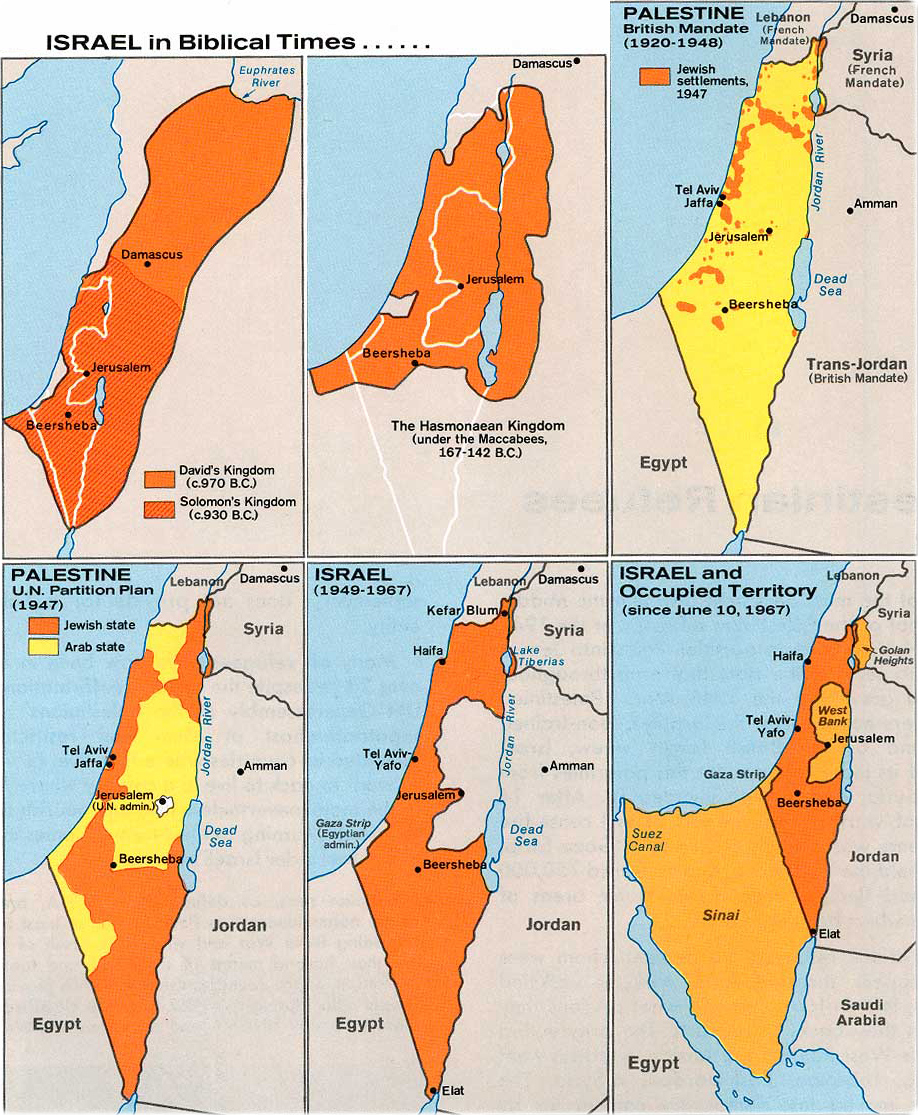
Most people are unaware that the original United Nations partition plan was a recommendation, not a binding resolution. And most people don’t know of the inherent unfairness of the plan; namely that it gave most of the land of Palestine to the minority of the population that was Jewish. It’s no wonder the Palestinians rejected this plan.
Bear with me here because what I’m about to elucidate also goes to the heart of why there’s been unquestioning US military support for Israel.
Even fewer people are aware of how the leader of the Zionist movement at the time, David Ben-Gurion, viewed the UN recommendation. In a meeting with the leadership of his party, Ben-Gurion said that the UN plan created only a 56% Jewish majority in the state that was to be Jewish. This was unacceptable, Ben-Gurion said, because it meant the Zionists might have to enter into a coalition government with an Arab party. Keep in mind they were envisioning a parliamentary system. Co-governance with Arab political parties meant the Zionist movement wouldn’t have a Jewish state, which was its openly proclaimed goal ever since 1942.
Ben-Gurion proposed that the new Jewish state must have at least an 80% Jewish majority. That is when the expulsion of the Palestinians was envisioned. At the time it was called “transfer.” Military planning began almost immediately under the name Plan D, and by April 1948, 350,000 Palestinians had either been expelled or forced to flee due to massacres and military attacks on their villages.
That was one month before Israel declared itself a state, an often overlooked fact because Zionist historiography likes to portray the refugees as a result of the war declared by Arab states in May 1948. Ultimately, 800,000 Palestinian Arabs were expelled from Palestine and made refugees, more than 500 villages were destroyed, and Israel controlled more than 70% of the land. Palestinians call this the Nakba, Arabic for catastrophe. By 1949 only about 100,000 Palestinian Arabs remained in Israel, making it a de facto Jewish state.
Because Israel was created on this foundation of ethnic cleansing and apartheid, it was certain that it would not be able to provide safety for Jewish people. Injustice never guarantees safety, and indeed, the Jewish citizens of Israel have faced two wars and ongoing, unrelenting popular resistance to their occupations. Peace and safety only come with justice and equal rights for all
Today, with the recent passage of the Nation-State Law, which states openly that Israel is a state of the Jewish people and the Jewish people alone, Israel is a de jure Jewish supremacist state.
Most of us think that a democratic state is a state that belongs to all the people, and in which the people are sovereign.Today 20% of Israel’s population is Palestinian Arab. Yet they are told that the state does not belong to them. They are inherently unequal. And so are Palestinian refugees still living in Gaza, the West Bank, Jordan, Lebanon, Syria, and here in this country. A Jew living anywhere in the world has the right to become a citizen of Israel, yet Palestinians are told they do not have the right to return to the homes and land from which they were expelled.
Imagine if a candidate for political office in this country declared, “This is a state for white people, and for white people alone.”
And this is where I’m suggesting that the United States government has an ideological affinity with Zionism and the state of Israel. Because in fact we do have more than 200 years of history of white supremacy. We did expel and commit genocide against Native Americans. And then we confined the remaining indigenous refugees to reservations.. We enslaved black Africans. And with the defeat of Reconstruction in the Deep South, we disenfranchised Black people in the South and confined them to ghettos in the North and the West. We have only begun to come out of this period in the last 50 years and then only partially.
We are ourselves a settler-colonial society, much like Israel is today. The values we share with Israel as a Jewish supremacist state are the same values of a white supremacist state. And like Israel, we have a militaristic culture of might makes right, as we’ve attempted to impose our will not only on minorities within our country but on countries around the world.
Most of our current Congress and the Biden Administration itself doesn’t even blanch at the genocide unfolding in Gaza. But this probably shouldn’t surprise us because neither have we ever come to terms with the genocides we carried out in Vietnam and in Iraq.
Finally I want to talk about our shared culture of militarism and interventionism with Israel. And in doing so, let’s bring it back to Gaza.
It’s important to see the parallels with Israel’s reaction to the 2006 parliamentary elections in the Occupied Palestinian Territories. The blockade of Gaza actually began after Hamas won those elections. Israel imprisoned the Hamas legislators who won their elections in the West Bank, then, together with the U.S., supported a coup attempt against Hamas in 2007. After the failure of that coup, the stranglehood on Gaza–what could come in and what could come out–tightened even further.
Similarly, when the U.S. doesn’t like the outcome of elections in certain countries, we also stage coups and support assassinations and try to impose a military solution, as we did in Iran, Guatemala, and Chile. It’s in our DNA, the DNA of settler-colonialism,militarism, and intervention in the internal affairs of other nations and people striving for self-determination. This culture of militarism and interventionism is the fifth component of our unquestioned military support for Israel.
We must break with it, and there is a crack in the wall finally with the growth of the Squad in Congress. Significantly, the 18 members of Congress who originally called for a ceasefire were all people of color. And significantly the Israel Lobby–particularly AIPAC and the Democratic Majority for Israel–have pledged $100 million in the 2024 congressional elections to defeat them.
Ultimately it comes down to building an electoral majority that rejects all forms of colonialism and imperialism. We don’t need access to the oil-rich regions of the Middle East. Just the opposite. We need to keep the oil in the ground because burning fossil fuels is fundamentally altering our climate and ultimately threatening mass extinctions.
We don’t need yet another ethno-supremacist state claiming that other people–migrants and refugees–for example, are “poisoning our blood,” a phrase echoing the Nazis that Donald Trump, one of Israel’s biggest supporters, just used.
What the Biden Administration has done is unprecedented in many ways. Past administrations have eventually admonished Israel for bombing civilians in Gaza and pushed for ceasefires. But not this one. Biden is complicit in a genocide, and he is trying to pressure every progressive in Congress to fall in line.
Witness the congressional delegation in Oregon where only Senator Merkley has called for a ceasefire.
Biden must demand an immediate ceasefire and push for a political solution or step aside and announce he will not run for re-election. Otherwise, he will continue alienating young voters, Arab Americans, people of color, and vast numbers of people of conscience. He will usher in Trump.
Footnotes:
https://sgp.fas.org/crs/mideast/RL33222.pdf
https://breakingdefense.com/2021/01/ike-was-wrong-the-military-industrial-congressional-complex-turns-60/
https://www.motherjones.com/politics/2023/12/how-joe-biden-became-americas-top-israel-hawk/
https://www.c-span.org/video/?c4962369/user-clip-joe-biden-israel-usa-invent-israel-protect-interest-region
https://www.palestinechronicle.com/dying-to-forget-dying-to-forget-oil-power-palestine-and-the-foundations-of-u-s-policy-in-the-middle-east-book-review/
https://www.amazon.com/Palestinian-Refugee-Problem-1947-1949-Cambridge/dp/0521338891
https://www.amazon.com/Ethnic-Cleansing-Palestine-Ilan-Pappe/dp/1851685553
|  |  | |
|
Exclusive to OpEd News:
OpEdNews Op Eds 10/20/2023 at 1:26 PM EDT H3'ed 10/20/23
By Steven Jonas
"Either this nation shall kill racism, or racism shall kill this nation." (S. Jonas, August, 2018)
Preface:
As I have said for quite some time, the existence of the State of Israel has proved that the age-old anti-Semitic claim that "Jews are totally different from everyone else" is totally wrong. Give Jews State Power and they can behave just as badly as anyone else.
Who benefits and who does not benefit from the current Israel/HAMAS/Gaza crisis? Well, to begin with, the Palestinians who have been jammed into what I have called "The World's Largest Concentration Camp" for quite some time now, most obviously do not. The dense civilian infrastructure which provided at least some relatively civilized-although-highly-packed-in living conditions is being routinely and ruthlessly destroyed by the Israeli government. (And do note that I say here "the Israeli government," not "Israel." For a highly significant minority of Israelis [although that minority is now for sure smaller than it was before the Oct. 7 Hamas outrage] do not approve at all of the current government's policy.) So, who does?
Indeed, there are very significant forces and interests that do benefit from the initial attack, and then the overwhelming Israeli response which forced the mass evacuation of civilians from an already overcrowded living space to a spectacularly overcrowded one. (Gee, I wonder which government did that to Jews 75 years ago, or so?) Obviously, among them are not the ordinary Palestinian civilians of Gaza, regardless of their personal political persuasion. So, who are they, then? Well, every government, force, interest group, other nation (e.g., Iran), which was/is against the restoration of the "peace process," which would lead in one way or another to some sort of "two-state solution" which has been going-on-and-off the international/political agenda since the founding of the State of Israel by UN resolution in 1947.
What does the Israeli Right, summarized by the word "Likud," have to gain from the current conflict? Exactly what Hamas has to gain from it: the end of the "peace" process for the foreseeable future. And then further for Likud, full-steam ahead on the Expulsionist Policy in the West Bank, under the cover of the Gaza conflict. As the Israeli Prime Minister, Benjamin (I know, I know, everyone, not just his friends, calls him "Bibi") Netanyahu put it:
"Anyone who wants to thwart the establishment of a Palestinian state has to support bolstering Hamas and transferring money to Hamas " This is part of our strategy - to isolate the Palestinians in Gaza from the Palestinians in the West Bank." (Benjamin Netanyahu, statement at a March 2019 meeting of his Likud Party's Knesset members, Haaretz, October 9, 2023, emphasis added.)
For the last 15 years or so, during which time the Israeli anti-settlement/-expulsionist Right has been in power for most of it, the "Peace Process" has been going nowhere. But recently, following the conclusion of the "Abraham Accords" between Israel and several Arab countries, there has emerged the possibility of an overall peace agreement between Israel and several other Arab countries, most importantly including Saudi Arabia, being pushed heavily by the United States, that would in one way or another finally pave the way for some form of "two-state" solution.
Whatever form it took, it would bring an end to the gradual expulsion from the "West Bank" of Palestinians by Right-wing Jewish "settlers," which has been occurring at an ever-increasing pace under the protection of the current (far) Right-wing coalition government. In that government are several leading Jewish right-wing figures like Itamar Ben-Gvir and Bezalel Smotrich who almost openly support expulsion. The Israeli Right certainly supports the "settlements" being rapidly expanded in the West Bank and totally opposes any kind of "two-state solution." As for Netanyahu, while he says that he is for some sort of "two-state solution," such an one would not include any provision for any sort of Palestinian sovereignty, in the usual sense of the word.
The horror (and indeed it is a horror) of what has been going on in the West Bank is encapsulated in this letter from Yossi Alpher that the organization Americans for Peace Now sent to its members (and I am one) on March 5, 2023:
"I'm writing to you today from East Jerusalem. I was here in Israel last Sunday and watched in real time as settlers rampaged through the West Bank village of Huwara, indiscriminately beating people, burning their homes and destroying their cars and businesses. The horror of this act punctuated by disturbing images reminiscent of some of the darkest moments of Jewish history was something I won't ever forget. In the ashes of what remains of Huwara, no decent human being would look at the carnage and think: 'let's finish the job.'
"But that's exactly what Israeli Finance Minister Bezalel Smotrich [emphasis added] --- the pro-annexation settler leader to whom Benjamin Netanyahu has also entrusted civilian control of the West Bank - had to say. 'I think the village of Huwara should be wiped out. I think that the State of Israel should do that.' This goes beyond Smotrich's previous hateful incitement. This is calling for a war crime. And it's doing so at a time when it's more evident than ever that incitement like this has deadly consequences."
Smotrich, by the way, holds to the position that: "There's no such thing as the Palestinians."
HOWEVER, (yes, that is a big however) as noted the pressure has been building, principally from the United States, but also from Saudi Arabia and certain of its allies. Their primary concern to get things sorted out between the anti-Iran countries in the region so that a common front could be presented against that country. By the way, it is important to note that while Iran and Saudi Arabia certainly have competing commercial, diplomatic, and military interests, they also represent the religio-ideological split that has riven Islam almost since its founding. Sunni vs. Shia
Although not in terms of population, in terms of its oil reserves and its repressive government that keeps any disagreements with government policy in that country firmly under lock and key (both figuratively and literally), Saudi Arabia is the leading Sunni power (religious and governmental) in the world, while Iran is the leading Shia power. As it happens, for reasons which, I must admit, are not entirely clear to me, Iran is totally against any kind of Middle East peace agreement which would lead to some sort of two-state solution.
And aye, there's the rub. With pressure from the Biden government all 'round (which, by-the-way, the President repeated in his "Israel-Ukraine" speech of Oct. 20, 2023), there had been some movement towards a major Israeli/Arab settlement, which would include some sort of two-state solution, supported by many Israelis, which would be a solution for the "Palestinian Problem," which has been with the Palestinians and Israel since its founding over 75 years ago.
So, to review, who is (or least, not speaking for every one of those interests now, has been) in favor of some sort of "two-state solution?" Well, the Israeli Left and at least some of the center-Left who together regret the failure of the Oslo Peace Process which for all intents and purposes ended with the assassination of Israeli Prime Miniter Yitzhak Rabin by an Israeli far-rightist in 1995. The "Process" has been dying a very slow death ever since, that is until the current attempts to revive it by the pro-peace political forces in Israel, the Palestinians for sure, and the "Arab group" led by Saudi Arabia. Opposed? As reviewed above, they are the two well-known militant anti-Israel armed groups, one to the North, Hezbollah, on the Lebanese border, and one to the South, based in Gaza, Hamas. As well-known, they are both affiliated with/sponsored by Iran.
We could go on here (and as was the case above, on-and-on), getting into the details of the alliances in whole and in part, but we won't. Suffice it point out that there are interests on both military-and-national-interest sides which benefit greatly from what has happened since Oct. 7 and continues to happen. It appears to be quite obvious that the peace process must be considered dead for the foreseeable future, from both the Israeli side and from the Arab (that is the Saudi-led/Suuni) side as well. Given the, for me, totally unforgivable attack by the Israeli Defense Force on the civilian population of Gaza (which has not even yet begun in earnest, with boots on the ground), no local Arab leader (except for some among the totally powerless Palestinians, like the Palestine Liberation Organization) can now possibly advocate for the resumption/initiation of some sorts of talks. And there is your answer to the "Who Benefits?" question. Those forces on both sides that DO NOT WANT PEACE.
This is a subject, Israel/Palestine, with which I have dealing in writing for well over 10 years. As it happens, I have been dealing with it in my mind since I was a child. My father, Prof. Harold J. Jonas, was a leading fighter against U.S. anti-Semtisim in the 1930s (Father Coughlin and Hitler's writing-buddy Henry Ford were leaders in that movement). Towards the need of that decade, he became involved in the fruitless efforts to save the Jews of Europe. (See. e.g., his articles "People in Flight," which appeared in The Contemporary Jewish Record, September-October, 1939, and "More Homelands for the Jews?" which appeared in Jewish Frontier in January 1940.)
As I pointed out in a recent column here on OpEdNews, the State of Israel was essentially created in the first instance by the developing political anti-Semitism in Europe in the late 19th century. In response to it, "Zionism," in the person of Theodore Herzl, was first created. Even before the advent of Nazi Germany, an increasing number of Jews wanted to leave Europe, but had a limited number of options for emigration. After World War I, increasingly, nations around the world, like the United States, in which a highly restrictive policy was put in place by the Immigration Act of 1924, limited Jewish emigration from Europe, except (for relatively small numbers at the time) to Palestine.
And so then, in summary, after World War II, at the expense of the Palestinian Arabs who lived in the space in the region assigned by the UN to the Jews (plus land added in the several Israeli-Arab wars), the reality which has led right down to the present has been created. Could there be peace? Yes, certainly there could be. But now, following the events which have occurred in less than two weeks from the Gazan outrage over the border into Southern Israel, followed by the Israeli outrage which is ongoing (for who knows how long), any chances for peace would seem to be put off for at least several decades.
In sum, "Who Benefits?" The Israeli Right on the one hand, and on the other, the local Arab forces opposed to the very existence of Israel, represented in the region by Hezbollah and Hamas, and their Shiite overlords in Teheran.
Let me conclude with a statement written by a long-time State Department official, one Josh Paul, who, it seems, has been working on the "peace process" for the 11 years he has been with the Department.
" 'Let me be clear,' [Josh] Paul wrote. 'Hamas' attack on Israel was not just a monstrosity; it was a monstrosity of monstrosities. I also believe that potential escalations by Iran-linked groups such as Hezbollah, or by Iran itself, would be a further cynical exploitation of the existing tragedy. But I believe to the core of my soul that the response Israel is taking, and with it the American support both for that response, and for the status quo of the occupation, will only lead to more and deeper suffering for both the Israeli and the Palestinian people - and is not in the long-term American interest.'
" 'This Administration's response - and much of Congress' as well - is an impulsive reaction built on confirmation bias, political convenience, intellectual bankruptcy, and bureaucratic inertia,' Paul adds. 'That is to say, it is immensely disappointing, and [here I would say "but"] entirely unsurprising. Decades of the same approach have shown that security for peace leads to neither security, nor to peace. The fact is, blind support for one side is destructive in the long term to the interests of the people on both sides.' "
------------------------------------------------------------------------------------------------------------------------
Speaking as a life-long Secular Jew, let me say, "Amen."
(Article changed on Oct 20, 2023 at 9:23 PM EDT
|  | |
|
|
Total Privatization and Profiteering of our
Healthcare - Whose Goal Is It?"
By marilyn Albert
Those of us who are health care justice fighters need to view the onslaught of privatization and profiteering in a comprehensive way – because it is the reality that one can barely think of any sector or service of US health care that is not being taken over by these processes.
In part thanks to media exposes like one in the NY Times of Oct. 18 2022, a movement has developed to fight the privatization of Medicare, which takes various forms. The agency which is in charge of Medicare and Medicaid, the CMS, has declared their commitment to having all Medicare beneficiaries covered by some form of a privatized system by 2030. Up until recently, most Democratic elected officials have unquestioningly endorsed privatization of Medicare – in fact hundreds of Congressmembers annually would send a letter to CMS supporting Medicare Advantage – but two major forms of privatization -- Medicare Advantage insurance plans and a new attempt to privatize Traditional Medicare – are becoming the targets of a growing opposition movement. The creation of a think tank within CMS called the Center for Medicare and Medicaid Innovation, -- now called ACOREACH - places traditional Medicare beneficiaries into a profit making set up without their knowledge if their doctor has been recruited to it. So these are the major attempts at privatizing Medicare.
On top of all this, private equity capital is taking over an astounding variety of health care services at a rapid rate. Private Equity capital has taken over hospitals, nursing homes, doctors practices, behavioral health, hospice care and just about any health service you can think of. The New Yorker magazine had two horrifying articles about this – one about the closing of the one public hospital in Philadelphia due to its private equity takeover, and another more recently about what private equity has done to hospice care. Truly horrifying. Private Equity capital’s activities are unregulated for the most part, but fortunately government is starting to examine this - for example the General Accounting Office issued a report two .months ago about how private equity takes over nursing homes.
All of this profiteering impacts oppressed minorities and women more sharply, both as patients and as workers.
To just review what the problems with Medicare Advantage plans are very briefly, half of Medicare beneficiaries are now in Advantage plans. They are attracted to them largely because they are cheaper than the supplemental plans which are pretty much needed if you stay with traditional Medicare. Seniors who say they like their Advantage plan are usually those who remain healthy, but once they get sick, they quickly become aware of what is wrong with Advantage plans – denial of care, in the form of a prior authorization process, narrow provider networks, especially with respect to specialist doctors, and poor quality of the “extra benefits” in the advertisements.
The Advantage plans ripped off the Medicare fund to the tune of $120 to 140 Billion in 2022. A process called Upcoding is one of the major techniques of this rip off. The Advantage plan makes a patient appear sicker than they really are to get a higher reimbursement from Medicare.
Unions have been sucked into the Medicare Advantage profit game – however we must keep in mind that only 13% of union members enjoy retiree health benefits. A lot of unions have moved their retirees into Medicare Advantage plans because they save money for their employers, and this also contributes to health care bargaining difficulties for the unions. Some groups of retirees are fighting this notably a group of municipal retirees in NYC, who have won their legal fights with their own unions and the city of New York so far.
Finally, if you make a cursory examination of the profit making health industry’s literature, you will frequently see the terms Value Based Care, Value Based Payments, all of which mean the same very specific thing. Using misleading terminology, Value Based Payment systems shift responsibility for the costs of patient care away from the insurance companies and onto providers. Doctors can profit through this system, called Shared Savings. But it is a form of denial of care. Plus there is always a profiteering middleman in Value Based Payment systems.
So we have various interlinked forms of profiteering reaching into every part of health care in the country.
We do have the beginnings of a movement in opposition to this, which is decentralized and made up of all kinds of constituency groups and which is starting to formulate demands and involve elected officials. The Biden administration has made a very weak attempt at regulating some of the less aggregious aspects of Medicare Advantage. But one bright spot is the Federal Trade Commissioner Lina Kahn, a progressive who is moving against private equity in health care. Senators Elizabeth Warren and Jeff Merkley are taking on the private equity and profiteering epidemic also as is a group in the House of Representatives.
So we have a very long and hard struggle against the complete domination of profitmaking over our health care. In order to literally save lives, we have to advocate for partial, proximate victories, but at the same time, push for the real solution, which is Medicare for All, single payer health care.
| |
Sunday, May 7, 2023
REMEMBERING DR. MARTIN LUTHER KING, THE LETTER FROM A BIRMINGHAM JAIL, AND HIS VISION OF A JUST SOCIETY
Harry Targ
Remarks prepared for participation in a panel discussion of The Letter From a Birmingham Jail
Diversity Roundtable Summit
April 29, 2023
Lafayette, Indiana
Barbara Ransby wrote in a recent Nation article about the election of Brandon Johnson to serve as the new mayor of Chicago. Johnson, is an African American, a teacher, and a longtime Chicago Teachers Union activist She reported that “Johnson described his victory as the coming together of the civil rights and labor movements, much as Martin Luther King always envisioned.”
Reflecting on the corpus of Dr. King’s writings, speeches and activism suggests a continuity of his worldview and politics over a decade before the dramatic Letter From a Birmingham Jail was written, the seeds of which were planted when Dr. King was a graduate student. Given this approach, it can be argued, that the Letter From a Birmingham Jail represents a piece in the puzzle of King’s work, not the initiation or conclusion of it.
Race and History, Economics, Politics, Culture, and Interpersonal Relations
To clarify we can identify racism as a multidimensional process, with causes that can be understood historically, economically, politically, culturally, and in social psychological terms. Using what may be called a “levels of analysis” approach we can identify the multiple causes and impacts of racism in the United States.
If we begin with the historical and political economy “level”, we see that racism emerges with the introduction of the globalization of capitalism in the fifteenth century. The countries of Northwest Europe, Portugal, Spain, Great Britain, France, Belgium began to traverse the seas, establishing colonies where they could by military conquest. The purpose of such expansion was the acquisition of land, people, and resources. In North and South America, indigenous people were killed and land and resources were appropriated for processing and transport back to the home country and then the world.
Along with technological advances, shipping and guns, and the occupation of land and resources, the colonial powers needed inexpensive labor to grow the crops and extract the gold, silver, and rubber. Thus, with the globalization of capitalism came conquest and the enslavement of peoples, mostly from Africa. In this sense, modern racism begins with colonialism and slavery. Without slaves kidnapped from their homes and brought to the Western Hemisphere, there would have not been the appropriation and growth of cotton, sugar, coffee, and the extraction of other commodities such as silver and gold. Without land, resources, and slave labor there may not have been the industrial revolution.
Along with global economic realities, the slave system was institutionalized in new constitutions and the creation of military and police forces to control the slave populations. Scholar of white supremacy Theodore Allen noted that when indentured servants, Black and whites, rose up in opposition to the exploitation by large plantation owners in the seventeenth century, these owners “invented” the white race and the Black race. Race was a social/political creation designed to divide the exploited workers who produced the agricultural commodities and natural resources central to the economic system. Race forever more was used to split the exploited so that they would not join together to overthrow an oppressive system. Again, political institutions were established to ensure the divisions between Blacks and whites. Slaves were defined as three-fifths of a person in the United States constitution, for example. Furthermore, African Americans could not vote, Slave rebellions were crushed, and after the US civil war the system of Jim Crow was established.
In addition, economic and political order was rationalized over and over again by culture. What was written in history books about economic and political institutions, about history, and cultural stereotypes in literature, the stage, radio, television and in virtually every transmission of ideas served to justify the economic and political systems based on race. Racist narratives found their way into science, religion, and educational curricula. And finally, the institutionalization of racism historically, economically, politically, and culturally was reproduced every day in interpersonal contacts. Here is where the word “discrimination” fits.
It is important to add that while each of these levels of racism reinforce each other to create a powerful system of white supremacy, they all are affected, shaped, and challenged by resistance. All of these forces, economic, political, cultural, and interpersonal are not omniscient. And Dr King articulated and organized against these forces his entire life. And his Letter from a Birmingham Jail argues particularly for an ethical and political resistance against racism at all levels.
The Letter therefore is located in a community struggle, a political culture of racism, a regional institution of segregation, and the need for resistance. Also it was implicitly about the history of slavery, systems of oppression based on “haves” and “have nots” and the common struggles of people of color all over the world.
The Importance of Class Struggle for Dr. King’s Project of Resistance
Dr. King’s thinking about the need for an alliance between the civil rights and labor movements was expressed many times. As far back as 1957 at a convention of the United Packinghouse Workers of America (UPWA) he asserted that “organized labor can be one of the most powerful instruments in putting an end to discrimination and segregation.” During an organizing effort of the Hospital Workers Local 1199 in the fall of 1964, King was a featured speaker at a fundraising rally, He said of the 1199 struggle;
“Your great organizing crusade to win union and human rights for New Jersey hospital workers is part and parcel of the struggle we are conducting in the Deep South. I want to congratulate your union for charting a road for all labor to follow-dedication to the cause of the underpaid and exploited workers in our nation.”
Upon his return from Norway in 1964 after receiving the Nobel Peace Prize, King returned to the picket line, this time in support of Black women workers of the Chemical Workers union at the Scripto Pen Plant in Atlanta. He said there: “Along with the struggle to desegregate, we must engage in the struggle for better jobs. The same system that exploits the Negro exploits the poor white…”
Dr. King recognized in the Letter that the Birmingham struggle paralleled the struggles of Black and Brown people going on all around the world to liberate themselves from the historical patterns of colonialization then just ending. Oppressed people cannot remain oppressed forever, he wrote. “The yearning for freedom eventually manifests itself, and that is what has happened to the American Negro….Consciously or unconsciously, he has been caught up by the Zeitgeist, and with his black brothers of Africa and his brown and yellow brothers of Asia, South /America and the Caribbean, the United States Negro is moving with a sense of great urgency toward the promised land of racial justice.”
And finally the Dr. King of Birmingham connected the race and class issues at home with US imperial war in Vietnam in his famous Riverside Church speech of 1967: “Somehow this madness must cease. We must stop now. I speak for those whose land is being laid waste, whose homes are being destroyed, whose culture is being subverted. I speak for the poor of America who are paying the double price of smashed hopes at home and death and corruption in Vietnam. I speak as a citizen of the world, for the world as it stands aghast at the path we have taken,” He spoke defiantly of the need for a “radical revolution of values,” an unremitting commitment to “go out into a sometimes hostile world, declaring eternal opposition to poverty, racism, and militarism.”
The Relevance of Dr, Martin Luther King for Today
This Diversity Round Table Summit demonstrated the continued relevance of Dr. Martin Luther King’s work, protests, writings, speeches, for today. The material above reminds us that Dr. King was fully aware of the history, economics, politics, culture, and interpersonal relations of racism in his day. He was also cognizant of the connections of domestic political life and international relations. The struggles for social and economic justice, for King, were truly global.
Therefore we can conclude these brief remarks with the following conclusions about the relevance of Dr. King, and his writings, such as The Letter From a Birmingham Jail.
This relevance for today includes the facts that:
--he articulated what is today a global struggle against violence and war
--he articulated what we see today as the enormity of economic inequalities within countries as well as between them
--he emphasized that combatting racism, white supremacy, and neo-colonialism require alliances between the poor, the oppressed including women, and workers
--he correctly argued that a just society, local and global, a beloved community is one in which people's needs are met, cooperation supersedes competition, and every member of these communities is an active and equal participant in their development.
Today visionaries in the King tradition include Vijay Prashad, Medea Benjamin and members of Code Pink. And particularly Reverent William Barber and the New Poor People’s Campaign, and the thousands of young people, workers, who are struggling to acquire the right to form unions, and Black Lives Matter activists, are pursuing the King legacy.
Suggested reading: Michael K. Honey, To the Promised Land: Martin Luther King and the Fight for Economic Justice,W.W. Norton, 2018.
| |
|
King's daughter says wars, gun violence,
racism have pushed humanity to the brink
Jan. 4, 2024, 8:38 PM ET
By SUDHIN THANAWALA Associated Press
ATLANTA (AP) — Citing gun violence in the U.S., the deaths of families in Ukraine and Gaza from war, and threats from artificial intelligence, the Rev. Martin Luther King Jr.’s daughter said Thursday the world urgently needs to study and adopt her father's philosophy of nonviolence to avoid self-destruction.
The Rev. Bernice King used an address to announce events for the upcoming holiday in honor of her father to warn that humanity was at a critical juncture.
“We are witnessing unprecedented loss of human life and especially among the Black, brown and indigenous people throughout the world," she said.
She also mentioned conflicts in Yemen, Congo and Ethiopia and cited racism against Black people as another threat to humans, saying it remained a “blight” more than 50 years after her father was assassinated.
Overall, humanity was dangerously close to fulfilling her father's prophecy that it could destroy itself through the misuse of its own instruments, she warned. But she also offered a solution.
The study and practice of her father's philosophy of nonviolence could teach people how to live together peacefully, she said. The events the King Center has planned this year for the week leading up to the MLK holiday, including a teach-in and training seminars, are therefore centered on the theme of shifting "the cultural climate” through “Kingian nonviolence.”
“We face individual and collective choices that will determine whether we will continue to diminish and devastate humanity and the earth or if we will become co-conspirators to shift the cultural climate throughout our nation and world," she said.
King said the center also plans to honor her mother, Coretta Scott King, with a virtual exhibit later this year that will highlight her work to advance civil rights and her husband's legacy.
| |
 | |
TRIBUTE TO BLACK PANTHER LEADER FRED HAMPTON
Carlito Rovira
The month of December has varying significance for different people. Some associate this time of the year with the Christmas holidays. While others, as in the case of many politically minded folks like myself, associate the month with the December 4, 1969, assassination of Black Panther leader Fred Hampton.
It is for that reason why I was motivated to paint the portrait of this revolutionary figure. The portrait is 20” X 24”, acrylic paint on canvas. I still have vivid memory and will never forget as long as I live when those of us in the Young Lords New York office received the sad and shocking news of Fred Hampton’s death at the hands of the state.
In a coordinated effort between the Illinois State Attorney’s Office, Cook County Police Department, the Chicago Police Department, a heavily armed assault was launched on Hampton's residence, in the morning hours of December 4, 1969. With a vicious sense of racist hatred, police fired their weapons at will through a wall separating the hallway from the apartment. Panther leaders Fred Hampton and Mark Clark were killed.
This murderous onslaught was part of Operation: COINTELPRO, a campaign directed by the notorious FBI Director J. Edgar Hoover who aimed to destroy the Black Panther Party and the political Left in this country.
But despite the efforts of the police state to silence and intimidate revolutionaries of that period, specifically the Black Panther Party, their courageous examples live forever and will prove decisive in the future struggles against this system of oppression.
| |
A Comrade Supports a Child Tax Credit for DC | |
In Case uou missed it
November 27th
CCDS's Socialist Education Project presents
How important is the United Nations today in curbing war and promoting peace?
views at:https://www.facebook.com/OULeft.org/videos/314755664759695
| |
|
The Man Who Changed Colors
By Bill Fletcher, Jr.
When a dockworker falls to his death under strange circumstances, investigative journalist David Gomes is on the case. His dogged pursuit of the truth puts his life in danger and upends the scrappy Cape Cod newspaper he works for.
Spend a season on the Cape with this gripping, provocative tale that delves into the
complicated relationships between Cape Verdean Americans and African Americans, Portuguese fascist gangs, and abusive shipyard working conditions. From the author of The Man Who Fell From The Sky.
“Bill Fletcher is a truth seeker and a truth teller – even when he’s writing fiction. Not unlike Bill, his character David Gomes is willing to put his life and career in peril to expose the truth. A thrilling read!” − Tavis Smiley, Broadcaster & NY TIMES Bestselling Author
Review by John Bachtell
Click HERE to purchase
| |  |
|
From Upton Sinclair's 'Goose Step' to the Neoliberal University
Essays on the Ongoing Transformation of Higher Education
By Daniel Morris
and Harry Targ
Paperback USD 17.00
This is a unique collection of 15 essays by two Purdue University professors who use their institution as a case-in-point study of the changing nature of the American 'multiversity.' They take a book from an earlier time, Upton Sinclair's 'The Goose-Step A Study of American Education' from 1923, which exposed the capitalist corruption of the ivory tower back then and brought it up to date with more far-reaching changes today. time. They also include, as an appendix, a 1967 essay by SDS leader Carl Davidson, who broke some of the original ground on the subject.
Click HERE to Purchase
| | |
From the CCDS Socialist Education Project... | |
A China Reader
Edited by Duncan McFarland
A project of the CCDS Socialist Education Project and Online University of the Left
244 pages, $20 (discounts available for quantity), order at :
The book is a selection of essays offering keen insight into the nature of China and its social system, its internal debates, and its history. It includes several articles on the US and China and the growing efforts of friendship between the Chinese and American peoples.
| | |
|
Taking Down White Supremacy
A Reader on Multiracial and Multinational Unity
Edited by the CCDS
Socialist Education Project
166 pages, $12.50 (discounts available for quantity), order at :
https://www.lulu.com/spotlight/changemaker
This collection of 20 essays brings together a variety of articles-theoretical, historical, and experiential-that address multi-racial, multi-national unity. The book provides examples theoretically and historically, of efforts to build multi-racial unity in the twentieth century.
Click here for the Table of contents
| | |
CHANGEMAKER PUBLICATIONS: Recent works on new paths to socialism and the solidarity economy
Remember Us for Gift Giving and Study Groups
We are a small publisher of books with big ideas. We specialize in works that show us how a better world is possible and needed. Click Gramsci below for our list.
| |
522 Valencia St.
San Francisco, CA 94110
415 863-6637
| | | | | |