CT CAN End Homelessness Digest | | |
This digest serves as a monthly update of CT CAN End Homelessness, including Committee and Sub-Committee Reports, upcoming meetings and events, and other relevant information about our state's homeless response effort.
Your input and participation are what make CT CAN End Homelessness possible. All of our meetings are open to the public. Please join us at a meeting, invite your colleagues, or share this with your networks. Thank you for all you do, and together, we will end homelessness in Connecticut.
| | |
As we enter the final month of session, I want to ground us in both the urgency of this moment and the strength of what we can do together.
Connecticut is already facing a homelessness crisis, and federal instability is making it harder for individuals and families to hold on to housing. New analysis from DataHaven confirms what many of us are seeing every day across our communities: homelessness has increased each year since 2021, unsheltered homelessness has risen sharply, and more than 300,000 adults in Connecticut ran out of money for housing in the past year. In our state, homelessness is being driven by affordability.
And yet, this is also a moment to be clear about what is possible.
Behind every number is a neighbor, a family, a young person, an older adult, someone whose life can be changed by timely support, coordinated response, and the courage to invest in what works. DataHaven’s report, Mapping Communities at Risk: Federal Policy Changes That Could Triple Connecticut Homelessness, underscores what is at stake. At the same time, it reminds us why this work matters so deeply and why our shared advocacy is so important right now.
That is why CT CAN’s updated legislative request of $28.3 million is so important in this final month. It is a practical, values-driven response to the reality in front of us: $10 million to Prevent, $18.3 million to Respond, and continued investment to House our neighbors and strengthen pathways to permanent housing.
I remain hopeful because I know this network. I know the commitment, compassion, and determination that lives across our providers, people with lived expertise, backbones, advocates, municipal leaders, and partners. When we move together, we are powerful.
In this final stretch, every voice matters. Every call, every email, every meeting, every relationship, and every act of advocacy helps build the momentum we need.
Our neighbors deserve more than urgency alone. They deserve action, investment, and a shared belief that homelessness can be prevented, reduced, and solved. Let’s stay aligned, keep pushing, and finish strong together.
In solidarity,
Sarah Fox
| Annual Training Institute | | |
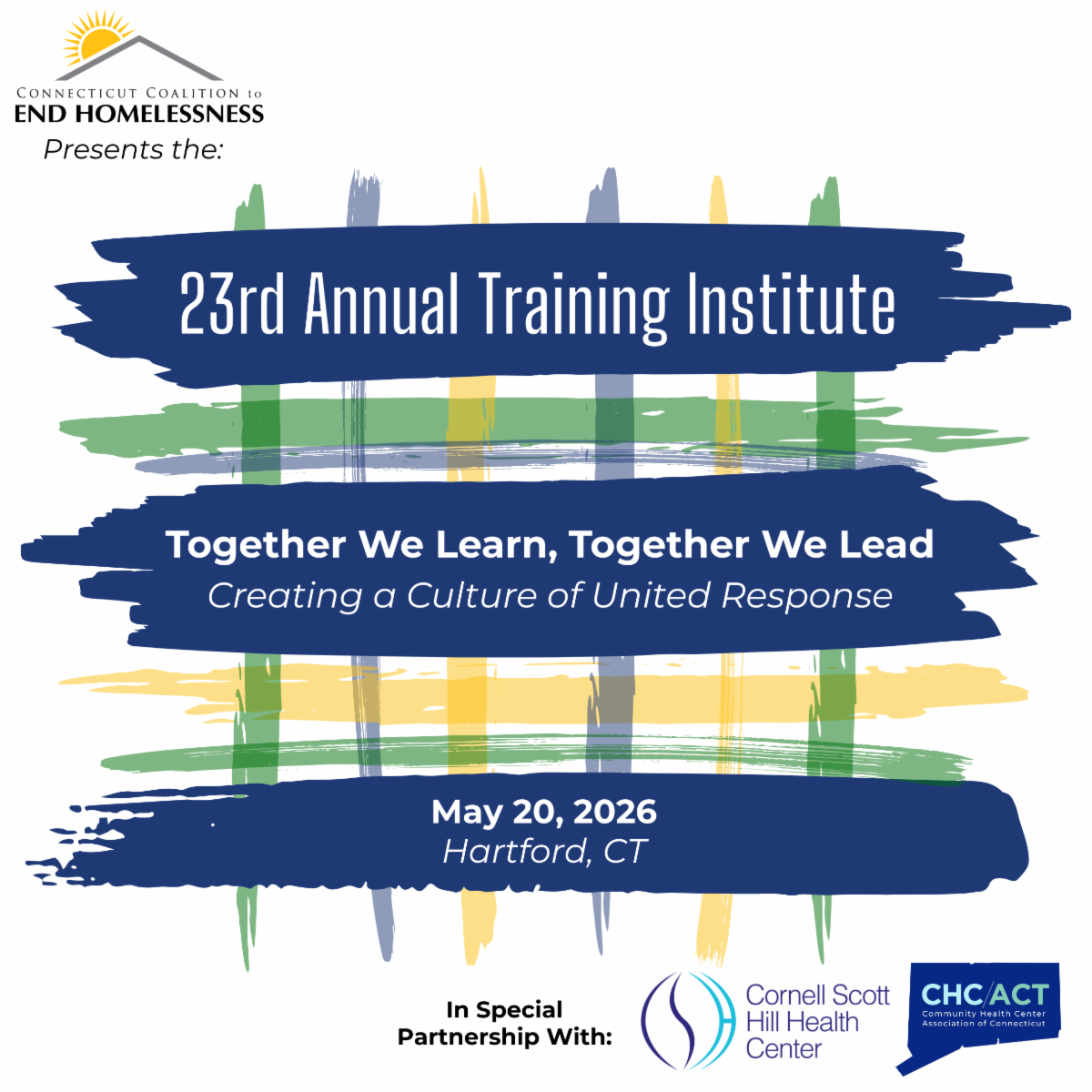
The 23rd Annual Training Institute (ATI)
Together We Learn, Together We Lead
Creating a Culture of United Response
Wednesday, May 20th
8:00 A.M. - 4:30 P.M.
The Connecticut Convention Center
100 Columbus Boulevard
Hartford, CT 06103
Last day for Award Submissions and Early Bird Pricing - April 10.
Visit CCEH.ORG/ATI2026 to nominate, register, and for more information about workshops, speakers, and more!
| | |
Steering Committee Updates:
The CT CAN Steering Committee met on March 27 and approved a narrowed state advocacy strategy in response to Connecticut’s budget deficit, reducing the campaign’s funding request to $28.3 million and prioritizing flexible funding, extreme weather response, and staffing across Coordinated Access Networks (CANs). Members noted growing momentum around these priorities, particularly as first-time homelessness and housing unaffordability continue to rise.
The group also reviewed progress on several system improvement efforts, including implementation of the Coordinated Entry System (CES) evaluation and development of new dashboards to better track inflow and outflow, length of homelessness, and exit destinations. Workforce challenges remain a key focus, with continued efforts to elevate findings from the workforce study and explore policy solutions.
Updates were also shared on campaign workgroups advancing priority areas such as youth and young adult strategy development, coordinated entry improvements, and housing exit pathways. Immediate next steps include promoting the revised funding ask, expanding advocacy engagement through the April Week of Action, and continuing implementation of CES evaluation recommendations.
| |
Coordinated Entry and Outreach Committee Updates:
The most recent Coordinated Entry and Outreach meeting focused on system challenges and ongoing improvement efforts.
Members continued discussing DMV-related barriers, including limits on fee waivers, access to services, documentation requirements, and inconsistent practices across branches. The group is seeking specific feedback from the field to help identify concrete issues to bring back to DMV.
The new Coordinated Entry Modernization Workgroup was also introduced as a space to streamline workflows, improve data accuracy, and reduce duplication. In addition, a statewide inflow/outflow dashboard was presented and generally supported as a helpful starting point for more consistent data tracking, with recognition that future development should also reflect client experience and local context.
The meeting also included a presentation on work underway in Greater New Haven focused on older adults, aligned with the broader goal of developing regional care teams. This highlighted the need for more tailored resources, stronger coordination, and potential opportunities to expand similar approaches across other regions.
| | |
Policy & Advocacy Updates:
In February and March, the Policy and Advocacy Committee participated in hearings on priority funding and policy legislation. All of the committee’s policy priorities and funding requests were successfully voted out of joint committee.
The committee also voted to update the CT CAN End Homelessness funding request to include $10 million for a Housing Crisis Response Fund, $12.3 million annually for extreme weather capacity, and $6 million for staffing, for a total immediate request of $28.3 million to prevent homelessness, strengthen crisis response, and support housing access. Rental Assistance Program voucher and COLA requests will continue to be led by partner organizations.
With these priorities clarified, outreach and awareness efforts launched in mid-March, supported by advocacy tools including scripts, tracking sheets, and a social media campaign. Advocates are continuing to engage legislators, particularly key budget leaders, as the statewide Week of Action (April 20–23) and the Alliance’s annual Rally at the Capitol on April 29 approach.
Visit our advocacy page for more information and materials.
| | |
Youth and Young Adult (YYA) Updates:
The Youth and Young Adult (YYA) Subcommittee met to continue advancing a youth-led, equitable governance structure in support of ending youth homelessness.
During the meeting, members reaffirmed the group’s shared values, centering equity, youth voice, and inclusive decision-making. Using an Equity Co-Design (ECCD) approach, the group continued identifying system challenges and exploring opportunities for improvement.
Members also reviewed key data trends showing continued youth engagement with the homeless response system through 211, while noting the need for deeper analysis to better understand system flow, diversion, and outcomes.
Through a “current state to transform state” exercise, the group identified several priority areas for improvement, including governance and decision-making, cross-system coordination, communication, and elevating youth voice. Looking ahead, the group will focus on clarifying structure and roles, strengthening collaboration, improving data alignment, and increasing meaningful youth engagement.
An upcoming virtual retreat in April will provide dedicated time to continue this work and begin shaping solutions. Members were also encouraged to complete session polls to help guide the collaborative moving forward.
| | |
Exit Updates:
The Exit Committee did not meet this month, so there are no updates to share at this time.
| | These sessions are a space for community members to contribute to achieving our goal of eliminating homelessness. Your participation enriches our open dialogues and collective efforts to develop lasting solutions. | | |
Exit Subcommittee
The purpose of the Exit Subcommittee is to increase exits to housing, decrease the length of time homelessness, and reduce returns to homelessness.
Date: April 10, 12:00 - 1:00 PM
| |
|
Youth and Young Adult Subcommittee
The Policy & Advocacy Committee leads the statewide advocacy efforts of the Homeless Response System throughout the calendar year.
Date: April 14, 1:30 PM - 2:30 PM
| |
Policy and Advocacy Subcommittee
The Policy & Advocacy Committee leads the statewide advocacy efforts of the Homeless Response System throughout the calendar year.
Date: April 21, 12:30 - 2:00 PM
| |
Coordinated Entry and Outreach Subcommittee
The purpose of the Entry Subcommittee is to improve coordinated entry and to provide households access to appropriate services and shelter quickly. The purpose of the Outreach and Engagement Subcommittee is to identify, engage, and house all unsheltered individuals and families using a coordinated approach across the state
Date: April 23, 12:00 - 1:00 PM
| | | | |