|
New Jersey Business Immigration Coalition
Pursuing Bipartisan and Evidence-Based Immigration Policy
| |
|
NEWSLETTER TOPICS
The Trump Administration's Plan for Mass Deportation
Data on Unauthorized Immigrants
| |
THE TRUMP ADMINISTRATION'S PLAN FOR MASS DEPORTATION | |
|
How will the New Administration Implement Mass Deportation
Economic Consequences of Mass Deportation
The Desperate Need for More Legal Immigrant Pathways
Should the U.S. Allow Unauthorized Immigrants to Legalize?
Revive the Registry Program?
Research Articles and Commentary
| |
|
The 2024 election brings in a new administration with a wide range of policy priorities in the area of immigration. The NJ Business Immigration Coalition knows that President Trump has strong views on securing control over the southern border and deporting migrants who entered the country illegally. Whether the new administration pursues “mass deportation” or selective deportation remains to be seen. However, as we are on the brink of a major change in federal policy, the Coalition decided to devote this entire issue to the deportation question. As an organization committed to bipartisan policies designed to strengthen our economy and to benefit all workers, both U.S.- and foreign-born, we will also put forward a few recommendations relevant to the deportation question. | |
|
Some Data on Unauthorized Immigrants
| |
|
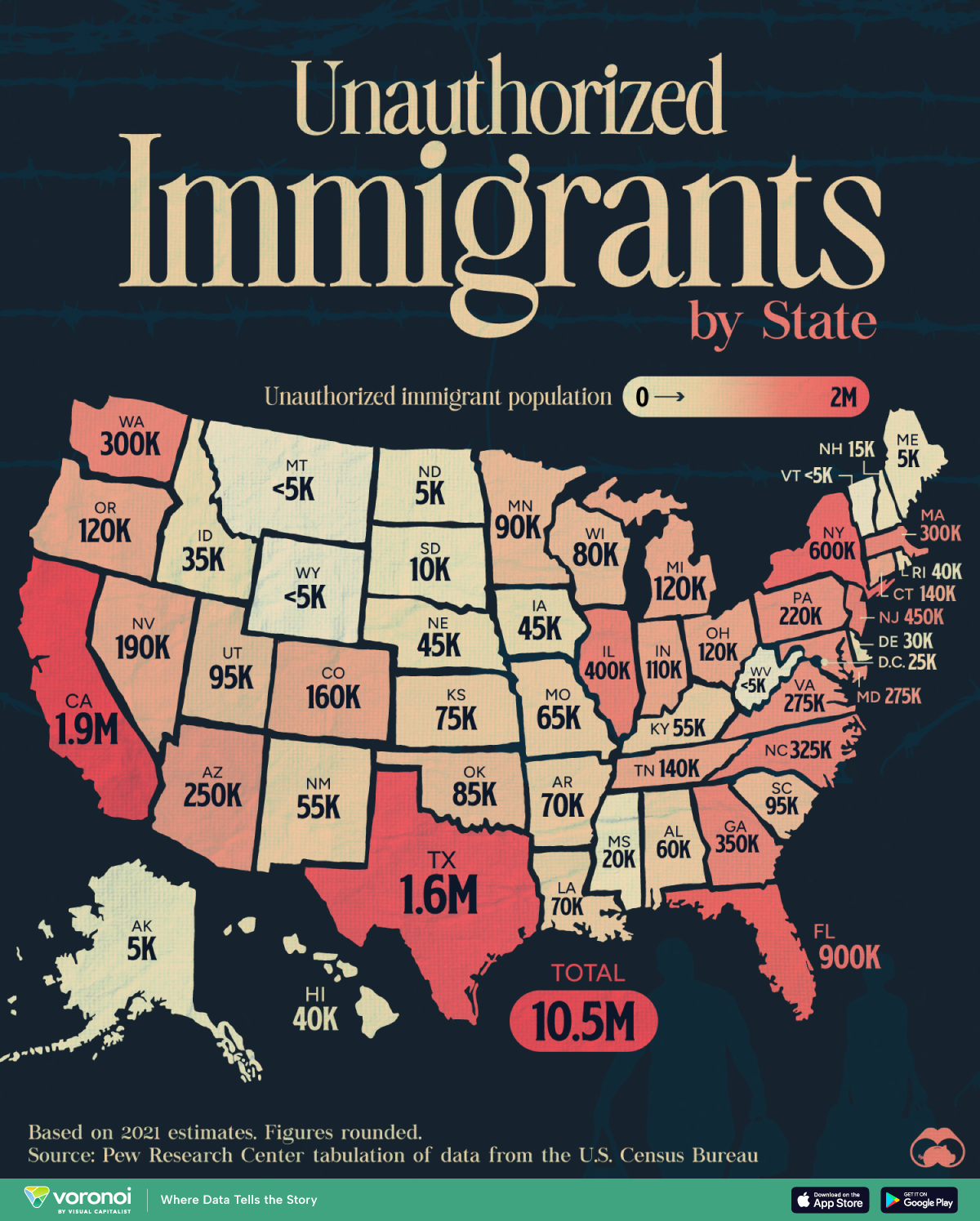
In recent years, the number of unauthorized immigrants has hovered between 10 and 11 million. By July of 2023, the unauthorized population increased to about 11.7 million -- an increase of about 800,000 compared to the previous year. This number is still below the peak of 12 million reached in 2008.
Unauthorized immigrants constitute 3.3% of the U.S. population and about 23% of all immigrants in the country. They are predominantly of working age, with two-thirds between 25 and 54 years old, and approximately 8 million are employed, making up about 5% of the U.S. workforce.
Over 60% of unauthorized immigrants have lived in the U.S. for 10 or more years. There are 450,000 unauthorized immigrants in New Jersey, with 8% of all New Jersey households having at least one unauthorized family member.
It should be remembered that roughly 40% of all unauthorized immigrants did not cross the southern border. Rather, they entered the country by plane on temporary visas but lost legal status when they overstayed their visas.
Significant numbers of unauthorized immigrants also have various "twilight" statuses such as TPS or DACA allowing them to remain in the U.S. temporarily.
| | | |
|
How will the New Administration Implement
“Mass Deportation”
| |
|
Since numerical immigration restrictions were first put into place a century ago in 1924, steps have been taken to grant legal status to immigrants who either entered the country illegally or couldn't enter at all. One approach has been the registry program (see article below for details). Another has been the assignment of temporary status to large groups of migrants, such as the "parole" status given to Hungarians after the 1956 Revolution and the “entrant” status given to Cubans during the Mariel boatlift of 1980. Another has been the legalization program passed by the Reagan administration in 1986.
Many Republicans believe that all programs of this type incentivize illegal immigration and must be discontinued. Although there have been many critiques of so-called “mass deportation” (see below), some Republicans understand that mass arrests, incarceration, and forced returns could cost billions of dollars, and might do more harm than good.
Writing in the National Review, Mark Krikorian, executive director of the Center for Immigration Studies, a restrictionist think tank, suggested ways “to get illegal aliens to return home on their own by making it impractical to stay” in the U.S. According to Krikorian, there is always a “churn” in the undocumented population, with large numbers of people returning to their home countries for a variety of reasons, and the Trump administration needs to “harness that churn.” One example of how to do this, according to Krikorian, is to immediately revoke the temporary protected status for 200,000 people from El Salvador. Another is to revoke the two-year parole status of over 1 million potential asylum applicants. Krikorian believes that Trump could actually “get the deportation ball rolling before Inauguration Day” by announcing his intentions before actually becoming president.
Another tool that Republicans may try to use is passage of the Mandatory E-Verify Act of 2024 requiring all employers to use the federal electronic E-Verify system to confirm the employment eligibility of their workforce.
| |
The Desperate Need for More
Legal Immigrant Pathways
to Stem the Flow of
Unauthorized Workers | |
|
The debate over immigration policy often focuses on enforcement and deterrence measures. One important issue that often gets overlooked is the mismatch between U.S. workforce needs and the strict limits on legal immigration. If more immigrants with needed skills could enter the country legally, they would never resort to crossing the border illegally.
The U.S. currently operates with a legal immigration system more than a half a century old. Only 14% of all legal immigrant visas are granted for employment purposes -- one of the lowest percentages in the developed world. Not only that, the vast majority of these visas are only for high-skilled workers, not for less-skilled and unskilled workers willing to fill high demand jobs.
According to David Bier of the CATO Institute, a Washington-based conservative think tank, legal immigration is "nearly impossible" for most people, especially because of the caps placed on immigration from populous countries like India. Opening up more legal avenues for migration would discourage irregular migration and address labor market needs, especially important now as we deal with worker shortages and population decline, as well as increased labor market demand for immigrants.
The Coalition has urged the federal government to increase the number of immigrants admitted for employment purposes and to raise or eliminate per country caps on migration for a more equitable allocation of visa numbers.
| |
Should the United States Allow Unauthorized Immigrants to Legalize? | |
|
|
Since the beginning of numerical controls over immigration more than a century ago, the United States has found ways to allow unauthorized immigrants to remain in the country. One tool has been the registry program (see article below). Another method has been collective legalization programs.
The last such program occurred during the Reagan administration in 1986, when nearly 3 million unauthorized immigrants were legalized, roughly one million of whom were agricultural workers. Subsequent bipartisan efforts to pass similar legislation failed.
In 2013, for example, Congress came close to passing a legalization program when a bipartisan bill passed the Senate by an overwhelming margin of 68 to 32, but the House refused to consider it.
Several years earlier in 2007, the Bush administration sought to pass a similar piece of legislation creating a 13-year pathway to citizenship, requiring the payment of a $2,000 fine in order to advance to permanent residence. This initiative also failed.
In 2021, the Biden administration proposed the "U.S. Citizenship Act of 2021," which aimed to create an eight-year pathway to citizenship for undocumented immigrants. The House passed part of Biden's bill, giving permanent residence to Dreamers, TPS holders, and around one million farmworkers, but the bill failed to pass in the Senate.
One of the arguments for this kind of legislation is that most unauthorized immigrants are law-abiding persons who actually did a favor to the U.S. by helping to ease labor shortages and strengthen the economy. Most of them didn't jump immigrant queues, because no such queues were available.
Another argument for legalization is that spending a lengthy period of time in illegal status may in itself be considered a form of punishment. In addition, legalization would lower barriers between immigrants and local law enforcement authorities.
And, of course as mentioned earlier, removing millions of people from the country would not only cost billions of dollars but could also bring more harm than good to the economy.
The Coalition has urged passage of a legalization program for Dreamers.
| |
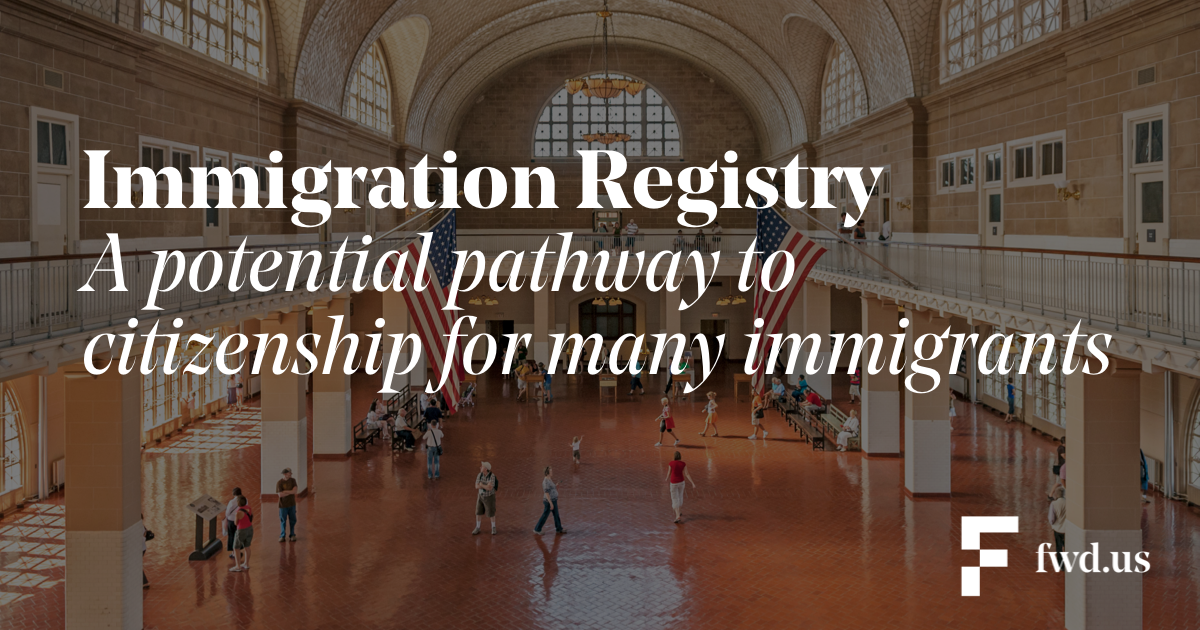
Should We Revive the Registry Program? | |
|
Since restrictions were first placed on immigration more than a century ago, the U.S. has allowed unauthorized immigrants to gain legal status and eventually advance to citizenship if they satisfied a number of conditions, including being of “good moral character” and not having any extended absences from the U.S. The main condition, however, was the number of years of residence in the U.S.
Starting in 1929, a so-called “registry date” became a regular feature of immigration law. The first such date was 1921, but the date was moved up on a fairly regular basis (twice under Republican administrations and twice under Democratic). The last update to 1972 was done during the Reagan administration. There has been no update of the registry date since that time. During the 1985-1989 period, almost 60,000 immigrants qualified for legal status through the registry program.
In recent years, bills have been introduced in Congress to create a "rolling registry date" of 7 years. As most of the undocumented population have lived in the country for more than a decade, such a bill would successfully legalize an estimated 8 million people, including groups such as Dreamers, TPS holders, and farm workers. Among the many legal arguments for such a program is the need to introduce a "statute of limitations" for immigration law, just as we have for other forms of law.
The Coalition thanks Adam McGovern of the Wind of the Spirit Immigrant Resource Center for sharing the above information about the Registry program.
| | |
|
THE COALITION WELCOMES NEW MEMBERS!
Check out our NJ Business Immigration Coalition policy goals here and if your company or organization (or you as an individual) agrees with our basic principles, we encourage you to sign up as a member of the Coalition. There is no fee to become a member.
Share your thoughts on the immigration reform challenges facing the United States. How is your industry affected? What specific reform proposals are you championing?
What do you think about mass deportation?
Write us at: info@njbusinessimmigration.org
| | |
|
The New Jersey Business Immigration Coalition,
c/o Einstein's Alley, P.O. Box 175, Plainsboro NJ 08536,
info@njbusinessimmigration.org
Newsletter Editor: Nicholas V. Montalto
| | |
THE NEW JERSEY BUSINESS IMMIGRATION COALITION | |
| | | |