Happy Halloween Friday!!! |
|
A Little About this Frightful Holiday...
Halloween, contraction of All Hallows’ Eve, is a holiday observed on October 31, the evening before All Saints’ (or All Hallows’) Day. The celebration marks the day before the Western Christian feast of All Saints and initiates the season of Allhallowtide, which lasts three days and concludes with All Souls’ Day. In much of Europe and most of North America, observance of Halloween is largely nonreligious. Halloween is celebrated on Saturday, October 31, 2020.
Please enjoy this selection
of scary awesome guitars...
|
|
Very Similar to the One Used by Jimi Hendrix... in His 'Pre-Fame Days' |
|
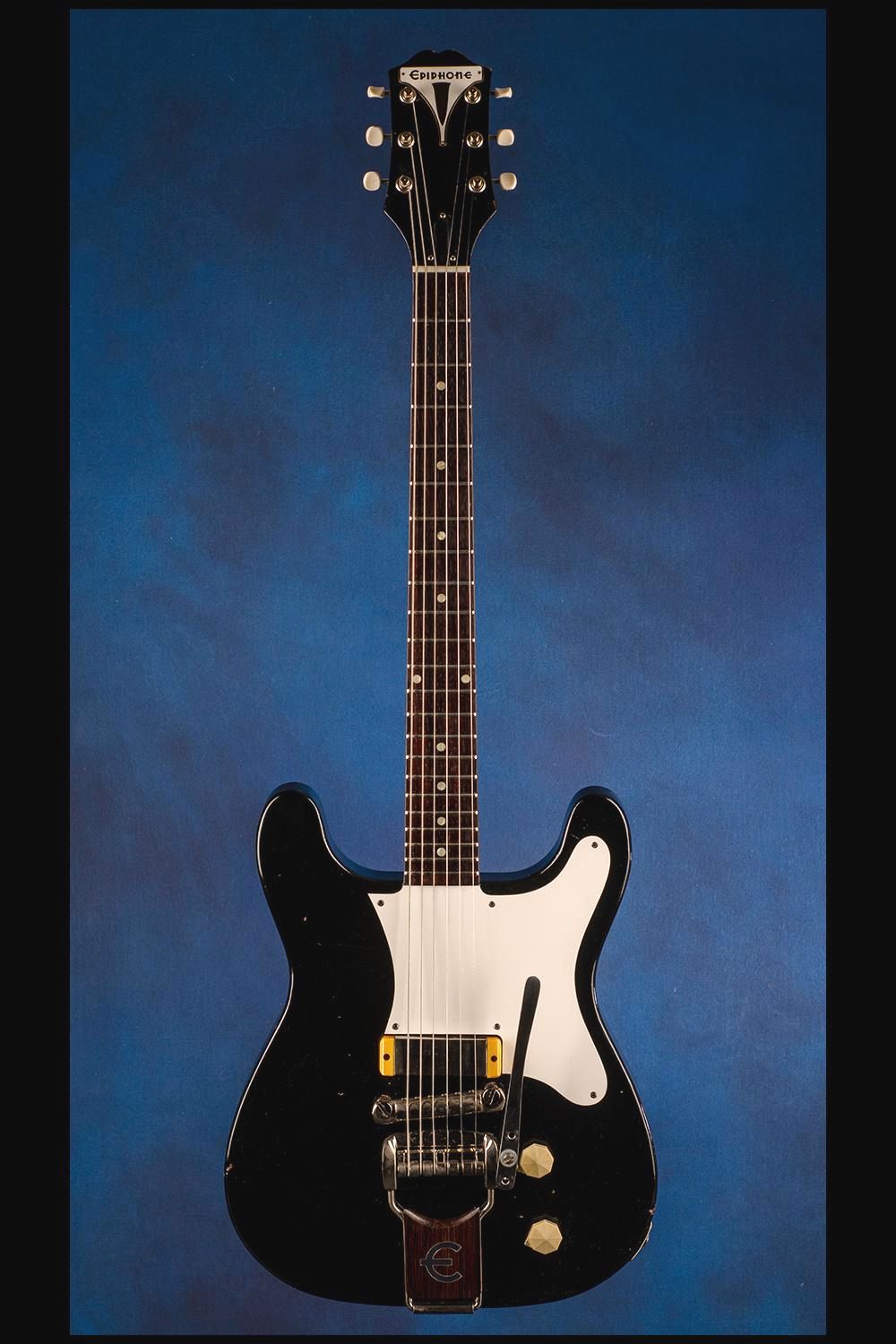
1959 Epiphone Moderne Black Coronet (First Generation), Black |
Double cutaway solid body with rounded horns. This early 1959 incredibly rare guitar, which is like a cross between a Fender Esquire and a Gibson Les Paul Junior, weighs just 8.00 lbs. Solid mahogany 'slab' body with two symmetrical horns. One-piece mahogany neck with a fat nut width of 1 11/16 inches, a wonderful medium-to-fat profile and a standard Gibson scale length of 24 3/4 inches. Slab rosewood fretboard with 22 jumbo frets and inlaid pearl dot position markers. Serial number "9 8252" inked-on in white on back of headstock. Metal Epiphone 'Bikini' headstock logo plate enameled in white and gold and pressed metal truss-rod cover with three screws. Closed-back single-line Kluson Deluxe strip tuners with white plastic oval buttons. Single Epiphone 'New York' single-coil pickup in the bridge position with cream-colored "blocks" or side extensions with a very healthy output of 6.25k. Single-layer white plastic pickguard (0.08 iches thick) with six screws. Two controls (one volume, one tone). The potentiometers are stamped "134 841" (Centralab, October 1958). Epiphone octagonal 'carousel' white bakelite pointer knobs. Jack socket on treble side of guitar - three layer black over white jack-plate with four screws. Wrap-over stud bar bridge and factory Epiphone vibrato with Epi 'epsilon' inlaid in silver on rosewood plaque. All hardware nickel-plated. This exceptionally rare guitar (the only one that we have ever seen or heard of with the Epiphone vibrato) is in exceptionally fine (9.00++) condition with just a few minor surface chips/marks/indentations mainly on the edges of the body and four on the back of the neck. Truly an absolutely stunning example. Complete with the original eight-page Epiphone hang-tag/instruction booklet and 'Easy Pickings for Christmas' - a sixteen page songbook dated 11-12-59. Housed in the original Epiphone three-latch, black faux aligator rectangular hardshell case with black faux aligator ends and maroon plush lining (9.25).
Several years ago we had a similar bodied 1960 Epiphone Crestwood Custom in original sunburst. The neck on that guitar was almost identical to this 1959 Coronet - starting out with a profile of 0.85 inches behind the 1st fret, rising to 0.88 at the 3rd, 0.93 at the 5th, 0.97 at the 7th, 0.97 at the 9th, 1.00 at the 12th and 1.01 behind the 15th fret.
The Gibson-made Epiphone Coronet guitar started out as an alternative to the Gibson Les Paul Junior. Something slightly different, but still a good basic single pickup solidbody guitar (for a very economical price). Initially, the 1958/1959 models had a rather thick 1 3/4" mahogany body, like it's sister Les Paul Junior, and a bit similar to a Telecaster body. But when the Les Paul Junior converted to the thinner SG LP Junior body style by late 1960, the Coronet also thinned down to 1 3/8" thick, and the edges got rounded.
The 1959 Coronet is a superb guitar. In 1958 and 1959, the first two years of production, the Coronet featured an open-book headstock with metal Bikini logo, and was fitted with a single Epiphone New York pickup in the treble position. This pickup was found primarily on the pre-Gibson archtops and worked very well in that environment. On this solid body it retains it's sweet brightness. "The single-coil 'New York' pickup produce a rip-roaring sound when cranked up through a small tube amp, with a surprisingly mellow purr at low volume. The tone is quite different from the typical Gibson of the period, thinner perhaps than a PAF Standard or a P-90 Junior, but still fierce in its own right. So few were sold it's difficult to find evidence of any in use when new, though Jimi Hndrix did play a '59 Coronet briefly in his pre-fame days." (Peter Stuart Kohman in Vintage Guitar Magazine, October 2020 pp. 38-41).
"It's not like a Fender single coil, it's not like a P-90 and it's not like a mini-humbucker. And it's not a very high output pickup. But put it way back just hugging the tailpiece-bridge and it is without doubt one of the snottiest, edgy, rock & roll pickups we've heard. It rips on 10. Back it off and it sings. As we said, it's not high output so if you want even more snot, throw a volume boost in line. Controls are a straight Volume and Tone. Finished in Black with Nickel hardware, this guitar oozes style and personality. Did we mention "Snotty" ? The sound of this guitar played through a Supro or Deluxe, is to be savored." (respectfully copied from an old Imperial Guitar & Soundworks description which we felt we could not improve upon!).
According to the Epiphone shipping records just 237 Coronets were produced in 1959.
Notable players include Mikael 'Vigilante' Carlstroem (The Hives).
FA 02178
$15,500
|
|
A Near Mint, All Original "DeArmond" Duo Jet...
By Far the Best We Have Ever Seen!
|
|
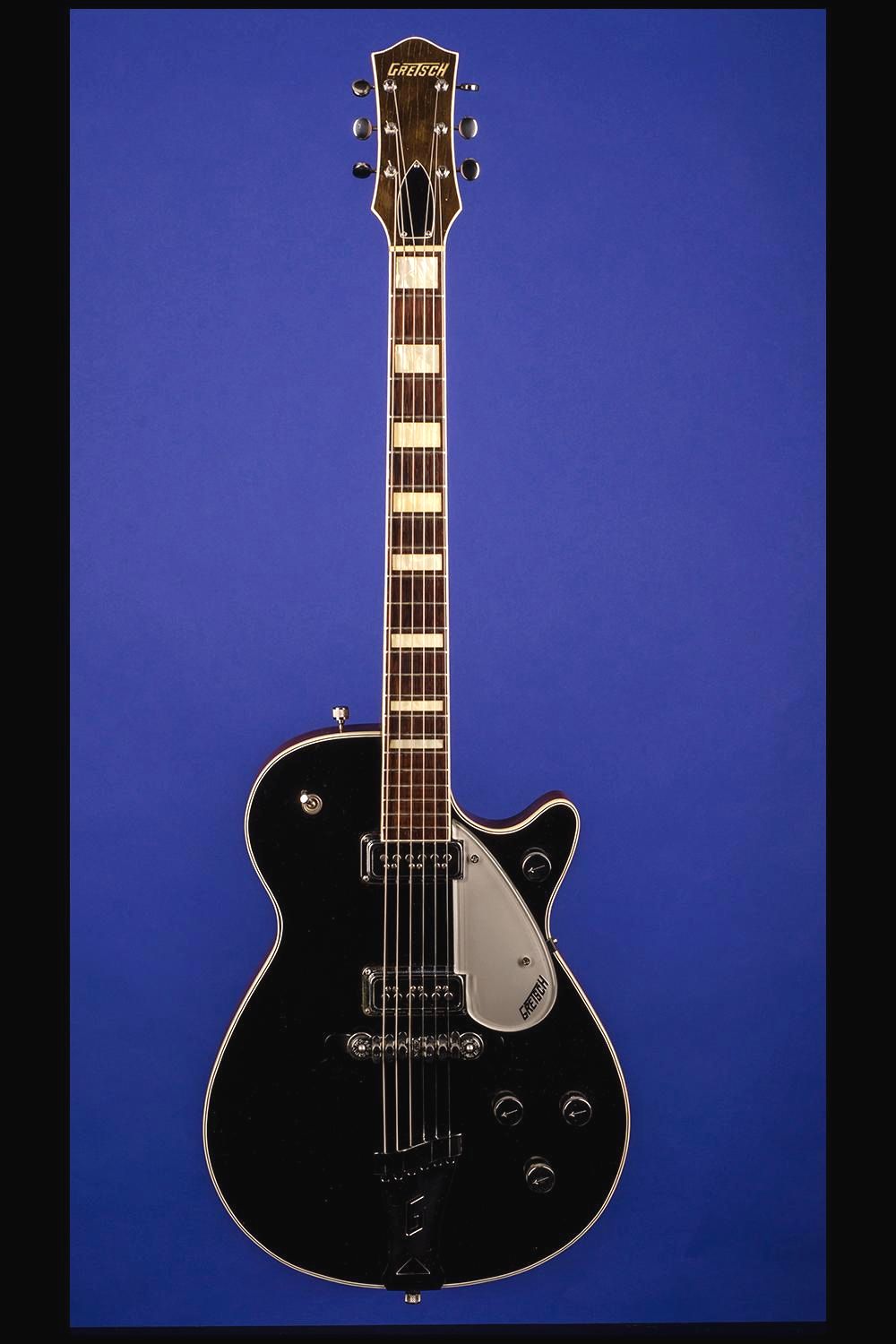
1956 Gretsch 6128 Duo Jet, Black |
|
Single cutaway. This early 1956 Duo Jet has a 13 1/4-inch-wide, 2 inch deep chambered mahogany body and a triple-bound pressed arched top with black plastic laminate, weighs just 7.70 lbs. One-piece mahogany neck with a fat fat nut width of just over 1 11/16 inches, a wonderful medium-to-thick neck profile and a scale length of 24 1/2 inches. Single-bound Brazilian rosewood fretboard with 22 original 'medium' frets and inlaid pearloid block position markers. Single-bound, dark brown maple faced headstock with inlaid pearl Gretsch "T-roof" logo. Original 'Bullet" shaped two-layer black over white plastic truss-rod cover with three screws. Individual open-back Grover StaTite tuners with oval metal buttons and hexagonal bushings. Two single-coil DeArmond pickups with outputs of 9.43k and 9.30k with original tortoise-shell plastic spacers. Clear Lucite pickguard painted silver on the underneath and engraved in black from the underneath with Gretsch "T-roof" logo. Four controls (three volume, one tone) and one three-way selector switch. The potentiometers are stamped "615 7033 534" (IOC August 1955). "Arrow-through-G" chrome-plated control knobs with cross-hatch pattern on sides. Melita Synchro-Sonic bridge with six individually adjustable saddles on height-adjustable base and chrome cut-out "G-hole flat" tailpiece. Original two-layer white on black plastic neck heel cover. Original two-layer black over white plastic control cover secured by three screws. Inside the control cavity is the original Gretsch label with Model "6128" stamped in blue and Serial No. "18077" stamped in red. One circular three layer black over white plastic and one two-layer black over white plastic switch/potentiometer covers, each secured by two screws. This very rare guitar is in near mint and totally original (9.25++) condition with absolutely no belt-buckle rash on the back - just the bare minimum of lower edge wear on the mahogany body and some light finish checking on the laminated maple face of the headstock. Complete with the original (slightly worn) "Gretsch Guitar Guarantee" with matching model and serial numbers in blue ink. Housed in the original Gretsch five-latch, two-tone gray, shaped hardshell case with dark burgundy velvet lining (9.25+). Without question the finest example we have ever seen…
"In early 1954 [actually August 1953], Gretsch premiered its single cutaway Jet series, a line of quasi-solid-bodies that persisted in one form or another until the end of the Baldwin era. Intended to imitate and compete with Gibson's Les Paul "goldtop" Standard Model, the Jet guitars differed, in a structural sense, in that they were not true solidbodies but semi-solids with top, back and sides formed from separate pieces. Their arched tops were laminated from several plies of pine, maple, mahogany, spruce or sheets of Nitron plastic drum material. The 1954 models issued were the Gretsch Electromatic solidbody Model 6128; Duo Jet in black; 6129 Silver Jet with silver sparkle top; Model 6130 Western-outfitted Round Up; similarly appointed Model 6121 Chet Atkins Solidbody, companion to the Model 6120 Chet Atkins Hollowbody, and, apparently hearkening back to the Gretsch-Bacon banjo days, Model 6126 Duo Jet Baritone Uke and Model 6127 Duo Jet tenor guitar. 1954's 6128 Duo Jet and Model 6129 Silver Jet were fraternal twins. The ebony-topped Duo Jet is finished in natural-mahogany back, sides and neck… [the] earliest pickguards for 1954 are white plastic without "Gretsch" inscribed on it. The pickguard is not cut to fit around the pickups and instead butts against the treble end of the DeArmonds' surrounds. (Jay Scott. The Guitars of the Fred Gretsch Company, pp. 91-92).
"In 1953 Gretsch launched its first solidbody, the single-cutaway Duo Jet. In fact, the guitar was a semi-solid with routed channels and pockets inside, but the visual effect was certainly of a solidbody instrument. In its early years the new Duo Jet had, unusually, a body front covered in a black plastic material, as used on some Gretsch drums. It also had Gretsch's unique two-piece strap buttons (an early take on the idea of locking strap buttons) and the Melita Synchro-Sonic Bridge" (Tony Bacon, Electric Guitars: The Illustrated Encyclopedia, pp. 163-165).
George Harrison bought a 1957 Gretsch Duo Jet early in 1961. "Harrison used the Duo Jet throughout the group's rise to fame, only retiring it when he acquired a double-cutaway Gretsch Country Gentleman in summer 1963" (Tony Bacon, Electric Guitars: The Illustrated Encyclopedia, p. 164).
FA 02047
$11,500
|
|
2012 Fender G.E. Smith Telecaster
Fitted with a 2019 Fender Custom Shop
1962 'Slab-Board' Neck
|
|
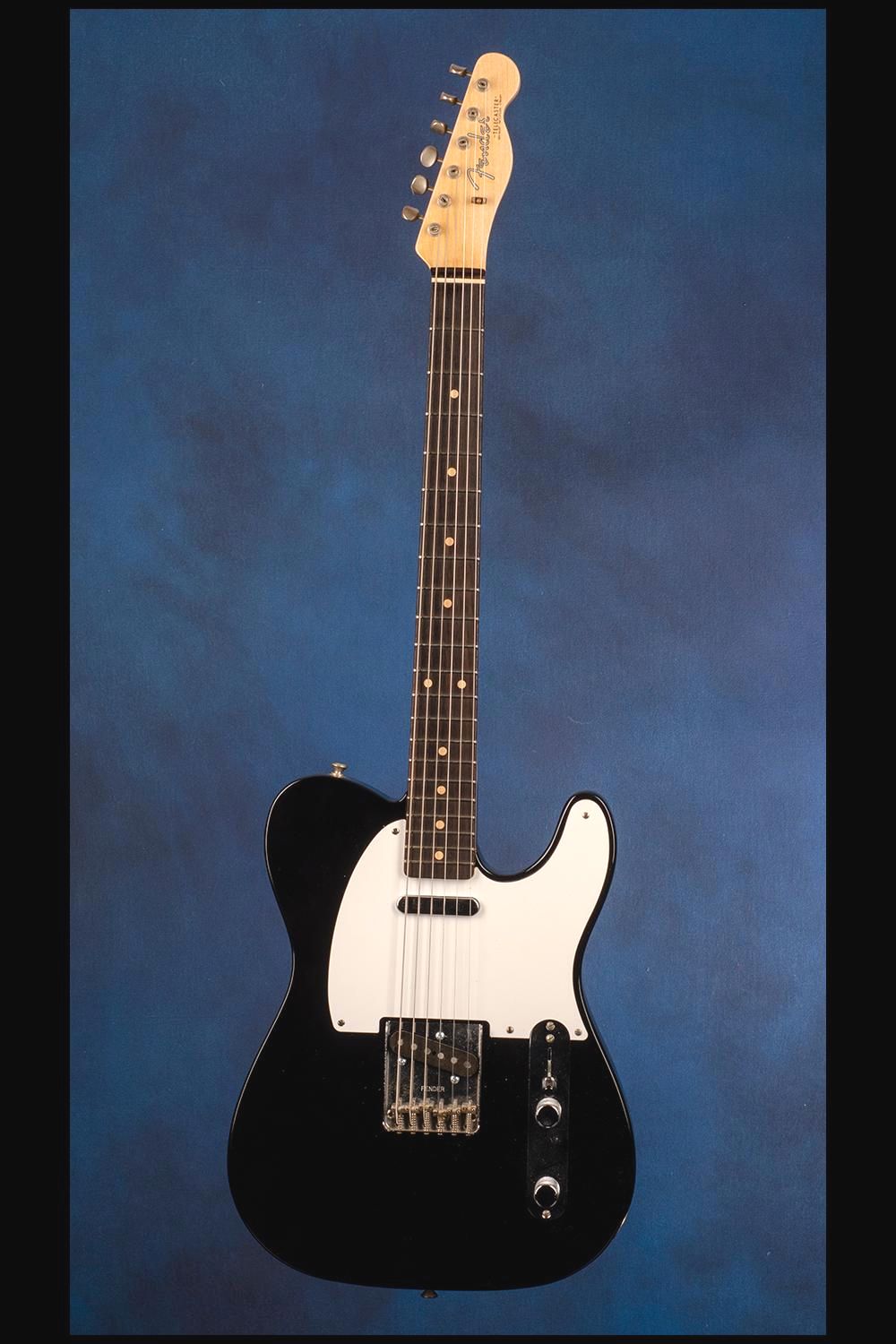
2012 Fender Telecaster, Black |
|
Single cutaway solid body. This is a 2012 Fender G.E. Smith, Telecaster with original black Nitrocellulose Lacquer finish. One-piece solid premium ash body and electronics which has been fitted with a 2019 Fender Custom Shop 'Journeyman' 1962 specification rosewood 'slab-board', maple neck. This 'Frankenstein' (in a very good way) Telecaster weighs just 7.60 lbs. 2019 Fender Custom Shop maple neck with a nut width of just under 1 11/16 inches, a scale length of 25 1/2 inches and a wonderful medium profile 'slab' fretboard with 21 original medium-thin frets and inlaid clay dot position and side markers. Individual single-line "Fender" Kluson Deluxe tuners with oval metal buttons. Headstock with 1962 style "Fender" 'spaghetti logo' in silver with black outline, "Telecaster" in black below, and "DES.164,227 PAT.2,573,254. 2,784,631" in black below that. Single "butterfly" string tree with metal spacer. Four-bolt neck plate with serial number "SV000566" between the top two screws and "C.E. Smith" beneath. One plain metal-cover Fender American Vintage Telecaster pickup (at neck) with an output of 7.03k and one black Fender American Vintage Telecaster 'Broadcaster' flat polepiece pickup (angled in bridgeplate) with an output of 9.78k. Single-layer white plastic pickguard with five screws. Two controls (one volume, one tone) plus three-way selector switch (with black plastic 'Barrel-Style' tip) all on metal plate adjoining pickguard. Chrome knobs with flat tops and knurled sides. Earlier Fender combined Standard bridge/tailpiece with six individually adjustable 'Elite' metal saddles (for better intonation). There are two small chips on the underside of the body by the neck plate, otherwise the guitar is virtually as new. Housed in the original 2012 Fender three-latch, shaped black hardshell case with black plush lining (9.25).
"As a child during the early 1960s, George Edward "G.E." Smith got a Telecaster guitar for his birthday and never looked back. Through his six hit-making years with Hall and Oates, his decade-long run as Saturday Night Live bandleader, and his touring stints with Bob Dylan, Smith is widely hailed as a modern master of the Telecaster."
FA 00899
$2,500
|
|
This Newsletter is Approved by Ozzy! |
|
|
|
|
|
|