|
President's Message
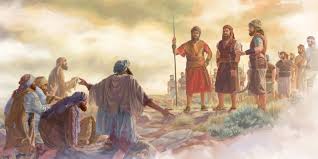
Achan’s Theft
“But the Israelites acted unfaithfully regarding the devoted things; Achan son of Carmi, the son of Zabdi, the son of Zerah, of the tribe of Judah, took some of them. So the Lord’s anger burned against Israel” (Joshua 7:1).
The site where Jericho once stood had been devoted to destruction. In connection with this, 1 Kings 16:34 later records the consequences of rebuilding Jericho. Yet a shadow falls over the glorious victory at Jericho. Although it was only one man, Achan, who violated God’s exclusive claim over the plunder, the entire people of God suffered punishment as a result. The community bears responsibility for the individual, and all must share in the consequences of one person’s wrongdoing.
Israel could win in battle only when they acknowledged—even in the smallest matters—that it was God who fought for them and gave them the land. In the case of Ai, the regulations concerning plunder were applied with particular strictness because it was regarded as an offering of “firstfruits.” Later, however, the Israelites would be permitted to take plunder for themselves.
Defeat at the Small City of Ai (7:2–5)
After Jericho in the Jordan plain, Israel turned its attention to Ai, a hill country city, as the next target of conquest. Ai lay about twenty miles northwest of Jericho, and two miles further northwest from Ai was Bethel, associated with Jacob’s dream of the ladder. The two cities were either under one ruler or had formed an alliance against Israel.
From a human perspective, this city, unlike Jericho, should have been easily conquered with a small force. Therefore, the defeat was incomprehensible and plunged Israel from confident victory into deep despair. What is demonstrated here is that human success is connected to obedience to God’s commands. God had already made this clear to Joshua in Joshua 1:8: “Keep this Book of the Law always on your lips; meditate on it day and night, so that you may be careful to do everything written in it. Then you will be prosperous and successful.”
Joshua’s Prayer of Repentance (7:6–15)
God ties the honor of His own name to the honor of Israel’s name. This is the point to which Joshua appeals. Yet here, unlike Moses in a similar crisis (Exod. 32:11–14), Joshua does not stand as boldly; instead, like a discouraged and complaining people (cf. Exod. 14:11), he laments.
In response to Joshua’s prayer, God presents a difficult issue. Israel has taken some of the devoted things—the plunder that had been set apart as belonging to God Himself (7:17–19). Israel’s very life depended on the covenant with God, but by breaking that covenant, they placed themselves under the sentence of destruction. The offender must be identified, whether by God’s direct judgment or by the casting of lots. To carry out this holy process, the people must consecrate themselves, just as they would when preparing for worship. To make atonement for the offense committed in Israel, there must be public confession, removal of the wrongdoing, and punishment of the guilty party.
Achan Stoned (7:22–26)
As in the case of Korah’s company, the punishment extends even to family and possessions. Because the consequences of Achan’s sin affected the entire nation, all Israel stones him. The heap of stones remains visible for a long time and serves as a warning sign. In verse 26, the name Achor means “trouble,” and in verse 25 Joshua uses a related Hebrew verb, akar (“to trouble”), to explain the basis of Achan’s punishment.
Reflection
Achan likely did not realize how his sin would affect the entire community of Israel. He may not have understood the nature of God’s holy covenant community. Perhaps he saw himself merely as “one individual” within Israel, not recognizing that he represented the whole and that his actions would influence everyone.
But the community of God’s people is not just a gathering; it is “one body.” In a faith community, one person represents the whole, and one person’s actions affect the entire body.
Conversely, the good deeds of one person bring glory to God and to the church. Jesus said, “Let your light shine before others, that they may see your good deeds and glorify your Father in heaven” (Matt. 5:16). We are people who reflect the light of Christ. Others should be able to see His light through us.
|