Finding Joy in a World of Negativity
Director of Spiritual Life: Brandt Akin
October 2020
For the last ten years or more, the National Institute of Health (NIH) has been releasing studies on what is required for an individual, particularly an adolescent, to be emotionally healthy. The data continues to come in and affirm that a key component is a 3:1 ratio of positive thoughts to negative thoughts. For every negative thought that runs through a teenager’s brain, three positive thoughts are needed to balance his or her outlook on life.

While it sounds a bit too much like a self-help book, it also has a ring of truth to it. We have all spent time around someone who has a particularly negative outlook on life and is vocal about it. Chances are, we tend to manage the amount of time we spend with that person because we find it impacting our own outlook on life, and we don’t like it very much. It’s certainly not the disposition we hope and pray for our children to develop as they grow up. We want our children and students to enjoy life and to embrace Jesus’s call to the good and abundant life. We want them to have a positive outlook. So now that the data is in, it seems easy enough - just think happy thoughts and all will be well. Right?

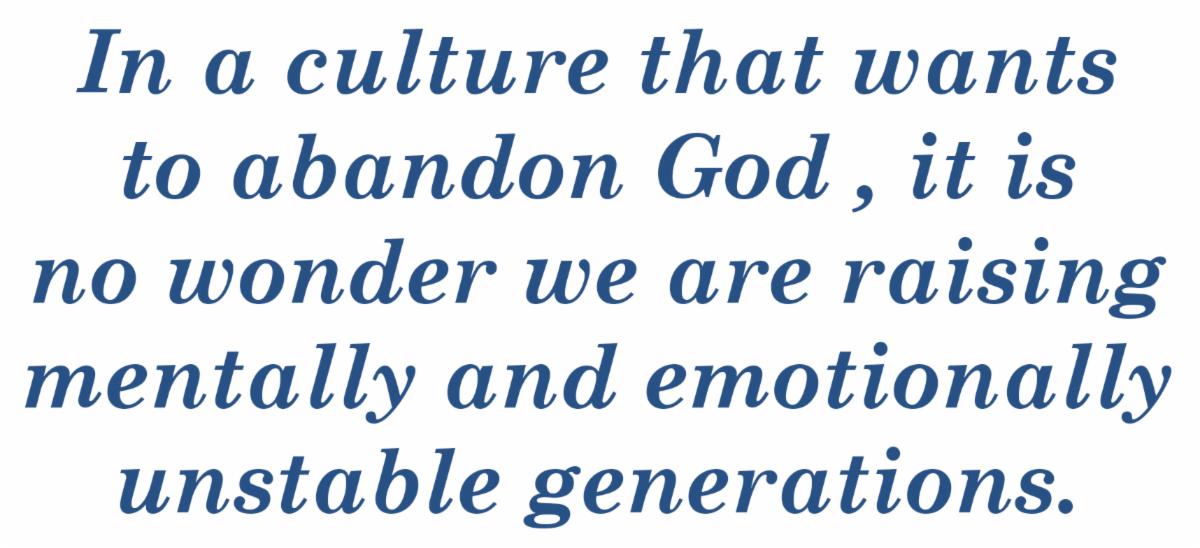
When the data is left at that, then we really are left with a self-help book, and not a particularly helpful one at that. It’s simply a regurgitation of modern pop psychology that says “think happy, be happy” because it is rooted in a worldview that prioritizes individual happiness over truth and reality. Living life by the motto “do what makes you happy” over living by what is true has failed us, and it is leaving a younger generation incapable of combating the difficulties of life. The data from these studies reveals that younger generations are less emotionally stable and less capable of maintaining the healthy ratio it identified. In a culture that wants to abandon God (to try and find the good life God created us for in the good world He created, but do it apart from Him), it is no wonder we are raising mentally and emotionally unstable generations.
The interesting idea about the way these scientific studies consistently define “positive thoughts” is they are not simply happy thoughts. Instead, a positive thought is defined as, “a thought that includes gratitude and contentment”. This sounds more like, “Give thanks to the Lord for He is good” in Psalm 107 or “I have learned the secret of being content in any and every situation” in Philippians 4 than it does pop psychology. What it reveals is that the Bible’s encouragements for living are true. They match the evidence. Science is inadvertently telling us that gratitude and contentment for who God is and what He has done will lead us to a fulfilled life. In order to raise a healthy generation, one that can handle the difficulties of say, a global pandemic, we need to be raising a generation with a resilient faith in God and His Word.

But when everyone seems to put the focus on the negative in the world to remind us of how bad things have become, how do we still cultivate gratitude and contentment and lead our children in the same way?

God has told us all along how to approach life and find joy even when our circumstances do not make it easy, so I want to leave you with three things from Scripture about how to handle our thought life as we follow Jesus and encourage you to lead your children in these as well. I have italicized a key phrase in each that stands out as a directive to us as followers of Jesus.

  • “For though we walk in the flesh, we are not waging war according to the flesh. For the weapons of our warfare are not of the flesh but have divine power to destroy strongholds. We destroy arguments and every lofty opinion raised against the knowledge of God, and take every thought captive to obey Christ.” (2 Cor. 10:3-5)

  • “Finally, brothers, whatever is true, whatever is honorable, whatever is just, whatever is pure, whatever is lovely, whatever is commendable, if there is any excellence, if there is anything worthy of praise, think about these things.” (Phil. 4:8)

  • “Looking to Jesus, the founder and perfecter of our faith, who for the joy that was set before him endured the cross, despising the shame, and is seated at the right hand of the throne of God. Consider him who endured from sinners such hostility against himself, so that you may not grow weary or fainthearted.” (Heb. 12:2-3)