|
What Does It Really Cost to Run an Election in Maricopa County?
When voters walk into a Vote Center or drop an early ballot in the mail, most of us see the final product: a ballot. What we don't see is the enormous operation behind that ballot.
Maricopa County is one of the largest voting jurisdictions in the country, serving more than 2.5 million registered voters. Running an election requires permanent employees, thousands of temporary workers, Vote Centers, ballot printing and postage, warehouses, trucks, couriers, security, computer systems, tabulation equipment, technical support, voter hotlines, advertising, training and much more.
And all of that costs money.
How Maricopa Compares
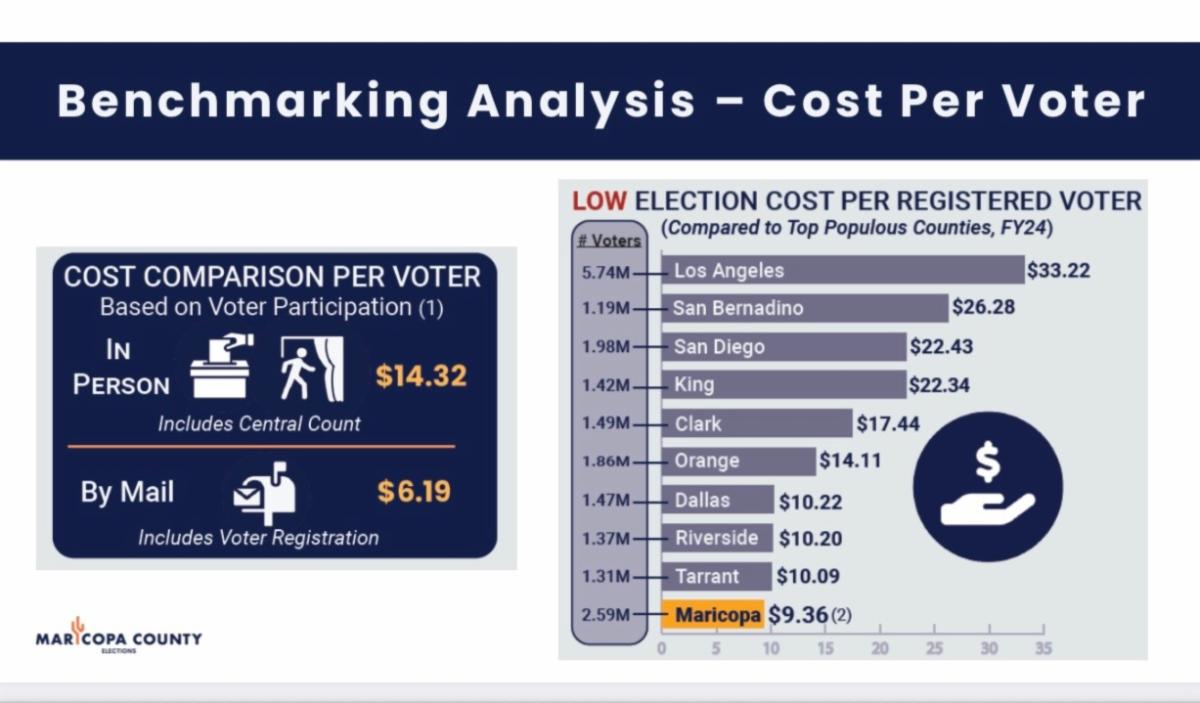
A set of county comparison figures provided for this article puts election-administration spending per voter at:
CountyCost Per Voter
San Bernardino County, CA $36.38
Los Angeles County, CA $33.22
San Diego County, CA $22.43
King County, WA $22.34
Clark County, NV $17.44
Orange County, CA $14.11
Dallas County, TX $10.22
Riverside County, CA $10.20
Tarrant County, TX $10.09
Maricopa County, AZ $9.36
There is an important caution when comparing these numbers: counties don't necessarily calculate election costs the same way. Some include permanent staffing, facilities, equipment and technology that others account for elsewhere. Even within Maricopa County, the per-voter figure changes depending on which election-cycle expenses are included.
For example, Maricopa County's official 2024 Primary and General Election Plan estimated nearly $29 million for the two elections, or approximately $12 per registered voter using the county's calculation at the time.
So the $9.36 comparison is useful as one benchmark, but it should not be presented as an apples-to-apples audited ranking without knowing precisely what each county included.
Where Does the Money Go?
The 2024 election plan provides a good picture of what it takes to conduct elections here.
Maricopa County budgeted approximately $14.5 million for staffing alone. That included permanent employees, temporary workers, poll workers, central boards, call-center employees, security, incentives and mileage reimbursements.
Another $13.3 million was budgeted for supplies and services.
The largest single item in that category was printing, mailing and postage for ballots and voter-registration identification cards—approximately $9.8 million between the Recorder and Elections operations. Another $1.4 million was budgeted for advertising, while roughly $1.35 million covered expenses including fuel, temporary parking, shuttles, vehicle rentals and Vote Center rentals.
Then there are the smaller expenses that quickly add up: Vote Center supplies, radios and telecommunications, translation services, consumables, ballot reprints and other operational expenses.
Thousands of People Make an Election Happen
The sheer manpower required is easy to underestimate.
For the November 3, 2026 General Election, Maricopa County says it needs more than 4,000 election workers. In addition to poll workers, Elections expects to hire nearly 500 temporary workers for functions including warehouse operations, technical support, ballot courier services, tabulation and hotline support. Temporary positions generally pay between $18 and $23 per hour, depending on the job and experience.
And these aren't all Election Day jobs.
Some temporary employees work for weeks or months before and after an election. Ballots must be prepared. Equipment must be tested. Workers must be recruited, background-checked and trained. Vote Centers must be prepared. Trucks must deliver equipment. Technical workers must be ready to respond when something goes wrong.
On Election Day, poll workers can begin at 5:30 a.m. and continue until approximately 8 p.m. or later.
Follow the Ballot
Consider what has to happen with just one early ballot.
It must be designed and printed correctly, placed into the appropriate ballot packet and mailed to the voter. When returned, it has to be received, secured, processed and ultimately prepared for tabulation.
That requires people and machinery.
Maricopa County employs mail-room workers who transport and process election mail and operate specialized envelope-opening equipment. Pre-tabulation ballot processors work in bipartisan teams, opening and counting ballots, balancing paperwork and preparing ballots for tabulation.
Ballots deposited at drop boxes create another operation entirely. Couriers work in bipartisan teams to retrieve ballots and transport them securely, with chain-of-custody documentation accompanying the transfer.
Then There Is the Equipment
Modern elections also require a substantial technology infrastructure.
Maricopa County's FY2026 Elections budget includes approximately $3.15 million for operating election equipment. The county also added ongoing funding for Ballot on Demand printer licensing, IT contracts and software and hardware licenses.
Ballot-on-demand printers, tabulators, computers, networking equipment and other systems don't simply appear at Vote Centers on Election Day. Equipment has to be stored, maintained, tested, transported, installed and supported.
That means warehouses and trucks.
Warehouse drivers load and transport equipment to voting locations and then bring it back when the election is finished. Technical workers travel among Vote Centers troubleshooting equipment problems.
Maricopa County's election facility itself illustrates the scale of the operation. The facility was designed with expanded public observation areas, more than double the previous pre-tabulation and tabulation capacity, and three times the warehouse space for election equipment.
The 2026 Budget
For FY2026, the Elections Department budget shows approximately $26.46 million in expenditures, including about $8.76 million for personnel, $13.95 million for services, $1.62 million for supplies and $2.13 million for capital and other expenses.
Separately, the county budget identifies $13.8 million in one-time spending for the 2026 Primary Election, divided between $8.6 million for Elections and $5.2 million for the Recorder's Office.
And there is a new expense resulting from the 2026 settlement between the Board of Supervisors and Recorder's Office. Under that agreement, the county will fund additional Recorder positions and $15 million for a separate Recorder IT system. That is an infrastructure expense rather than simply the ordinary cost of conducting one election, so it should not be folded into a per-voter election-cost comparison without explanation.
Elections Are Expensive Because Elections Are Complicated
It is easy to look at an election budget and wonder why it costs millions of dollars to let people vote.
But we aren't paying simply to print pieces of paper.
We are paying for the infrastructure necessary to administer an election for millions of registered voters: full-time employees, temporary workers, poll workers, Vote Centers, ballot printing, postage, warehouses, trucks, fuel, couriers, tabulators, printers, computer systems, cybersecurity, training, public information, security, bipartisan processing teams and documented chains of custody.
There is also redundancy built into the process—and some of that redundancy costs money.
The appropriate question for taxpayers isn't simply, “How much does an election cost?”
It is also, “What are we receiving for that money, and are we administering elections efficiently while maintaining accuracy, security, accessibility and transparency?”
Maricopa County's scale makes that an especially important question. The available county budgets show that elections are a major logistical operation, but they also provide taxpayers with something valuable: the ability to examine where the money is going and ask whether every dollar is necessary.
One thing is certain: Election Day may last one day, but running an election does not.
|