So much can hold someone back from writing a memoir: feeling like they don’t have a compelling story to tell; not being a trained writer; fear of upsetting someone involved.
Memoirists Mindy Greiling and Abby Maslin shared their experience grappling with those issues and more during a program Friday by the National Press Club Journalism Institute. In “Write what you know: ‘Fix What You Can’ & ‘Love You Hard,’” the authors were joined by Angela Greiling Keane, managing editor, states and Canada at POLITICO, whose family played a role in both memoirs; with moderator Aly Colón, Knight Professor of Media Ethics at Washington & Lee University.
Greiling, author of “Fix What You Can: Schizophrenia and a Lawmaker’s Fight for her Son,” and Maslin, “Love You Hard: A Memoir of Marriage, Brain Injury, and Reinventing Love,” candidly shared their writing process, how they involved those included in the story, and how they confronted questions of accuracy during the editing process.
|
Some of their advice includes:
-
Start writing without an end in mind. For Maslin, writing became “a therapy, to make sense of what was happening in our life. … It was only right to write about it and publish at the point that I had mined the experience for the wisdom that I needed to see how it had changed me.”
-
Find a writing community. A writing group can spark inspiration through exercises that can narrow your focus, and sharing your work throughout the process can shed light on how others may have perceived an event you are focused on.
-
Accuracy in memoir is important. But the memories you choose to share are your interpretations of an event. Check dates, places and other facts. Having beta readers of different backgrounds and degrees of closeness to the story can help gut check content.
-
Source material is at your fingertips: journals, photo albums, scrapbooks, blogs, historical, medical or genealogy records can both inspire details to include and spin you closer to your central storyline. As a long-time journaler, Greiling found her collection of personal writing “immensely helpful, even though they weren’t intended as a resource for a memoir.”
-
Read other memoirs or autobiographies. They can inspire structure choices and provide insight into detail selection.
-
When it’s tough, remember your “why”. Both Maslin and Greiling tapped into their desire to pull back the curtain on the topics of schizophrenia and life after brain injury, respectively, in service to their central figures’ struggles.
-
Accuracy is important, but a memoir can’t be 100 percent right. It’s impossible to write a memoir with 100 percent accuracy. By nature, they are the author’s interpretation of events. Both Maslin and Greiling shared chapters or segments of their books with central figures ahead of publication. “You can’t candy coat everything and write from the heart,” says Greiling.
-
Remember that, “No one asks to be written about in a memoir,” Maslin said. Being truthful to and about subjects and events is key. “You want to do right by the people you are writing about,” says Maslin.
-
Prepare to cut, add, and let the story evolve during the writing process. A memoir captures “a very kind of concentrated chapter” of life, says Maslin. “Just figuring out what needed to be there as an essential way of connecting to the authenticity of the experience.”
|
|
Visual social media posts are no longer a nicety — they are a necessity. Not all teams, though, have the resources to devote to designing and creating social media posts that sing.
Learn how to stop skimmers in their scrolls with visually dynamic social media messaging in “Design Hacks: How to create social media graphics.” During this hands-on workshop, participants will practice design fundamentals while creating posts from start to finished product. This session is designed for journalists and communicators who don’t regularly produce graphics but find themselves taking on some of that work right now.
|
|
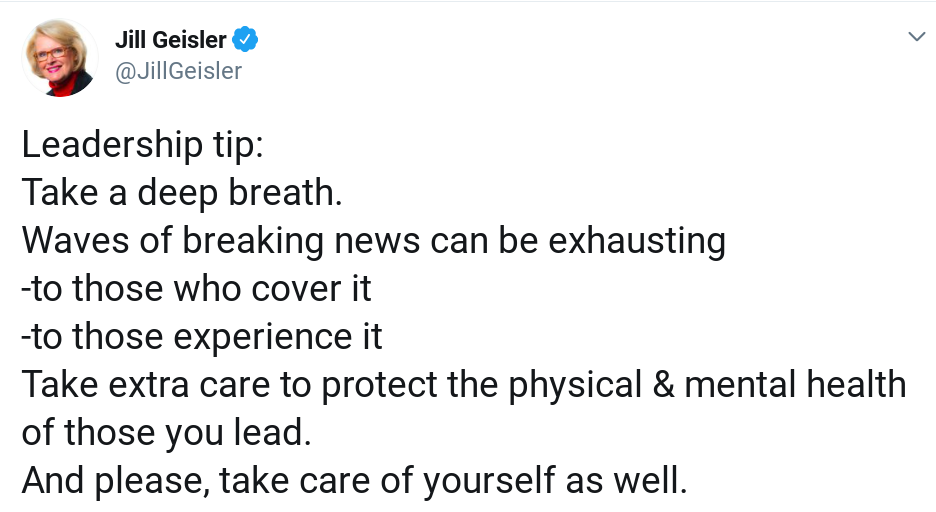
Advice from Jill Geisler, Bill Plante Chair in Leadership & Media Integrity, Loyola University Chicago, Freedom Forum Fellow in Women’s Leadership
|
|
|
Prashant Rao, international editor at The Atlantic, shared how he's been taking care of himself during the COVID-19 pandemic.
“I've been watching some old TV shows I missed out on when they first came out (Line of Duty, which is like a British version of The Wire; Borgen, about Danish politics; and Schitt's Creek), and changing up my reading habits, so I read things that aren't too current or news-y (I just finished "Kidnapped" by Robert Louis Stevenson, and have been making my way back through all my various Calvin & Hobbes books).”
|
|
This newsletter is written & edited by the National Press Club Journalism Institute staff: Beth Francesco, Holly Butcher Grant, and Julie Moos. Send us your questions and suggestions for topics to cover.
|
|
|
|
|
|
|