The American Society of Le Souvenir Français Inc.
Monthly Bulletin - Vol. IV. No 4 - April 2024
|
|
La Pérouse in the Pacific Northwest, California and Hawaii |
|
Cover illustration:
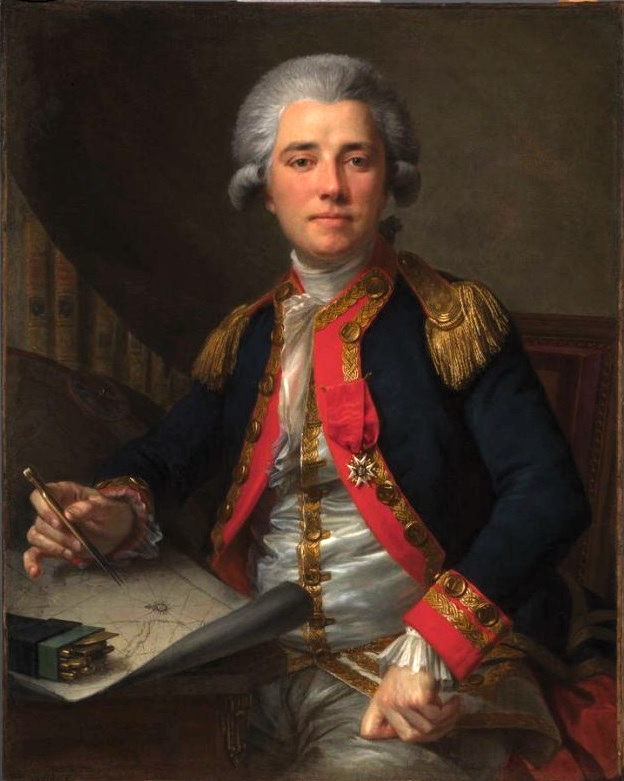
1778 portrait of Count Jean-François de Galaup de La Pérouse (1741-1788), portrayed on his return from the Indies, dressed as a lieutenant and wearing the Order of Saint-Louis issued the previous year. Location: Fine Arts Museums of San Francisco.
By Geneviève Brossard de Beaulieu - tumblr.com, Public Domain,
|
|
EDITORIAL
There are several sites in the Pacific Northwest, California and Hawaii which were discovered by the great navigator and explorer Jean François de Galaup, comte de La Pérouse. In keeping with its mission to honor Frenchmen who accomplished great deeds in America, your Society plans to honor him with interpretive markers at these sites. While these projects are underway, it is fitting that we dedicate this Bulletin to his memory and to his companions, sailors and scientists.
We are grateful to Marc Onetto, Regional Delegate for the West Coast, and who is himself a keen admirer of La Pérouse, for lending a significant corpus of his past conferences to this Bulletin, as well as his support for the restoration of a monument in his honor at La Pérouse Bay in Maui. And, as La Pérouse (and his trusted companion Paul Antoine Fleuriot de Langle) both fought for American Independence, we are also honored to collaborate with the Hawaii chapters of the Daughters of the American Revolution.
The French-American alliance spans over more than two centuries. We therefore jump from the 1780’s to the 1910’s with our series honoring members of the Lafayette Flying Corps. This month, we are paying tribute to Sgt James Henry Baugham, who “Died for France” and whose remains rest at the Lafayette Escadrille Memorial in Marnes-la-Coquette just outside Paris.
We are entering a period filled with several important celebrations. Mark your calendar! Of course the 80thAnniversary of D-Day has a special significance, as we say a profound “Merci” to the last survivors of this heroic fight for freedom and democracy. There are also several other events, also worthy of your attention and support, and we list them in the final part of this Bulletin.
The Lafayette Bicentennial is now entering its final preparation stages! We invite you to visit the website Lafayette200.org to be kept abreast of all the numerous events being finalized throughout 24 States, starting with the kick-off on August 16th in New York.
Thank you for providing your feedback and recommendations. We encourage you to spread the word about this Bulletin among your friends, colleagues, and especially within the education community. Passing on the torch of memory to the younger generations is crucial.
On behalf of the Board of Directors,
Thierry Chaunu
President, American Society of Le Souvenir Français, Inc.
|
|
Historical Context:
To complete Captain Cook's explorations
|
|
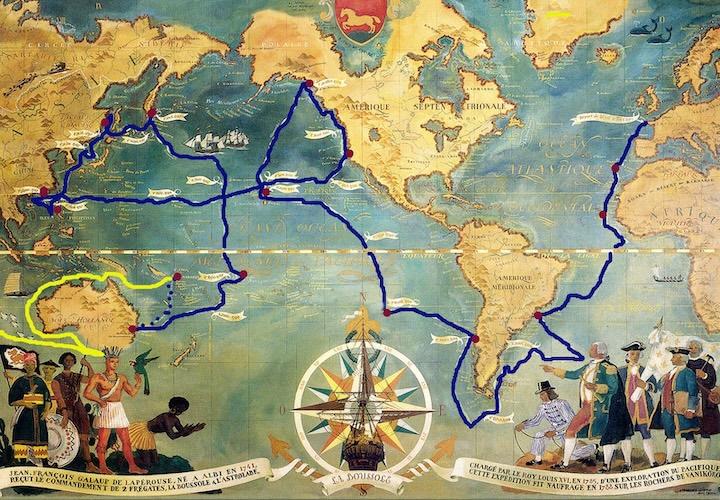
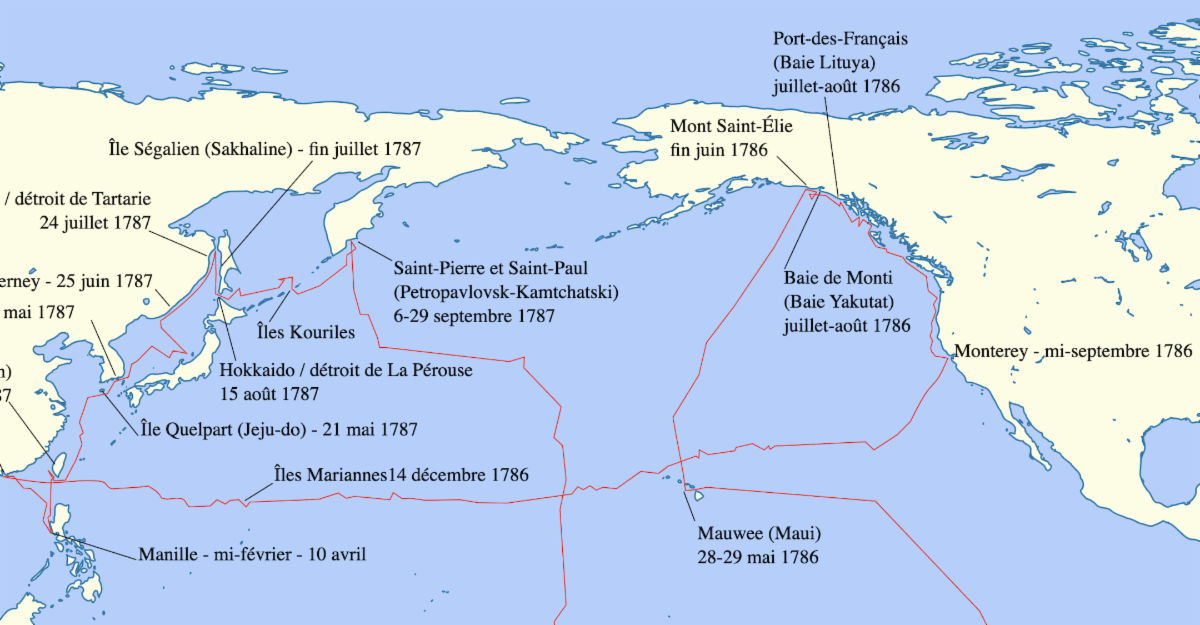
Above: Voyage map of La Pérouse 1785-1788
Expédition La Pérouse. La Boussole and l'Astrolabe route, Pacific Ocean map
|
|
• In 1785, King Louis XVI, under the advice of his Minister of the Navy, the Marquis of Castries, selected Jean François de Galaup, comte de La Pérouse, to lead an expedition around the globe. La Pérouse had initially caught the King's attention due to his remarkable bravery and valor exhibited during the American War of Independence, where France supported the American colonies against Great Britain.
• The expedition was viewed as a significant move in furthering France's political influence. Unexplored territories awaited discovery, trading prospects were to be nurtured. A new expedition would augment the corpus of knowledge amassed by Cook's journey in various fields such as geography, hydrography, physics, astronomy, mineralogy, botany, and meteorology with the aim of carrying out the unfinished work of Cook. The concept of an exploration was enthusiastically endorsed by the king, who had always held a keen interest in exploration, geography, and the natural sciences.
• The itinerary, and instructions, were overseen in the smallest details by the King himself.
• The expedition was initially planned to last three years, necessitating a significant effort to equip it accordingly. The vessels chosen for this mission were the Astrolabe and the Boussole, each weighing 500 tons. Originally intended as store-ships, they were refitted as frigates for the purpose of the expedition. Each ship was loaded with 350 barrels of food, as well as 1,000 tons of equipment and goods intended for trade at the various ports they would visit.
• La Boussole, under the command of La Pérouse, and L'Astrolabe under the command of De Langle, departed from Brest in August 1785. Accompanying La Pérouse on this voyage were a crew of 114 in each ship, and ten scientists including an astronomer, engineer, mineralogist, naturalist, gardener-botanist, and two draughtsmen.
• Between 1785 and 1788, the expedition traversed the world's oceans.
The initial route took them to Brazil and Cape Horn, before venturing into the Pacific Ocean to explore the coast of Chile, Easter Island, the Sandwich Islands, Hawaii, Alaska, California, Macao, Manila, the China and Japanese seas, the Tonga Islands, and Australia.
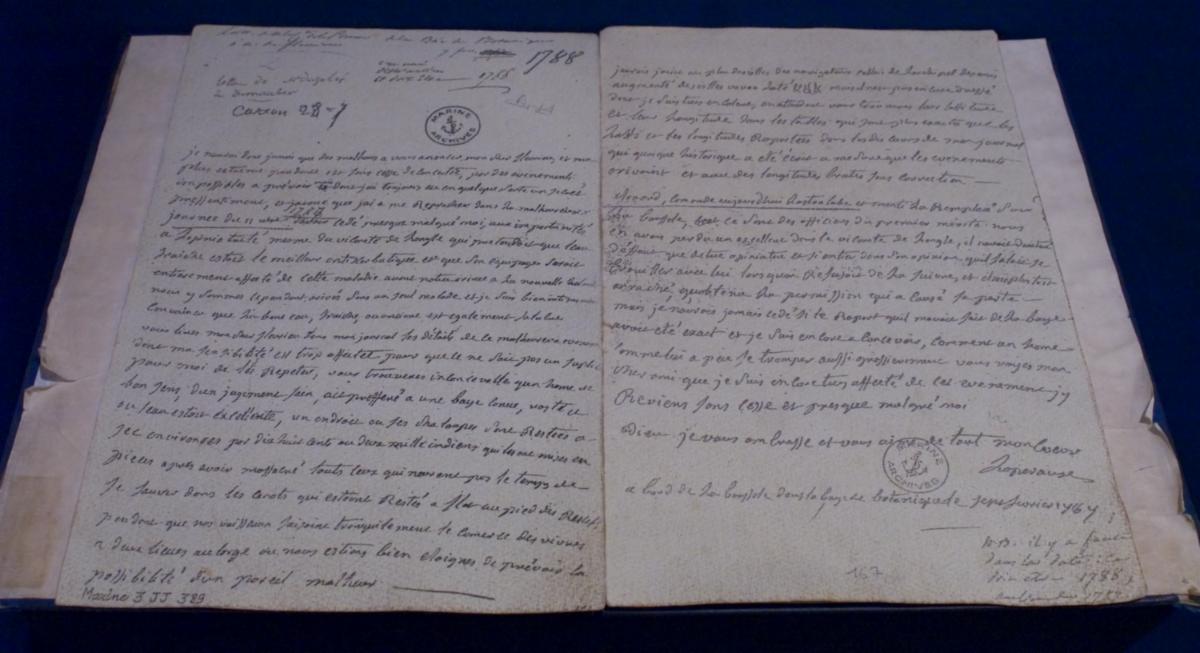
• Although they were scheduled to return to France in the summer of 1789, no communication was received from La Pérouse's expedition after their departure from Botany Bay (just south of Sydney) in Australia where the crew sought refuge after a massacre by natives on Maouna Island (today known as Tutuila Island) resulted in the loss of thirteen members. La Pérouse's last letter, obligingly carried by a British ship was dated February 7, 1788. The expedition left Australia in March 1788, never to be seen again. Tragically, the fate of the expedition remained a mystery for several decades.
• The disappearance of the expedition led to concerns and speculation, prompting the king to dispatch a rescue mission, which unfortunately proved unsuccessful. A decree from the National Assembly in April 1791 mandated the publication of the reports, maps, and drawings that Lapérouse had sent during his voyage. Milet-Mureau published the official account of the expedition, based on the documents entrusted to Barthélémy de Lesseps, the expedition's interpreter and historiographer, (and uncle of Ferdinand de Lesseps, of Suez Canal fame), during a stopover in Kamchatka in September 1787, shortly before the tragic events unfolded.
• It was not until 1826 that the wrecks of the two ships were found on Vanikoro, in the Santa Cruz islands, now part of the Solomon Islands in the heart of the South Pacific. We now know with reasonable scientific certainty that both ships were caught in a typhoon in May 1788 and were wrecked on the reefs of Vanikoro. Were there any survivors? No one knows for sure, but is quite possible. Some historians suggest that Captain Edwards of the HMS Pandora, tasked with searching the South Seas for the mutineers of The Bounty, may have sailed past the island in 1791 and, focusing solely on pursuing the mutineers, disregarded smoke signals of distress emanating from the island.
• Literally dozens of sites were discovered, mapped, drawn with scientific precisions all over the Pacific ocean and the Western coastline of North and South America.
In this Bulletin, we will confine ourselves to narrating the French explorations of Hawaii, the NorthWest Pacific, the California coast, and the American Samoa.
...But before we do, let us introduce La Pérouse, and his brilliant role in the War of Independence!
|
|
Jean-François de Galaup de La Pérouse
a valiant hero in the fight for American freedom
|
|
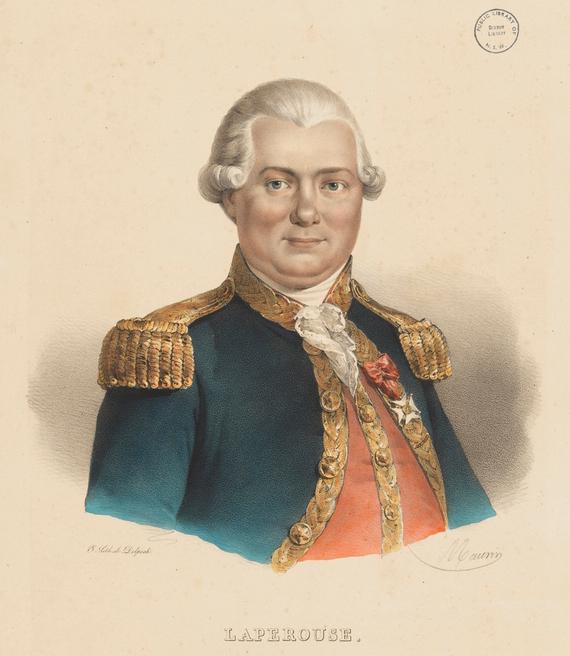
Above: Jean-François de Galaup, comte de Lapérouse, lithograph c. 1835, by Antoine Maurin, State Library of New South Wales, by Antoine Maurin - State Library of New South Wales, Public Domain,
|
|
• Jean François de Galaup, comte de La Pérouse, was born at Château du Gô, in the parish of Saint-Julien, two leagues from Albi, France. His family was ennobled in the year 1558.
• Note, "La Pérouse" was the spelling consistently used in all official documents during his time, however, it is more commonly spelled "Lapérouse" in the years following the French Revolution, and he himself signed "Laperouse" as was the frequent usage at the time for the sake of rapidity, often without the accent. We will use both spellings depending on the context, even though an in-depth study by Jacques Thomas "La Pérouse ou Lapérouse, légitimité d'une orthographe , in "Bulletin de la Société d'Etudes Historiques de la Nouvelle-Calédonie", n° 71, 1987", recognized by the Institut de France and the Minister of Culture, the only spelling to be respected when writing the navigator's name is "La Pérouse", as evidenced in all the ensuing official documents, down to postage stamps.
• A seasoned sailor: La Pérouse received his education at a Jesuit college and entered the Navy as a "Garde-Marine" in Brest on 19 November 1756. In 1757, he was assigned to the French ship Célèbre and took part in a supply mission to the fort of Louisbourg in New France. He also participated in another supply mission in 1758 to Louisbourg, during which the fort was besieged at the early stages of the Seven Years' War, leading the expedition to take a detour around Newfoundland to avoid British patrols. During the Battle of Quiberon Bay in 1759, Lapérouse sustained injuries while serving on the Formidable. He was captured, briefly detained, and later released on parole back to France; he was officially exchanged in December 1760. In 1762, he was involved in a French endeavor to seize control of Newfoundland, managing to escape with the fleet when the British forces arrived in large numbers to expel them.
• When France sided with the Insurgents and declared war to England in 1778, La Pérouse was appointed as the commander of the 32-gun frigate Amazone, a sister-ship of the Hermione, in La Motte-Picquet's division, which left Brest on May 1, 1779 to reinforce Count d'Estaing's squadron. He took part in the Battle of Grenada.
• Comte d'Estaing's squadron reached the coast of Georgia on September 1, 1779 and was sent to Charleston. He captured the 20-gun HMS Ariel* on September 11, 1779. He was present at the siege of Savannah, then captured the frigate HMS Tigre off the coast of Georgia on December 8, 1779.
Lapérouse was promoted to the rank of Captain on 4 April 1780, and was part of the "Expédition Particulière" led by Rochambeau, and served under Admiral Ternay, setting sail from Brest on May, 2nd 1780. Between October and November 1780, Amazone patrolled the waters of Rhode Island, and then proceeded to the Caribbean.
• Subsequently, Lapérouse switched to the Astrée. In the summer of 1781, he was offered the command of the larger 50-gun Sagittaire, but due to his crew being afflicted with scurvy, he sought permission to retain control of Astrée. He was then designated to lead a frigate division, alongside the Hermione, which was under the command of Captain (and future admiral) Latouche-Tréville.
• For his service to the cause of American Independence, La Pérouse was made a Member of the Order of the Cincinnati.
* A note of trivia: The French took the captured ship HMS Ariel into service as Ariel. Ariel underwent repair and refitting at Lorient between March and October 1780. The French then lent her to the American Continental Navy in October, where she served briefly as USS Ariel.
|
|
Battle off the Spanish River, Nova Scotia
a.k.a. Battle of Cape Breton
Action of July 21, 1781
|
|
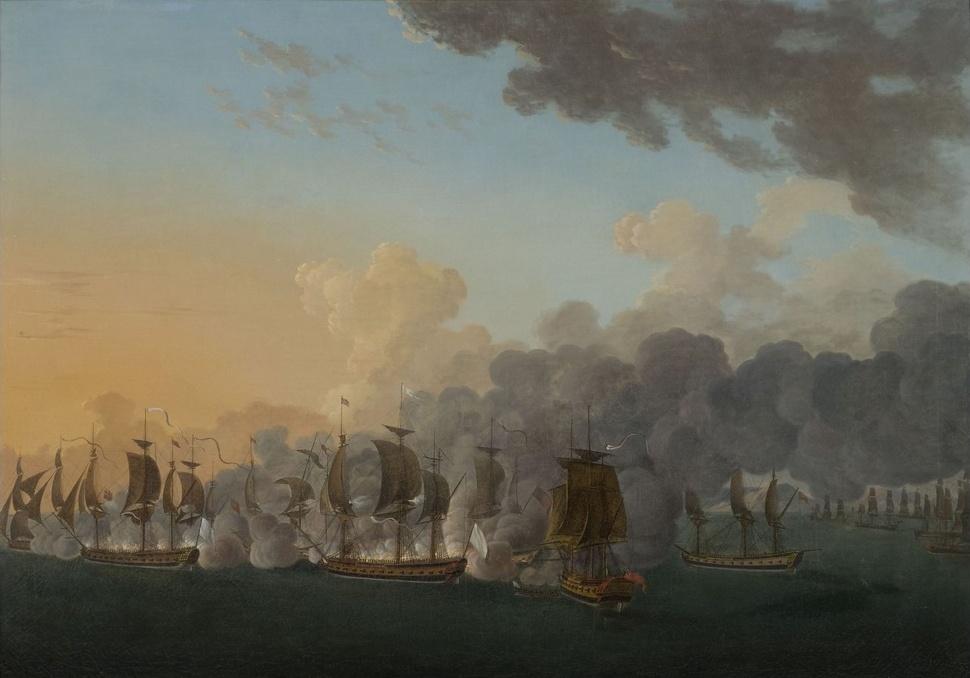
Above: "La Pérouse victoriously led the frigate Astrée in the naval battle of Louisbourg, 21 July 1781", by Auguste-Louis de Rossel de Cercy.
By Auguste-Louis de Rossel de Cercy - Musée National de la Marine, Public Domain,
|
|
• In June 1781 Hermione was attached to a frigate division under La Pérouse, recently promoted to Captain after capturing HMS Ariel, with his flag on Astrée. Both ships were light frigates, designed for speed, coppered, and armed with 26 12-pounder long guns, a larger calibre than that carried by most privateers, but under-powered against larger naval ships. The two ships cruised off Pennsylvania and New England, preying on British merchantmen, privateers, and smaller naval ships.
• In the morning of 21 July, 1781, while cruising north towards Halifax, Astrée and Hermione, detected a 18-ship convoy, with two corvettes or frigates detaching to investigate. The convoy, which consisted of 13 merchant vessels, including nine colliers and four supply ships, was bound for Spanish River on Cape Breton Island to pick up coal for delivery to Halifax, along with their Royal Navy escorts. The escorts were the frigate Charlestown (Charleston), commanded by Captain Francis Henry Evans, the sloops Allegiance and Vulture, the armed transport Vernon, and Jack, a small armed ship commanded by Richard Peter Tonge.
• As Astrée and Hermione approached the convoy, the five British warships formed a battle line. La Pérouse maneuvered to prevent the convoy from escaping, came within cannon range and started firing. The French had the advantage in firepower, as the British had 9-pounder guns, which were less powerful than the French 12-pounders.
• Astrée directed her firepower towards the British flagship Charlestown, as it attempted to seek assistance from the two ships ahead of her. However, Hermione swiftly surpassed Astrée and unleashed a barrage of broadside attacks on Charlestown for a duration of 30 minutes. Charlestown came to a halt, but in doing so, it once again positioned itself within Astrée's line of fire, while Hermione had the freedom to engage Jack at close range. Eventually, Jack surrendered by lowering its flag. Shortly thereafter, the main mast of Charlestown collapsed, and with its captain deceased, Charlestown also surrendered.
• By nightfall, the three remaining British warships were trying to escape from Hermione. Astrée captured Jack and and signaled Hermione to capture Charlestown, but Charlestown managed to escape into the darkness. Hermione and Astrée tried to chase her but lost her, eventually giving up the pursuit. Six French and seventeen British sailors were killed in the action. Hermione had 3 killed, 6 gravely wounded, and 13 lightly wounded; Astrée had 3 killed and 15 wounded. After temporary repairs, Astrée and Hermione returned to Boston on 17 August.
• Learning of their presence, the British sent three heavy frigates to intercept Astrée and Hermione, but the French frigates managed to return safely to Boston without meeting the British division. Captain Tonge and his crew were taken as prisoners to Boston. The French sent Jack to Boston with a prize crew, along with four other captured ships: Thorn, Friendship, Phoenix, and Lockard Ross. Friendship and Lockard Ross were recaptured by the British while in transit.
• Jack was sold at Salem but was recaptured the following year in the Naval battle off Halifax. Lapérouse and Latouche were initially annoyed by Charleston's escape but later expressed regret upon learning of Evans' death. La Pérouse praised Evans as "a very brave man."
• In 1788, Rossel de Cercy painted a large depiction of the battle, now displayed at the Musée National de la Marine in Paris.
• La Pérouse, with a naval squadron of 3 ships including the Astrée commanded by his trusted friend de Langle, went on to a successful expedition in Hudson Bay to capture and destroy the Prince of Wales Fort and York factory in 1782, after the Yorktown Victory and prior to the Peace Treaty of 1783. This allowed La Pérouse to hone his skills in polar navigation.
His exploits earned him popular acclaim in Europe and North America.
At the conclusion of the war, he was made Captain, married at the age of 39, and was soon to be selected to conduct the major expedition around the world that bears his name...
|
|
A meticulously prepared scientific expedition |
|
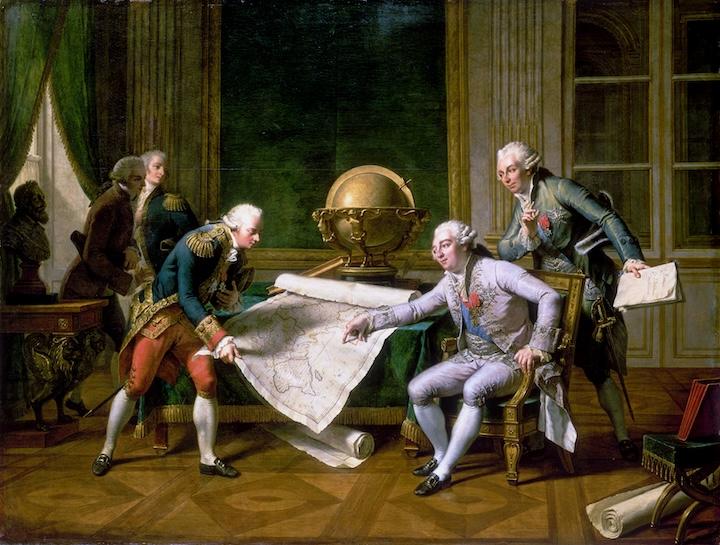
Above: Louis XVI, seated at right, giving Lapérouse his instructions on 29 June 1785, by Nicolas-André Monsiau (1817), by Nicolas-André Monsiau - Chateau de Versailles, Public Domain. While the painting has historically been inaccessible because it hangs in the Queen’s Guards Room in Versailles, it has recently been made available online. It shows The participants depicted are Louis XVI (seated), showing the route he was to follow after rounding Cape Horn, skirting the entire Pacific coast from the Americas to Alaska via Easter Island and Hawaii. From Kamchatka to Australia, La Boussole and L'Astrolabe will complete Bougainville and Cook's exploration of the Pacific. Behind him the minister of the Navy Charles-Eugène-Gabriel de La Croix, marquis de Castries, (holding a very thick book of Instructions), La Pérouse bending on the map, and in the background Ange-Auguste-Joseph de Laborde de Boutervilliers, Edouard-Jean-Joseph de Laborde de Marchainville.
|
|
The King’s Instructions:
• As we noted above, King Louis XVI and the Marquis de Castries, who was minister of the Navy, appointed La Pérouse to command a global expedition. Louis XVI had always taken an interest in cartography and geography. The 45-page written set of instructions are quite remarkable by their length, precision, and constant insistence on respecting the expedition's pacific and scientific intentions. The prologue is worthy of being reproduced in extenso:
“His Majesty, having ordered the frigates, la Boussole, commanded by the sieur de La Pérouse, and l’Astrolabe, commanded by the sieur de Langle, captains in his Navy, to be equipped in the port of Brest for a voyage of discovery, makes known to the sieur de La Pérouse, whom he has appointed commander in chief of the two vessels, the service he will have to perform in the important expedition with which he is entrusted.
The different objects, which his majesty had in view, in giving orders for this voyage, require the present instructions to be divided into several parts, thereby to explain the more clearly to the sieur de La Pérouse his Majesty's particular intentions, with respect to each of the objects he will have to pursue.
The first part will contain his route, or the plan of his voyage, in the order of the discoveries, which he will have to make or improve; and to this will be added a collection of geographical and historical notes, which may serve to guide him in his different researches.
The second part will treat of subjects relating to politics and commerce.
The third will exhibit a detail of operations relative to astronomy, geography, navigation, physics, and the different branches of natural history, and will serve to regulate the labors of the different artists and men of science, employed in the expedition.
The fourth will contain directions for the conduct of the sieur de la Perouse towards the savages, and the natives of the different countries he may have an opportunity of discovering or visiting.
The fifth will point out to him the precautions he ought to employ, to preserve the health of the ships* crews under his command* “
These instructions were explicit, extensive with a significant level of detail, and infused with profound compassion and humanity, a perfect illustration of the Age of Enlightenment...
To wit, here are just a few:
• “On all occasions, Sieur de LaPérouse will act with great gentleness and humanity towards the different peoples whom he will visit during the course of the voyage.”
• “His Majesty will consider it as one of the happiest events of the expedition if it should end without costing the life of a single man.”
• "He will direct the draughtsmen embarked on board the frigates to take views of all remarkable places and countries, portraits of the natives of different parts, their dresses, ceremonies, games, buildings, boats and vessels, and all the productions of the sea and land, in each of the three kingdoms of nature, if he shall think that drawings of them will render the descriptions more intelligible."
Despite Cook's violent death in Hawaii in 1779, the instructions to La Pérouse bear witness to the influence of the Enlightenment on the expedition:
• "If circumstances, which it is prudent to foresee in a long expedition, should ever oblige the Sieur de La Pérouse to make use of the superiority of his weapons over those of the savage peoples, in order to procure, in spite of their opposition, the objects necessary for life, such as substances, wood and water, he would only use force with the greatest moderation, and would punish very severely those of his people who had exceeded his orders".
• “Of all the plans of countries, coasts, and harbors, two copies will be one will be kept by each of the captains of the vessels; and at the termination of the voyage, the sieur de La Pérouse will cause all the charts, plans, and instructions relative to them, to be delivered to himself. “
La Pérouse had a strong bond with his crew, who held him in high regard. His team consisted of ten scientists, each with their own expertise, which we will briefly introduce further down this Bulletin. Interestingly, even the chaplains had a scientific background!
At long last, dear Reader, let's accompany La Pérouse on the deck of La Boussole...
... And let's transport ourselves back in the middle of an immense ocean, in 1786...
|
|
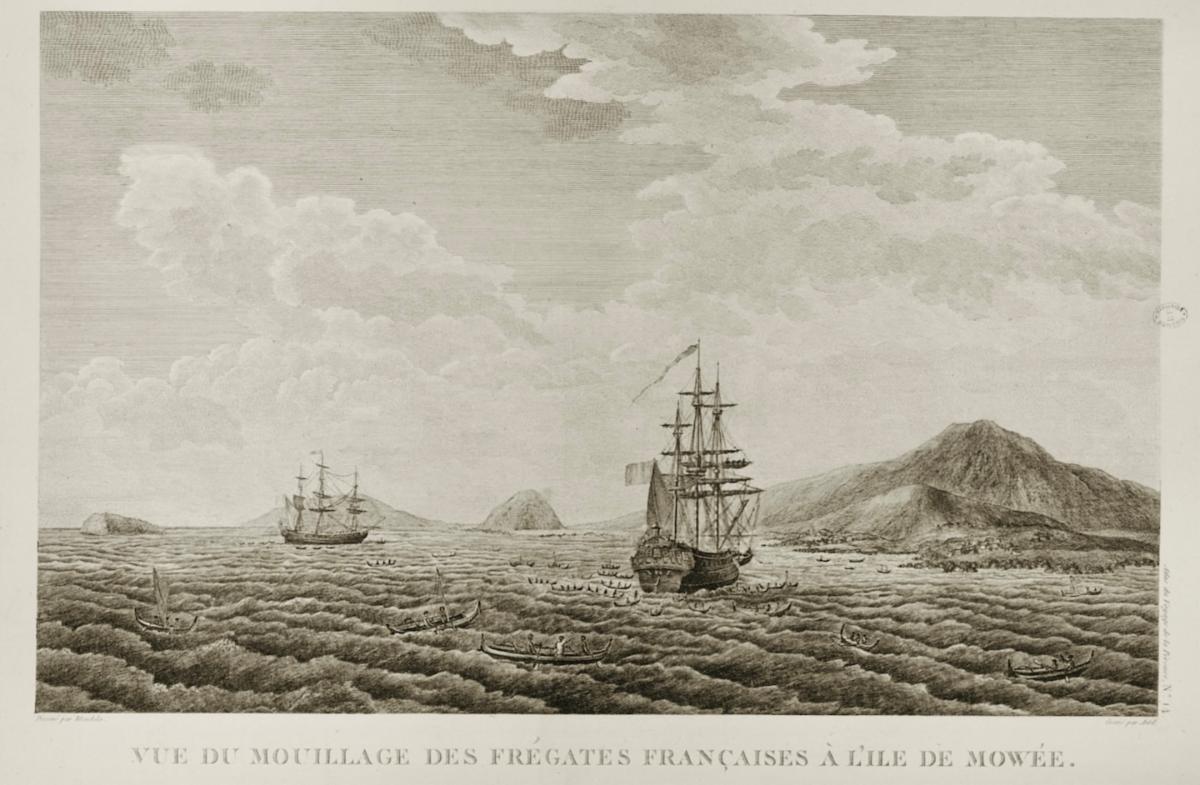
Above: "Vue du mouillage des frégates françaises à l'île de Mowée" (French frigates anchored near Mowee island), Engraving by Louis-Antoine Destouff Milet-Mureau (1797), based on the original drawing by Francois-Michel Blondela (1761-1788), Polynesia, 18th century, Service Historique de la Marine, VincennesGallica Digital Library, Public Domain.
|
|
Excerpts from the King’s Instructions:
“If, when he puts to sea from the Marquesas Islands, the wind should be favourable to allow him to make good his course to the north, he may reconnoitre some of the islands to the east of the Sandwich Isles […], which he will afterwards visit, and where he may enlarge his stock of provision, but will make no stay.” - - The Sandwich Isles, discovered by Cook, are present-day Hawaii.
• After leaving Brest on August 1, 1785, and stops in Madeira, the Canaries islands, Trindade island, Rio de Janeiro, La Pérouse successfully navigated around Cape Horn and proceeded to explore the Spanish colonial administration in the Captaincy General of Chile in Concepcion. After a lengthy journey, the expedition reached Easter Island on 9 April 1786.
• The vessels navigated towards the northern regions through unexplored waters, reaching locations where fragments of land were merely indicated on maps. La Pérouse encountered no significant findings. Much of the data available at the time, as it turned out, proved to be mere fabrications, products of creative imagination of previous Spanish or Portuguese navigators. In his journal, La Pérouse wryly remarked that, unlike other navigators who unveiled new territories and archipelagos, "he was left with the task of "closing" them."
• Continuing their expedition, they set sail towards the Sandwich Islands, known today as the Hawaiian Islands. As Captain Cook had merely anchored nearby, it was during this leg of the journey that Lapérouse achieved the distinction of being the first European to step foot on the island of Maui, on May 30, 1786.
• The Bay where both frigates dropped the anchor is now commonly called LaPérouse Bay.
• La Pérouse’s journal while at Maui notes he fully honored the Instructions:
“Although the French are the first to have stepped onto the island of Mowee (Maui) in recent times, I did not take possession of it in the King’s name.” [...]
“This European practice is too utterly ridiculous, and philosophers must reflect with some sadness that, because one has muskets and canons, one looks upon 60,000 inhabitants as worth northing, ignoring their rights over a land where for centuries their ancestors have been buried, which they have watered with their sweat, and whose fruits they pick to bring them as offerings to the so-called new landlords.”
“Modern navigators have no other purpose when they describe the customs of newly discovered people than to complete the story of mankind. Their navigation must round off our knowledge of the globe, and the enlightenment which they try to spread has no other aim than to increase the happiness of the islanders they meet”.
• LaPérouse stayed at Maui for only two days. He then sailed westward passing between Kahoʻolawe and Lānaʻi and into the channel between Molokaʻi and Oʻahu.
“… the island of Mowhee (Maui) looked delightful …. We could see waterfalls tumbling down the mountainside into the sea … the trees crowning the mountains, the greenery, the banana trees we could see around the houses, all this gave rise to a feeling of inexpressible delight.”
“… the waves were breaking wildly against the rocks and, like new Tantaluses, we were reduced to yearning, devouring with our eyes what was beyond our reach.” (The first sight of Maui, as described by LaPérouse, May 30, 1786)
• LaPérouse observed the region known to the ancients as Keoneʻōʻio ("bonefish sand") while sailing down the coast from Hāna. The area was characterized by permanent Hawaiian occupation, which relied on marine resources and dryland crops, particularly ʻuala (sweet potato), grown in the mauka areas. Fish and other marine resources played a crucial role in the diet of the inhabitants, with bonefish (ʻōʻio) being abundant in the region.
• La Pérouse documented the presence of up to five villages in the area, each consisting of 10 to 12 thatched houses. The shoreline residents primarily engaged in fishing activities and had easy access to potable water from shoreline springs. These inhabitants frequently traveled between the uplands and the coast for trading purposes.
• The natives were most cordial and offered La Pérouse much needed hogs, which were gladly accepted. In turn La Pérouse, like in Easter Island earlier, provided iron tools and other useful gifts, including grains.
|
|
Monument to La Pérouse, Maui |
|
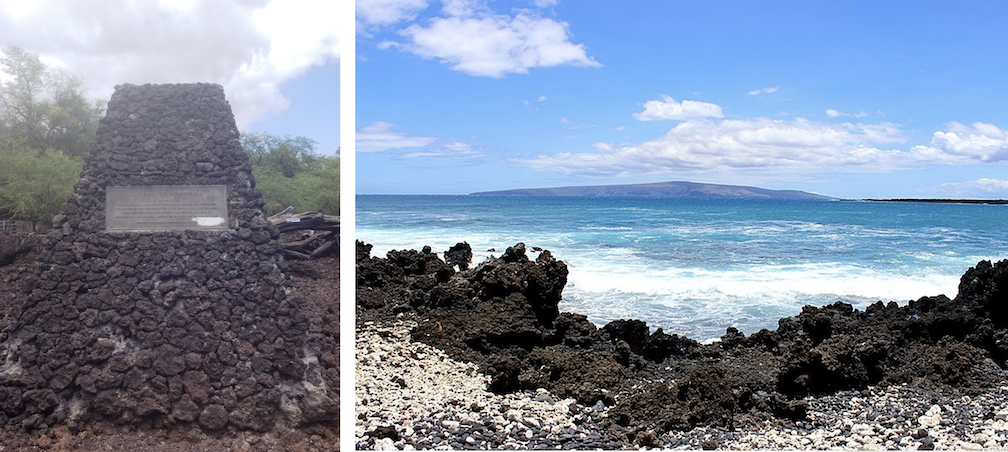
Above left: La Pérouse Monument, Maui, Hawaii (Photo by Marc Onetto)
Off Makena Road, Kihei, HI 96753
This monument, erected in 1994 by the "Association des Amis de Lapérouse" has seriously deteriorated with the passage of time. Our Society has projected its restoration and embellishment of immediate surroundings in 2022 with the addition of an interpretive marker to explain to the numerous tourists who was Lapérouse and the pacific and geographical purposes of the voyage.
Inscription:
"Laperouse Memorial
On May 30th, 1786
French Admiral Jean-françois Galau Comte De Laperouse
Commanding The Two Frigates La Boussole And L’astrolabe
Was The First Known European Navigator To Land At
Keōne’o’io Also Known As Laperouse Bay
Donated By The Friends Of Laperouse On May 30th, 1994"
|
|
Above:
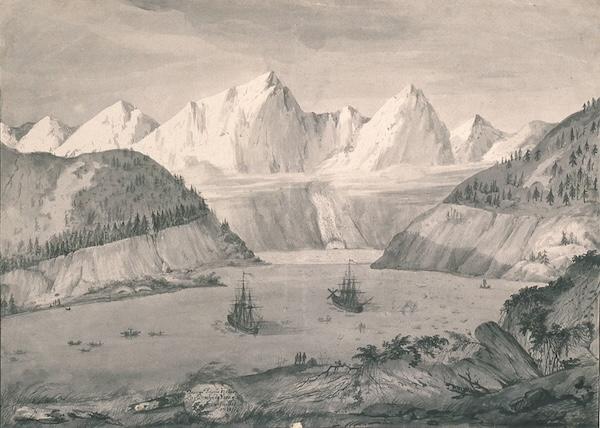
Top: The Astrolabe and Boussole frigates at anchor in July 1786 at Port des Français in North America (west coast, present-day Alaska). La Pérouse expedition, drawing made during anchorage. Today Lituya Bay. By Duché de Vancy - Public Domain
La Boussole and L’Astrolabe (on the right with its wind-mill to make flour on board), anchored at the Île du Cenotaphe. Tlingits canoes and floating chunks of ice are visible. At the end, glaciers ending in the fiord. Cliffs on both sides are the result of frequent tsunamis caused by the breaking of glaciers.
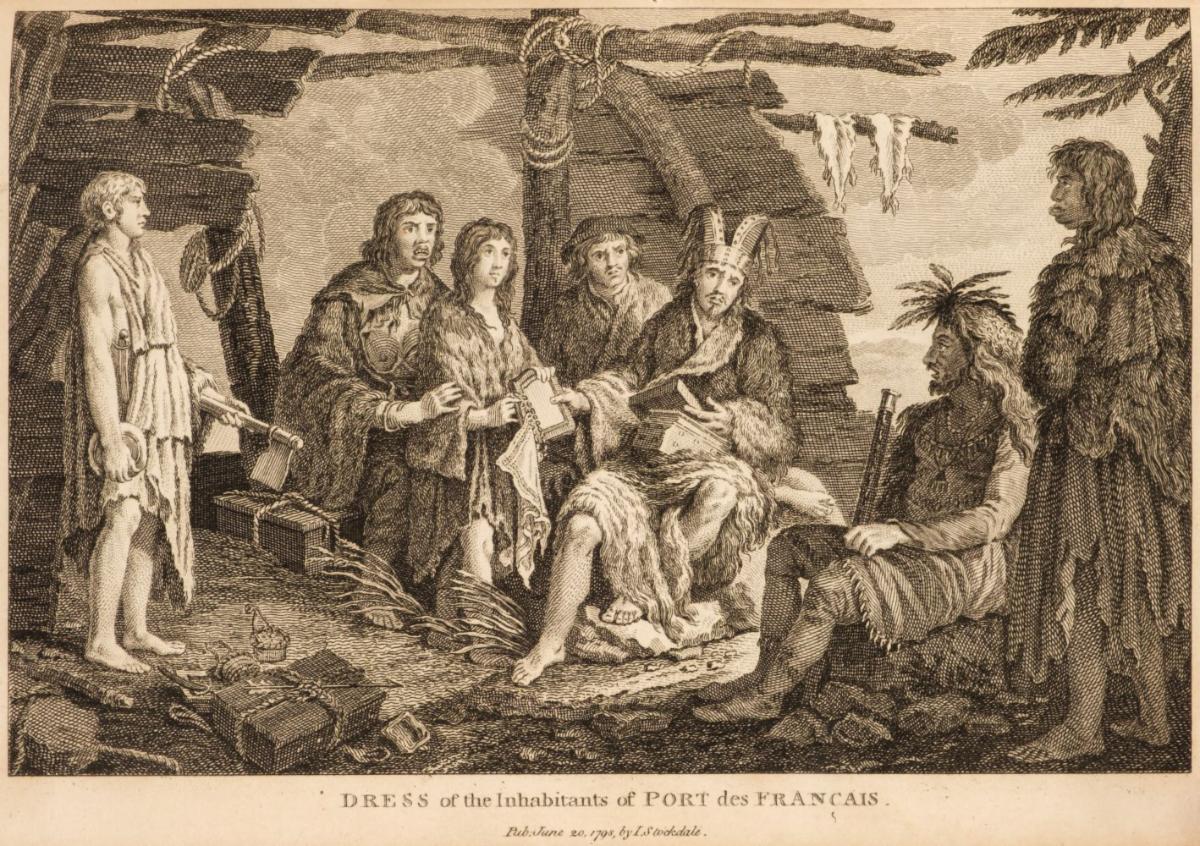
Middle: Engraving, "Dress of the inhabitants of Port des Français", from "The Voyage of La Perouse Round the World, in the Years 1783, 1786, 1787, and 1788", 2 volumes, London: John Stockdale, 1798
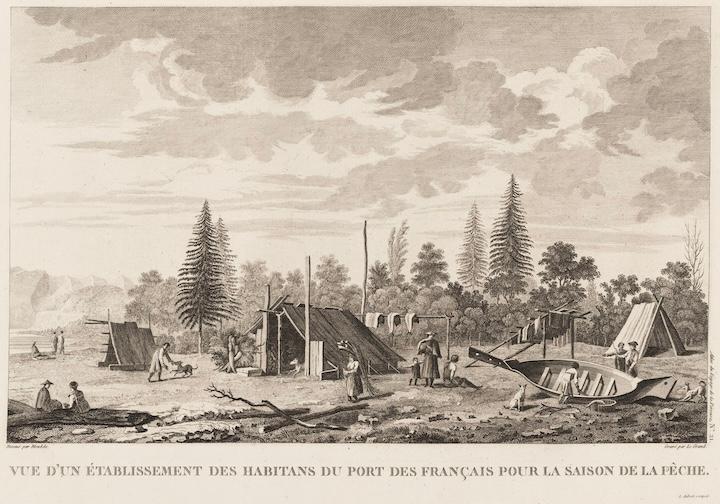
Bottom: Lapérouse en Alaska : Port-des-Français (Baie Lituya). Voyage de La Pérouse autour du monde /publié conformément au décret du 22 avril 1791, et rédigé par L.A. Milet-By Duboy-Laverne, P. D.; La Pérouse, Jean-François de Galaup; Milet de Mureau, Louis Marie Antoine Destouff; Mourelle de la Rúa, Francisco Antonio; Pingré, Alexandre Guy Public Domain https://commons.wikimedia.org/w/index.php?curid=44636328
|
|
From the King’s Instructions:
"Prince William's Sound and Cook's River having been sufficiently examined, he will not waste his time in visiting them but from mount Elias he will shape his course for the islands of Shumagin, near the peninsula of Alascha."
On June 26, 1786, La Pérouse arrived off the Alaskan coast near Mt. St. Elias.
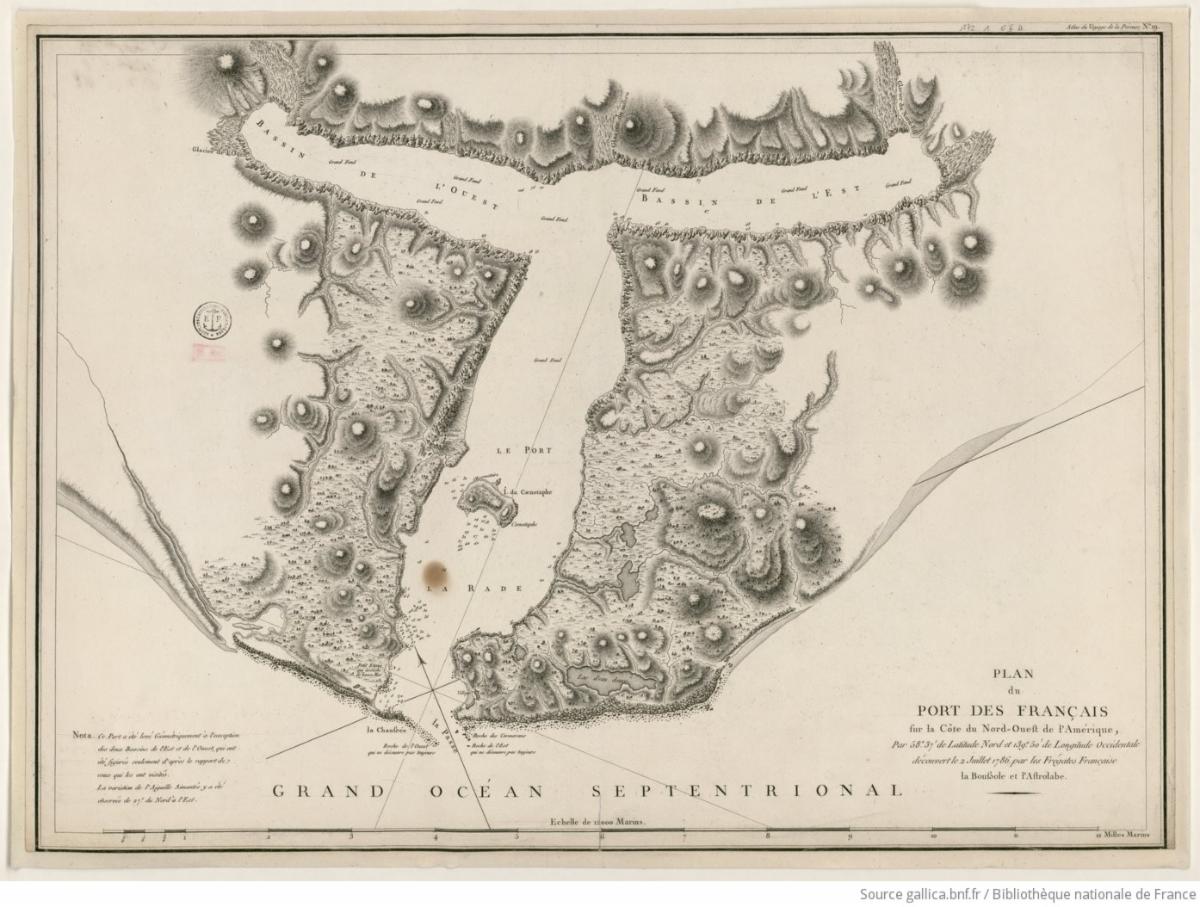
• Following a southward journey, the Boussole and the Astrolabe dropped anchor in a bay which La Pérouse named "Port des Français", or French Port, today known as Lituya Bay. The expedition remained in the bay for approximately a month, departing on July 30, 1786.
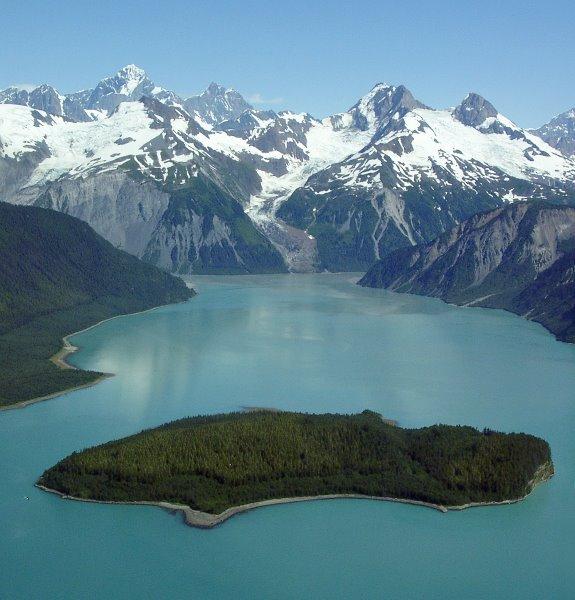
• La Pérouse and his crew were the first Europeans to explore the bay, although the indigenous Tlingit inhabitants had already acquired some European goods through trade with other Native groups in the area. In comparison to other ports along the Alaska coast, Lituya Bay is a relatively small inlet characterized by its western and eastern basins that terminate in striking active glaciers. The term "Lituya" in Tlingit language signifies "the lake within the point," alluding to the elongated, curving spit that narrows the bay's entrance.
• The following day, on June 27th, a narrow entrance to an inlet was discovered east of Cape Fairweather. De Pierrevert and Flassan, from the Boussole and Astrolabe respectively, were sent in small boats to explore the inlet. Their positive feedback convinced La Pérouse, albeit somewhat reluctantly, to navigate the ships into the inlet. Initially, their attempt was unsuccessful, leading them to sail offshore throughout the night until the tide allowed them to enter the following morning. Despite this, the passage was risky, with both ships nearly running aground on rocks. They eventually anchored just inside the entrance, but La Pérouse was dissatisfied with the shallow, rocky seabed. Consequently, he dispatched men to search for a safer anchorage. D’Escures identified a more suitable location behind a large island within the inlet, prompting the two ships to relocate there. This event took place on 3 July 1786.
• Upon their arrival, local inhabitants observed them and promptly approached in canoes to engage in trade, particularly involving sea otter skins. A tribal leader visited the ships to extend a welcome. An observatory was constructed on the island, while crew members set up tents for repairs.
• In 1886, an oral history was documented and later published in 1911, detailing the encounter between the local Hoonah Tlingit people and the La Pérouse expedition. The Hoonah Tlingit, who had never encountered Europeans before, initially perceived the arrival of the Frenchmen through the lens of Tlingit mythology. They believed that the two ships were akin to large black birds, which were seen as manifestations of the creator bird Yehlh, who was known to transform into a raven. Despite their apprehension about the potential outcomes of this encounter, local leaders and warriors decided to approach the French expedition, leading to the establishment of trade relations. The French were interested in acquiring food supplies and Tlingit artifacts for scientific purposes, while the Tlingit sought iron tools and nails. Although there were occasional tensions between the Native people and the newcomers due to cultural disparities and misunderstandings, the initial meeting did not result in any violent conflicts.
• La Pérouse was deeply impressed by the beauty of the Bay. He personally led an expedition to investigate the head of the bay, which branches into two arms, each nourished by glaciers. The inlet penetrates the coastal mountain range, surrounded by towering snow-capped peaks on all sides. The impact of the glaciers became evident when an iceberg broke off, creating a wave that overturned one of the longboats. Although they attempted to ascend one of the glaciers, the treacherous conditions made progress slow and perilous, prompting them to abandon the endeavor and return to their ships.
• There are no current markers to commemorate La Pérouse's presence. The only one that makes a mention of his expedition is located more than 300 miles away in Ketchikan:
Interpetive marker, with the headline: “Proud Canoes & Coastal Traders”
210 Front St, Ketchikan, AK 99901
• Inscription (excerpts):
[...] “Alaska's exploration was hastened by the competing interests of Russia, Spain, England, France and young America to establish a lucrative fur trade here.
Between 1774 and 1792, the Spanish sent many exploratory voyages to Alaska from its outposts in Mexico and California [...]
In 1778, Captain James Cook brought Britain's interests to Alaska during his final World Voyage, and was followed by the English fur trading captains Dixon, Meares and Portlockin 1786. The Frenchman La Perouse arrived that year, with Marchand following in 1791 [...]
Erected by Historic Ketchikan, Inc.
|
|
The expedition's first tragic accident |
|
Illustrations Above:
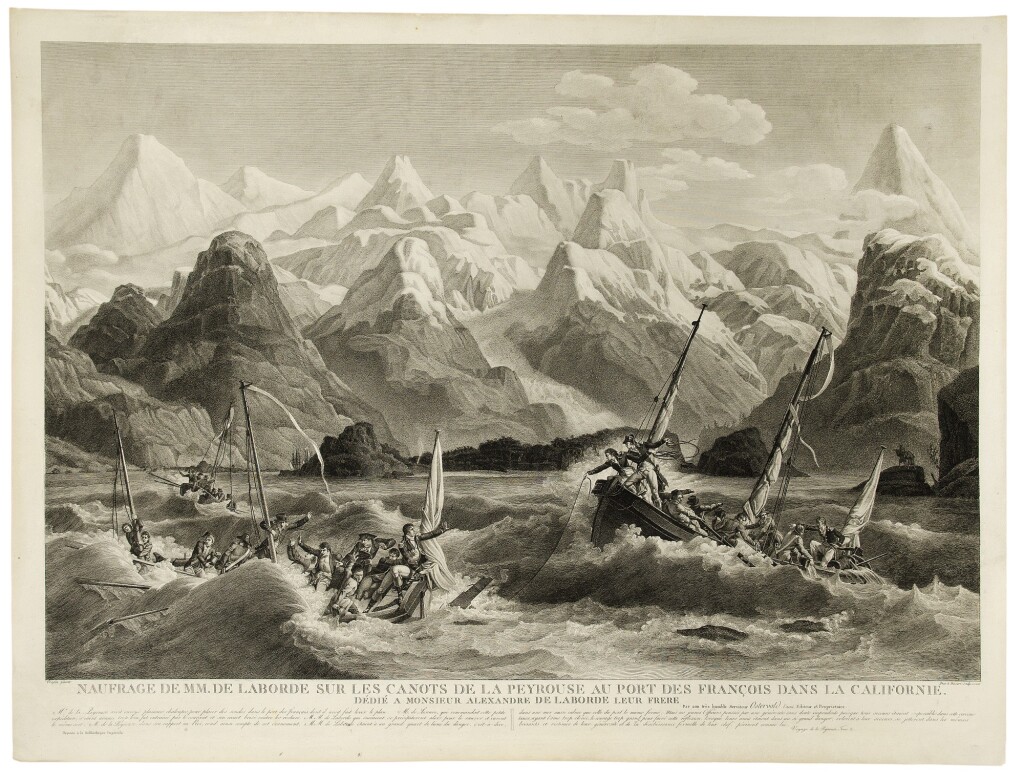
Top: "Naufrage de Mm. de Laborde sur les canots de la peyrouse au port des Francois dans la Californie". [Paris: Ostervald, ca. 1806, after Louis Philippe Crepin
Middle: “Plan du Port des Français sur la Côte du Nord-Ouest de l’Amérique, par 58°37′ de Latitude Nord et 139°50′ de Longitude Occidentale, Découverte le 2 Juillet 1786, par les Frégates Française la Boussole et l’Astrolabe.” Plate number 19 in Atlas Du Voyage De La Pérouse. 1797. Gallica.bnf.fr /Bibliothèque nationale de France, Public Domain
Bottom: Lituya Bay, with Cenotaph Island in the foreground. Source; Panoramio user footsnviews.
|
|
• By the 12th of July, La Pérouse was prepared to depart. Although his Chief cartographer Gérard Sébastien Bernizet had already mapped out the inlet, further depth soundings were still necessary. Three boats were dispatched early in the morning of the 13th to complete the mapping process. D’Escures, as the senior officer, led the Boussole’s Biscay boat. La Pérouse, aware of d’Escures’ impulsive nature, took precautions by issuing written instructions advising d’Escures to avoid approaching the inlet’s entrance if the sea was turbulent. De Marchainville oversaw the Astrolabe’s Biscay boat, while Boutin was responsible for the third boat.
• The departure took place at 6.00am, and by 10.00am, Boutin returned distressed. Despite La Pérouse's warnings, d’Escures had ventured too close to the entrance, resulting in his boat being swamped. De Marchainville attempted to rescue the occupants of the first boat, but his boat also capsized. Recognizing the danger, Boutin retreated. Search parties were sent out to scour both shores of the inlet, but unfortunately, all 21 occupants of the two Biscay boats perished, and their bodies were never recovered.
• The Hoonah Tlingit community assisted in the rescue efforts, albeit without success in saving any survivors or recovering the deceased individuals.
• The entire expedition was deeply affected by the tragedy. They stayed for an additional two weeks, hoping for survivors or any remains to be found. They also had to reorganize the crew and duties, as well as revise the plans for the next leg of the journey. A cenotaph was erected on the island, which La Pérouse bought from the Tinglit Chief, and which he named "l’Île du Cénotaphe", (Cenotaph island). Two bottles were buried, one taking possession of the island for France, the other one with the names of the twenty-one lost sailors. These bottles have never been found, and probably lost forever due to the erosion and changes of the coastlines.
• In July 1786, towards the conclusion of the month, a cenotaph (marker of an empty tomb) was constructed on the western side of the island to commemorate the unfortunate loss of twenty-one sailors. Additionally, a bottle containing the comprehensive list of their names was interred at that very location. Monsieur de Lamanon, the expedition physicist, expressed, "At the entrance of the port, twenty-one courageous sailors met their demise. Whomever you may be, we implore you to unite your tears with ours."
This monument has long disappeared. A bronze plaque installed by the Lituya Bay Historical Society, either stolen or deeply buried due to the changes of terrains occasioned by frequent tsunamis.
• Since this tragic accident, we now know that the place is exceedingly dangerous. Huge blocks of glaciers can fall and provoke a tsunami in a closed body of water. In fact, on July 9th, 1958, a massive landslide in Lituya Bay resulted in the highest wave ever documented on Earth, reaching a staggering 524 vertical meters on land, surpassing the height of the Empire State Building by 100 meters. Throughout recorded history, smaller yet significant waves have occurred in Lituya Bay on five separate occasions: the waves in 1853-54, 1874, 1899, 1936, and the colossal 1958 wave, which uprooted trees from a hillside at a height exceeding 1,720 feet.
• Despite the loss, the expedition managed to gather detailed descriptions of the inlet and its inhabitants, compile a small vocabulary, and create charts. Finally, on July 30th, the two ships departed from Port des Francais.
The voyage had to go on, and there was so much more to explore...
|
|
Marker, “Mount Shasta”
Vista Point, California Rte 97, Weed CA 96094
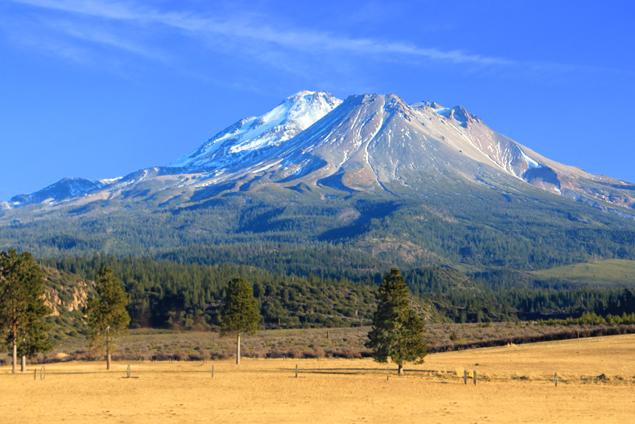
Mount Shasta as seen from the WNW (south of Weed) in California,
|
|
• Lapérouse sailed south towards the Spanish Las Californias Province, which is present-day California. It was reported that he witnessed the historical eruption of Mount Shasta on 7 September 1786, although this information has since been questioned.
• La Pérouse's handwritten journals talk about the colorful eruption in 1786, and his original map (stored in Paris at the French National Archives) shows the volcano's smoke in a striking deep purple hue. A mystery remains how he could have seen the volcano which is far inland, “since no volcano or volcanic soils exist along the coast of the region in question, Laperouse probably saw a forest fire; but, since the latitude of the sighting was equal to that of Mt. Lassen, the possibility remains of the explorer having seen the 10,453 foot mountain in eruption.
• Inscription of marker:
“Dominating the landscape, Mt. Shasta can be seen for 100 miles from certain points drawing hikers, skiers and travelers. Mt. Shasta rises 11,000 fro the base to the summit for a total elevation of 14,162’ above sea level, one of the nation’s largest rises, ranking 49th. It is one of the southernmost volcanoes in the Cascade Range and is the second tallest, falling short of Mt. Rainier by 248’. It has a 17 mile diameter with 5 glaciers, the Whitney Glacier being the largest in California. The most recent eruption occurred in 1786 and was witnessed from sea by explorer La Perouse.”
|
|
La Pérouse in San Francisco |
|
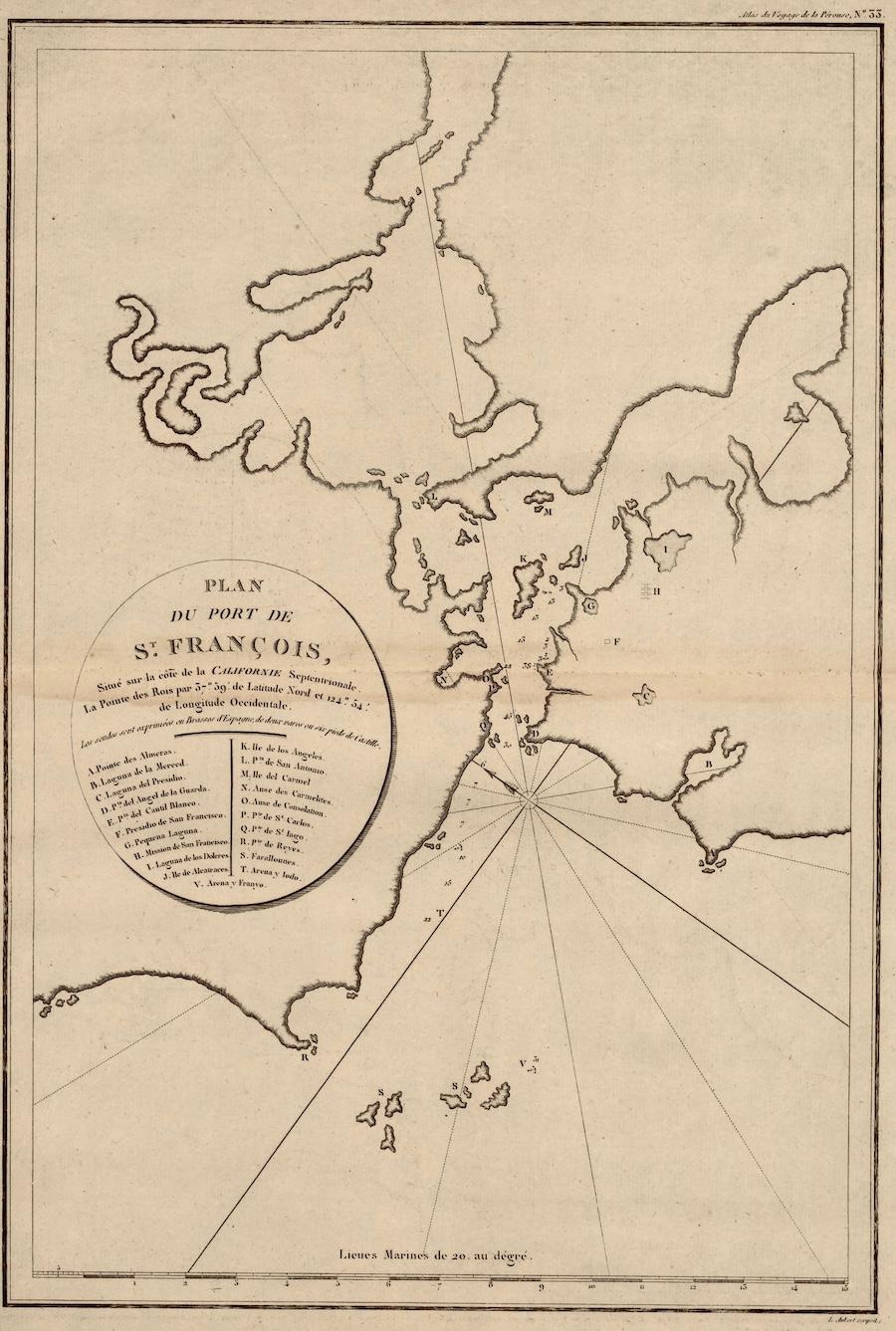
Above: "1797 - Plan du Port de St. Francois, situe sur la cote de la Californie Septentrional" (2017). Pre-1824 Maps. 53.
|
|
• La Pérouse paused at the Presidio of San Francisco for a brief period to sketch an outline map of the Bay Area, known as "Plan du port de St. François, situé sur la côte de la Californie septentrionale" ("Map of the port of San Francisco, situated on the coast of Northern California"). This map was later included as Map 33 in the 1797 "Atlas du voyage de La Pérouse".
• The map identifies 21 place names that included Alcatraz, the Presidio of San Francisco, Point Reyes, the Mission de San Francisco and the Farallonne Islands. Lapérouse did not survey the region himself but most likely based his map on the maps of the area by earlier cartographers (1776-1785).
|
|
La Pérouse in Monterey, California |
|
Photos:
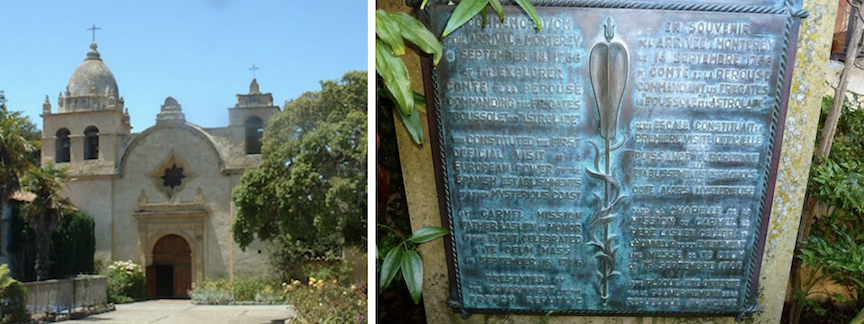
Left: Mission San Carlos Borromeo de Carmelo
By Burkhard Mücke - Own work, CC BY-SA 4.0
Right: Plaque, Visit of La Pérouse in Monterey, CA in 1786
The plaque was donated by the French Government in 1947 (photo Marc Onetto)
San Carlos de Borromeo church in Carmel, CA
3080 Rio Rd, Carmel-By-The-Sea, CA 93923
|
|
Excerpts from the King’s Instructions:
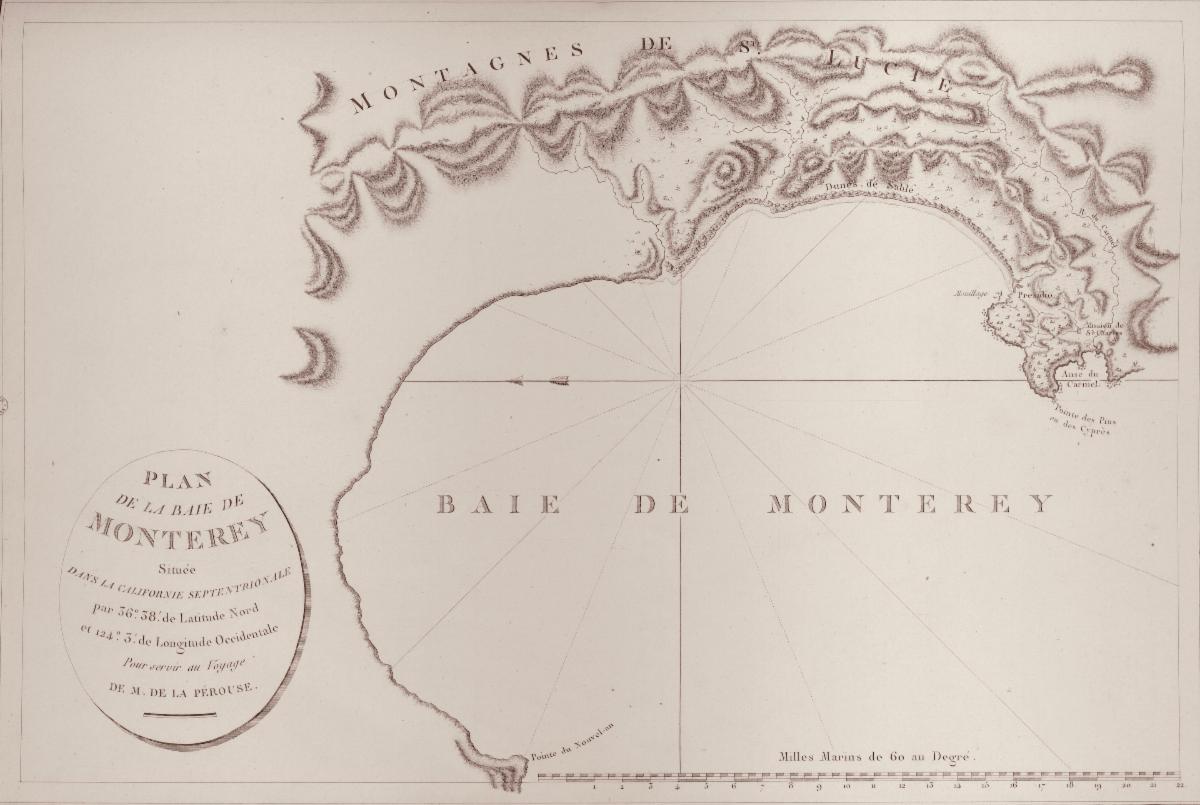
"He will make without delay for the north-west coast of America and for this purpose he will proceed to the latitude of 30° north, in order to get out of the trade winds, and fetch the coast in the latitude of 36° 20', at Punta de Pinos, to the south of Port Monterey, which may be known by the mountains, or sierra, of Santa Lucia."
• La Pérouse's journey continued, and when the Boussole and the Astrolabe arrived in Monterey Bay on 15th September 1786, they were warmly welcomed. News of their impending arrival had already reached Concepción, with instructions that they were to be treated as honored guests of the King. Spanish ships sent pilots to assist them, and the fort of Monterey fired a seven-gun salute to greet them. During their ten-day stay, the French visitors were treated with great hospitality and offered generous supplies for their voyage.
• La Pérouse and his officers were frequent guests at the residence of Governor Pedro Fagès.
• During his exploration, he examined the Spanish settlements, ranchos, and missions. He noted that "The country of the Ecclemachs extends above 20 leagues to the [south-]eastward of Monterey." Lapérouse also made critical observations regarding the treatment of California indigenous peoples at the Franciscan-run missions, likening the conditions to those of a slave plantation. It is important to note that during this time, France and Spain maintained friendly relations. Lapérouse's visit marked the first instance of a non-Spanish visitor to California since Drake in 1579, and he was the first to arrive in California following the establishment of Spanish missions and presidios.
• There is a memorial plaque commemorating La Pérouse's visit at the entrance to the present-day San Carlos de Borromeo church in Carmel, presented by the French government in 1948.
• Inscription:
“In memory of the arrival at Monterey on September 14, 1786, of the explorer Comte de La Perouse, commanding the frigates Boussole and Astrolabe. This constitutes the first official visit of a European power to the Spanish establishments on a then mysterious coast. In this chapel of the Carmel mission, Father Lasuen in honor of the event celebrated a te deum mass on September 16, 1786.
This plaque was presented by the government of the French Republic.”
|
|
Illustration: La Pérouse in Monterey
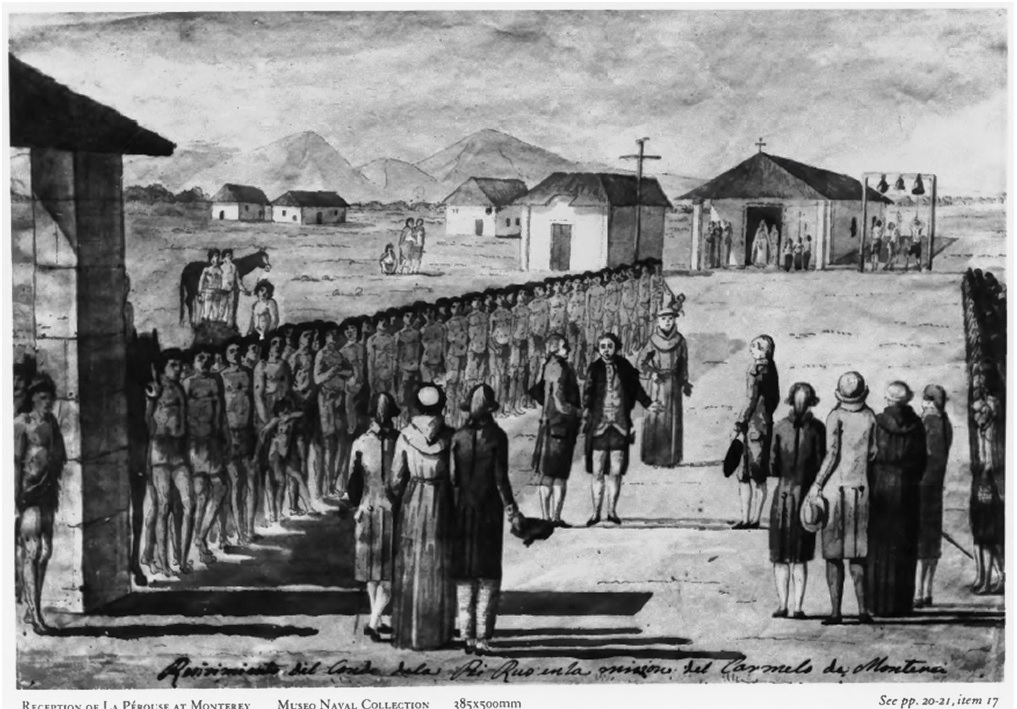
Bottom: La Pérouése at Carmel Mission – Drawn by José Cardero in 1791 from a drawing left by Gaspard Duché de Vancy in 1786 (see below). It is believed to be the first significant work of art in California done by a European, which is appropriate given Carmel’s later history as an artist colony.
Copy of Duché de Vancy's painting, now in the Museo Naval Madrid
|
|
• Upon his arrival in Monterey on September 14, La Pérouse noted the structure of the Spanish empire's California mission system, which was established by Fr Junipero Serra (who passed away in 1783). Each mission consisted of one padre overseeing nine soldiers, resulting in a team of two padres and eighteen soldiers per mission. The French explorer expressed his disapproval of the situation, stating that the new Spanish settlements did not resemble European towns.
• The Instructions given to him included assessing the Spanish presence in the region, which, according to French intelligence, was limited to a few small forts along the coast between San Diego and Monterey. He was tasked with reporting on "the condition, strength, and purpose of these establishments" (Part 2, no.9).
• La Pérouse noted that despite the vast territory under his control, the governor only had "two-hundred and eighty-two cavalrymen" who manned garrisons at five small forts and provided protection for twenty-five missions with small detachments. This seemed to be sufficient to manage a population of fifty thousand "wandering Indians", of which ten thousand had converted to Christianity.
"The women are largely employed in household tasks, looking after their children, and roasting and crushing the grain, a very slow, laborious task because their only method is crushing it on a stone with a roller, more or less as is done with chocolate in Europe. Mr de Langle who witnessed this operation gave his mill to the missionaries, and it would be difficult to render them a greater service; four women will now do the work of a hundred, and there will be time left to spin the wool of their flocks and manufacture some rough cloth; but until now the religious, more concerned with the interests of Heaven than with temporal matters, have been very neglectful of the need to introduce the more common crafts; they are so austere in respect of themselves that they not have a single room with a fireplace even though the winter is quite severe, and the greatest saints have not led a more edifying life". (from Journal of La Perouse trans. John Dunmore, Vol 1:182)
|
|
Above: Detail La Pérouse's description in Voyage, vol. 1 p.445-6
|
|
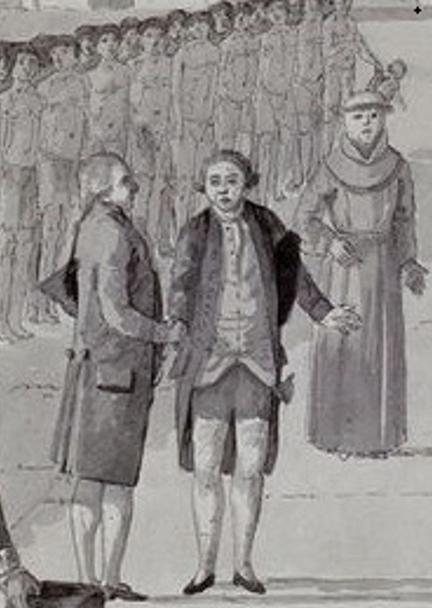
In the center of the scene, Father Matias Noriega warmly welcomes La Pérouse and Langle, urging them to approach the unassuming church adorned with a thatched roof. Positioned to the side is likely Barthélémy de Lesseps, who would have been present to provide translation services. The foreground is occupied by various groups of officers. Father Fermin Francisco Lasuén, entrusted with the Franciscan mission, can be observed patiently awaiting their arrival at the church entrance, donned in his ceremonial vestments and holding a vessel of holy water. Positioned beside the Padre are two indigenous individuals, accompanied by three recently arrived missionaries. According to La Pérouse, the church was brilliantly illuminated for the occasion, evoking the ambiance of a festive celebration. To the right, three men diligently ring the bells, their resonating chimes announcing the arrival of the French expedition.
• Additionally, the scene showcases two lengthy rows of native converts, assembled to form an honorary guard. "Before we entered the church, we traversed a square where indigenous men and women stood in a disciplined line." La Pérouse found himself taken aback by the native Indians' apparent lack of curiosity, as their countenances displayed no signs of astonishment upon encountering the Frenchmen. Instead, they patiently awaited the conclusion of the service.
• La Pérouse, a product of the liberal Enlightenment, expressed criticism towards the organization of the new Spanish colony. Despite acknowledging the "inexpressible fertility" of California's land, he believed that the region was hindered by a policy of isolation from the broader global community. La Pérouse observed the Spanish focus on religion and the strict paternalism of the missions as factors that suppressed the economic potential of the Indian converts, who were subjected to treatment scarcely better than that of African slaves.
"A friend to the rights of men rather than to theology, I could have wished, I confess, that there had been joined to the principles of Christianity a legislation, which might gradually have made citizens of men, whose state a present scarcely differs from that of the negro inhabitants of our colonies...(p.442-3) "
|
|
Discovery of Necker Island, Hawaii
& La Pérouse Pinnacle, French Frigate Shoals, Hawaii
|
|
Above:
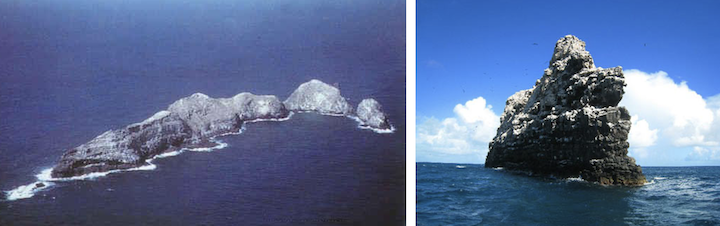
Right: The towering La Pérouse Pinnacle is made of hard volcanic rock and rises 122 ft (37 m). It is located some 84 nautical miles (96 miles) west of Necker Island.
|
|
• On his way to China, La Pérouse's expedition crossed its earlier route eastward, and sailed north of Hawaii. The Hawaiian island chain was situated beyond the usual paths taken by early European explorers, and it was not until Jean-François de La Pérouse's perilous encounter that the shoals became known to the rest of the world. La Pérouse, commanding the frigate Boussole, was traveling westward from Monterey towards Macau.
• Necker Island (Hawaiian: Mokumanamana "branched island") is a small island in the Northwestern Hawaiian Islands. It is located 430 miles (370 nmi; 690 km) northwest of Honolulu, Hawaii. It is part of the City and County of Honolulu in the State of Hawaii. However, being also part of the Hawaiian Islands National Wildlife Refuge, it falls under the jurisdiction of the United States Fish and Wildlife Service. The island does not have any permanent human inhabitants.
• On November 4, 1786, La Pérouse became the first European to visit Necker Island.
…”I approached within the distance of a third of a league. The banks were perpendicular, like a wall, and the sea broke so violently against them, that it was impossible to land. As we sailed almost entirely round, it, the plan of this island, as well as the different views, are perfectly accurate. It's latitude and longitude, as determined by Mr. Dagelet, are 34' north, and 166° 52' west of Paris. I called it Isle Necker. Though its sterility may render it of little value, its precise position must be an object of considerable importance to navigators, to whom it might other-wise be fatal...” - La Pérouse Journal, Voyage around the World, p 471
• The French Frigate Shoals, also known as Kānemilohaʻi in Hawaiian, stands as the most extensive atoll within the Northwestern Hawaiian Islands. This atoll is comprised of a crescent-shaped reef stretching 20 miles (32 km) in length, twelve sandbars, and the La Pèrouse Pinnacle rising to a height of 120 feet (37 m), serving as the sole remaining evidence of its volcanic beginnings.
• On the night of 6 November 1786, sailors spotted breakers directly ahead, approximately a thousand feet away. Both the Boussole and its companion ship, the frigate Astrolabe, swiftly changed course, narrowly avoiding the breakers by a few hundred feet. By daybreak, the vessels returned to chart the southeastern portion of the atoll, and also discovered the rock that would later bear La Pérouse's name. La Pérouse christened the shoals as "Basse des Frégates Françaises", or the "Shoal of the French Frigates".
• After the two frigates narrowly escaped disaster, La Pérouse ordered to sail back the next morning to further inspect the islet and determine its exact position. It is a testimony to his scientific and humanitarian righteousness to read in his Journal:
“…But it was not sufficient to possess certainty upon the subject, and to have, escaped from danger ourselves. I was also desirous that future navigators should not be exposed to it i and accordingly, at day-break, I gave orders to put about ship, and stand back again” […] “The geographical position of this islet, estimated from the only visible part, was fixed by Monsieur Dagelet in 23° 45^ of north latitude,and 168°10 of west longitude, and is distant twenty-three leagues west north-west from Necker island. It must not be forgotten, that the eastern point is four leagues nearer. I named it Basse des Frégates Françaises because it had nearly proved the final termination of our voyage” - -La Pérouse Journal, Voyage around the World, p 477
... The expedition took a circuitous route, and so does our narration. It is by now high time that we introduce La Pérouse's most trusted friend and American War of Independence companion, Captain de Langle, as well as the many scientists who transmitted to us their findings...
|
|
Other notable expedition members
Paul Antoine Marie Fleuriot de Langle
Commander of l'Astrolabe
La Pérouse trusted lieutenant and friend from
the American War of Independence
|
|
Above:
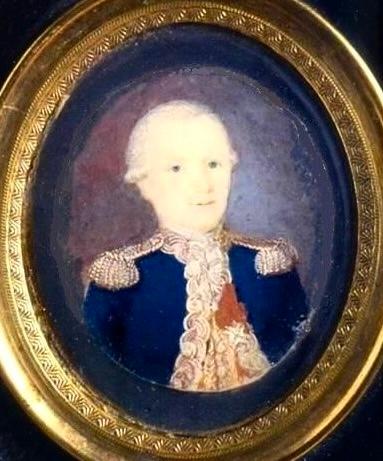
Portrait of Paul Antoine Fleuriot de Langle
|
|
• Paul Antoine Fleuriot de Langle (born on 1 August 1744 at château de Kerlouët in Quemper-Guézennec, Côtes-d'Armor, and died on 11 December 1787 in Maouna (Tutuila Island, American Samoa) was an accomplished naval commander, and intrepid explorer, as well as a renowned académicien de marine. He served as the second-in-command during the La Pérouse expedition.
• Fleuriot de Langle took part in the American Revolutionary War. In April 1781, Fleuriot de Langle was given command of the 32-gun frigate Résolue. From March 1782, he commanded the 50-gun Experiment which had been seized from the British Royal Navy and then commanded the frigate Astrée in the Hudson Bay expedition under La Pérouse's orders. He became a friend and inseparable companion to La Pérouse.
For Fleuriot de Langle's expertise, knowledge of math and astronomy, and force of character, La Pérouse chose him as his deputy, commanding the 114-man frigate Astrolabe.
• Fleuriot de Langle was a Member of the Order of Cincinnati.
|
|
Tragic death at
Massacre Bay, Tutuila island, American Samoa
|
|
Above:
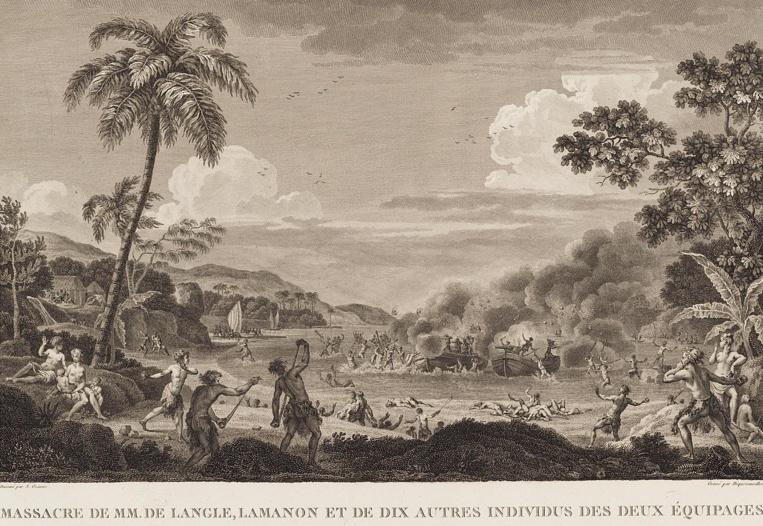
Top: "Massacre De Mm. De Langle, Lamanon Et De Dix Autres Des Deux Équipages" Atlas Du Voyage De La Pérouse. 1797, Bibliothèque Nationale de France, Public Domain
Bottom:
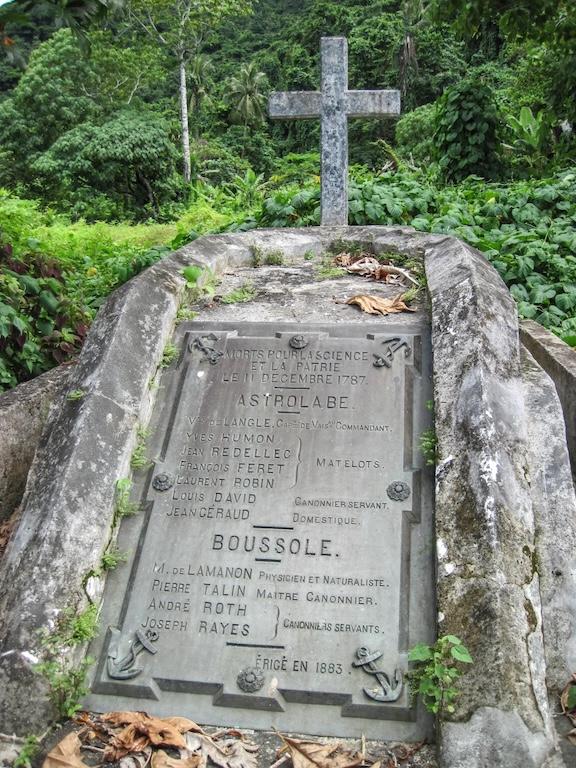
Memorial, Captain de Langle & French Sailors
Massacre Bay, Aasutuai (old Aʻasu), Tutuila Island, American Samoa
Photo by Brenda, https://bksmithdvm.com/2015/01/19/massacre-bay-american-samoa/massacre-bay-23/
|
|
• As scorbut was beginning to appear among some of the sailors, Captain de Langle was eager to go back to shore and secure fresh drinking water. La Pérouse was reticent, as he had observed some negative signs from the natives the day before, in spite of overt manifestations of friendship.
• On December 11, 1787, de Langle and sixty men approached the bay of Aasu in two cutters and two longboats. Due to low tide, only the boats managed to navigate through the narrow channel to reach the shore. Approximately 1,500 native Samoans gathered at the site, with tensions escalating when a Samoan woman was injured. De Langle attempted to retreat with his men in the longboats, but the receding tide hindered their escape from Aasu. As the Samoans started hurling rocks, De Langle was struck, fell overboard, and perished. Before the French could reach their cutters by swimming or wading through the reef, eleven more sailors were killed. Native canoes approaching the frigates were eventually repelled by rifle fire.
• It is amazing that Captain de Langle followed the Set of Instructions to the letter and initially refused to use force. A few shots in the air would have likely dispersed the natives…
• Deeply affected, La Pérouse could have sunk one hundred pirogues containing more than five hundred people, before leaving the island, but, he wrote, "I feared to be mistaken in my choice of victims, and the cry of my conscience saved their lives."
• On 24 April 1788, Fleuriot de Langle was granted a posthumous promotion to the position of “Chef de Division”. La Pérouse, in his tribute to Langle, expressed profound admiration by stating that Langle had sacrificed his life for the sake of humanity. La Pérouse further lamented the devastating loss of his dearest friend of three decades, describing Langle as a remarkable individual endowed with intelligence, discernment, expertise, and unquestionably one of the most exceptional officers across all European fleets. During a French expedition in 1883, the local Chief donated Langle’s skull and a tibia which were kept as a relic. Thus, the final resting place for Langle's remains was transferred to the Saint-Louis church in Brest.
• The monument, constructed by the French government in 1883, comprises a rectangular concrete structure enclosed by a low concrete wall, housing a bronze plaque and cross. The village of Aasu is responsible for the maintenance of the monument. It is listed on the National Register of Historic Places.
• Inscription (in French):
“Morts Pour la Science et la Patrie
Le 11 décembre 1787
Astrolabe
Vte de Langle, Capne de Vaisau Commandant
Yves Humon, Jean Redellec, François Feret, Laurent Robin, matelots,
Louis David, (Canonnier Servant) Jean Géraud, domestique
Boussole
M. de Lamanon, Physicien et Naturaliste
Pierre Talin, maître Canonnier, André Roth, Joseph Rayes, Canonniers Servants
Erigé en 1883”
(English translation):
"Died for Science and the Motherland
December 11th 1787
Astrolabe
Viscount de Langle, Captain
Yves Humon, Jean Redellec, François Feret, Laurent Robin, sailors,
Louis David, (Servant Gunner) Jean Géraud, servant
Boussole
M. de Lamanon, Physicist and Naturalist
Pierre Talin, Master Gunner, André Roth, Joseph Rayes, Servant Gunners
Erected in 1883"
|
|
Other notable scientists from the expedition |
|
Illustrations above:
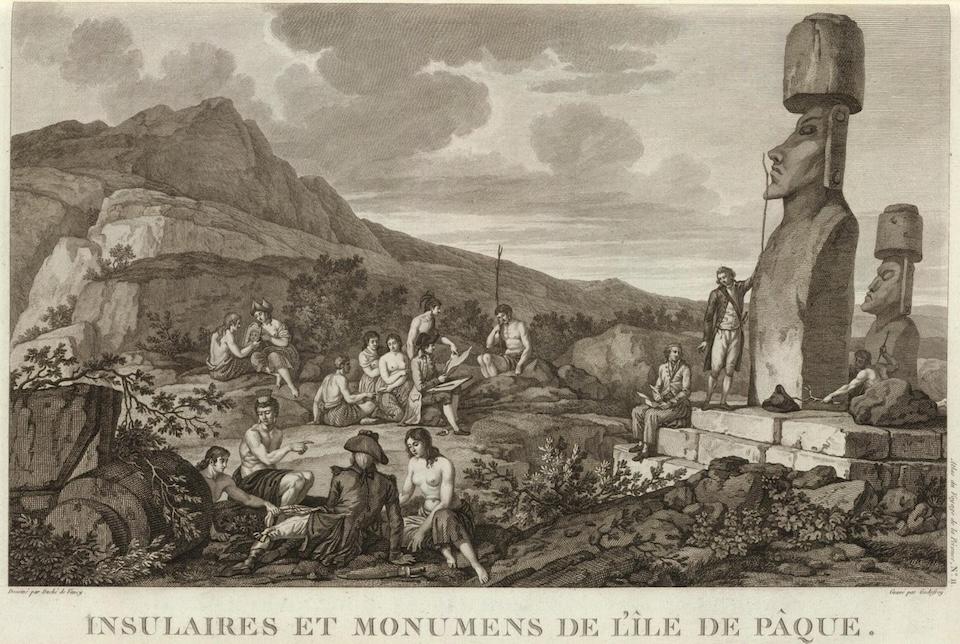
Top: Easter Island population and Moai statues during the La Pérouse expedition's visit in 1786, by Duché de Vancy - Gallica.fr, Public Domain,
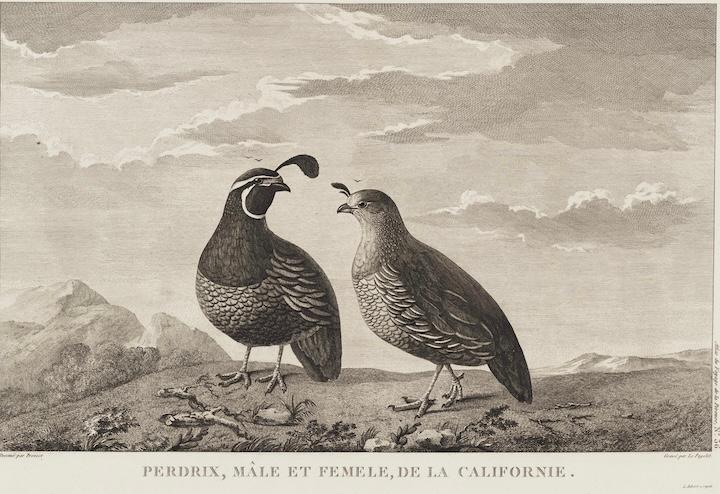
Middle: Perdix de Californie mâle et femelle, (California Perdix male and female) Voyage de La Pérouse autour du monde /publié conformément au décret du 22 avril 1791, et rédigé par L.A. Milet-Mureau, Par Duboy-Laverne, Domaine public, https://commons.wikimedia.org/w/index.php?curid=44636959
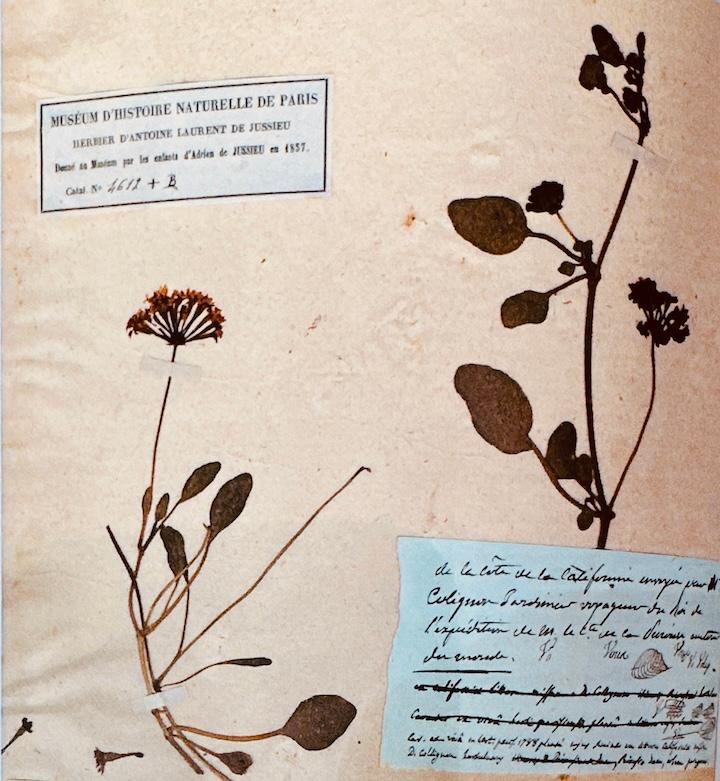
Bottom: "Bronia Umbellata", "Collignon's gift to the Jardin du Roi" Herbarium at the Museum National d'Histoire Naturelle, Paris, using seeds collected by Jean Nicolas Collignon in Monterey.
|
|
There were ten scientists, including Chief Engineer Paul de Monneron, Joseph Lepaute Dagelet, a renowned astronomer and mathematician from 1751 to 1788, Robert de Lamanon, a geologist, La Martinière, a botanist, a physicist, three naturalists, and three illustrators, Gaspard Duché de Vancy, as well as an uncle and nephew duo named Prévost. Additionally, Jean-André Mongez was among the scientists, and even the two chaplains had scientific education.
• Paul Mérault de Monneron, was a skilled engineer officer in the French Army. Lapérouse selected Monneron as the expedition's chief engineer, for "such a character joined to knowledge is that which convened in him". Moneron Island, which was discovered by the expedition to the west of Sakhalin Island, was named in his honor.
• Joseph Lepaute Dagelet (1751–1788) was a French astronomer, clockmaker and mathematician. Dagelet gained recognition for his notable contributions, including the precise calculation of the distance separating the center of Mercury from the Sun. Additionally, he is renowned for his meticulous mapping of the solar eclipse that occurred in the year 1778. The island of Dagelet, which was given its name in tribute to him, is presently recognized by its Korean designation, Ulleungdo. In Alaska, the appellation of Mount Dagelet remains unchanged.
• Gérard Sébastien Bernizet (born March 2, 1760 at Narbonne, province of Languedoc-Roussillon –died 1788 at Vanikoro) was the expedition’s Chief cartographer and geographical engineer.
• Jean Honoré Robert de Paul de Lamanon, commonly referred to as Robert de Lamanon, was a distinguished French scientist who made significant contributions in the fields of botany, physics, geology, and meteorology. Born on 6th December 1752 in Salon-de-Provence, he dedicated his life to the pursuit of knowledge and scientific exploration. He was killed on Tutuila island massacre on 11th December 1787.
• Joseph Hugues Boissieu (de) La Martinière, known as Joseph La Martinière (1758, Saint-Marcellin, Isère - 1788, Vanikoro, Solomon Islands), was a French physician, botanist, and biologist.
• Gaspard Duché de Vancy (1756–1788) was an French artist born and raised in Vienna. He showcased his artistic prowess not only at the renowned Salon of Young Artists in Paris in 1781 but also at London's Royal Academy in 1784. Primarily focusing on portraiture, Duché de Vancy skillfully captured the likeness of prominent figures such as Stanislaus of Poland (1784), the secretary of the Kingdom of Naples (1784), and even Marie Antoinette. Additionally, he was appointed as the official artist for the La Perouse expedition. Although there were claims of discovering his skull off Vanikoro in April 2003, the results of DNA tests were inconclusive.
• François Michel Blondela, a French Navy officer and draftsman, was born on May 17, 1761 in Saint-Malo and died in 1788 in Vanikoro. His sailing career began in 1777 at the age of 16. During the American War of Independence, he served as an auxiliary officer under the command of Bougainville, who praised his bravery, dedication, conduct, and knowledge. Blondela actively participated in nine squadron battles and was promoted to the rank of frigate's lieutenant on October 1, 1784. In 1785, he enlisted in the expedition and was assigned to L'Astrolabe. Known for his exceptional draughtsmanship, he compiled "L'Atlas de Blondela", and his drawings were extensively used to illustrate La Pérouse's accounts of his voyage in the 1790's. Alongside Gaspard Duché de Vancy, Blondela was a principal draughtsmen.
• Jean-André Mongez (1750-1788) was a French priest who also was a scientist. In addition to his expertise in mineralogy, Mongez possessed remarkable skills in various scientific disciplines, including ornithology, entomology, water chemistry, and the study of mineral salts.
• Claude-Francois Joseph Louis Receveur O.F.M. Conv., (1757 – 17 February 1788) was a French friar priest who possessed a diverse range of talents. In addition to his role as a naturalist and astronomer, Receveur was highly regarded for his expertise in botany, geology, chemistry, meteorology, and philology. His comprehensive knowledge and understanding of the natural world led him to be recognized as an early pioneer in the field of ecology during the 18th century. Father Receveur never recovered from his injuries during the Tutuila massacre and died on 17 February 1788 in Australia. He was buried at the camp set up by La Pérouse near Botany Bay.
• Claude-Nicolas Rollin (born in 1752 à Neufchâteau in Lorraine) assumed the position of head surgeon on La Boussole, where he conducted a series of medical and anthropological investigations on five indigenous groups in the Americas and Asia. Within the Americas, Rollin focused his studies on the Indios bravos or Araucanian Natives from the Conception region in Chile, the Coastanoen-Natives from Monterey, California, and the Tlingit-Natives from Yakutat-Bay, Alaska. In Asia, Rollin's research encompassed the Orotchies and Bitchys (Oroks) or Tungunzian people from De Kastri, which is now part of the Khabarovsk Territory in Eastern Russia, as well as the natives from the Island of Sakhalin, also located in Eastern Russia.
• Jean Nicolas Collignon (born in Metz 1762 – died in Vanokoro in May 1788) was a gardener and botanist from the Jardin du Roi (the King's Garden, today the Jardin des Plantes in Paris) and who served on board L'Astrolabe. On the 29th of May in the year 1786, the vessel arrived at Maui. Being aware of the unfortunate outcome that Captain Cook had faced, the ships decided to remain there for a mere 24 hours, allowing only a brief period for Collignon to plant seed. In Monterey, the land was rich and Collignon provided seeds to the Spanish governor and the nearby mission, as well as potatoes from Chile that were kept fresh and healthy.
• Trivia: In a peculiar historical twist, a young man who had sought a spot on the crew but was rejected was none other than the 16-year-old Napoléon Bonaparte (he had preferred to join the navy instead of the army due to his strong skills in mathematics and artillery, which were highly valued on warships.)
A number of scientific and medical experiments were prescribed as part of the Set of Instructions.
• Fighting curvy was a main preoccupation, and variations on Captain Cook's previous experiments were to be conducted.
Scurvy, known as the "plague of the seas," was a prevalent disease during the 16th to 19th centuries, although it still exists today. This ailment, caused by a deficiency in vitamin C, was particularly severe. The crews of famous explorers such as Vasco de Gama and Magellan suffered greatly from scurvy, with approximately three-quarters of the sailors succumbing to the disease after three to four months of travel. As the epidemics progressed, sailors discovered that making stopovers helped alleviate the spread of scurvy. This was especially true when they consumed fresh produce, particularly citrus fruits, which are rich in vitamin C. However, finding a solution to this problem proved challenging due to difficulties in preserving fruits and logistical constraints. James Cook, found a unique solution by carrying barrels of fermented cabbage, famously known as sauerkraut, on his expedition to the South Pacific. This preserved food source was not only easy to store but also provided a good source of vitamin C. Inspired by Cook's success, surgeon Claude Nicolas Rollin advocated for frequent stopovers and a healthy lifestyle to combat scurvy.
• Monneron procured the latest scientific navigation and astronomical instruments in London and Paris. The scientists on this expedition will adopt the work methods of Cook's scientists, relying on precision chronometers and measuring the distance between the Moon and the Sun. They would also utilize theodolite triangulations or bearings taken from the ship, similar to those used by Cook to create his maps of the Pacific islands.
• The Montgolfier brothers, inventors of the hot air balloons (the first flight took place in Versailles in 1783) donated two balloons to be on board L'Astrolabe. However, there is no documented proof of their utilization throughout the journey.
|
|
How La Pérouse's Journal was hand-delivered to Versailles! |
|
Above:
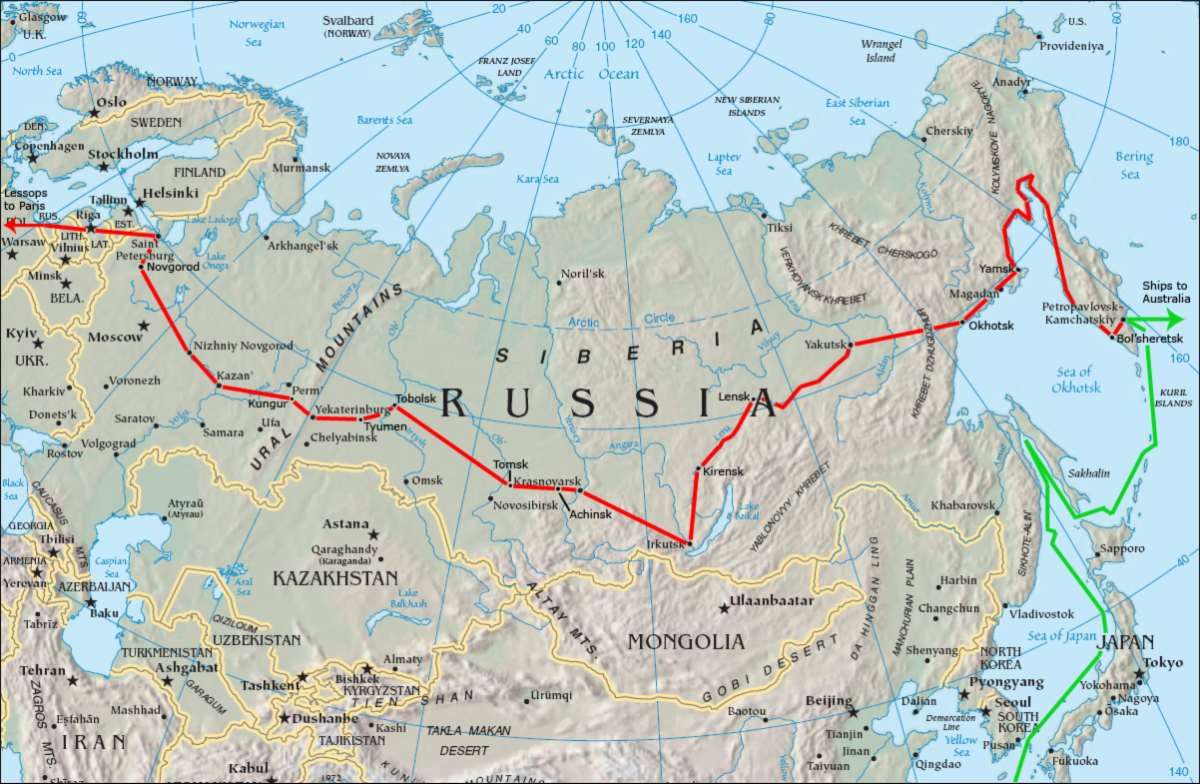
Top: Path of Barthélemy de Lesseps of the La Pérouse expedition, By Peter Varley - CIA World Fact book, Public Domain
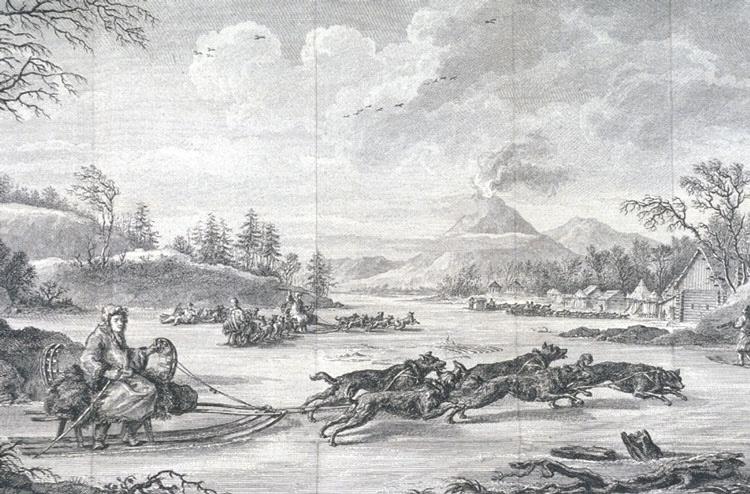
Bottom: Lesseps crossing the Kamchatka Peninsula by dog sled, By Imprimerie Royale (Paris France) - Public Domain
|
|
• Jean-Baptiste Barthélemy de Lesseps, (born on 27th January 1766 in Sète - died 26th April 1834 in Lisbon), was a renowned French diplomat and writer. Himself the son of a French diplomat posted in Hamburg and St Petersburg, by age 12 he spoke fluent Russian, German, Spanish.
• He participated in the expedition as a translator. When the French expedition arrived on the Kamchatka peninsula in Russia on 7 September 1787, where they were warmly welcomed by the local Russians and had the opportunity to rest after their journey, La Pérouse received letters of instructions from Paris to investigate the new British settlement in New South Wales, Australia. It is rather amazing that letters from France were dispatched thousand of miles away and were hand delivered in Kamchatka. Again, the entire planning of the expedition was astounding, and points of "rendez-vous" had been calculated within weeks.
• Hence, upon learning that he had to go to Botany Bay, La Pérouse sent de Lesseps back to France to hand deliver the expedition's Journal and scientific discoveries to the Court of Versailles. From Petropavlovsk, Lesseps was able to deliver the logs, maps, and correspondence of the expedition to Louis XVI, whom he successfully reached following a remarkable year-long trek through Siberia and Russia... but his odyssey could fill another Bulletin, outside the scope of our Society's geographical boundaries.
• Trivia: he was the uncle of Ferdinand de Lesseps, the brilliant engineer behind the construction of the Suez Canal.
|
|
The expedition's ended tragically
in Vanikoro, Solomon Islands ...
... But left an enduring legacy
|
|
Above:
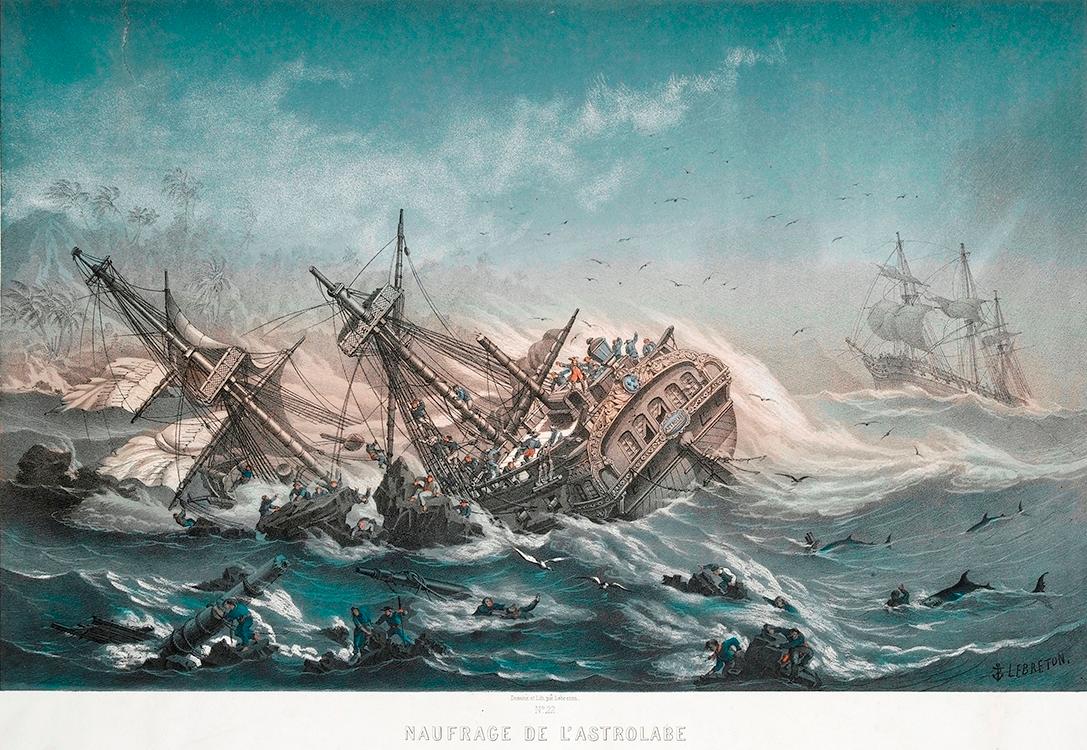
Top: "Le naufrage de L’Astrolabe et de La Boussole dans lequel disparait Jean-François de La Pérouse en 1788", "The shipwreck of L'Astrolabe and La Boussole in which Jean-François de La Pérouse disappeared in 1788", By Louis le Breton (1818-1866) — nmm.ac.uk, Public domain
Middle: The final letter by Lapérouse received in France. The document was carried to Europe from New South Wales in 1788 by the British ship Alexander, which had been part of the First Fleet carrying convicts to Australia. Photo by CC BY-SA 3.0,
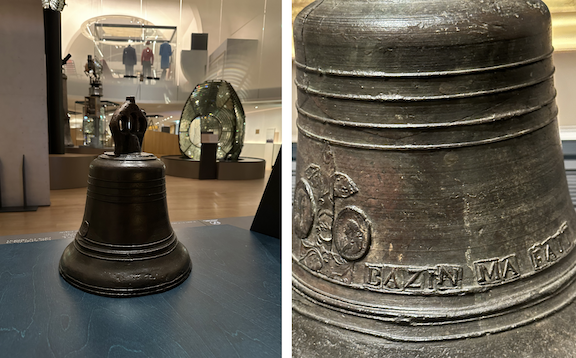
Bottom (left and right): the recovered bell from L'Astrolable, exhibited at the Musée National de la Marine, Paris (photo Thierry Chaunu). Note the detail "Bazin m'a fait" ("Bazin made me", i.e., the signature of the founder, which irrevocably identified it as l'Astrolabe's bell)
|
|
• It is easy to imagine the popular anxiety that spread in Versailles, but also in the French and European public when letters ceased to reach Europe, and the ships did not return to Brest as scheduled in the summer of 1789. Of course, as every one knows, the French Revolution had just started with the storming of the Bastille on July 14, and a distant expedition was naturally not the main preoccupation. Still, as Louis XVI was stripped of his absolute power to become a constitutional monarch under the National Constituent Assembly, he, and most of the politicians, journalists, and public opinion, never ceased to be preoccupied by the fate of La Pérouse.
• Right before the Constituent Assembly was dissolved in September 1791, a "search and rescue" expedition led by d'Entrecastraux was dispatched, but couldn't find any trace. Sadly, it stopped at the same Vanikoro island (which he called Île de la Recherche) where we now know that the tragic end of La Pérouse took place.
• Franco-British relations soured amidst the turmoil of the French Revolution, with baseless rumors circulating in France accusing the British for the unfortunate events near the new colony. Prior to the resolution of the mystery, the French authorities had already released the accounts of the expedition up to Kamchatka: Voyage de La Pérouse autour du monde, 1–4 (Paris, 1797). These publications still remain valuable sources of cartographic and scientific data on the Pacific region. Three English versions were subsequently published in 1798–99.
• To this day, all French schoolchildren know the following famous anecdote: ... Shortly before climbing to the scaffold, it is said that Louis XVI asked: "...Do we have any news from Monsieur de La Pérouse?..."
|
|
Places named after La Pérouse |
|
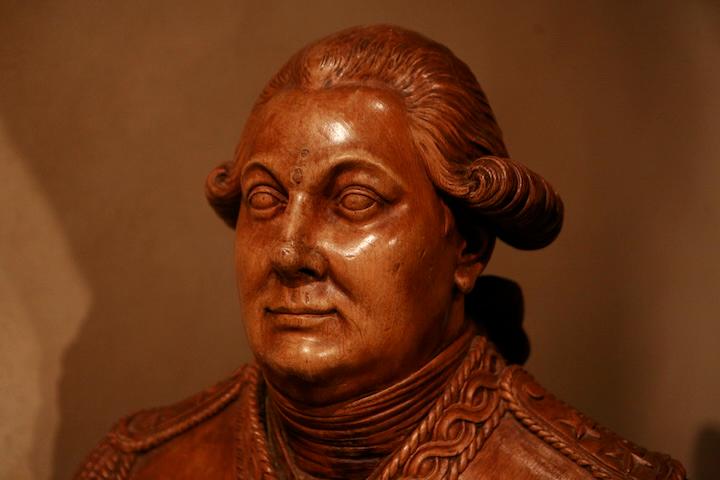
Above: Bust of Jean-François de Galaup, comte de Lapérouse, by the sculpture workshop of Brest arsenal. On display at Brest naval museum
|
|
• Mount La Perouse (3231 m) and La Perouse Glacier, Fairweather Range, Alaska
• Mount La Pérouse (1127 m) on Haida Gwaii, British Columbia
• La Pérouse Reef off the west coast of Haida Gwaii, British Columbia
• La Perouse Bank, Off the West Coast of Vancouver Island / West of Ucluelet/Tofino. This is the site of Environment Canada weather buoy 46206, at location 48.83N 126.00W
• La Perouse Strait between Hokkaidō and Sakhalin
• Mount La Perouse (1157 m) and the La Perouse Range, Tasmania, Australia
• La Perouse Pinnacle (37 m), in the French Frigate Shoals, Hawaii
• La Perouse (New Zealand) (3078 m), in New Zealand's Southern Alps
• La Perouse Glacier, Westland, New Zealand
• La Perouse Bay, site of his landing on Maui
• La Perouse Bay (Easter Island)
• La Perouse, a suburb of Sydney, Australia, on the northern headland of Botany Bay
• La Perouse Street, a main street in the suburb of Griffith in Canberra, Australia. There is a statue of La Perouse at the northern end of La Perouse Street at the Red Hill shopping centre.
• A Sidney suburb is called Laperouse...
Father Receveur who died there from his wounds received at the Tutuila massacre was the first Catholic priest and the second non-indigenous person to be buried in Australia. His obsequies are considered to have constituted the first Catholic religious ceremony held in Australia. Therefore local churches of La Perouse in Sydney hold a special memorial mass in February each year to recognize the historical religious significance of Receveur's arrival, death and burial.
• Rue La Pérouse, a street in the 16th arrondissement of Paris
• Sadly, the Lycée La Pérouse changed its name for Lycée Français de San Francisco (LFSF) in 2012. As an independent establishment, they are perfectly free to select their own name; our Society can merely convey disappointment regarding this decision.
• ... However, there is a La Pérouse crater on the Moon!
|
|
The La Pérouse Museum and statue
in his native city of Albi, France
|
|
Illustration:
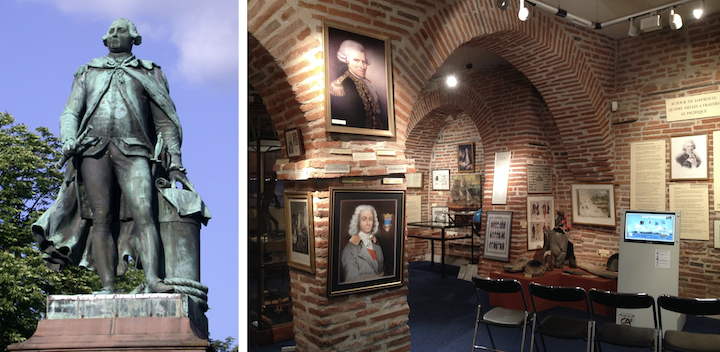
Statue of Laperouse, Albi, France by Nicolas Raggi, erected in 1853
Musée Lapérouse, Square Botany Bay 41, rue Porta, 81000 Albi, Franc
|
|
• There are several memorials dedicated to La Pérouse throughout the Pacific, notably in Vanikoro in the Solomon Islands, Petropavlovsk-Kamchatsky, Kamchatka...
• In 1825, on the initiative of Hyacinthe de Bougainville, commander of La Thétis, a column was erected in Botany Bay (Australia).
• In 1843, a monument was erected (on Nikolski Hill) at Petropavlosk (Russia), on France's initiative and with the Tsar's authorization. Destroyed in 1854, it was restored in 1882 at the expense of the Polish scientist Dybowski.
• In 1853, the city of Albi, the navigator's hometown, erected a bronze statue of him by the sculptor Raggi.
• In 1887, in Samoa, a memorial was erected by the French Navy in memory of Captain de Langle, killed in September 1787.
• In 1947, a plaque was affixed near the church of San Carlos de Borromeo in Carmel, CA.
• In 1952, a commemorative plaque mentioning the capture of Fort Prince of Wales (Canada) was affixed by the Historical Sites and Monuments Board of Canada.
• In 1985, a memorial plaque was placed on Cenotaph Island in Lituya Bay (Alaska, USA). It has since disappeared. Our Society is projecting to install an interpretive marker near the Visitor's entrance of Glacier National Park.
• In 1989, in Mauritius (formerly Île-de-France), a stele was erected by General Construction Co Ltd to mark the bicentenary of the French Revolution. The stele was inaugurated on March 14, 1989 by Mr. Alain Decaux of the Académie française, Minister for the French-speaking world. Another stele erected in Mauritius on land where the illustrious navigator lived " [...] bought this land in April 1773 and lived there". Captain Flinders says "In this spot he once dwelt, perhaps little known to the world but happy".
• In 1997, a monument was erected in Terneï (Russia) on the initiative of the town's authorities, bearing the name borrowed from a toponym given by La Pérouse when he landed on the coasts of the Tartarian Channel: Ternay.
• On May 30, 1994, a memorial and a commemorative plaque was unveiled by The Friends of La Pérouse, in memory of the arrival La Pérouse, on May 30, 1786, at Keone'O'Iu, or La Pérouse Bay, in Maui. Our Society is working towards the restoration of the crumbling monument and the embellishment of its immediate surroundings, with the addition of an interpretive marker.
• On May 5, 2006, a stele dedicated to Lapérouse was inaugurated in Tomari-Penzenskoi (Sakhalin Island, Russia).
• On October 27, 2007, a monument was erected at Cape Soya (Hokkaido Island, Japan) to commemorate La Pérouse's passage through the strait that bears his name. The monument was erected with the support of the municipality of Wakkanaï and the Lapérouse association in Albi.
• On June 29, 2011, a stele was inaugurated in the main courtyard of the Brest maritime prefecture.
• In 2013, thanks to the local authorities, a monument was erected in Kastri Bay (Russia) at a place named by Lapérouse in honor of the Minister of the Navy de Castries (the Russians didn't know that it was pronounced "Castres").
As for us in the United States, our Society is projecting to install in the coming months and years more interpretive markers, notably in Alaska, San Francisco, and Monterey.
|
|
Illustrations:
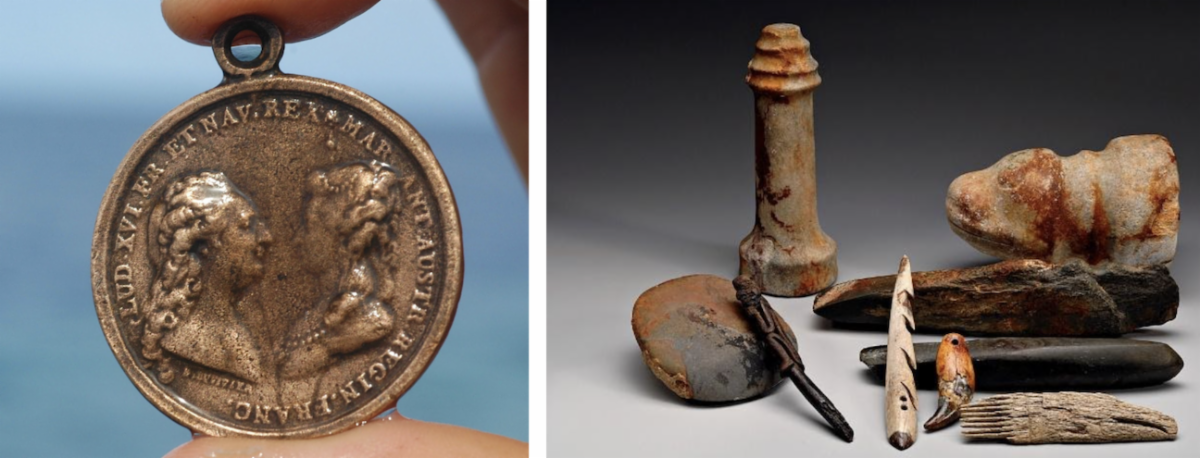
Above Left: Medal bearing the effigy of Louis XVI and Marie Antoinette, distributed by La Pérouse at each port of call. It was found on the wreck of La Boussole in Vanikoro (Ass. Salomon/photo Pierrot Larue).
Above Right: These objects were found on the L’Astrolabe and the Boussole shipwrecks, in Vanikoro (Salomon Islands) and are all from Lituya bay. Photo: Drassm/ Photo Frédéric Osada.
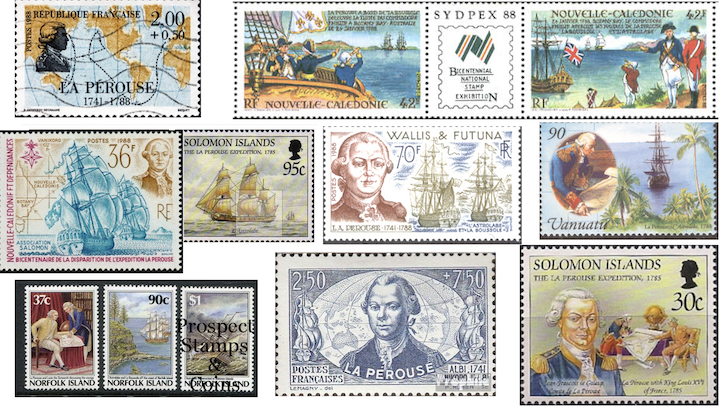
Below: a few stamps from different nations of the Pacific Ocean honoring the expedition of La Pérouse. Maybe, for its 250th anniversary in 2036 will there be a US Post Office stamp?
|
|
Tribute to Sgt. James Henry Baugham
Lafayette Flying Corps
"Died for France"
on July 2, 1918, at Villers-Coterêts, (Aisne)
We continue our series started this past October with tributes to members of the Escadrille Lafayette, later part of the Lafayette Flying Corps. For access to our Bulletin dedicated to the Escadrille Lafayette, please click on:
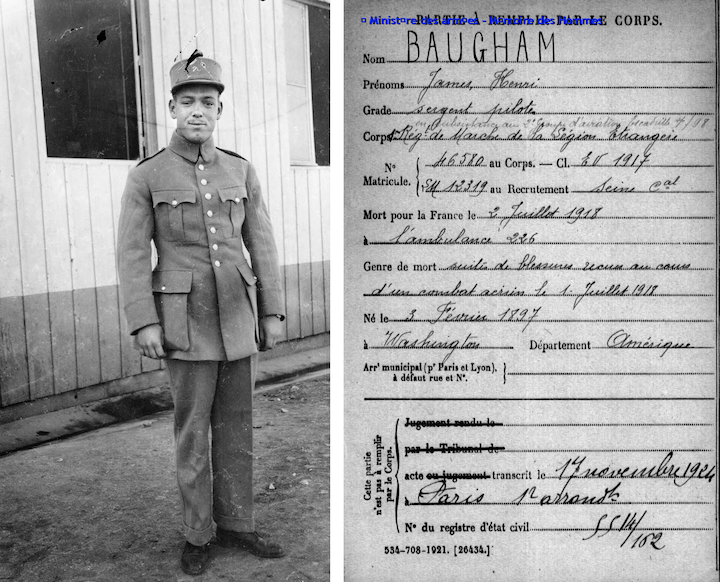
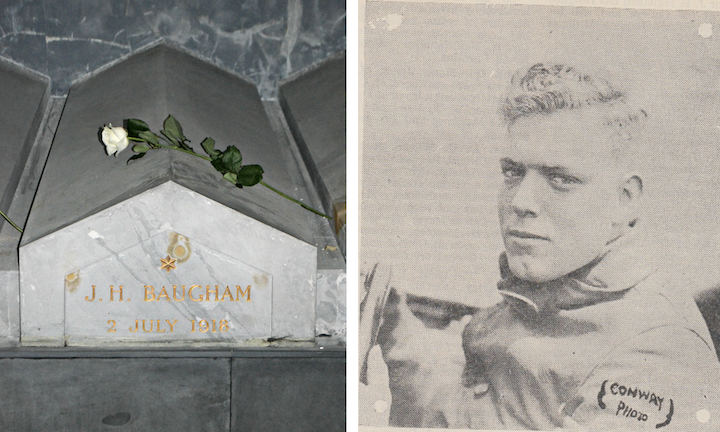
This month, we pay hommage to Sergeant James Henry Baugham, who "Died for France" while serving in World War One, decorated with the Croix de Guerre with Palm and the Médaille Militaire.
|
|
Photos above, from Left to Right:
Page from Sgt Baugham's' "Livret Militaire" with citation "Mort Pour la France" ("Died for France")
Buried at Escadrille Lafayette Monument, Marnes-la-Coquette, France.
|
|
James Henry Baugham, the son of William P. and Mary H. Baugham, was a World War I fighter pilot. Initially a member of Spa 157, he later transferred to Spa 98 and became a member of Lafayette's Flying Corps.
On July 1st, 1918 at 4:30 pm, Baugham bravely attacked three German aircraft single-handedly. Despite sustaining two serious wounds, he skillfully managed to bring his plane back and land behind the French lines. Unfortunately, Baugham succumbed to his wounds on July 2nd, 1918.
His remarkable story is documented in the book "Portraits of War: James Henry Baugham" by Jessica A. Bandel, published on January 26, 2017 by the University of North Carolina Press.
Baugham, a native of Washington, North Carolina, was the youngest North Carolinian to fly for France. He had to seek an alternative path to join the war due to his young age of eighteen, which barred him from joining the U.S. Air Service. Baugham attended Curtiss Aviation School in Newport News, Virginia in the spring of 1917 and graduated on June 20. Shortly after, he arrived in France and joined the Lafayette Flying Corps.
He was the only North Carolinian with prior piloting experience to enter the French flying service. After six more months of flight instruction with the French, Baugham was assigned to Escadrille 157, a pursuit squadron. He remained with this squadron until June 27, 1918, when he was transferred to Escadrille 98. Just four days later, Baugham fearlessly engaged three enemy aircraft near Villers-Cotterets, despite lacking support. Although he fought valiantly, he was eventually forced to withdraw towards the French lines due to a mortal wound and severe damage to his aircraft.
Baugham passed away at the age of nineteen in a French hospital on July 2, 1918. He is officially credited with two kills, making him North Carolina's most accomplished fighter pilot.
James Henry Baugham is buried at the Escadrille Lafayette Monument, at Marnes-la-Coquette on the outskirts of Paris.
|
|
ANNOUNCEMENTS AND SAVE THE DATES |
|
Our Hermione Fund raising appeal continues!
|
|
• This past November, our Society helped launch the US Fund raising campaign to help Save the Hermione and have it sail back in time for the United States Semiquicentennial. This is an ongoing campaign and all donations are tax-deductible.
• Save the Date! On Saturday August 17, throughout the morning, an ongoing presentation on the history of the frigate Hermione followed by Q&A's from the general public will take place on board of the three-mast Wavertree at South Street Seaport in downtown Manhattan, as part of the kickoff celebrations of the Lafayette Farewell Tour Bicentennial.
|
|
"Merci Train" 75th Anniversary Celebrations |
|
• Our November 2022 Bulletin narrated the incredible story and ongoing legacy of the "Train de la Reconnaissance Française", affectionately called "The Merci Train" (November 2022: "The Merci Train, 49 boxcars of French gifts"
• 2024 is the 75th anniversary of the "Merci Train", a gesture of friendship and gratitude from the French people to Americans who gave 49 boxcars full of gifts for each State in 1949.
• The Merci Train, the 40&8 National Box Car Association and many other local organizations, custodians of the various "Merci train" boxcars in several States are planning celebrations throughout the year. We are honored to help get the word out.
• The Historic Museum of Holly Hill is planning with our Society, represented by Brigitte van den Hove-Smith, Déléguée Générale Adjointe, South East USA a special commemoration in Holly Hill, Daytona Beach, FL at the Florida boxcar on November 11 at 11:00AM, with the French General Consulate in Miami. Stay tuned for more details!
• Another "Save the Date": February 2, 2025 for the re-dedication of the Hawai'i boxcar, currently being restored thanks to Mr. Jeff Livingston, Historian, 40 & 8 Project Manager, Hawaiian Railway Society, and volunteers, as well as the enthusiastic support of the Aloha Chapter, NSDAR, of the Daughters of the American Revolution, Laura Ingenluyff, State Vice-Regent, Hawai'i NSDAR. See the photos below that we just received, showing the incredible efforts that are being deployed to save this historical artifact.
|
|
Highlight of the month:
Preservation work done by volunteers in Arizona
|
|
Above: Photo & caption from The Daily Independent, March 20, 2204: "The Merci Train at the McCormick-Stillman Railroad Park is getting some TLC from local groups hoping to preserve a beloved piece of American and French heritage. Pictured is the 75th-anniversary event of the Merci Train attended by city council, American Legion members, Four Peaks Questers and the Forty & Eight Society of Arizona (Photo Courtesy of the City of Scottsdale via FaceBook)"
Signage for the Merci Boxcar in Scottsdale, AZ is currently on production. 8 signs will be installed this summer. The Four Peaks Questers volunteers will be going on to Phase Two for display of objects contained in the Merci Train. the City of Scottsdale has been very supportive in keeping this important historic relic!
The Arizona boxcar can be viewed at:
McCormick-Stillman Railroad Park Playground
7301 E Indian Bend Rd, Scottsdale, AZ 85250
Our Society applauds the dedication and efforts of the American Legion and all the patriotic associations all over the United States who are the custodians of these boxcars. Their preservation work and dedication are admirable.
|
|
A memorable visit at the Harlem Hell Fighters headquarters
March 27, 2024
|
|
Following the publication of our February 2024 Bulletin - Tribute to the Harlem Hell Fighters - 369th Regiment
https://conta.cc/4bDQZWu (version en français), it was an honor and a privilege to visit the Headquarters of the 369th Sustainement Brigade this past Friday, March 27th.
• With the Association of French Reserve Officers in the United States (ACREFEU), and the Federation of French War Veterans, our Society received an invitation to tour the Armory in Harlem.
• LTC LG David Myones, US ARMY NG NYARNG, Executive Officer and SGM Gentile took the time from their busy schedule to present us with the rich history of the Harlem Hell Fighters.
• This all African-American regiment was the first regiment to enter combat in 1918, never retreated from the enemy, was the most decorated regiment of the entire war, was the first one to cross the Rhine river, never lost any prisoner to the ennemy, suffered more than 1,500 casualties, and was awarded the Croix de Guerre. Still today, soldiers of this regiment, now called the 369th Sustainement Brigade of the New York National Guard, wear the French «fourragère» on their uniform. In addition to being heroes on the battlefield, musicians of the regiment’s band introduced jazz to France, and by extension to Europe.
• We were impressed by the tour of the armory and the memorabilia of the Harlem Hell Fighters on display, many of which testify to the close and enduring historical links between the US and French Armies.
• An obelisk stands right by the Harlem River Drive, a testimony to the close bonds between the US and French armies forged in battle.
369th Regiment Memorial Obelisk
5th Ave. &, W 142nd St, New York, NY 10037
• This 12 ft high black granite obelisk is the exact same replica of the obelisk that adorns the town of Séchault in France, site of one of the most heroïc deeds of the 369th Infantry regiment, once part of the 4th French Army.
• Inscription:
« 93rdST Division (US) - 161st Division (FR)
369th Infantry Regiment (15th Reg-NY) (colored)
In Memory – 1918 – Meuse Argonne Offensive
Ripont - Mont-Cuvelet – Sechault - 26 Sep - 1 Oct »
Erected 2006"
Photos: Daniel Falgerho
|
|
It's all about Rochambeau!
Announcements from the W3R:
|
|
The Battle of Rhode Island Association Lecture Series sponsored by the Rhode Island Senate Legislature and the General Society of Colonial Wars continue as we partner with the Portsmouth Historical Society and the Varnum House Museum to bring a series of lectures from historian Dr. Robert A. Selig in Portsmouth and East Greenwich.
On Sunday April 21st at 1:30 PM, Dr. Selig will present “The Culture of Death: Military Burial Practices during the American War of Independence”. Battlefield clean-up is a topic rarely covered by historians, yet following almost any military engagement, there are corpses to dispose of. But who is responsible for the disposal of corpses? Can we tell who buried whom? When does the burial take place? How many hours, days, months later? Where are the corpses buried? Individually or in mass graves? In natural crevices? Naked or dressed? Officers and other ranks together or separate? How long do they remain in the ground? Are they ever found? Who would dig them up and why? Can we identify them? Based on primary sources as well as recent discoveries of the remains of Revolutionary War soldiers, this illustrated talk by historian Dr. Selig will provide answers to these and related customs and usages surrounding military burial practices during the American War of Independence.
Dr. Selig is a historical consultant who received his Ph.D. in history from the Universität Würzburg in Germany in 1988. He has published several books on the American War of Independence and is a specialist on the role of French forces under the Comte de Rochambeau during the War. In 2022 the French government recognized his contributions by awarding him the National Order of Merit. He serves as a project historian to the National Park Service for the Washington-Rochambeau Revolutionary Route National Historic Trail Project (WARO). For this project he researched and wrote surveys and resource inventories for the nine states (and the District of Columbia) through which American and French forces marched in 1781 and 1782.
|
|
80th anniversary of D-Day - events in preparation |
|
There will be countless official ceremonies celebrating the 80th Anniversary of D-Day on June 6, 2024, at the beaches of Normandy, in Paris, and at commemorations with the participation of French Consulates throughout America.
• You may remember that 3 years ago we also supported premiere in New York
the incredibly moving documentary "The Girl Who Wore Freedom", by filmmaker Christian Taylor.
This is the perfect time to view it again, or for the first time! It is now widely available on several platforms such as AppleTV or Amazon Prime Video. For a complete list, visit: https://thegirlwhoworefreedom.com/
|
|
"Operation Mirror 2024"
"La Flamme de la Nation" from the Arc of Triumph, Paris
to the Tomb of Unknown Soldier, Arlington National Cemetery
Saturday May 24th at 2:00PM
• As part of the 80th anniversary of the Normandy landings, the "Flamme de la Nation " which has been burning since November 11, 1923, on the tomb of the Unknown Soldier under the Arc de Triomphe, will be collected on May 8, 2024, around 7:30 pm, following the daily rekindling of the flame.It will then be physically transported to the United States.
• 12 young French students will accompany the flame. They will reach Cherbourg in a convoy of vintage 1944 military vehicles along the "Voie de la Liberté" from the village of Saint Symphorien-le-Château. They will cross the Channel for a stopover at Southwick House, near Portsmouth, England, which served as the departure point for the Allied armada. They will then cross the Atlantic on board the Queen Mary 2, disembark in New York and reach Arlington, VA. where the flamme will be presented at the Tomb of the Unknown Soldier on May 24th at 2:00PM.
• This gesture is a testimony of France's gratitude to its allies, as their commitment was crucial in regaining its freedom.
• This project is placed under the High Patronage of Mr. Emmanuel Macron, president of the French Republic.
• Le Souvenir Français in Paris, which is an association placed since its inception in 1887 under the High Patronage of the President of the Republic, is an Official partner of "Operation Mirror".
• Our Society will participate in ceremony at the pier in NY to welcome the students upon their arrival is in the planning stages, along with other French and American youth organizations from the Tri-State area. Please stay tuned for details in our next Bulletin.
|
|
D-Day in Paris celebration
by TheFrenchWillNeverForget.org
June 6, 1944 - June 6, 2024
|
|
• We are proud to announce that our First Vice-President, Patrick du Tertre, who is also co-Founder of TheFrenchWillNeverForget.org, along with Paul Bensabat, Jean-Pierre Heim, and Christian Millet (in memoriam), are planning a momentous celebration in Paris, with 1,944 schoolchildren waving American and French flags at the foot of the replica of the Statue of Liberty, Pont de Grenelle, with the Eiffel Tower in the background.
One goal is to create a video clip and an emblematic photo to be distributed widely and especially in the United States.
You will find all the details in the 2 documents (each in English and French) at the link:
This commemoration organized by The French Will Never Forget has recently obtained from the French Government the prestigious label "Mission Liberation” and has the full support of local leaders (town halls) and the largest patriotic associations in France, as well as the American Legion Post1 in Paris. It also has the official support of Le Souvenir Francais in France.
It will bring together thousands of people and high-ranking officials.
We encourage you to associate your name and/or that of your company with what will be the largest commemoration of D-Day in Paris, by making a donation to allow The French Will Never Forget to close their budget. You will of course be recognized as one of the promoters of the event and will also contribute to strengthening the ties of friendship between France and the United States. Ways to donate are listed below.
The French Will Never Forget is a 501c3 charity, and any donation is tax deductible in the USA.
|
|
Homage of the Souvenir Français to Anna Marly
Composer of the "Chant des Partisans"
Friday, June 7, 2024
Palmer, Alaska
|
|
Gravesite, “Anna Marly”
Palmer Pioneer Cemetery , S Old Glenn Hwy, Palmer, AK 99645
• We are also proud to announce that on June 7th, our Society will honor Anna Marly, the composer of the "Chant des Partisans", in close partnership with the Alaska Chapter of the Daughters of American Revolution. Anna Marly is buried in Palmer, Alaska. Her hymn galvanized the French Resistance and became the second unofficial French national anthem. She became an American Citizen in 1965.
Mme Sonia Lelarge,
Honorary Consul of France in Anchorage, Alaska
will present a wreath in the name of Le Souvenir Français
in collaboration with
The Daughters of the American Revolution, Alaska
Specific details will be announced in our next Bulletin
• Anna B. Smiernow, born Anna B. Betulinskaya, known as Anna Marly, (30 October 1917 – 15 February 2006) was born in Saint Petersburg, Russia and died in Palmer, Matanuska-Susitna Borough, Alaska. Her mother fled the Russian Revolution with baby Anna and found refuge in Nice, France. As a teenager, Anna became a ballet dancer in Monaco and as a young woman became a cabaret singer in Paris when WWII broke out. She joined the Free French in 1940.
• Anna Marly is the composer of the "Chant des Partisans" ( Joseph Kessel and Maurice Druon wrote the lyrics) which became a second national anthem of France after La Marseillaise during WWII and up until today, whenever ceremonies are held in honor of the French Resistance.
• After the war and her divorce, she moved to Latin America, then Pennsylvania with her second husband, and moved to Alaska after his death. She became a naturalized American citizen in 1965.
• She also wrote "La Complainte du Partisan" (known in English as "The Partisan"), which was later famously covered by Leonard Cohen and Joan Baez.
• Inscription:
Composer - Singer
"She made her talent into a weapon for France."
---- General Charles De Gaulle
|
|
PAST MONTHLY BULLETINS
OUR GOAL: turn the spotlight on a famous, or less famous, episode or historical figure during the long shared history between France and the United States, with illustrations and anecdotes.
You can have access to all our past 2023 monthly Bulletins
(in English and French) by clicking these thumbnails below or by
|
|
CALENDAR OF EVENTS 2024
List is subject to change. All dates to be confirmed
|
|
2024 promises to be a busy year with several projects and events!
It will be the start of the Bicentennial of Lafayette's Farewell Tour with many, many events starting in August, to celebrate his triumphal tour as "Guest of the Nation" throughout 24 States and lasting 13 months! This Bicentennial is organized by The American Friends of Lafayette and we will provide in future bulletins all details.
• Sunday, May 5: celebration of "French Alliance Day" at Washington Memorial Chapel, Valley Forge, PA
• Saturday & Sunday May 18 & 19 : Rochambeau Festival, Yorktown (NY)
• Monday, May 27: Memorial Day
• May 24: "Operation Miroir" In honor of the 80th Anniversary of
D-Day: Fifty young French students will carry "La Flamme de la Nation" from the Arc de Triomphe in Paris to Arlington National Cemetery, where a ceremony will take place on May 24th at 2:00PM.
• Thursday, June 6: D-Day allied landing in Normandy celebration
• Thursday, June 6: TheFrenchWillNeverForget.org is planning a memorable event in front of the replica of the Statue of Liberty in Paris at the Pont de Grenelle, with the Eiffel Tower in the background, with 1,944 schoolchildren waiving American and French flags. With the support of Le Souvenir Français in Paris and several other French and American patriotic associations.
• Friday, June 7: American Society of Le Souvenir Français wreath-laying at Anna Marly's grave, Pioneer cemetery, Palmer, Alaska (composer of Le Chant des Partisans) by Mme Sonia Lelarge, Honorary Consul of France in Alaska, in cooperation with the Daughters of the American Revolution.
• Tuesday, June 18: Appel du 18-Juin
• Friday July 5: annual wreath-laying at the tomb of general Lafayette at Picpus cemetery, Paris, by the American Ambassador.
• Weekend July 12-13-14: annual wreath laying ceremony in front of the Statue of Rochambeau in Newport, R.I., homage at the tombs of Admiral de Ternay, Chevalier Pierre Rousseau de Fayolle, LT Benjamin de la Villemarais at Trinity Churchyard and "Tribute to France"
• Saturday, July 13: Bastille Day celebration in Central Park
• Thursday, August 15: 80th anniversary of Allied landing in Provence
• Friday, August 16: Kick-off Lafayette Farewell Tour Bicentennial on Broadway
• Friday, October 18: stele and boulder with bronze plaque honoring by name the hussars who died at the Battle of Hook, to be installed between our two markers at Abingdon Elementary School park.
• Saturday, October 19: celebration of French-American Victory at Yorktown, dedication of a bronze plaque "Sailors buried at sea” at the French Memorial
• Sunday, November 10: Annual wreath-laying at the 463 "Morts Pour la France", Notre Dame Church in Manhattan
• Monday, November 11: Veterans Day / Armistice Day, 5th Avenue Parade in NYC, Washington DC, Houston, TX
• Monday, November 11: wreath-laying ceremony at the Merci Train boxcar in Holly Hill , Daytona Beach, Florida
Exact dates to be announced in the future:
• Tribute at Varian Fry's grave, Green-Wood cemetery, Brooklyn, NY (Righteous Among the Nations)
• Ceremony to honor the memory of 8 French Soldiers who are buried by Old St. Peter's Church in Old Hillside Cemetery, Cortlandt, NY
• Re-dedication: La Pérouse Memorial restoration at LaPerouse Bay, Maui, HI
• Dedication of 4 commemorative plaques in honor of the 4 American “Companions de la Libération”: General Dwight D. Eisenhower, John Hasey, James Worden, Jacques Tartière
• Dedication of a bronze plaque honoring "Le Tigre" French prime minister Georges Clemenceau in New York, where he spent four years as a young journalist from 1865-1869
• Dedication of a bronze plaque at Gramercy Park, New York, honoring Varian Fry who lived in Marseilles in 1940 and 1941 and helped many jews escape to America.
• Dedication of the Memorial to 4 soldiers from the Royal-Deux Ponts regiment who are buried in the vicinity of the Odell House – Rochambeau Headquarters
• Other sites of exhibits in France of the touring US Unknown Soldier exhibition in Paris will be announced as they are confirmed.
• Statue of Alexis de Tocqueville, author of the 1835-1840 classic "Democracy in America" (university site TBD)
• Bronze plaque to the memory of 3 soldiers of the Auxonne, Saintonge and Soissonnais regiments who died at West Point in 1782.
• Bust of Antoine de Saint Exupéry at the Intrepid Pier, New York
• Commemoration at Odet Philippe's monument, Philippe's Park, Safety Harbor, FL (Founder of grapefruit industry in Florida)
• Bust of Jean Ribault, site of the Trinity shipwreck, near Cape Canaveral, FL
• Beautification of "Matanzas" marker at the site of Jean Ribault's colony massacre in 1565, Saint Augustine, FL.
Last but not least, we will pursue our national fund-raising campaign in partnership with other US patriotic and cultural organizations to help the frigate Hermione sail again and participate in the upcoming semiquincentennial (250th anniversary) of the United States.
Help us make these a reality with your tax-deductible financial support!
You are welcome to specify the project(s) you wish to help.
Un grand "Merci"!
|
|
OUR MISSIONS:
• To preserve the memory of the French soldiers, sailors and airmen who gave their lives for freedom, and who are buried in the United States.
• To honor French Citizens who did great deeds in the United States, or with a strong connection with the United States,
• To promote the appreciation for French culture and heritage in the United States, and the ideals that unite our two nations, in order to pass the torch of memory to younger generations.
• To strengthen the long-standing traditional bonds of friendship between the American and French peoples, and to this end: erect or maintain memorials and monuments and encourage historical research, public presentations and publications in the media.
The American Society of Le Souvenir Français, Inc. is an independent American corporation, apolitical, established in 1993 in NY, with 501 (c) 3 non-profit status.
|
|
Board of Directors
American Society of Le Souvenir Français, Inc.
Members (2024):
Françoise Cestac, Honorary President • Thierry Chaunu, President, and General Delegate, Le Souvenir Français in the United States • Yves de Ternay, Treasurer • Patrick du Tertre, 1st Vice President • Henri Dubarry • Francis Dubois • Alain Dupuis, 2nd Vice President & Deputy General Delegate, Le Souvenir Français in the United States • Daniel Falgerho, General Secretary • Clément Mbom, Education Advisor • Jean-Hugues Monier, Auditor • Harriet Saxon • Nicole Yancey
Regional Delegates:
Jacques Besnainou, Great Lakes and Midwest • Bruno Cateni, South
Prof. Norman Desmarais, New England • Alain Leca, Washington D.C. •
Marc Onetto, West Coast • Brigitte Van den Hove – Smith, Southeast • Nicole Yancey, Yorktown & Virginia, former Honorary Consul of France in Virginia
|
|
Help us implement several historic commemorative projects celebrating the 246-year-old Franco-American friendship and alliance! |
|
The American Society of Le Souvenir Français, Inc. is a registered NY State non-profit corporation and has full IRS tax exempt 501(c)3 status. All donations are tax deductible.
Copyright © 2024 The American Society of Le Souvenir Français, Inc.
All Rights Reserved
Merci de nous contacter si vous souhaitez recevoir ce bulletin dans sa version traduite en français.
Contact: Thierry Chaunu, President
500 East 77th Street #2017, New York, NY 10162
|
|
|
|
|
|
|