|
In the spirit of its usual climate fearmongering, the National Academies of Sciences, Engineering, and Medicine is promoting its fifth annual Ramanathan Climate Conversation with the title “Extreme Heat and Health.” It frames rising nighttime temperatures, humidity, and urban heat islands as an “escalating global challenge.”
The message is familiar: Heat is an existential threat, communities must “prepare,” and emissions of greenhouse gases are the culprit.
What the Academies omit matters more.
Cold still kills far more people than heat. Multi-country studies find cold-related mortality 10–20 times higher than deaths from heat. An analysis of 74 million deaths across 384 locations linked 7.3% of deaths to cold versus 0.42% to heat.
In Europe, cold is roughly 10 times more lethal overall and 40 times more so in the north. In the United States, cold still accounts for most temperature-related deaths even as heat dominates media attention.
Heat mortality has fallen as increased prosperity has enabled better adaptation. U.S. heat-related death rates in major cities dropped 74% from the 1960s through the 1990s despite warmer weather, thanks to air conditioning, improved housing, warning systems, and public-health measures.
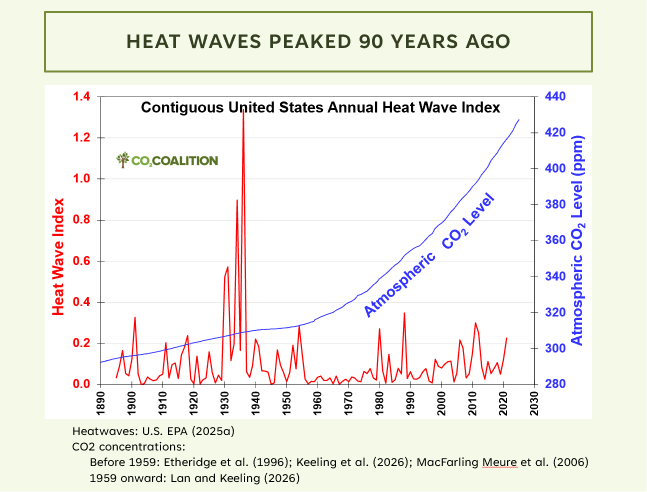
The Academies highlight a July 4 temperature of 103 degrees Fahrenheit in Washington, D.C., that broke a 1919 record. However, isolated daily records do not prove “unprecedented” danger. As mentioned in last week’s newsletter, historical heat waves, including the Dust Bowl of the 1930s, produced far higher death rates before the advent of modern infrastructure.
The Academies’ agenda includes brain health webinars and “heat protection” papers. Missing is contextual material about winter mortality, the harmful effects of insufficient energy supplies, and the life-saving role of affordable, reliable power. The Academies treat fossil fuels as a problem rather than a foundation for the economic advancement that has slashed weather-related deaths for a century.
The relative warmth of our modern era has extended growing seasons and, combined with increases in atmospheric CO2, has driven higher crop yields and the greening of ecosystems around the globe. As for temperature extremes, humanity has never been better equipped to handle heat or cold.
Yet despite all these positive facts, the National Academies continues to flog the tired narrative of climate doom to the detriment of its own credibility.
We hope you’ll support the CO2 Coalition to provide the science behind the full story.
|