|
Six HR Strategies for Fostering a Positive, Successful Work Environment
by Jessica Mulholland, Managing Editor, CalChamber
Running a business is no easy feat, as doing so requires not only financial and operational duties, but also numerous HR-related responsibilities — managing, paying and scheduling employees, and making sure the interactions among them are respectful.
The following strategies are aimed at not only helping HR operations and compliance, but also fostering a work environment that’s positive, inclusive and well-managed.
1. Emphasize and Maintain Zero Tolerance for Harassment
Despite increased social awareness over the last five years, harassment remains a serious area of concern for employers — whether it’s sexual harassment, or harassment based on a person’s race, national origin, religion or any other protected characteristic.
Not only is harassment illegal, but when it occurs in the workplace, it may interfere with morale and work performance. Ultimately, an employer’s obligation is to prevent all forms of harassment, which can be aided by openly emphasizing zero tolerance for harassment of any kind and maintaining that stance under all circumstances.
Start by making sure that your clear and concise company policies emphasize your zero-tolerance stance. The employee handbook should include the company’s commitment to not only providing a method for individuals to come forward and file a complaint (that includes an alternative to going to their direct supervisor), but also conducting timely and thorough investigations.
To maintain your zero-tolerance stance, follow through on the commitments laid out in your policies and ensure that those in leadership positions model the behavior they expect to see from employees.
Mandatory harassment prevention training that meets California’s strict requirements shows employees and supervisors what to look for — inappropriate behavior and remarks, and other red flags — and encourages them to act in respectable ways that can ultimately prevent harassment-related situations from occurring.
Employers with five or more employees must provide one hour of sexual harassment prevention training to nonsupervisory employees and two hours of training to supervisors. And to further solidify and entrench an anti-harassment, all-inclusive environment, employers may want to consider incorporating diversity, equity and inclusion (DEI) into their workplaces.
2. Properly Manage Protected Leaves of Absence
Managing leaves of absence can be tricky, so the best place for employers to start is by knowing which leave laws apply to you and their specific requirements. Here’s the lowdown.
The California Family Rights Act (CFRA) applies to all private employers with five or more employees and provides up to 12 weeks of job-protected leave in a 12-month period, as does the federal Family and Medical Leave Act (FMLA), which applies to private employers with 50 or more employees. Many qualifying reasons for taking these leaves overlap (but some key differences exist).
Pregnancy Disability Leave applies to all private employers with five or more employees and provides up to four months of unpaid leave when an employee is disabled by pregnancy.
While our Leave Interaction Wizard can help you determine for which leave an employee is eligible, there are additional things to keep in mind once an employee is out on protected leave — primarily if you’re considering terminating an employee after that person exhausts 12 weeks of CFRA/FMLA leave but still can’t return to work.
In this case, you may have to consider extending leave as a reasonable accommodation, per California’s Fair Employment and Housing Act, under which, employers must engage in the interactive process with an employee to determine whether additional leave would be an effective and reasonable accommodation.
Also important to remember is California’s Paid Sick Leave (PSL) law, which applies to nearly all employers and provides employees with a minimum of 24 hours of sick leave annually. Local paid sick leave ordinances also exist in Berkeley, Emeryville, Los Angeles City, Oakland, San Diego City, San Francisco and Santa Monica. Employers with employees working in any of those localities must comply with both state and local requirements. Use this chart to compare California PSL requirements with the various local leave requirements.
And new for 2023 is that California now requires private employers with five or more employees and all public employers to provide up to five days of bereavement leave upon the death of a family member.
3. Correctly Classify Workers
Employers may classify workers in a few different ways, such as exempt vs. nonexempt or employee vs. independent contractor.
The presumption is that a worker is your employee. If you have individuals working for you as an independent contractor, it’s critical to ensure they are classified correctly, which can be done by applying the “ABC test” (unless they fall under a particular exception). To establish that a worker is an independent contractor, an employer must prove that the worker:
- A - Is free from control and direction of the hiring entity in connection with the performance of the work, both under the contract for the performance of the work and in fact;
- B - Performs work that is outside the usual course of the hiring entity’s business; and
- C - Is customarily engaged in an independently established trade, occupation or business of the same nature as the work performed.
Workers that don’t meet all these requirements are not considered independent contractors; they are employees.
And understanding whether an employee is exempt vs. nonexempt is critical, as strict wage and hour requirements (such as overtime pay, and meal and rest break) apply to nonexempt employees. Stated simply, job titles alone don’t designate an employee as exempt or nonexempt — for California employees to be exempt, they must meet strict job duties tests particular to each exemption and meet the minimum salary requirement of that exemption. Using our exempt analysis worksheets can assist you in determining an employee’s status:
Before you even begin recruiting and hiring, educate yourself on the different types of workers, formulate a job description and analyze the position; doing these things before classifying the worker will help ensure all of your workers are classified correctly. And if you’re currently unsure of your worker classifications, seek legal counsel.
4. Implement Employee Retention Initiatives
Finding and retaining employees is a challenge, as the job market is flooded with open positions — more than 1 million in California alone, according to the most recent U.S. Bureau of Labor Statistics data. With all that opportunity out there — much of which is now fully remote work, thanks to COVID-19 upending the traditional work model — many workers are leaving their current jobs for something new.
In fact, 96 percent of workers are looking for a new position in 2023, according to a Monster.com report released in December, and the reasons include needing a higher income (40 percent), not seeing room to grow (34 percent) and that their workplace is toxic (25 percent).
But employee turnover is burdensome; not only does it cost companies an average of $57,150 in lost productivity and to rehire another employee, according to a December 2022 survey from The Harris Poll (with 23 percent of hiring managers saying it costs their company $100,000 or more annually), but it also impacts other employees whose workloads tend to increase when colleagues depart.
To reduce employee turnover, consider developing strategies to retain employees. A starting point is to gather data by surveying your employees, and then use that data to target struggling areas and implement retention initiatives.
Some retention ideas to consider, per a recent Forbes article, include offering clear opportunities for advancement, as organizations with a strong learning culture have 30 percent to 50 percent higher engagement and retention rates, according to Deloitte; and focusing on company culture and creating one that’s compelling, as 77 percent of prospective employees consider a company’s culture before applying, according to Glassdoor.
No matter what strategies or initiatives you implement, make sure that company leadership commits to resources and supports the methods you identify as assisting with employee retention.
5. Properly Handle the Form I-9 Process
Under the Federal Immigration Reform and Control Act of 1986, every employer, regardless of size, is required to verify that an individual is authorized to work in the United States, and they use the Form I-9 to do so.
The Form I-9 process is tricky, however, so use caution — and remember that it’s illegal to discriminate based on national origin and citizenship status during not only this process, but also the individual’s employment.
All U.S. employers must complete the Form I-9, either electronically or hard copy, for every new hire within three business days of the employee's first day of work for pay.
When verifying the employees’ documents, you can neither accept expired documents nor decline documents that are acceptable under the law — and you must retain Form I-9 records for at least three years from the date of hire or one year from the date of termination.
6. Enforce Meal and Rest Break Policy for Nonexempt Workers
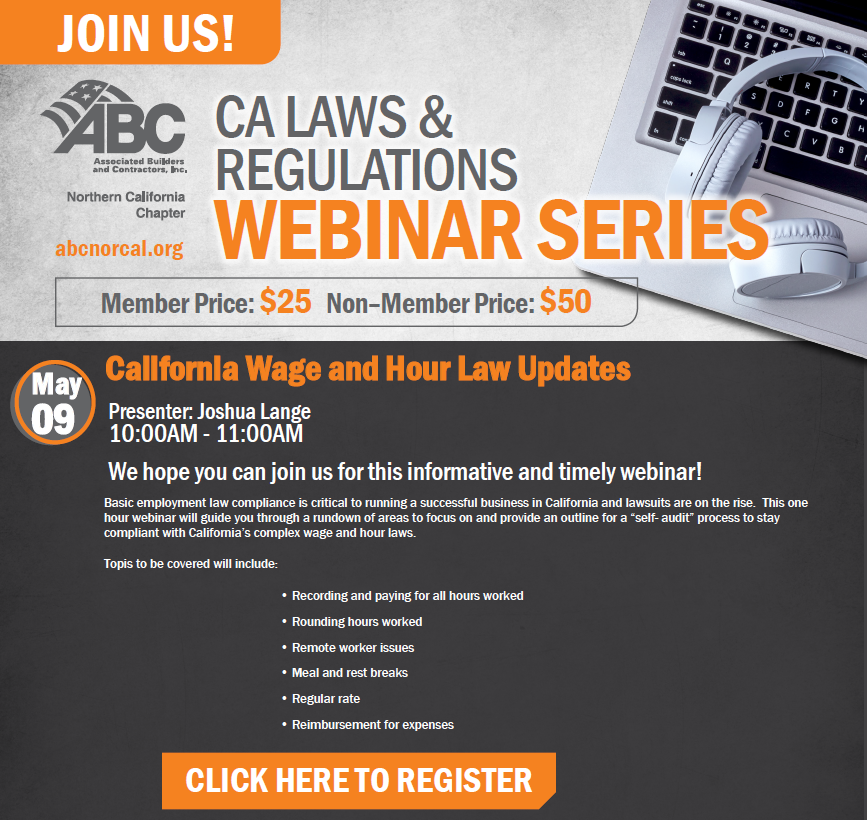
California’s wage and hour laws require that you provide meal and rest breaks to your nonexempt employees — at least one 30-minute uninterrupted, unpaid meal break before the fifth hour of work has begun and one 10-minute paid rest break for every four hours worked.
An unpaid, off-duty meal break:
- Relieves employees of all duty;
- Relinquishes control over their activities;
- Permits them a reasonable opportunity to take an uninterrupted, 30-minute break; and
- Doesn’t impede or discourage them from doing so.
Mandatory rest breaks of a “net” 10 minutes must be offered for every four hours worked or “major fraction thereof,” which is anything more than two hours. Generally, rest breaks should be provided in the middle of each work period.
Depriving nonexempt employees of their meal or rest breaks means you’ll owe the employee “premium pay,” which consists of one additional hour of pay at the employee's regular rate of pay for each workday that the meal or rest break was not provided.
While the maximum penalty for missed meal breaks and missed rest breaks is two hours of pay per day no matter how many meal or rest breaks were missed in the day, failing to provide the required meal and breaks could result in costly, time-consuming litigation.
Best practices in this area include maintaining and enforcing a well-drafted meal and rest break policy, ensuring your employees adhere to the policy and promptly addressing any violations, as well as:
- Requiring employees to accurately record time in for the day, meal break beginning and end times, and time out for the day.
- Regularly auditing timecard records to determine whether employees are accurately reporting time and/or if there is a pattern of employees working through breaks.
- Educating managers about meal and rest break rules, including that they can’t interrupt employees during breaks and should discipline those who don’t follow policy.
- Informing employees to notify HR if they've been denied the opportunity to take a meal or rest break.
|