May 17, 2022
Spring Issue #12
Weekly activities and lessons to keep your child thinking and progressing throughout the school year.
Hello and Happy Tuesday!

Testing Season has begun and I know students don't need any extra pressure right now, but if you're finding yourself with an eager bunny who is missing homework or who is stuck home with a positive COVID test, this flyer is perfect for you. There is a very fun building and science project that most children can do independently, a beautiful new book recommendation (This would make a great family read aloud.), and loads of problem solving and creative writing opportunities. Keep learning, keep experimenting, and keep positive.

Please share this flyer with your friends and encourage them to join our mailing list by following the links on this page.

Mr. McManus :-)
Great Read of the Week
The Last Cuentista
by Donna Barba Higuera
Started reading the first chapter just to make sure it was appropriate as far as content and reading level... Got so absorbed, I finished it in three days. It's so beautifully written, heartfelt and thought provoking especially given the current state of the world. I will say I think it has some heavy themes for the suggested age range. Lots of grief and loss and fear, nothing graphic, but lots of ethical/moral metaphors and situations also. I will be thinking about this one for a while. I feel so grateful to have randomly picked it up, and experienced this gorgeous piece of storytelling. The Last Cuentista is the rare book that completely entertains, while getting across its theme, that stories are so important because they are the DNA of our culture. It’s classified as Middle Grade Sci-fi, but it’s SO much more than that. This is a book you can give to any reader of any age and they will find something in it that speaks to them. I can’t wait to read more from this author. Enjoy!
Inquiry Quest
How to Make a Bottle Rocket
Did you know you can make and launch a water bottle rocket using just a plastic bottle, water, cork, needle adaptor and pump?

HOW DO WATER BOTTLE ROCKETS WORK?
As you pump air into the bottle the pressure inside the bottle builds up until the force of the air pushing on the water is enough to force the cork out of the end of the bottle. The water rushes out of the bottle in one direction whilst the bottle pushes back in the other. This results in the bottle shooting upwards.

WHAT YOU NEED TO MAKE A BOTTLE ROCKET
  • an empty plastic bottle
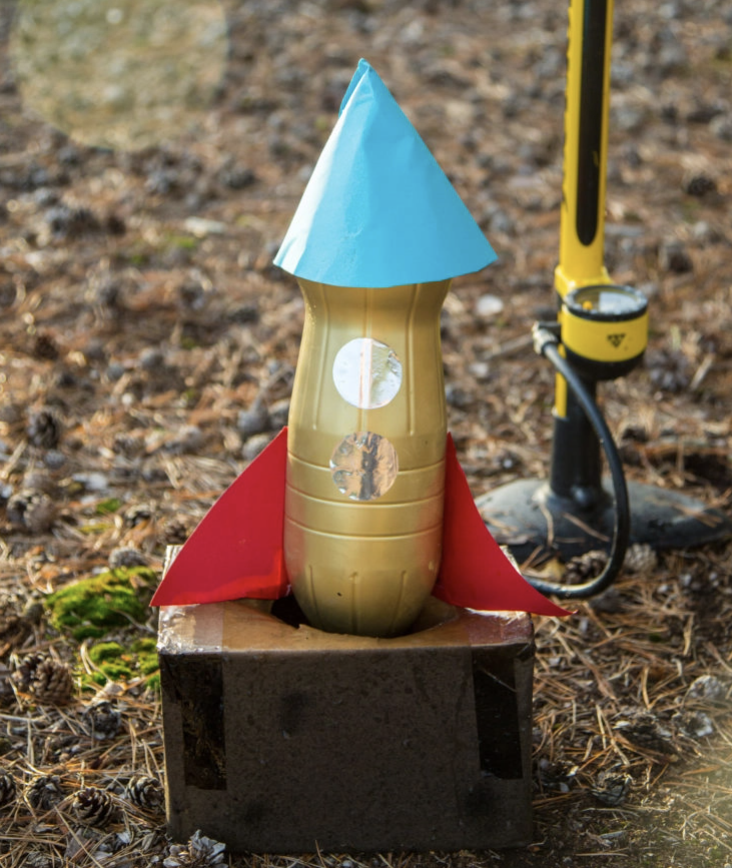
  • cardboard made into a cone and 4 fins
  • a cork
  • a pump with a needle adaptor
  • water

INSTRUCTIONS – HOW TO MAKE A BOTTLE ROCKET
  • Push the needle adaptor of the pump through the cork, it needs to go all the way through so you might have to trim the cork a little bit.
  • Decorate the bottle with the cone and fins.
  • Fill the bottle one quarter full of water and push the cork in tightly.
  • Take the bottle outside and connect the pump to the needle adaptor. Ours wouldn’t stand up on the fins so we rested it on a box, but if you make some strong fins it should stand up by itself.
  • Pump air into the bottle, making sure all spectators stand back, the bottle will lift off with force after a few seconds.

WARNING!
Please make sure an adult is around as the rocket takes off very suddenly and forcefully as you can see in this video clip. Do not approach the rocket once you have started pumping even if it looks like nothing is happening.

WHY DOES THE WATER BOTTLE ROCKET LAUNCH?
As you pump air into the bottle pressure builds up inside. If you keep pumping, the force of the air pushing on the water eventually becomes strong enough to force the cork out of the bottle allowing water to rush out in one direction while the the bottle pushes back in the other direction. This forces the rocket upwards.

Space rockets work in a similar way to the bottle, but instead of squirting water they burn fuel to make a powerful jet of hot gas. The force of the gas downwards pushes the rocket upwards. This is a great demonstration of Newton’s Third Law.

WHAT IS NEWTON’S THIRD LAW?
Newton’s Third Law says:

‘for every action there is an equal and opposite reaction’

WHO WAS ISSAC NEWTON?
Issac Newton was an English scientist most famous for his theory of gravity, but he also worked out three laws of motion to describe how objects move. You can find out more about the Three Laws of Motion in my book, This Is Rocket Science which has lots of activities to demonstrate all three laws based around rockets and space.

MORE ROCKET EXPERIMENTS
Find out how to make a rocket mouse
Try one of these other easy air pressure experiments, including making a fake lung, a barometer and a coin popper!
If you feel your child might benefit from a group or individual tutoring program to prepare them for the next phase of their education, please contact McManus Tutoring.

Programs are structured so that students learn independence, accountability, and self-possession. They will develop a repeatable structure that can be used to build success in the future.
Three Writing Prompts and a Riddle

These prompts and questions will help jump-start your daily writing. Just as it's important to read for at least 30 minutes each day, you should also write for 30 minutes a day. Don't worry about your organization or spelling, just write!


"The teacher gave the class a quiz because we..."


"I couldn't believe my best friend had a pet griffin..."


"The magic potion made me a math genius so I..."

Thinking Puzzle
Can you place six X's on a Tic Tac Toe board without making three-in-a-row in any direction?
Last week's answer... The only lockers that remain open are perfect squares (1, 4, 9, 16, etc) because they are the only numbers divisible by an odd number of whole numbers; every factor other than the number's square root is paired up with another. Thus, these lockers will be "changed" an odd number of times, which means they will be left open. All the other numbers are divisible by an even number of factors and will consequently end up closed.

So the number of open lockers is the number of perfect squares less than or equal to one thousand. These numbers are one squared, two squared, three squared, four squared, and so on, up to thirty one squared. (Thirty two squared is greater than one thousand, and therefore out of range.) So the answer is thirty one.
Problem of the Week
Play Ball
Mark McGwire became baseball’s home run king in 1998 with 70 home runs. His 70th home run ball sold for slightly over $3 million in 1999. Babe Ruth, an earlier home-run king, hit 60 in 1927. His home-run ball was donated to the Hall of Fame. Suppose that Ruth’s ball was valued at $3000 in 1927 and, like many good investments, doubled its value every seven years. Would you rather have the value of Ruth’s ball or McGwire’s?
Additional Challenge 1
 
If you invest $10 at an annual interest rate of 7%, in about how many years will your money double?
 
Assume no withdrawals or additional deposits(aside from interest).
Do not include units (years) in your answer.

Additional Challenge 2
 
If your investment earns 5% annual interest, how many years will it take to double your money?
 
Assume no withdrawals or additional deposits (aside from interest).
Do not include units (years) in your answer.

Additional Challenge 3
 
What annual interest would you have to earn to double your money in seven years?
 
Assume no withdrawals or additional deposits (aside from interest).
Do not include units (%) in your answer and round to one decimal place.

To receive your own copy of The McManus Files, join our mailing list
mcmanustutoring.com has all previous issues of The McManus Files posted in its library.
Visit the site by clicking mcmanustutoring.com