Clark County School Daze
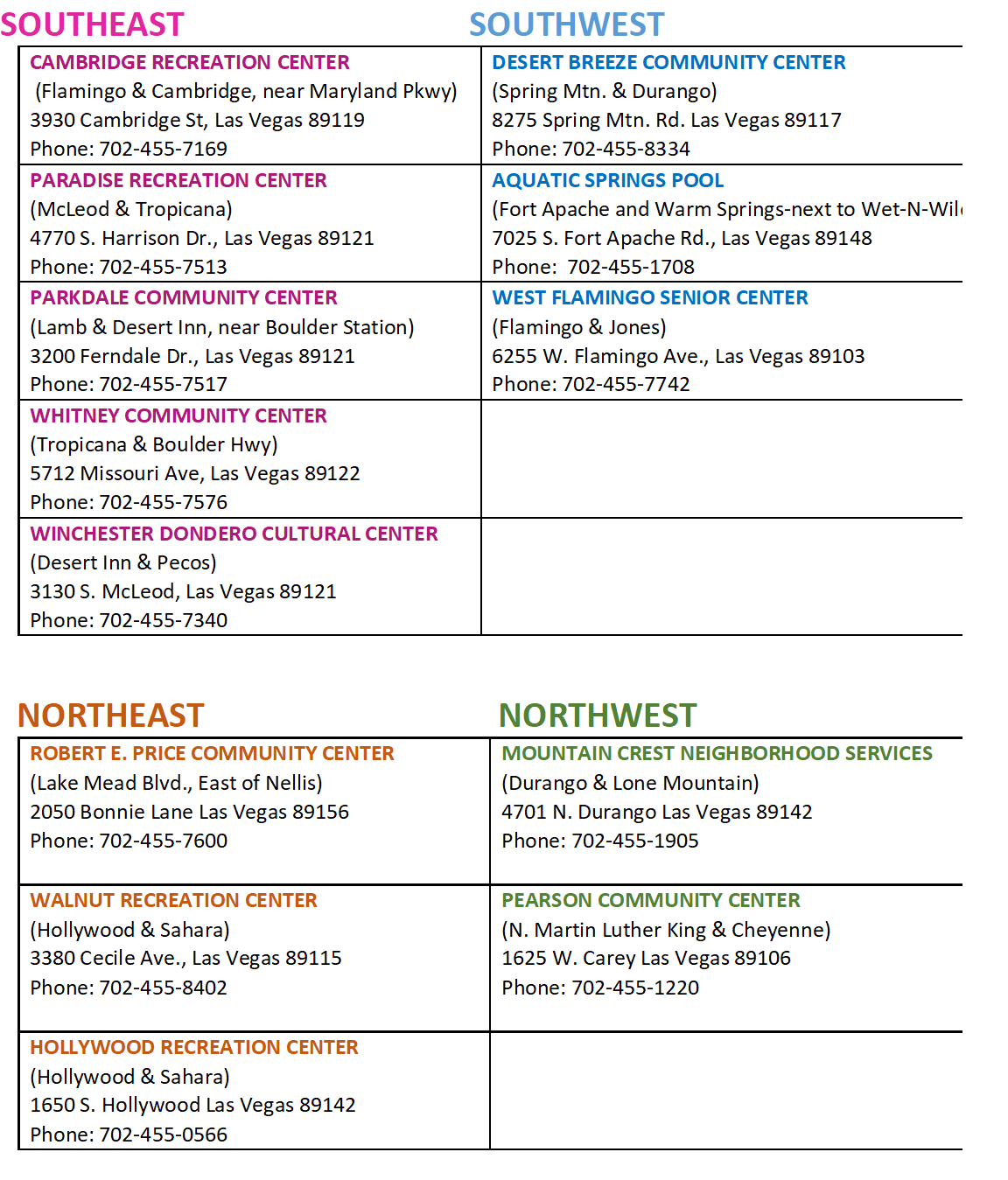
Clark County Parks and Recreation will be offering Day Camp programs during the upcoming school year at various centers and sites listed below. Camps will coordinate with the start of the school year and will begin on Monday, August 24.
Space is limited at each site, due to the current 50-person capacity requirement issued by the Governor. Children will be put into smaller groups at each site and social distancing and face coverings will be required. Each child must bring their own lunch and snacks daily.
Fee for the program is $100 per week, Monday through Friday, from 7 a.m. to 6 p.m.
Click HERE for a fillable registration form. Highlighted fields are required. Please ensure you choose your preferred location from the pull-down menu in the upper right hand corner and hit SUBMIT when finished. Also attached are instruction to complete registration and payment online. List of locations below:
|
|
City of Henderson– Youth Enrichment 702-267-4100
Program Hours 7 am - 6 pm, Monday – Friday $100.00 per week
Registration begins August 10
City of Las Vegas Parks & Recreation 702-229-7529
City of Las Vegas Youth Development & Social Innovation – 702-229-3402
Program Hours 7 am - 6 pm, Monday – Friday $100.00 per week
Registration begins August 12
City of North Las Vegas
Program Hours 7 am - 3 pm, Monday – Friday $100.00 per week
Registration begins August 10
|
|
Program Hours 7 am - 7 pm, Monday – Friday Price varies per facility
Registration currently open
Program Hours 7 am - 6 pm, Monday – Friday $150.00 per week
Registration currently open
|
|
Pandemic Parenting
by: Anne-Marie Abruscato, LCSW
University of Nevada, Las Vegas
|
|
How to Support Children
Regulate yourself first
Even the most calm and composed adults are facing new anxieties and frustrations. These feelings are valid. And, it is crucial to try your best to put these concerns aside before talking to children.
Children who have experienced abuse and neglect - even when they are safe – are more anxious than other children. Their brains have been wired to always be “on guard.” So, they are more attentive to body language, tone of voice, and facial expressions than other children. They pay attention to these cues more than they listen to the actual words being used. If you are showing anger or distress, they may hear you – but not listen. You know what works for you to regulate your own emotions. To ensure children listen, do some of that before communicating important information to children.
Remember, stress = regress
Childhood trauma exposure causes changes in the brain that make it more difficult for children to manage their emotions and stress. With school and other activities being disrupted, children may regress – and have behaviors such as bedwetting, tantrums, clinginess, neediness, or defiance. To manage regression, keep structure in your home. Try your best to stay patient so that you maintain an emotional connection with your child. When traumatized children think you are angry at them, they can feel unsafe, which will make their behaviors worse. Children behave best when they feel emotionally safe. What makes for emotional safety? Predictability, structure, and a calm environment that includes connection and a feeling of support.
Set limits
It is important to limit news exposure for children with a history of trauma. Children may already be worried that they may get COVID-19, that you may get sick, and that family members they are separated from may get sick. They may even worry about death, especially if they see statistics online or on television. By limiting their news exposure, you can be sure that you are the source for delivering information in an age appropriate way. You can talk with them about the facts, and what your family and the community do to stay healthy.
Emotional and physical wellness
Practicing relaxation skills with children takes just a few minutes, and can bring rewards such as enhanced concentration, improved sleep, and more skillful regulation of emotions. Also, you can get the same benefits if you practice with them! To begin, just breathe together - taking slow, deep breaths that calm the body and mind. When getting started with relaxation, it is best to practice when the child is already calm. Doing deep breathing together before bed is a great addition to the nighttime routine, providing the anxious or traumatized child with an opportunity for skill-building, while fostering their connection to a supportive adult.
To get started, here is a short video you and your child can enjoy together:
Physical wellness contributes to emotional well-being. It does not have to be intense exercise - simply taking a walk outside with your child can help them reduce anxiety and improve their mood. To heighten the benefits, having a routine time for walks or other physical activities contributes to the predictability and structure that help traumatized children feel safe and secure.
|
|
How to Support Yourself
Monitor your news intake
Are you watching/reading/hearing too much news? Or, is just enough to stay informed? If you think your exposure is too much, then be disciplined about limiting your news each day.
Assess social media use
When you spend time on Facebook, Twitter, Instagram, etc. – do you feel better? If so, that’s great. It can be a nice distraction, and be a way to feel connected with others. But some people experience social media overload, in which they feel frustrated or angry. Some people find that it causes them to make comparisons between themselves and others, causing more self-criticism and more self-judgment. If social media is often frustrating or distressing for you – limit it, or take a break from it!
Self-care
As a parent, partner, teacher, house manager, and more…are you experiencing role overload? Does it feel like you take care of everyone else, with you at the bottom of the list? Now more than ever, it is crucial to remember the basics of self-care: sleep, nutrition, exercise, and connection with others. Maintain good boundaries to keep yourself balanced. Live in the present moment. Don’t think too far in the future: take it day by day, hour by hour, or even minute by minute.
Seek help when needed
Many children, and adults, were struggling to keep mental health stability even before the pandemic. Every person is going to respond differently to unprecedented stress and uncertainty. Signs of mental health distress for adults and children include:
- Being so overwhelmed that it becomes hard to complete daily tasks
- Excessive crying, irritability, anger, or aggression
- Isolating from others
- Using substances
- Sleeping or eating problems
- Thinking or talking about suicide
If any of these apply to you or your child, please seek mental health support. Most therapists now offer therapy by video conference, making it easier than ever to get help. If you would like assistance with a referral for a child, contact their caseworker. For assistance or referrals for yourself, or other adults, call SAMHSA’s National Helpline at (800) 662-HELP (4357).
Lastly, please acknowledge yourself. You are doing an outstanding service by caring for children during an unprecedented and uncertain time in our history. Please take 15 seconds and do this: close your eyes, take a deep breath in, and out, and recognize yourself for all that you do so well.
|
|
|
The Adoption Exchange offers a variety of classes and training opportunities for both families and professionals. Our classes are geared toward providing information, support, and guidance in creating healthy, stable adoptive relationships. Click HERE for a list of upcoming classes.
|
|
Family Support Groups
There are a variety of support groups available monthly for foster, kinship and adoptive families.
Foster Change has compiled all these wonderful resources into one useful guide.
You can view the list here.
|
|
What is Quality Parenting Initiative? |
|
|
Building quality relationships through support and partnership for the well-being and support of our children.
Enhance Your Skills
Various trainings are offered in the community to help enhance caregivers' capacity to parent. Please click on the links below to learn more about exciting training opportunities from which you can benefit.
The QPI Clark County Values
- Children do best in families
- Engaging our community
- Supporting & strengthening families
|
|
|
|
|
|
|