Bytes and Insights Logo

Learn21's Weekly EdTech Update

September 11, 2025

In Defense of the Em Dash — Humanity’s Most Expressive Punctuation

by Carly Ghantous

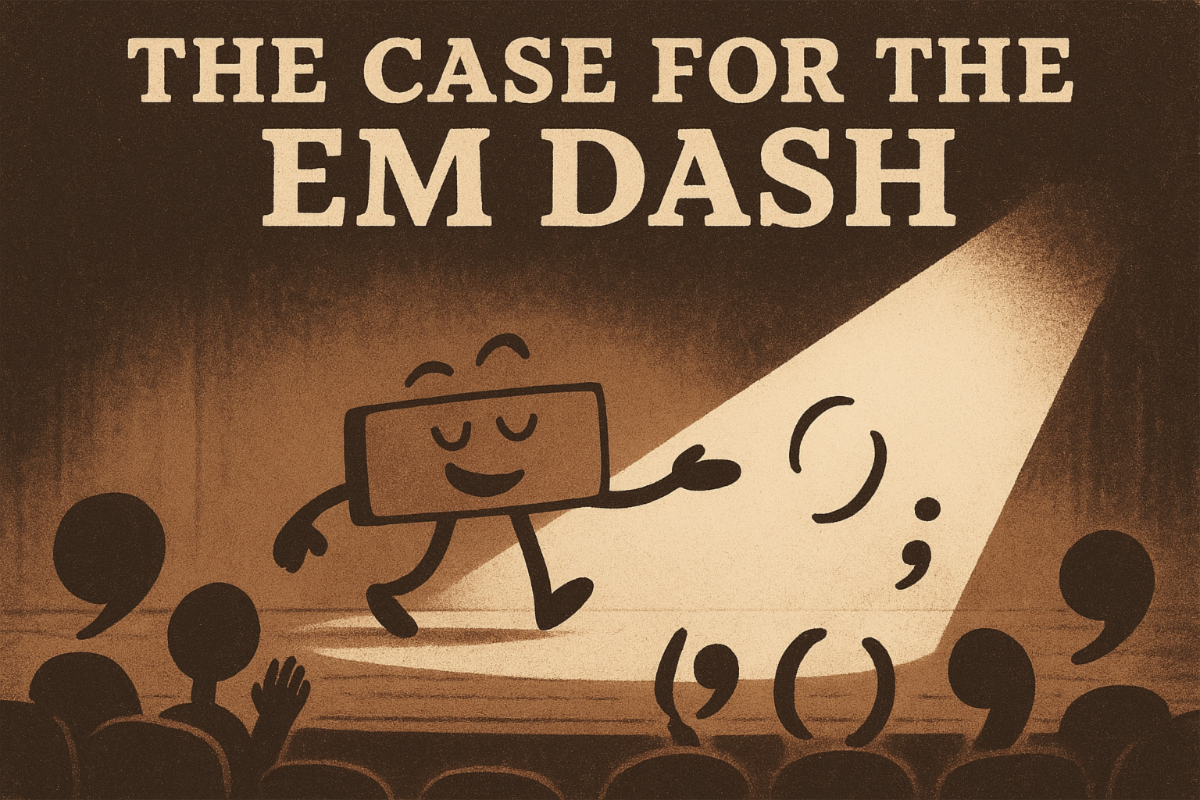
The case for the em dash image

The em dash (—) is under siege.


Once celebrated as a mark of versatility and flair, it has recently been dragged into an unlikely controversy: critics now point to it as a telltale sign that a piece of text was generated by artificial intelligence. The thinking goes like this — large language models have taken a liking to it, sprinkling em dashes liberally in their prose, and thus it has become suspect.


But here’s the thing: As someone who has devoted a career to studying and teaching the English language, I’ve been in love with the em dash far longer than the robots have. And I’m not ready to let it go.


The Case for the Em Dash

The em dash is the Swiss Army knife of punctuation. It can connect, interrupt, clarify, or emphasize. It’s a shape-shifter — a subtle scene-changer — and in the right hands, it’s a tool of rhythm, tone, and personality.


  • Flexibility: Unlike the comma, which often needs strict grammar rules, the em dash is freer. It can replace a parenthesis for a softer aside, or a colon for a more dramatic pause.
  • Voice: It mimics the patterns of real speech — the sudden swerve, the moment of emphasis — giving writing an almost conversational heartbeat.
  • Clarity: Used well, it can cut through complexity by breaking a thought into digestible pieces without feeling abrupt.


The AI Problem — and Why It’s Not a Problem

Yes, AI tools have embraced the em dash. But they’ve also embraced semicolons, sentence fragments, and the Oxford comma — which I also defend as integral elements of language and expression. The real issue isn’t the punctuation itself, but how it’s used. AI-generated writing can overuse the em dash as a crutch, replacing variety with repetition. That’s not a fault of the mark — it’s a fault of the craft.


Human writers have the advantage of intent. We choose the em dash not because it’s statistically likely to appear, but because it’s the right choice for the sentence’s music and meaning.


A Call to Keep It

To abandon the em dash because it has been “tainted” by AI would be like giving up on the guitar because computers can play chords. The em dash belongs to all of us — to the playful, the precise, the dramatic. It’s a part of the human writer’s toolkit, and in skillful hands, it will never feel robotic.

So I say: keep your em dashes. Use them boldly, sparingly, slyly — but use them. And if someone mistakes your human-made dash for a machine’s? Let them. The real giveaway will always be the thought, care, and personality behind the words.

Media Literacy Minute

Media Literacy Minute

Building Cyber Resilience Through Digital Literacy

As cyberattacks grow more sophisticated, digital illiteracy leaves both individuals and organizations vulnerable. Addressing the issue requires more than basic tech skills. Moreso, it means cultivating awareness of online risks and the critical thinking to resist manipulation.


The Cost of Burnout in Journalism

A commentary from Poynter highlights how the relentless pace of reporting drains one of journalism’s most overlooked resources: energy. While the piece is written for journalists, the practical strategies it outlines—such as setting clearer boundaries, prioritizing tasks, and being intentional about what to engage with—apply to anyone working in a demanding environment. For educators, who often juggle nonstop responsibilities, these tips serve as a reminder that conserving energy is just as important as managing time.


Is Social Media’s Era Ending?

According to Noema Magazine, declining trust in major platforms and the rise of niche online communities may signal the end of social media’s dominance. The shift could fundamentally reshape how people connect, share information, and participate in public discourse.

School Cell Phones: Ban, Embrace, or Something in Between? Tell Us What’s Really Happening

by Stacy Hawthorne, Ed.D.

From district boardrooms to classroom group chats, conversations about student cell phone use are everywhere. In recent months, we've seen a flurry of activity: districts implementing sweeping bans, schools investing in lockable pouches, and some states proposing legislation that could shape national policy. But for every headline, there's a real story playing out in schools, and we want to hear yours.


At Learn21 and the EdTech Leaders Alliance (ETLA), we support practical, student-centered decisions rooted in real-world practice, not just media buzz. That’s why we’re launching a nationwide Cell Phone Use in Schools Survey — and we need your voice.


We’re inviting all 16,000+ readers of Bytes & Insights and The Vibe to share what’s actually happening in your district, your schools, and your classrooms. Whether you’re a tech director navigating parent pushback, a superintendent leading policy reform, or an educator implementing daily routines, we want your insights.


What are we asking?

  • What policies are in place in your district?


  • How are they working?


  • What strategies or tech tools (like lockable pouches or network-level restrictions) are being used?


  • How are students, staff, and families responding?


We’ll publish a summary of the results, including quotes, trends, and practical takeaways, in an upcoming October edition of Bytes & Insights. Our goal is to provide a clearer picture of where schools really stand on this issue.


Why now?

Because decisions about digital access shape learning, behavior, and school culture — and they’re happening fast. Your perspective could help others across the country make more informed, balanced choices.

Take the short survey now → Survey link


Let’s move beyond buzzwords and bans and build a clearer view together.

Big Ideas

Big ideas image

For those of you that are parents, you’ll understand why this week’s edition of Big Ideas is in honor of my other daughter, a microbiologist. Since the girls are twins, I can’t leave one out of the fun that is Big Ideas.


Virtual Cells, Real Discoveries

The Chan Zuckerberg Initiative’s rCell platform is flipping biology on its head by training AI on simulated cells. No lab rats or petri dishes required. This leap could dramatically accelerate scientific discovery and drug development. Could your science curriculum be next to embrace virtual biology?


What Does a Cell Weigh? The Answer Just Got Wild

According to Asimov Press, cells don’t have a fixed weight, they fluctuate based on hydration, protein expression, and even mood (well, sort of). This simple question is reshaping how we understand cellular behavior. It’s a reminder that asking “obvious” questions often leads to revolutionary insights.


AI-Designed Antibiotics Target Superbugs

In a world first, MIT researchers used generative AI to design entirely new antibiotics atom-by-atom, creating promising compounds to fight drug-resistant gonorrhoea and MRSA. According to the BBC, these lab-and mouse-tested treatments still need years of refinement, but the breakthrough could spark a "second golden age" in antibiotic discovery. It's also a reminder: the tools we build to disrupt one system can just as powerfully rebuild another.


Meet the Girls of the Year

TIME’s Girls of the Year 2025 spotlight a dozen inspiring changemakers, from climate advocates to coders. Their stories remind us that leadership doesn’t wait for adulthood. How are you empowering the next generation of girls to lead with confidence and vision? Who knows, you may be teaching a future aerospace engineer or microbiologist today!

X Share on X
LinkedIn Share on LinkedIn

www.learn21.org

LinkedIn        X        YouTube        Instagram