Rail & Labor News from RWU
| |
Weekly Digest Number 41 - October 8th, 2024 | |
Welcome to the RWU Rail & Labor News! This news bulletin is produced and emailed out each Tuesday morning. We hope you find each week's news and information useful. If so, please share with co-workers, friends, and colleagues. If you like, you can sign them up to get all the news from RWU HERE. Or forward them the link. Got a hot tip? Please forward the article and a link to raillabornews@gmail.com. Note: If you read over this news bulletin each week, you will be sure to never miss the important news of what is going on in the railroad world from a worker's perspective! | |
THIS WEEK'S RAIL AND LABOR NEWS | |
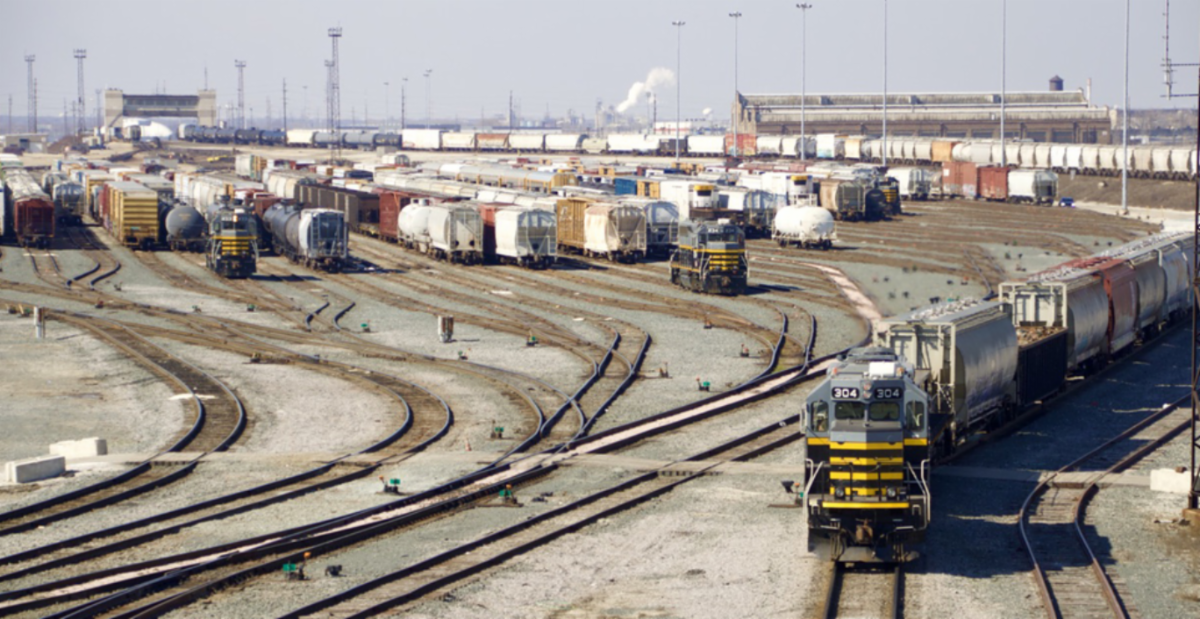
Editor's Note: The Class I railroads’ focus on profitability over growth has led to stagnation in carload and intermodal traffic, all while Wall Street continues to demand higher returns. Rail labor sees the dangerous trend of shrinking fleets, job cuts, and service reductions as not only unsustainable but also a direct assault on working families and the broader rail industry. This short-sighted approach prioritizes investor satisfaction over the long-term health of rail, and as railroaders, we must push back against these profit-driven decisions that threaten the very future of rail labor and freight transportation. | |
Trains Magazine / October 4th, 2024
Let’s suppose, for the sake of argument, that the Class I railroads cannot successfully shift into growth mode. What happens then? Carload business will slowly wither away, except for the few bulk and dangerous commodities with no other way to move. Intermodal will remain neutral, with domestic container and trailer traffic unable to break through a ceiling they hit in 2017. And no matter what railroads do, the onetime torrent of coal traffic will become a trickle. Sure, there will be pockets of growth here and there. But they won’t be able to make up for the overall downward trajectory as more and more freight moves to trucks. The irony is that the Class I systems are immensely profitable despite hauling less freight today than they did two decades ago. They’re a financial success story driven by higher productivity and higher rates. To continue to produce double-digit earnings growth — something that Wall Street has come to expect — ideally the railroads need to do three things: Gain volume, raise rates faster than inflation, and make productivity gains and/or reduce costs. Analysts say the railroads’ annual rate-increase strategy is nearing an end, meaning they’ll have to push harder on the volume and cost levers.
| |
Editor's Note: The ratification of these contracts by SMART-MD members at BNSF, CSX, and Norfolk Southern may appear to be a win, but a closer look reveals some concerns. While the wage increases and improved benefits are positive, the 18.5% over five years seems modest in an industry with soaring profits. SMART’s leadership touts this as a significant achievement, yet it feels like a settlement well below what rail labor deserves, especially given the railroads’ financial strength. It’s another example of how SMART often settles for less, leaving rail workers to shoulder the burden of modest gains while the industry thrives. | |
Reuters / October 4th, 2024
Berkshire Hathaway-owned BNSF Railway said that the members of the International Sheet Metal, Air, Rail, and Transportation union's railroad, mechanical, and engineering department have voted to ratify a five-year agreement with the company on Friday. The deal provides a yearly wage hike of 3.5% over the life of the agreement, along with health care benefits and provisions that offer railroaders more vacation days earlier in their careers. The railroad also reached a tentative agreement with the union's transportation division (SMART-TD) earlier in September.
| |
Editor's Note: The tragic death of Union Pacific conductor Austin Scott Raysby is yet another somber reminder of the dangerous conditions rail workers face daily. While the NTSB continues its investigation, it’s clear that more robust safety measures are needed, particularly in adjacent track protection. Rail labor must push for stronger safeguards that prioritize worker safety over operational expediency. This incident underscores the urgency of reform, as no worker should lose their life performing routine inspections that could be made safer with proper protections. | |
Trains Magazine / October 1st, 2024
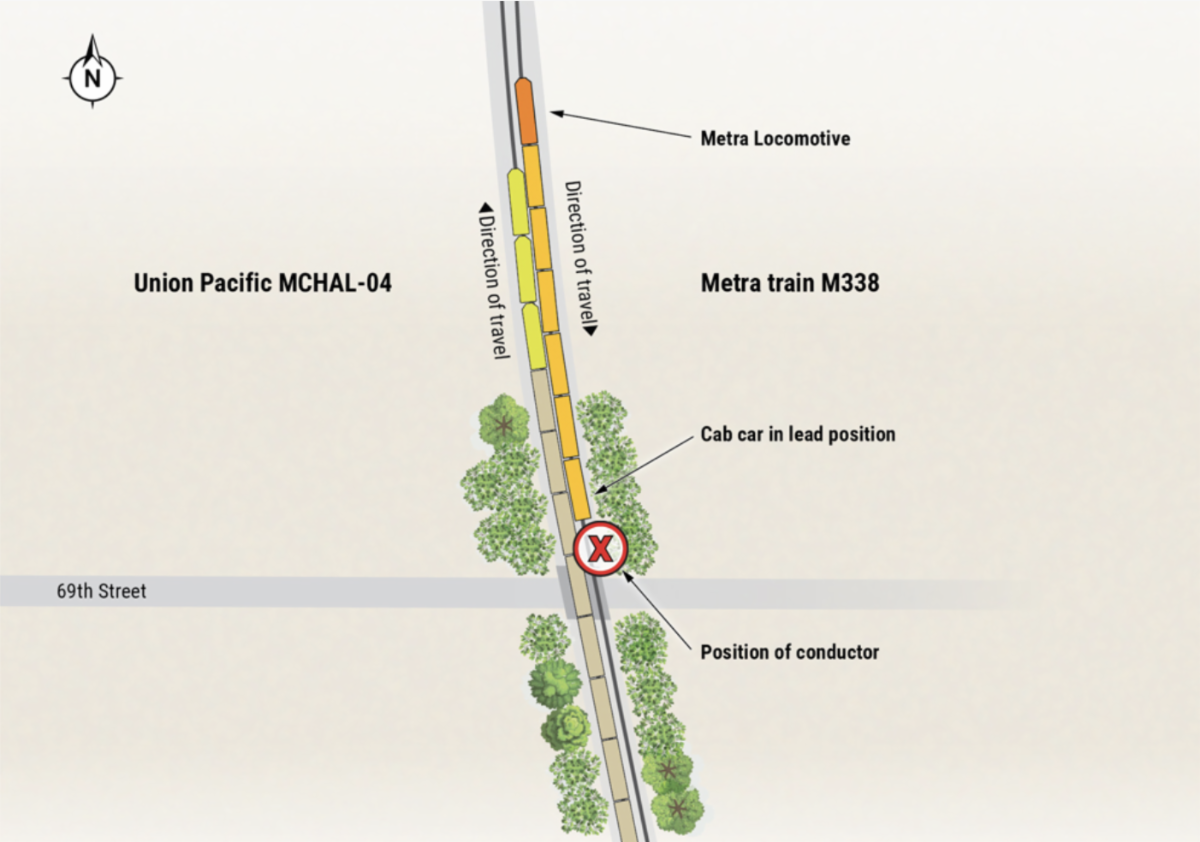
The Union Pacific conductor struck and killed by a Metra train in Kenosha, Wis., on Sept. 4 had left the locomotive of his freight train to address a hot-wheel report from a wayside detector, the National Transportation Safety Board says in a preliminary investigation report issued October 1st. The incident occurred about 12:11 p.m. local time at milepost 50.5 of UP’s Kenosha Subdivision, about a half-mile south of the Metra station in Kenosha, Wisconsin. News reports identified the worker killed as 34-year-old Austin Scott Raysby of Burlington, Wis. A detector had indicated a problem with the 51st car of UP train MCHAL-04, leading to the train being stopped on Main Track 1. The conductor walked across Main Track 2 and had the engineer move the train forward so he could inspect the car in question. While he waited to examine the suspected hot wheel, Metra train 338, with its cab car leading, rounded the curve and struck the conductor. Union Pacific issued a safety alert the next day to brief employees on the accident and review relevant operating and safety rules. The ongoing NTSB investigation will focus on adjacent track protection rules where changes may mitigate the risk for train crews on the ground.
|
|
Editor's Note: The recent advancement of a two-person crew requirement and restrictions on hazardous freight train lengths in New Jersey is a significant victory for rail safety advocates. Limiting train lengths and ensuring a second crew member on board are essential steps in reducing the risks associated with transporting dangerous goods. Rail labor has long argued that one-person crews are insufficient to manage the complexities and hazards of modern freight operations. This legislation is a critical pushback against cost-cutting measures that undermine safety, and we urge continued support as it moves through the legislative process. | |
NJ.com / October 1st, 2024
A bill that would require two-person train crews in New Jersey and limit the length of what are considered “dangerous hazardous” freight trains of tank cars carrying oil or chemicals to 8,500 feet in length was approved by the state Senate transportation committee. The measure was released from the committee Monday and now goes to the state Senate Budget and Appropriations Committee for hearing before a vote to send it to the full Senate for action. A companion bill in the state Assembly cleared the chamber’s transportation committee on Sept. 12 and went to its appropriations committee.
| |
Editor's Note: The NTSB’s findings on the March 2023 Norfolk Southern derailment in Alabama reveal a troubling combination of mismanagement and safety oversights. The coupling of locomotives without alignment control and the excessive in-train forces highlight the ongoing dangers created by the railroads’ operational practices. Rail labor has consistently warned of the risks associated with improper inspections and cost cutting measures, which put both workers and communities at risk. It’s clear that stronger regulations and rigorous safety standards are needed to prevent future derailments and protect both the workforce and the public. | |
Progressive Railroading / October 3rd, 2024
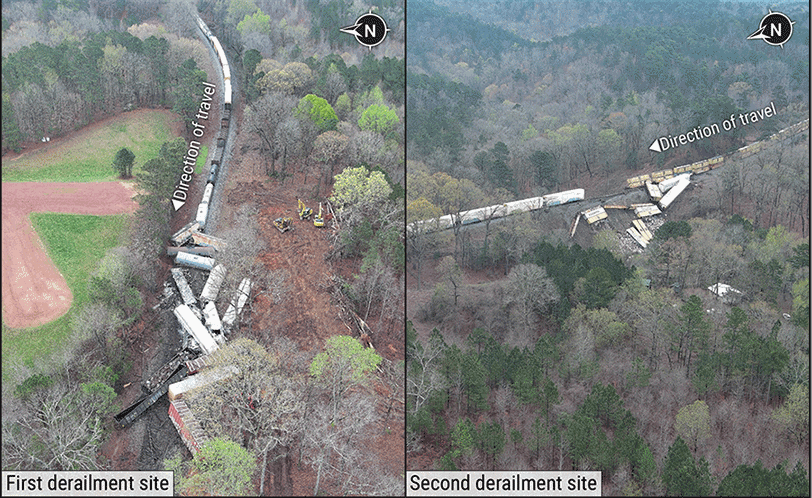
The National Transportation Safety Board (NTSB) has determined the probable cause of a March 2023 train derailment of a Norfolk Southern Railway train in Alabama was the combination of the coupling together of two revenue waybill locomotives without alignment control couplers and excessive in-train forces created due to the build of the train. Contributing to the accident was the misidentification of couplers without alignment control during the NS' inspection process, according to an NTSB report issued Sept. 22. On the morning of March 9, 2023, a westbound NS freight train derailed two locomotives and 37 rail cars on the Alabama East End District of its Gulf Division near Anniston. The derailment involved two sections of the train, resulting in two derailment sites. The first derailment site was located at the front of the train where two locomotives and 29 rail cars derailed. At the second site, located near the rear of the train, eight railcars derailed. Three of those cars were tank cars carrying hazardous materials. The tank cars remained intact and did not release hazardous materials, according to the NTSB report. There were no reported injuries or fatalities. NS estimated damages to equipment, track, and signal infrastructure to be $2.9 million.
| |
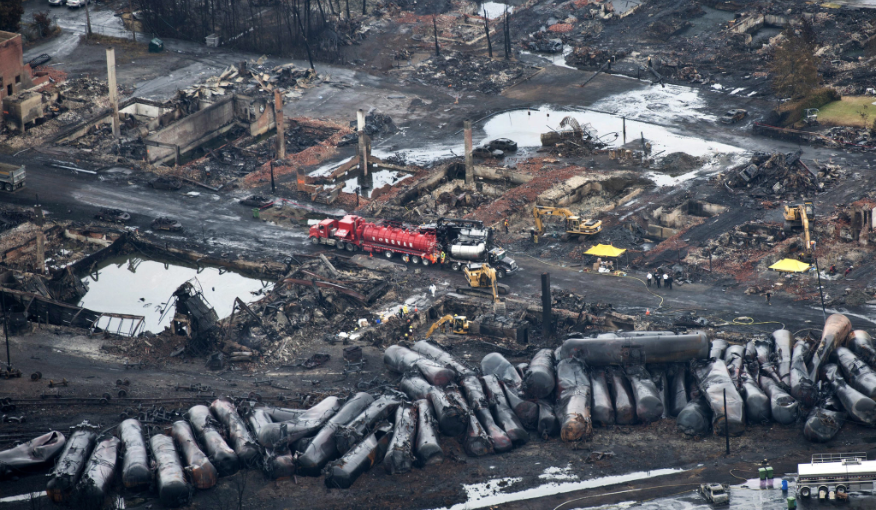
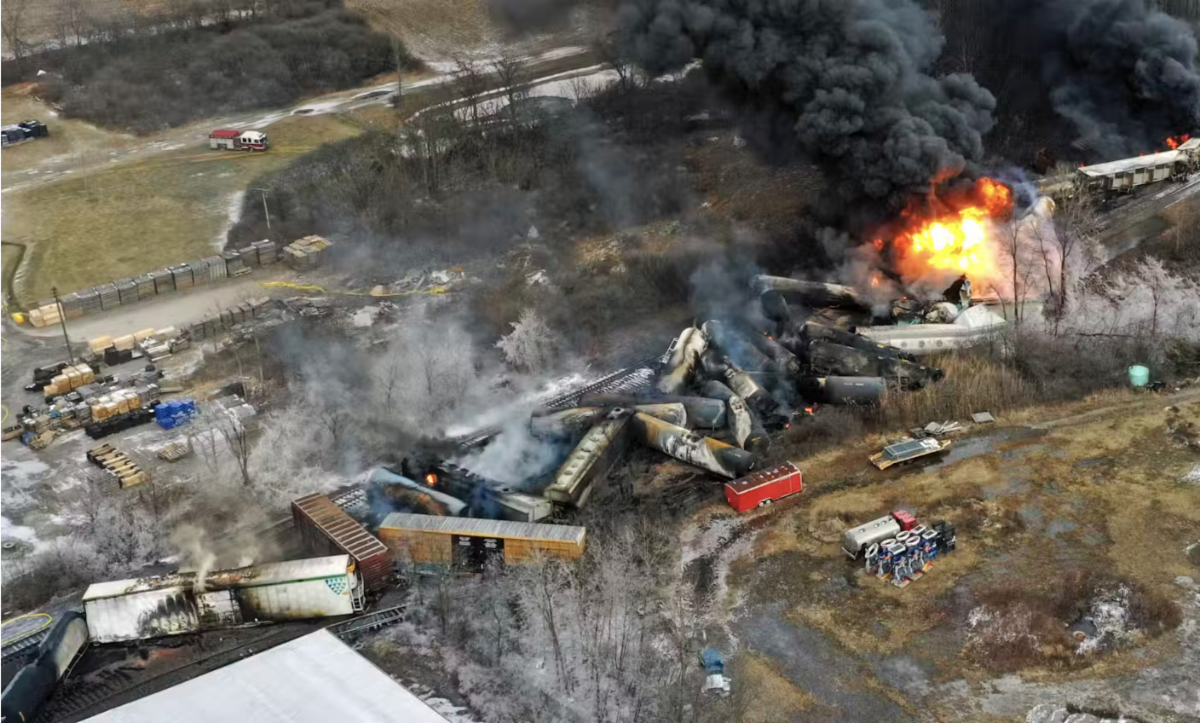
Editor's Note: The NTSB’s illustrated digest on the East Palestine derailment is a reminder that safety is too often sacrificed for profit. RWU has long sounded the alarm on the very conditions that led to this disaster, yet corporate interests and regulatory inertia have silenced those warnings. No number of reports or recommendations will protect workers and communities unless rail workers themselves are empowered to lead the charge for real, lasting safety reforms. | |
|
Progressive Railroading / October 3rd, 2024
The National Transportation Safety Board has released an illustrated digest of its investigation into the 2023 derailment of a Norfolk Southern Railway freight train carrying hazardous materials in East Palestine, Ohio. The digest serves as a companion to the NTSB’s 201-page final report, using photos and graphics to illustrate how and why the derailment occurred as well as explaining NTSB safety recommendations to prevent similar accidents in the future, NTSB officials said in a press release. While the final report, issued in June, remains the NTSB’s definitive publication on the derailment, the digest highlights the depth and scope of the 16-month investigation, they said.
| |
Editor's Note: Unifor’s early notice of dispute in negotiations with CN reflects the growing frustration of rail workers pushed to the brink by corporate interests. While CN frames this as premature, the reality is that rail workers have long endured stagnant conditions, and their demands for fair treatment are overdue. Rail labor must stand united in ensuring these negotiations prioritize workers’ rights, not just profits for the company or economy. | |
|
Progressive Railroading / September 30th, 2024
CN announced on Sept. 27 that Unifor had filed a notice of dispute three days after the beginning of negotiations. The union represents 3,300 mechanical, clerical, and intermodal employees in Canada across three collective agreements. The current collective agreements expire on Dec. 31. Also known as "‘conciliation’, the notice of dispute is sent to Canada's labor minister by either party during the negotiation and typically results in the appointment of a conciliation officer to assist the parties in reaching an agreement, CN officials said in a press release. "While CN is disappointed that Unifor is filing the notice so early in the process, the company is committed to reaching negotiated agreements with the union that are good for employees, customers and the economy," they said.
| |
Editor's Note: FRA’s announcement of over $1 billion in funding for passenger rail projects is a chance to revolutionize rail travel—but let’s be clear, without the backbone of rail labor, these projects are just promises on paper. Railroad Workers United has long argued that real progress hinges on empowering those who do the work, not just the bureaucrats and corporations that profit from it. If this funding is to mean anything, it must prioritize the safety, conditions, and voices of the workers who will bring these projects to life. | |
Trains Magazine / October 1st, 2024
The Federal Railroad Administration has announced the availability of more than $1 billion in funding for passenger projects outside the Northeast Corridor under the Federal-State Partnership for Intercity Passenger Rail program. The announcement covers new funding under the Bipartisan Infrastructure Law. Projects eligible for the funds expand or improve the performance of existing services, establish new services, or replace or rehabilitate infrastructure. The projects can address safety or reliability and can include planning elements, such as environmental review or final design. This funding follows the $8.2 billion in grants announced last December, which included $3.1 billion for California’s high-speed rail project and $3 billion for Brightline West. Those grants focused on funds for major construction and essentially bypassed projects seeking money for planning.
| |
Editor's Note: With the strike now over, BNSF’s readiness to handle the increased container volumes from West Coast ports takes on a new dimension. While CEO Katie Farmer’s assurances of steady service during peak volumes are commendable, let’s not forget that this surge will further strain the workforce. RWU believes it’s the laborers on the ground, not corporate executives, who bear the brunt of these pressures. If railroads are to meet these demands, fair conditions for workers must be at the forefront. | |
Trains Magazine / September 30th, 2024
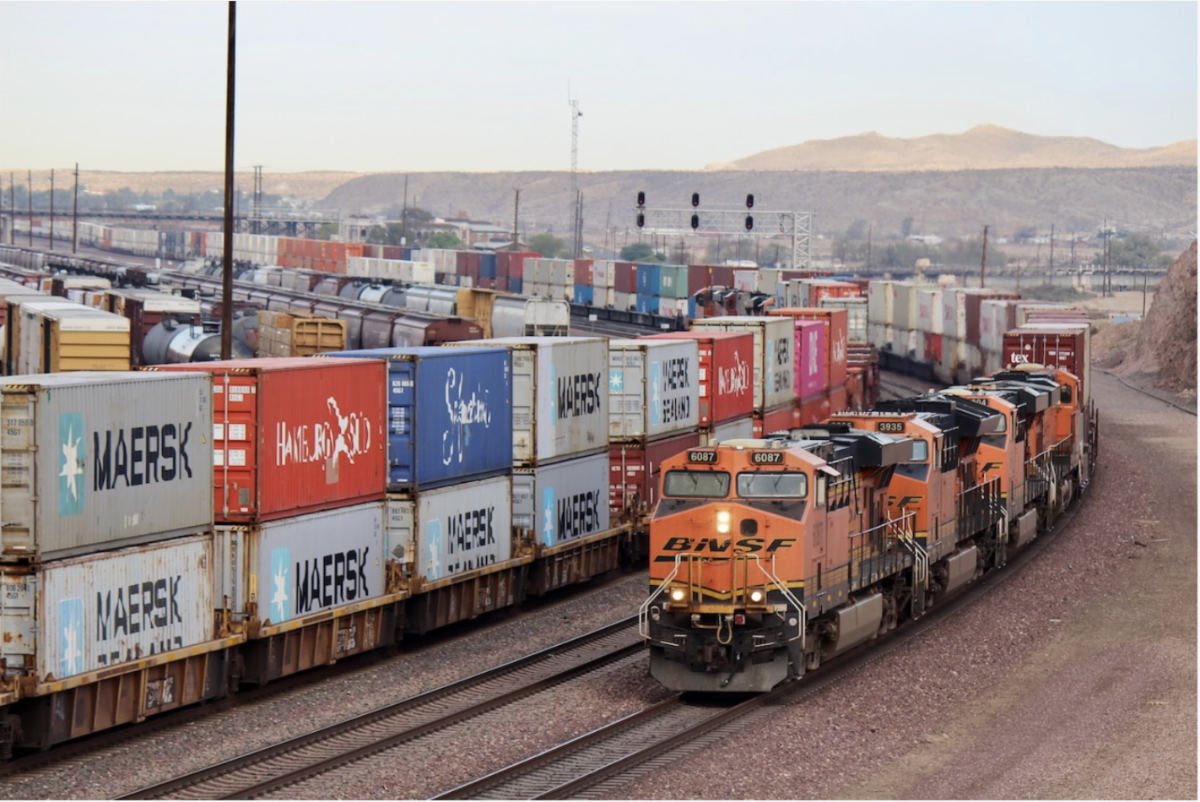
BNSF Railway says it was ready to handle additional container volume from West Coast ports, citing the record volumes it has already moved this year while maintaining service levels. “Although no work stoppages have occurred yet, volume shifts to the west coast have already been underway for the past six weeks, with the amount of volume diverted increasing each week,” BNSF CEO Katie Farmer wrote in a letter to Surface Transportation Board Chairman Robert E. Primus. Last week Primus requested information from BNSF and Union Pacific about how they will be able to handle an anticipated surge in container volume as importers divert shipments to the West Coast to avoid gridlock as dockworkers were expected to strike ports from Maine to Texas. In the first six months of this year, BNSF set a record for on-dock container volumes. “Despite the increase in volume, BNSF’s intermodal velocity has remained consistent. While there has been some increase in container dwell at west coast ports, dwell at the marine terminals we serve has largely held steady even as we have seen significant volume increases,” Farmer wrote in a Sept. 27 letter that was posted to the STB website today. “The service performance we are demonstrating now is thus indicative of our ability to handle additional volumes coming to the West Coast as a result of a potential work stoppage.”
| |
Editor's Note: The aftermath of the Norfolk Southern spill highlights the real and lasting dangers faced by workers and residents alike. This disaster is a reminder that when railroads cut corners on safety, it’s the workers and communities that suffer the most. Proper decontamination efforts must prioritize worker safety, not just ticking boxes to satisfy regulators, and Norfolk Southern must be held accountable for its failures. | |
The Conversation / September 30th, 2024
The creek that flowed through town became heavily contaminated by the spill. More than 43,000 fish died downstream, and chemicals traveled 270 miles (435 kilometers) down the Ohio River. As tainted water flowed downstream, light chemicals like butyl acrylate naturally left the creek and entered the air by a process called volatilization. Unnaturally, however, the equipment used for cleaning the creeks also transferred chemicals from the water into the air. Residents near aeration equipment, which injects air into water, in part to help fish survive, complained of odors entering their homes and experiencing health problems. Our study shows the chemicals in the air may have been up to 2 to 25 times higher near these aerators. People closest to the disaster site – those who lived in, worked in, or visited buildings that became contaminated – likely experienced the greatest exposures. Railroad workers, government workers, cleanup workers, visitors, and residents in Ohio and Pennsylvania were among those reporting health problems. Norfolk Southern and one contractor were cited for failing to protect workers from exposure. Indoor building contamination can be a long-term problem. Just like with wildfire smoke, affected buildings need to be professionally cleaned because the chemicals can remain for months. Building exteriors also need to be decontaminated. Chemicals may continue to release from surfaces into the air.
| |
Poolsen & Oden Law Firm / September 2024
Some of our clients have referred their co-workers to us who also have serious cancers and diseases. This helps your claim for several reasons. First, in any toxic exposure case where you are claiming that chemicals and toxins made you sick, it helps your case tremendously to have co-workers who testify that they were also exposed to these same toxins and chemicals (asbestos, diesel exhaust, benzene, etc). Also, our toxic substance experts can make a much stronger case for you if they can point to your coworkers who have also suffered from serious cancers and illnesses caused by toxic substances. In the legal world, this is called a 'cluster' of disease cases and it is usually strong proof that something was very toxic at that location and causing serious illnesses and cancers. Please let us know of any co-workers with serious illnesses whom we may speak with that can help your claim. Remember...Friends Help Other Friends. If you know someone considering whether or not they should file a claim, please get them in touch with us. We want to help! Have them call us ASAP at (888) 711-5449. They can also email us at ClientCare@PoolsonOden.com
| |
Editor's Note: This headline should probably read something more like, "While internodal attempts to claw its way back to 2022 levels, carload traffic is in the toilet." | |
Progressive Railroading / October 3rd, 2024
U.S. freight railroads hauled 507,537 carloads and intermodal units during the week ending Sept. 28, a 1.6% increase compared with volumes moved during the same week last year, according to Association of American Railroads data. Total carloads hauled were 227,046, down 3.5%, while intermodal volume was 280,491 containers and trailers, up 6.2%. Four of the 10 AAR-tracked carload commodity groups posted increases during the week, including grain, up 13.2% to 20,941 carloads; motor vehicles and parts, up 4.6% to 16,705; and petroleum and petroleum products, up 6.1% to 10,782. Commodity groups that reported decreases included coal, down 10.3% to 60,885 carloads; nonmetallic minerals, down 9.4% to 30,583; and metallic ores and metals, down 8.1% to 21,213. Meanwhile, Canadian railroads reported 96,659 carloads for the week, down 1.6%, and 70,390 intermodal units, down 0.3%. Mexican railroads reported 14,383 carloads for the week, down 17%, and 11,873 intermodal units, down 11.4%.
| |
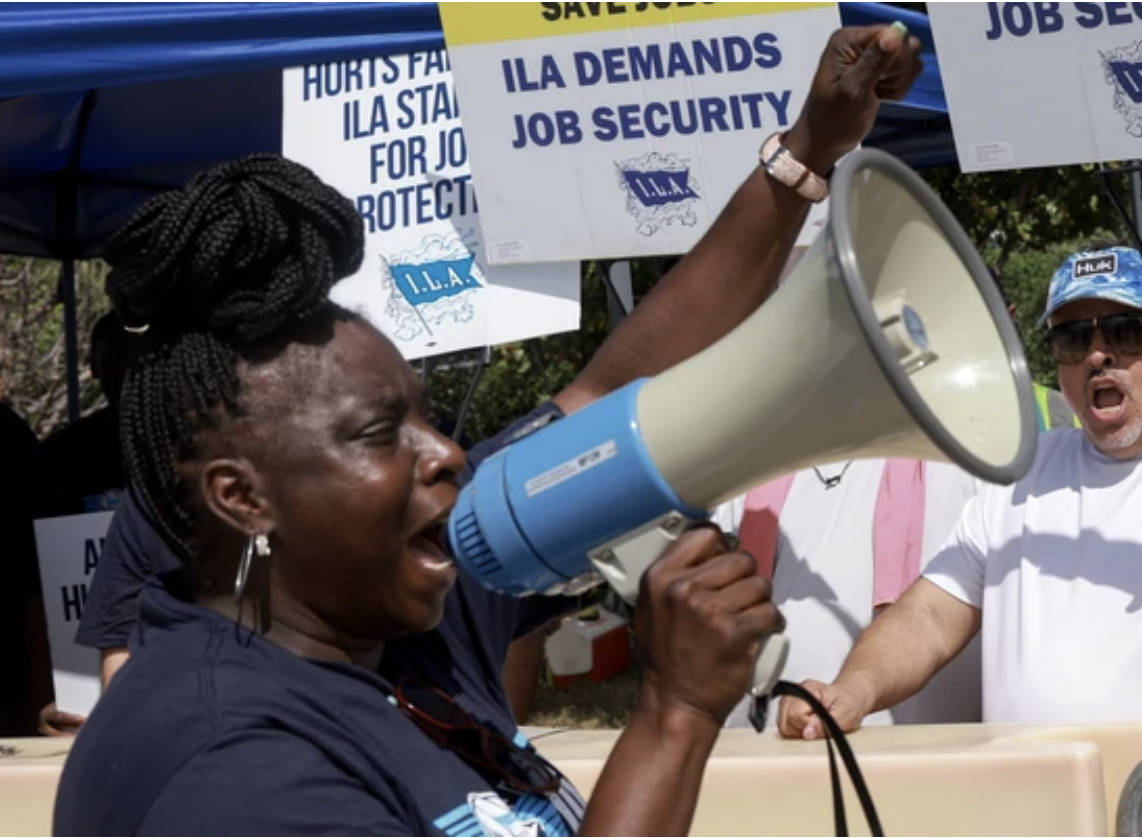
Editor's Note: Good to see the President admonishing the wealthy stevedore companies. Even better to see him NOT intervene and break the strike. Perhaps he has learned his lesson from his scabby performance during the rail workers' contract fight in the Fall of 2022. This labor action might be a little easier for Biden; i.e. he is facing a single united union (ILA) that is determined to strike, rather than a gaggle of divided and treacherous (12 of them) rail craft unions, completely divided and in disarray, whose leadership made it clear that they did not want a strike of any kind. | |
Freight Waves / October 1st, 2024
President Joe Biden broke his silence on the labor dispute between the International Longshoremen’s Association (ILA) and the United States Maritime Alliance (USMX) by accusing employers of hoarding profits. “Ocean carriers have made record profits since the pandemic and in some cases, profits grew more than 800 percent compared to their profits before the pandemic,” Biden said in a statement issued by the White House on Tuesday, after the ILA went on strike at 14 ports on the U.S. East and Gulf coasts, halting container and roll-on/roll-off operations at 36 marine terminals. “Executive compensation has grown in line with those profits and profits have been returned to shareholders at record rates. It’s only fair that workers, who put themselves at risk during the pandemic to keep ports open, see a meaningful increase in their wages as well.”
| |
NEWS FROM AROUND THE LABOR MOVEMENT | |
Each week, RWU includes a few articles about advances and developments in the larger labor movement that are of interest to railroad workers. Got an artcile to submit for possible inclusion next week? Email it along to raillabornews@gmail.com. Thank you! | |
Editor's Note: The suspension of the East and Gulf Coast dockworkers’ strike reflects both the power and the ongoing struggle of labor in the face of corporate greed. While a 62% wage boost over six years is a step forward, it’s important to remember that this fight is far from over. Dockworkers, like railroad workers, are the backbone of the economy, and their struggle against multinational giants highlights the critical need for labor to stand united in demanding fair wages and conditions in an era of skyrocketing corporate profits. | |
Common Dreams / October 4th, 2024
The union representing East and Gulf Coast dockworkers suspended its strike on Thursday after reaching a tentative agreement with shipping giants that reportedly includes a 62% wage boost over six years. The International Longshoremen's Association (ILA) said in a joint statement with the United States Maritime Alliance (USMX) that the union would suspend its strike until January 15 so the two sides can "return to the bargaining table to negotiate all other outstanding issues." "Effective immediately, all current job actions will cease and all work covered by the Master Contract will resume," the statement added. The tentative deal followed three days on the picket line during which dockworkers—who are essential to the functioning of the U.S. economy—cast their fight as a critical struggle against multinational corporations that raked in huge profits during the Covid-19 pandemic and enriched their investors as wages failed to keep pace with inflation.
| |
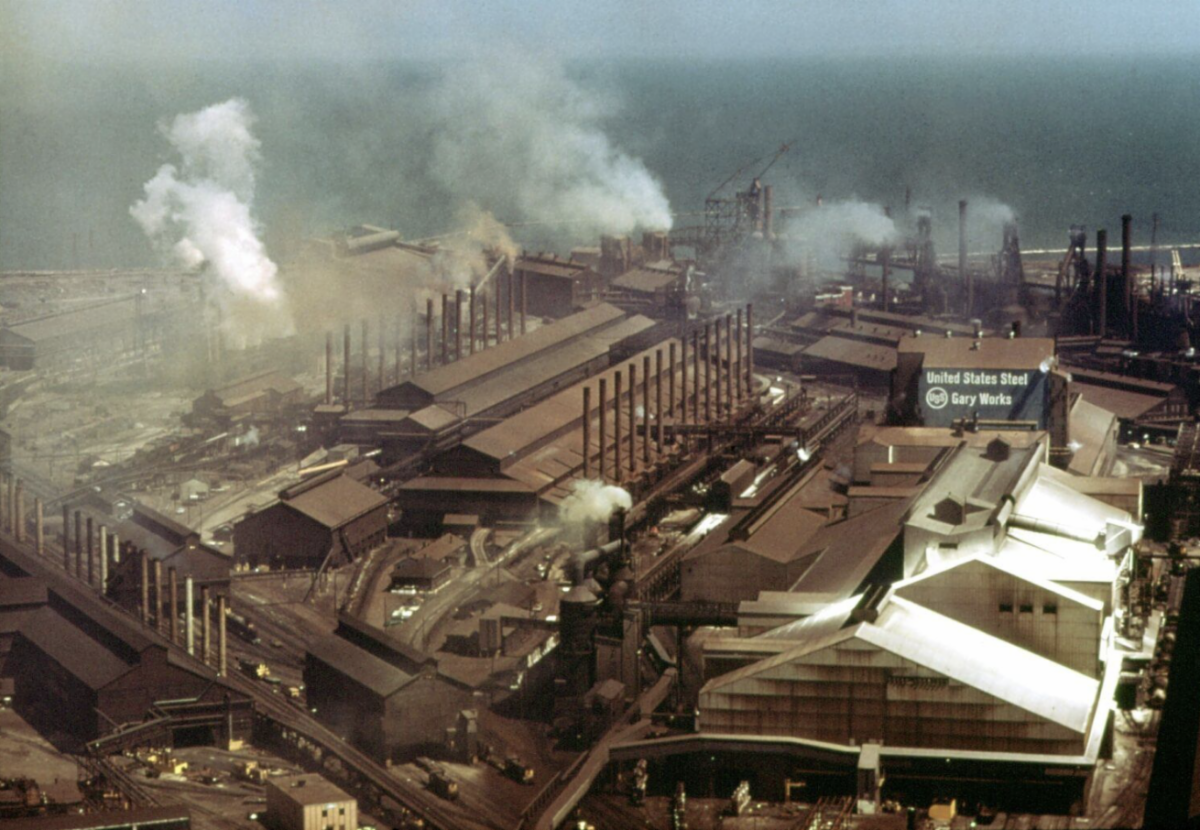
Editor's Note: The author - a long-time union and community activist from the Pittsburgh area - notes that the steel industry's current malaise is largely self-inflicted. Not too dissimilar to the rail industry, Grystar concludes that the only real solution to making high-quality, domestically produced steel in a safe environment with a well-compensated workforce that will meet the country's needs in the 21st century is public ownership of the industry. | |
CounterPunch / October 4th, 2024
Here in Pittsburgh and nationwide, a false debate has erupted over the sale of US Steel (USX) to Japan’s Nippon Steel. Biden, Harris, Trump, and labor are all opposed to the acquisition under the guise of national security and saving the US steel industry. We’re all supposed to be worried about the sale to a Japanese capitalist and forget about the decades of destruction of the steel industry in America under the private ownership of a US capitalist – USX. The narrow parameters of this debate give alleged “patriotic” US capitalist, USX, a free pass by the politicians, MSM, and labor despite the fact their “business model” contributed to the hollowing out of the industry and destroyed tens of thousands of steel jobs while leaving polluted communities in its wake over the past 45 years. This wholesale destruction occurred while the country’s basic infrastructure was (and still is) collapsing, with the obvious need for huge investments in infrastructure, transportation, and housing in plain view. Instead of developing a plan to address these basic public needs, industry, labor, politicians, and the MSM constantly focus on imports, foreign competition, and the apparent need to incentivize the industry.
| |
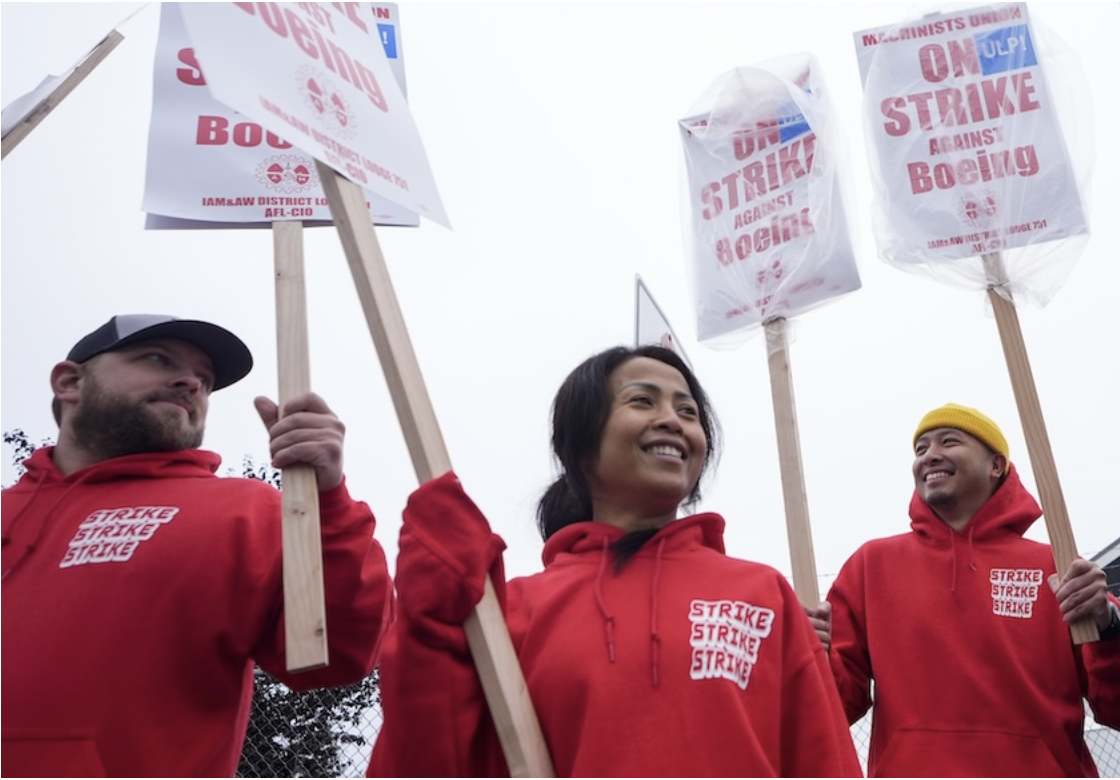
Editor's Note: Boeing’s latest offer to striking Machinists is yet another attempt to paper over the deep wounds the company has inflicted on its workforce. While wage increases and bonuses might seem like progress, the refusal to restore pensions and the continued outsourcing of jobs show where Boeing’s true priorities lie. For decades, workers have been fighting against the erosion of what were once secure, family-sustaining jobs. This strike is about more than wages - it’s a battle to reclaim dignity and security for the workers who built this industry. | |
CounterPunch / September 23rd, 2024
Boeing has increased its offer to striking Machinists, hoping to end a work stoppage that entered its eleventh day today. According to the Seattle Times, the new proposal would raise wages by 30 percent over four years, as opposed to 25 percent in the offer that workers rejected by 94.6 percent. Mediated talks with Boeing broke off September 18, the union said, with nothing more scheduled. Then on Monday morning, the company announced a new offer in the press. Twelve hours later, the union responded that Boeing “has missed the mark with this proposal.” In a scathing statement, the negotiating team noted that the company misled the press “by wrongfully stating that the union membership is required to vote on their latest offer... They are trying to drive a wedge between members with this divisive strategy.”
| |
WEEKLY DERAILMENT DEPARTMENT | |
Each Tuesday in this news bulletin, RWU does our best to present a picture of what has been happening over the course of the previous week in terms of derailments in North America, and investigation determinations of previous accidents. NOTE: This list is by no means comprehensive. Smaller and less consequential mishaps are generally not reported here. If the wreck results in injury or fatality, or is especially damaging/extreme, a full article will appear as a feature in the dozen or so rail articles above. Know of a train wreck? Please feel free to forward a link to raillabornews@gmail.com for possible inclusion next week. Thanks! |
| | | |