Campaigning for Democracy And Socialism | | |
July 4, 2025: The Week in Review
The Americas from Below Are Gathering Their Forces on July 17 for a John Lewis's 'Good Trouble' Day
| |
|
The Fourth of July and the Left
Celebrating the Promise of Abolition Democracy
By Carl Davidson
July 4, 2025
I’ve always had mixed feelings about the Fourth of July. As a young child in the 1940s, I was terrified of the loud fireworks, despite the colorful beauty they brought to the dark skies.
But to me in those years, the holiday was mainly about extended families. We would pick a park with decent swimming pools, and the clan would gather around picnic tables under trees. I had all varieties of potato and macaroni salads, hot dogs and burgers cooking on the grill, and a dozen varieties of desserts. The kids had games, like potato sack races. At some point, the older men would organize a serious baseball game. When I got older, I could play too.
In those years, I was growing up as a blue-collar greaser. Fifteen of us had black corduroy jackets, with “Satan’s Angels” on the back, a halo surrounding a red devil’s head. Our patriotism, such as it was, fit in with the outlaws: Wille Nelson, Waylon Jennings, and Johnny Cash.
But as I entered college, I was awakened by things that were new to me. I was a jazz fan, and read Jack Kerouac’s On the Road as a celebration of America from its underside, warts and all. My high school never offered us anything like Steinbeck or Hemingway. I devoured their works on my own, especially The Grapes of Wrath. James Baldwin's Another Country left me with many questions about who I was, and who all of us were, as times changed in a dramatic way. Along with all my friends, I was deeply alienated from our country. At the same time, we surged in efforts to reform or even overthrow its government.
In 1966, after the civil rights leader James Meredith was shot in Mississippi, I walked 250 miles through that state on the Freedom March with the Student Nonviolent Coordinating Committee (SNCC). I was thoroughly radicalized after returning from Mississippi. But our SNCC comrades made an important point. We were more needed as “white mother country radicals,” finding ways to win over “white America.” I took it seriously. I made a small rule for myself. If I could not explain what I was doing and why, to my friends and family in Beaver County, then I had to study more, and learn better ways to teach. I didn’t think I could win over all of my family and friends—too idealistic. But I could win over a large militant minority.
I had an important insight about change. Mao Zedong put it bluntly: “one divides into two.” I could see it everywhere, and it helped me think more about the Fourth of July: America divides into two. On the one hand, we have the America of slavery, war, and empire. On the other hand, we had the America of Native resistance, slave rebellions, and workers of all sorts trying to become a liberating force. I could easily celebrate the second America while fighting against the first.
Using “one divides into two” to study US history, I concluded that we have only rarely had a proletariat that is an active protagonist in a nationwide way. Class struggle in the US has rarely taken any pure form of “class against class.” We can draw diagrams and use statistics to define our multinational, multiracial, and multigender working class today. It would be helpful, but it would also be an abstraction. Abstractions are fine, as any reading of Marx will show you. But our analysis reveals that class struggle in the US tends to take the form of “historic bloc vs. historic bloc.”
What are these “blocs” in US history? America from below has always waged struggle. I call these battles the struggle of the four ‘E’s: the expropriated (slaves), the exterminated (native peoples), the exploited (indentured servants), and the enclosed (Puerto Rico, Guam). They rarely joined together to make their fight for freedom more effective. Their greatest advance was the Reconstruction governments from 1865 to 1876. Here a core of Black freedmen and their “Scalawag” poor white allies established a nascent “abolition democracy,” as W.E.B. Dubois envisioned—not just ending chattel slavery, but creating new institutions and social relations to afford freed Black persons the economic, political, and social capital to live as equal members in a better society for all. But the Reconstruction governments were overthrown by a bloody white supremacist counter-revolution.
The “other America” promised during the First Reconstruction is one we can readily support. We saw abolition democracy again in the Second Reconstruction, led by Martin Luther King, Jr., and now again in a Third Reconstruction being called for by Rev. William Barbour II and others.
The Fourth of July, then, can be celebrated as our aspiration for abolition democracy. In a funny way, you can find it on the back of a $1 bill. On the right, you see the armed eagle ready to wage war, or if need be, to make a few concessions. This belongs to the America of war and empire. But what’s with the other side (a question that has plagued conspiracy theorists for years)? We can view the all-seeing Eye as a sign for being Wide Awake. The unfinished pyramid means our national project has yet to be finished. We have a Latin phrase about a “New Order” to win. And then the motto that would make Trump and Miller cringe: E Pluribus Unum. Out of Many, One!
We are not national nihilists. In my travels around the world, every left group I met has found a way to tip their hat to their national forebears. But in our case, we draw a line against the superpower chauvinism of our upper crust. Dig deep into Woody Guthrie, Willie Nelson, Leadbelly, and Rosanne Cash. You’ll find an America to celebrate on the Fourth.
[All LeftLinks editorials, unless otherwise designated, express the views of our stalwart editor, Carl Davidson, and not necessarily any organizations he is connected with. Everyone, of course, is welcome to steal them and shamelessly pass them around, far and wide, with or without permission. A thank you note would be welcome, though!]
| | | | |
WE ARE INVITING FEEDBACK!
Please send us your letters, comments, queries, complaints, new ideas. Just keep them short and civil. Longer commentaries and be submitted as articles.
Click Here to send a letter
DIFFICULTY READING US?
View as Webpage
Food for thought: Our weekly format is missing too much of vital ideas in the news. What do you think of 'Daily Extras!' once or twice a week?
We're also considering 'Friday Night at the Movies' for 1940s Noir classics, as well as vital new films yet to gain top Hollywood status. Would you project us from a laptop onto your big screen TV and invite friends for popcorn and a 90-to-120 minute show?
Let us know.
|
We're going to try something new, and you are all invited.
Saturday Morning Coffee!
Started in August 2022, then going forward every week.
It will be more of a hangout than a formal setting. We can review the news in the previous days' LeftLinks or add a new topic. We can invite guests or carry on with those who show up. We'll try to have a progressive stack keeper should we need one.
Most of all, we will try to be interesting and a good sounding board. If you have a point you would like to make or a guest to invite, send an email to Carl Davidson, carld717@gmail.com
Continuing weekly, 10:30 to Noon, EDT.
The Zoom link will also be available on our Facebook Page.
Meeting ID: 868 9706 5843
Let's see what happens!
| |
Indivisible
We Fight On, Together
Our democracy is under threat.
But we will not yield to fascism.
We will stand together and we'll fight back in defense of our rights, our communities, and our values.
Join Our Weekly Chat
Every Thursday, Indivisible co-founders Ezra Levin and Leah Greenberg help wade through the week’s news, answer your questions, and provide timely calls to action.
Upcoming Actions: April 19
Register for Event
| |
Join us in Chicago,
July 3-6, for
Socialism 2025!
Dear Pluto readers: The far right ascends around the globe amid war and wildfires.
The coming period promises more and deeper crises, but also to ignite mass social movements with increasing frequency. It is a crucial time for the left to come together and build durable organizations, coalitions, and relationships.
At this critical juncture, the Socialism 2025 Conference will be a vital gathering space for organizers and activists to sharpen analysis, hone strategy, and build community.
A four day conference featuring 100+ participatory discussions, lectures, debates, and workshops organized by groups from all over the country, the Socialism Conference will facilitate exchanges between existing activists and organizations while also welcoming people new to the left.
Featured speakers at Socialism 2025 will include: Pluto authors Micha Frazer-Carroll and Richard Seymour, as well as Boots Riley, Robin D.G. Kelley, Harsha Walia, Kim TallBear, Dean Spade, Sarah Schulman, Kali Akuno, Lorgia García Peña, Chenjerai Kumanyika, Sophie Lewis, Daniel Denvir, Adom Getachew, Jesse Hagopian, Eric Blanc, Glen Coulthard, Paisley Currah, Mikaela Loach, and many more.
The Socialism Conference is brought to you by Haymarket Books, Pluto Press and dozens of endorsing left-wing organizations and publications. Visit socialismconference.org to learn more and register today.
Register for Socialism 2025 by April 25 for the early bird discounted rate! Registering TODAY is the single best way you can help support, sustain, and expand the Socialism Conference. The sooner that conference organizers can gauge conference attendance, the bigger and better the conference will be!
Register Now
| |  | |
David Schwartzmann,
Presente!
It is with profound sadness and a great sense of loss that we share the passing of our own Statesman, Dr. David Schwartzman.
David transitioned in the loving arms of his life partner Joanne Fleming, today (July 1) around 2:38 pm.
David was a strong DC Statehood proponent, committed to social justice and equality for everyone. He used all of his brilliant mind to further causes he believed in with all that he had. He ran for DC Council multiple times on the DC Statehood Green ticket and was a tireless party organizer.
David was Professor Emeritus in the Department of Biology at Howard University. For a glimpse of his visionary ecological optimism, visit his Solar Utopia web site
(https://solarutopia.org), created with his son Peter Schwartzman, Mayor of Galesburg, Illinois.
The DC Statehood Green Party is forever in David's debt and will continue the fight. We extend our thoughts and condolences to Joanne and to David's family. Further details on his memorial service are forthcoming.
| |
SECTION 4: THE NEW CONFEDERATE FRONT
4.1 From Conservatism to Right-Wing Revolution
4.1.1 Factional Balance of Power
On the right, this three-year period saw Trump’s near-total consolidation of leadership over the New Confederate front. Following the failed January 6th insurrection, the Republican old guard made a brief attempt to reclaim control, and the underperformance of MAGA candidates in the 2022 midterms led some to speculate that Trump’s influence might wane. But these hopes quickly faded. Trump’s decisive victories in the 2024 primaries, his ability to block a bipartisan immigration deal, and the elevation of Lara Trump to RNC chair confirmed his dominance— over the Republican voter base, elected leadership, and institutional machinery.
This consolidation marked the final stage in a broader realignment that had been reshaping the GOP since the early 2010s.
For decades, the party had been governed by a “fusionist” pact: economic neoliberals and foreign policy hawks held power, while the religious right provided mass electoral support from a junior position. This balance began to fracture with the rise of the Tea Party, a populist rebellion against the party establishment. Over time, that populist energy radicalized into the MAGA movement, whose focus shifted from constitutional conservatism to reactionary nativism and cultural grievance.
Simultaneously, the religious right evolved from a politically subordinate force into a core ideological engine of white Christian nationalism, increasingly aligned with MAGA’s militant posture. These two factions gained more and more power, especially after Trump’s 2016 election, and by 2024 they had nearly completed their takeover. Most establishment Republicans have now either been pushed out, silenced, or forced to fall in line with MAGA’s agenda.
| |
New class now open for enrollment in the
New York City DSA Academy:
The Long Popular Front
Application deadline: June 30, 2025 11:59 PM / Note: Course is in person only.
Instructor: Mary Reynolds
Dates: Alt. Mondays, 7–9pm
July 14, July 28, August 11,
and August 25, 2025
Location: TBA (Course is in-person only)
Course cost: $35 DSA members / $45 nonmembers
Course Description:
In our moment of desire and need for a ‘united front’ to fight authoritarianism and fascism, the American Popular Front’s history and legacy has a renewed resonance for the Left.
This course will go beyond the common understanding of the Popular Front as a short-lived, top-down Communist International policy of the mid-1930s. Instead, participants will explore it as an indigenous form and style of American revolutionary politics that took living shape within local grassroots campaigns for race, gender, and economic justice in the Depression decade, but survived far beyond it. ...Read More
| |
What to do if the
Insurrection Act is invoked
Here’s a starting point for how we’d respond:
1. Sound the alarm — If it happens, we move fast to make sure people know what it is and why it matters. No euphemisms. No hedging. Just the truth.
2. Push Democrats at every level to meet the moment — We’ll need every Democratic elected official using their platform to expose and challenge this abuse of power. That includes governors preemptively activating their National Guards (which may prevent federal takeover), press conferences, legal challenges, and public pressure campaigns.
3. Stay calm, disciplined, and united — Trump wants chaos. Our power is in joyful, defiant, nonviolent action. We protect each other, stay coordinated, and refuse to play into his narrative.
4. Flip the script — If Trump claims to be stopping “insurrectionists,” we remind people that he pardoned the actual ones. We shine a light on the real threat: a president using military force to suppress dissent.
5. Use ridicule to deflate his power — Strongmen hate being mocked. So we mock. Through memes, theater, satire, and creativity, we show how ridiculous and weak this play really is.
6. Plan for the long haul — This may be the opening move in a broader power grab. So we stay ready. We build legal infrastructure, strengthen communication channels, and invest in our communities’ ability to respond.
...Read More
Go HERE and HERE for more.
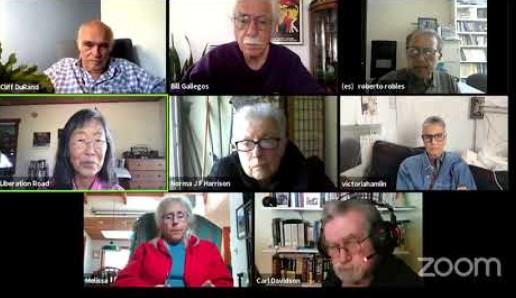
| | | Last Week's Saturday Morning Coffee | |
News of the Week, Plus More
| |
|
Photo: Trump during his tour of the so-called Alligator Alcatraz immigrant detention center in Ochopee, Florida ANDREW CABALLERO-REYNOLDS/AFP/Getty Images
'Aligator Alcaltraz:" The Grand Opening
of an American Concentration Camp
By Melissa Gira Grant
The New Republic
Jul 02, 2025 - What were you doing the day the president attended the opening of an American concentration camp in the Everglades? Dubbed “Alligator Alcatraz” by Republican officials because of the predators living in the surrounding swampland, it has been built to cage thousands of people rounded up by ICE and allied law enforcement agencies as part of President Trump’s mass deportations. “‘Alligator Alcatraz’ is a concentration camp,” Andrea Pitzer, author of One Long Night, a history of concentration camps, said on Tuesday.
That morning, Trump attended the camp’s opening in Ochopee, Florida, along with Homeland Security Secretary Kristi Noem and Florida Governor Ron DeSantis. “We’d like to see them in many states,” Trump said at a press conference there. “And at some point, they might morph into a system where you’re going to keep it for a long time.” He complained about the cost of building jails and prisons, then complimented his team, who “did this in less than a week.”
For the event, Trump wore one of his signature red ball caps, this one reading “Gulf of America,” his jingoistic name for the nearby Gulf of Mexico; Noem wore a white “Make America Great Again” ball cap with gold stitching. The flimsy camp offered them some shelter from the punishing humidity, which would later give way to a downpour. A C-Span camera followed them into one of the massive tents, where rows of chain-link cages contained numerous bunk beds—for the moment, empty. Photographers raced ahead of Trump and Noem to get shots of them entering, taking in the cells, pausing to ask inaudible questions. DeSantis stood as if he did not know where to put his hands. “They’re going to sweep this six times to make sure there’s nothing that could be used as contraband, as weapons,” DeSantis told Trump a bit too brightly, “before the detainees come in.” He smiled as he told reporters about how soon their prisoners would “check in.”
The American concentration camp on view Tuesday was erected within the Big Cypress National Preserve, traditional Miccosukee land. The tribe was not consulted, said Betty Osceola, a member and activist who lives a few miles from the camp’s entrance. She was one of hundreds of people protesting on the road outside the camp over the last several days as massive trucks streamed into the site. “People should be concerned about the secrecy of this,” Osceola told the Fort Myers News-Press. “It’s a big deal. Our ancestors were laid to rest in this area, and they talk about it like it’s a vast wasteland. It’s not.”
The site of the camp is also public-owned land, most recently occupied by the Dade-Collier Training and Transition Airport, “a remote facility for promising pilots to practice their touch-and-goes amid disinterested herons and alligators,” according to The Palm Beach Post. An executive order issued by DeSantis cited a nonexistent “emergency” to get around the legal process for building on the site.
Two environmental groups working in the area, Friends of the Everglades and the Center for Biological Diversity, filed a lawsuit Friday “to halt the unlawful construction of a mass federal detention facility for up to 5,000 noncitizen detainees.” Friends of the Everglades noted that their group was founded in part to stop construction of a major jetport on the same site. Members of the Miccosukee and Seminole tribes fought against the jetport too—generations ago. The state of Florida contended in court on Monday that the “risks” of not locking up immigrants on the site (on this expedited pseudo-emergency basis) “overwhelm any incidental environmental harm.” They also claimed the site was “temporary.”
There is no reason to believe any of the claims from the Florida and federal governments. The same day the concentration camp opened, ABC News reported that despite Trump’s campaign refrain that his mass deportations would target “criminals,” “new data shows a recent shift toward also arresting those who have not been accused of crimes.” This was foretold by Tom Homan, Trump’s “immigration czar,” who was the face of the mass deportation plan long before Trump returned to the White House. “No one’s off the table,” Homan said at the Republican National Convention last summer. “The bottom line is: Every illegal alien is a criminal. They enter the country in violation of federal law. It’s a crime to enter this country illegally.” Every immigrant—every person the Trump administration said was an immigrant—was a target from the beginning.
On Monday, a reporter asked Homan about an ailing 75-year-old Cuban man who died in ICE custody recently. His response: “People die in ICE custody.” He complained, “The questions should be, how many lives has ICE saved?” He challenged reporters to look into ICE’s detention standards. Last week, Wired reported on a chilling pattern of apparent neglect inside immigrant detention centers, based on nearly 400 calls made to 911 from the 10 largest ICE facilities. Incidents included seizures, self-harm, and sexual abuse. Some calls were made by the people caged inside, desperate for help.
At his press conference at the concentration camp, Trump learned that his massive budget bill had passed the Senate. The funding in the bill will make ICE the largest jailer in the world, with $200 billion at its disposal. As Felipe De La Hoz wrote last month for TNR, the bill “would take everything we’ve seen so far”—the targeting of activists for their speech, masked agents grabbing people off the street, sudden flights to Guantánamo or out of the country, ramping up detentions—and crank it to 11.”... ...Read More
| | |
Kirsten Gillibrand Apologizes To Zohran Mamdani Over ‘Jihad’ Claim
New York senator had claimed that Democratic nominee for mayor had made ‘references to global jihad’
By Edward Helmore in New York
The Guardian
July 2, 2025 - The New York Democratic senator Kirsten Gillibrand has apologized to Zohran Mamdani, the party nominee for New York City mayor, for comments she made claiming that Mamdani had made “references to global jihad”.
“Gillibrand apologized for mischaracterizing Mamdani’s record and for her tone on the call,” according to a readout of a phone call between Gillibrand and Mamdani that was obtained by Politico.
The apology comes after an interview the Democratic senator gave to the Brian Lehrer radio show last week in which Gillibrand was asked if she would hold Mamdani accountable for “glorifying” Hamas.
Zohran Mamdani won by being himself – and his victory has revealed the Islamophobic ugliness of others
That was prompted by an ongoing controversy over Mamdani – who would become New York City’s first Muslim mayor if he wins the election – declining to condemn the phrase “globalize the intifada” while also emphasizing that he plans, if elected, to be a mayor “that protects Jewish New Yorkers”.
Gillibrand said in the interview that Jewish New Yorkers were alarmed by Mamdani’s statements. While there is no evidence that Mamdani supports the Palestinian militant group, the city has been host to scores of pro-Palestinian protests. Some critics have called them antisemitic.
Reacting to a listener’s call-in question, Gillibrand said she would like to talk through the issues with Mamdani and that he should denounce the phrase “globalize the intifada”.
Gillibrand said that her constituents in upstate New York were “alarmed” by Mamdani’s past public statements, “particularly references to global jihad. This is a very serious issue because people that glorify the slaughter of Jews create fear in our communities.”
Mamdani argues that the phrase “globalize the intifada” has been deliberately misinterpreted to smear him and others who stand up for Palestinian rights.
He also said in an MSNBC interview that comments like Gillibrand’s represented “a language of darkness and a language of exclusion”.
Mamdani supporters have protested outside Gillibrand’s office and called for her resignation.
“I find it disgusting that someone who is one of the most powerful people in this country would repeat rightwing talking points to diminish” Mamdani, said the New York state representative Emily Gallagher.
A protest in front of Senator Kirsten Gillibrand’s office on Friday evening about her remarks made on WNYC radio’s Brian Lehrer Show. Photograph: Anadolu/Getty Images
Gillibrand’s comments also appeared to be rebuked by New York’s governor, Kathy Hochul, who said, “no one should be subjected to any comments that slur their ethnicity, their religious beliefs, and we condemn that anywhere it rears its head in the state of New York.”
Gillibrand had earlier backed away from her comment, releasing a statement on Friday saying she “misspoke”.
In Gillibrand’s call with Mamdani, they “discussed the need to bring down the temperature around the issue” of the war between Israel and Hamas, and that she “regretted not separating her own views from the radio show caller’s more clearly”.
“Gillibrand said she believes Mr Mamdani is sincere when he says he wants to protect all New Yorkers and combat antisemitism,” the readout continued. “She said the GOP attacks on him are outrageous and unacceptable.”
Those attacks continued on Tuesday when Donald Trump reasserted an earlier statement branding Mamdani as a communist, which Mamdani denies, and threatened to cut off federal funds to New York City if Mamdani becomes mayor and “doesn’t behave himself”.
“We don’t need a communist in this country, but if we have one, I’m going to be watching over him very carefully on behalf of the nation. We send him money, we send him all the things that he needs to run a government,” Trump said.
Trump also made a baseless allegation that Mamdani, 33, who was born in Uganda to ethnic Indian parents and became a US citizen in 2018, obtained his citizenship “illegally”.
The Trump administration is engaged in an aggressive effort to deport foreign-born citizens convicted of certain offenses, and Mamdani has pledged to maintain New York City as a “sanctuary” city that resists federal deportation efforts.
New York senator had claimed that Democratic nominee for mayor had made ‘references to global jihad’
The New York Democratic senator Kirsten Gillibrand has apologized to Zohran Mamdani, the party nominee for New York City mayor, for comments she made claiming that Mamdani had made “references to global jihad”.
“Gillibrand apologized for mischaracterizing Mamdani’s record and for her tone on the call,” according to a readout of a phone call between Gillibrand and Mamdani that was obtained by Politico.
The apology comes after an interview the Democratic senator gave to the Brian Lehrer radio show last week in which Gillibrand was asked if she would hold Mamdani accountable for “glorifying” Hamas.
That was prompted by an ongoing controversy over Mamdani – who would become New York City’s first Muslim mayor if he wins the election – declining to condemn the phrase “globalize the intifada” while also emphasizing that he plans, if elected, to be a mayor “that protects Jewish New Yorkers”.
Gillibrand said in the interview that Jewish New Yorkers were alarmed by Mamdani’s statements. While there is no evidence that Mamdani supports the Palestinian militant group, the city has been host to scores of pro-Palestinian protests. Some critics have called them antisemitic.
Reacting to a listener’s call-in question, Gillibrand said she would like to talk through the issues with Mamdani and that he should denounce the phrase “globalize the intifada”.
Gillibrand said that her constituents in upstate New York were “alarmed” by Mamdani’s past public statements, “particularly references to global jihad. This is a very serious issue because people that glorify the slaughter of Jews create fear in our communities.”
Mamdani argues that the phrase “globalize the intifada” has been deliberately misinterpreted to smear him and others who stand up for Palestinian rights.
He also said in an MSNBC interview that comments like Gillibrand’s represented “a language of darkness and a language of exclusion”.
Mamdani supporters have protested outside Gillibrand’s office and called for her resignation.
“I find it disgusting that someone who is one of the most powerful people in this country would repeat rightwing talking points to diminish” Mamdani, said the New York state representative Emily Gallagher.
A protest in front of Senator Kirsten Gillibrand’s office on Friday evening about her remarks made on WNYC radio’s Brian Lehrer Show. Photograph: Anadolu/Getty Images
Gillibrand’s comments also appeared to be rebuked by New York’s governor, Kathy Hochul, who said, “no one should be subjected to any comments that slur their ethnicity, their religious beliefs, and we condemn that anywhere it rears its head in the state of New York.”
Gillibrand had earlier backed away from her comment, releasing a statement on Friday saying she “misspoke”.
In Gillibrand’s call with Mamdani, they “discussed the need to bring down the temperature around the issue” of the war between Israel and Hamas, and that she “regretted not separating her own views from the radio show caller’s more clearly”.
“Gillibrand said she believes Mr Mamdani is sincere when he says he wants to protect all New Yorkers and combat antisemitism,” the readout continued. “She said the GOP attacks on him are outrageous and unacceptable.”
Those attacks continued on Tuesday when Donald Trump reasserted an earlier statement branding Mamdani as a communist, which Mamdani denies, and threatened to cut off federal funds to New York City if Mamdani becomes mayor and “doesn’t behave himself”.
“We don’t need a communist in this country, but if we have one, I’m going to be watching over him very carefully on behalf of the nation. We send him money, we send him all the things that he needs to run a government,” Trump said.
Trump also made a baseless allegation that Mamdani, 33, who was born in Uganda to ethnic Indian parents and became a US citizen in 2018, obtained his citizenship “illegally”.
The Trump administration is engaged in an aggressive effort to deport foreign-born citizens convicted of certain offenses, and Mamdani has pledged to maintain New York City as a “sanctuary” city that resists federal deportation efforts.
New York senator had claimed that Democratic nominee for mayor had made ‘references to global jihad’ ...Read More
| | |
Sanders Says Every Republican Who Backed Trump-GOP Budget 'Must Pay a Price at the Ballot Box'
"They do not deserve to be re-elected and they must be defeated," said Sen. Bernie Sanders.
By Jake Johnson
Common Dreams
July's 04, 2025 - As communities across the United States braced for impact after congressional Republicans approved the biggest Medicaid and nutrition assistance cuts in the nation's history, Sen. Bernie Sanders said Thursday that every lawmaker who supported the budget legislation "must pay a price at the ballot box" in the 2026 midterms and beyond.
"This bill includes the largest cut ever to Medicaid in order to pay for the largest tax break for billionaires that we have ever seen," Sanders (I-Vt.), who is working to recruit progressive candidates for office, said after the House passed the legislation, sending it to President Donald Trump's desk.
"Make no mistake about it: This bill is a death sentence for working-class and low-income Americans," said Sanders.
While some GOP lawmakers in the House and Senate voiced concerns about the bill's massive cuts to Medicaid and other programs as the measure moved through Congress, the legislation ultimately garnered near-unanimous support from the Republican caucus when it came time for the final votes. Just three out of 53 Republican senators and two out of 220 GOP representatives voted against the completed bill.
Analysts and advocates expect the legislation to inflict major damage across the country, shuttering rural hospitals, stripping health coverage and food aid from millions, raising costs for Medicare recipients, and devastating local economies.
Some of the pain will be concentrated in swing districts currently represented by Republican supporters of the budget package. For example, 64% of Rep. David Valadao's (R-Calif.) constituents in California's 22nd Congressional District rely on Medicaid.
Valadao is one of 10 Republicans targeted by an ad push that the advocacy group Protect Our Care launched following Thursday's vote in the House. The other targeted lawmakers are Reps. David Schweikert (R-Ariz.), Young Kim (R-Calif.), Ken Calvert (R-Calif.), Nick LaLota (R-N.Y.), Andrew Garbarino (R-N.Y.), Mike Lawler (R-N.Y.), Ryan Mackenzie (R-Pa.), Rob Bresnahan (R-Pa.), and Dan Newhouse (R-Wash.). ...Read More
| |
Photo: Members of the U.S. Army take part in a fitness competition on the day of a military parade to commemorate the U.S. Army's 250th Birthday in Washington, D.C. US, June 14, 2025. REUTERS/Kevin Mohatt
US Soldiers Demand Protection from Following
Trump’s Far-right Authoritarian Government'
By Adam Lynch
Alternet
July 04, 2025 - The New Republic reports members of the U.S. military are spending July 4 demanding answers about the consequences of following the orders of “Trump’s far-right authoritarian government.”
Air Force mechanic “Kim”, speaking anonymously to TNR, said she enlisted in the military “to get a stable paycheck, a roof over my head, food in my stomach at the end of the day.” But now she worries about the increasing prospect of being issued unlawful orders, fearing President Donald Trump is willing to use the military against American civilians
“And now we have military in our streets, and that’s not where you’re supposed to see them,” said Kim.
George Washington University law professor Laura Dickinson says more and more military members are worried about being caught in the middle of either being court-martialed for refusing to follow illegal orders or getting prosecuted for executing them.
“The United States federal government has been very cautious about using the federal military domestically for law enforcement purposes,” said Dickinson or Trump’s decision to send federal troops to the streets of LA. “It’s norm busting and very concerning to people in the military.”
Another fear is that Trump might invoke the Insurrection Act to quash protests, despite the Act being designed to deploy the military against insurrection, not protestors shielded by the Constitution.
“The Marines aren’t trained in policing,” said Brittany Ramos DeBarros, an Afghanistan veteran and organizing director of About Face, which opposes military weapons and tactics being deployed against U.S. civilians. “People in the military understand that there’s probably no less equipped branch of the federal government to do de-escalation work than the Marines,” who DeBarros describes as trained for warfare, with rules of engagement that are very different from those of law enforcement.
Even worse, people who served in Trump’s last administration admit the president has deliberated shooting civilians before at the height of Black Lives Matter protests.
“Can’t you just shoot them, just shoot them in the legs or something?” asked Trump, who received exemptions to avoid serving in Vietnam thanks to his wealthy father, according to the New York Times.
The About Face veterans’ group is spending the July 4th holiday launching it’s “Right to Refuse” campaign arguing that American service members deserve the power to refuse unlawful or immoral orders, particularly those issued against other Americans. The group also seeks to pressure Congress to pass a law providing protection to service members who refuse unlawful commands.
“I may not have joined the military out of the most patriotic of reasons, but I still raised my right hand and swore an oath to the Constitution to defend it from all enemies foreign and domestic,” said Kim. “But the American people are not the Constitution’s domestic enemies.” ...Read More
| | |
Photo: Rep. Alexandria Ocasio-Cortez, D-N.Y., attends a news conference on Temporary Protected Status (TPS) for Ecuadorians residing in the U.S., outside the Capitol on Tuesday, November 19, 2024. (Tom Williams/CQ-Roll Call, Inc via Getty Images)
Why Trump Is Terrified of AOC'
After Zohran Mamdani's win, Trump reveals how scared he is to face Rep. Alexandria Ocasio-Cortez
By Amanda Marcotte
Salon.com
June 30, 2025 - In the wake of state representative Zohran Mamdani’s historic defeat of former Gov. Andrew Cuomo in New York City’s Democratic primary, Donald Trump knew immediately who he feared most: Not Mamdani, who he doesn’t seem to know much about, as evidenced by a preposterous attack on Mamdani’s good looks. Certainly not Cuomo, who is a weak imitation of Trump in the “sexually predatory jerk” department.
No, his eyes went straight to his real nemesis: Rep. Alexandria Ocasio-Cortez of Queens. Trump’s biggest dig against Mamdani was “AOC+3” on Truth Social, citing the congresswoman’s nickname.
It’s no surprise that Trump so swiftly reverted to his AOC obsession. While multiple Democrats have called out the president for his illegal bombing of Iran and the apparent lies he’s told in exaggerating its effectiveness, it’s Ocasio-Cortez who got under his skin.
He unleashed a Truth Social post that was unhinged even by his standards, screeching that she’s “NOT qualified for office,” that she’s “stupid” and the “dumbest,” while defending his own intelligence by noting he “ACED” a cognitive test doctors use to determine if an elderly person’s dementia has gotten so bad they need to be put in full-time care. Trump’s fear that people will notice he’s stupid is never far from the surface, but his narcissistic anxiety is clearly aggravated by fears that Ocasio-Cortez is a formidable political opponent.
Trump should be worried. Ocasio-Cortez has not hinted at any presidential run in 2028. But if she were the Democratic nominee, she would be extremely hard for Trump to beat. (Yes, yes, I know the Constitution forbids him from running again. It also guarantees birthright citizenship, but the Supreme Court found a backdoor way to pause that on Friday. They’d make up some B.S. to justify letting him run a third time, if he’s physically capable of doing so.) Ocasio-Cortez isn’t just the opposite of Trump, brimming with the youth and intelligence he lacks. She also offers a sharp contrast to the rest of the Democratic Party, which voters see, for good reason, as feckless, weak and corrupted by corporate interests.
Democratic leadership has bet that hiding and making noises about “bipartisanship” will save them as Trump implodes, but it’s just led to their voters deciding they are too lame to be bothered with — a miscalculation that could very well drive down turnout of Democratic voters in the midterms.
Trump’s approval ratings are low, but they are still better than those of the Democrats. A mid-June Quinnipiac poll shows 38 percent of voters approve of Trump, but only 21 percent say the same about congressional Democrats. Democrats in Congress have a shocking 70 percent disapproval rating, driven up by the fact that 53 percent of Democratic voters are mad at them. Democratic leadership has bet that hiding and making noises about “bipartisanship” will save them as Trump implodes, but it’s just led to their voters deciding they are too lame to be bothered with — a miscalculation that could very well drive down turnout of Democratic voters in the midterms.
While it’s unwise to draw too many national lessons from Mamdani’s win in deep-blue New York City, one aspect of his resounding victory matters quite a bit for Democrats who want to turn the ship around: People actually like the guy. Centrist efforts to paint him as a communist, criminal-loving terrorist threat didn’t resonate with most voters, because Mamdani ran a positive campaign with bold ideas that excited voters, especially younger ones. As former Barack Obama staffer Dan Pfeiffer said on “Pod Save America” Thursday, “The hope he’s given people is something every Democrat should be learning from.” Mamdani, Pfeiffer said, spoke to people’s desire for a candidate ready to take on the “broken political system.”
Trump won in 2024 in large part because young voters are breaking with the Democratic Party, which they see as hidebound and corrupt. (Yes, Trump is worse, but turns out “not the worst” is hardly a great sales pitch for Democrats.) As Philip Bump wrote in the Washington Post last week, younger voters see “triangulating middle-ground positions” as a “betrayal.” They believe Democrats are ignoring their desires “for affordable housing and support for schools and child care.” Mamdani spoke directly to those concerns, and with strategies that actually reach younger voters, such as focusing on social media and word-of-mouth driven by in-person contact, rather than TV ads. He also seems like a genuine person, happy to speak in plain English, instead of parroting focus group-shaped talking points that often make Democrats seem inauthentic, reinforcing fears that they’re out of touch.
The numbers bear this out. As the New York Times reported Sunday, Mamdani turned out younger voters at eye-popping levels. Democratic primaries tend to lean older, with the largest turnout coming from people aged 55-75. In this primary, however, by far the largest group of voters was between 18-30 years-old. Young voters typically vote in primaries in vanishingly small numbers, comparable only to the size of the post-80 crowd, whose statistics are decimated by invalidity and death. These are the voters Democrats need to excite, and Mamdani showed the party how to do it.
He is a talented candidate, but Mamdani’s campaign strategy owed a great deal to Ocasio-Cortez, who used the same methods to oust longtime incumbent Rep. Joseph Crowley in the 2018 Democratic primary. Since then, she’s become one of the most famous Democrats in Congress, a distinction largely due to her social media savvy and her no-nonsense way of speaking to voters.
Even centrists must concede that Ocasio-Cortez is more popular than the mealy-mouthed Democrats who otherwise dominate the landscape. In a March CNN poll where Democratic and Democratic-leaning independents were asked to name one politician who best represents their values, AOC led the pack, beating out even former Vice President Kamala Harris and former President Barack Obama. In a Data for Progress poll from April, Ocasio-Cortez led Senate Minority Leader Chuck Schumer in a hypothetical primary for New York’s Democratic Senate nomination by a whopping 19 points. ...Read More
| | |
Photo: Trained Volunteers Patrol L.A. Streets as ICE Raids Intensify All photos by Marco Amador
Los Angeles: Neighborhood Groups Monitor Immigration Enforcement Amid Rising Fear And Federal Scrutiny.
By Myriam-Fernanda Alcala Delgado
The American Prospect
July 3, 2025 - Francisco Romero of Unión del Barrio patrols the streets of South Los Angeles for signs of ICE activity.
This article was produced by Capital & Main, an award-winning publication that reports from California on economic, political, and social issues. It is co-published here with permission.
The day after families across the country gathered to celebrate Father’s Day, Francisco Romero huddled at dawn with 10 volunteers in a South Los Angeles parking lot. The group was preparing to patrol the neighborhood for signs of Immigration and Customs Enforcement activity.
There was a heaviness in the atmosphere, despite the comradery and smiles. During the group huddle, some reflected on the difficulty celebrating Father’s Day while families across the city were being separated by ICE. Another volunteer mentioned viral videos from the prior weekend showing apparent ICE presence in the nearby city of Bell, including “snatch and grabs,” in which unmarked vehicles surrounded pedestrians suspected of being undocumented and ICE officers pulled them inside.
“It’s psychological,” Romero said, speculating about the timing of the raids, which coincided with a holiday meant to celebrate family.
While L.A. residents—and much of the country—were transfixed for days by images of masked officers rounding up immigrants and protesters flooding downtown streets, this quieter, grassroots effort to protect vulnerable communities from these raids has continued to unfold. Volunteers like Romero patrol the streets across Los Angeles weekly, keeping watch with the aim of alerting the community to any ICE operations.
Such patrols are nothing new. Since the civil unrest that erupted after the beating of Rodney King in 1992, Unión del Barrio has operated community patrol networks to monitor for law enforcement activity and other potential dangers to residents in neighborhoods across California. But the environment has become more treacherous in recent weeks. There has been an increase in ICE operations across the city, including masked officers detaining suspected undocumented immigrants from local stores, street shops and neighborhoods. Their enforcement actions have led to protests in Los Angeles and pushback from residents and organizers alike.
In addition, Unión del Barrio—along with the Coalition for Humane Immigrant Rights Los Angeles and the Party for Socialism and Liberation—has drawn the attention of Republican Sen. Josh Hawley, who alleged in a letter sent to the groups in mid-June that they are providing “logistical and financial resources” in support of civil unrest and “aiding and abetting criminal conduct.” The letter calls on the groups to “cease and desist” their operations.
In response, Unión del Barrio said in a June 15 statement, “The objective of Mr. Hawley’s letter was to intimidate us and compel Unión del Barrio to stop organizing the self-defense of our communities.”
Francisco Romero meets with Unión del Barrio volunteers in a South Los Angeles parking lot before heading out on patrol. Faces of volunteers who asked not to be identified have been obscured.
Many volunteers, including Aimee and Ruth, never interact directly with ICE, while those who do, like Romero, follow a strict protocol meant to protect them from arrest while they carry out their work. When Romero spots what he believes might be an ICE vehicle, he first calls for backup from fellow organizers before deciding whether to approach. In the past, he would tap on the car window and ask the officer to identify themselves.
“That was back when they would still roll down their windows. Now, they don’t,” he said.
The atmosphere of heightened fear has caused the members of the group to use extra caution when describing their work and when approaching ICE agents. When speaking among themselves or with the broader community, they avoid language that suggests they are “chasing out” or “following” ICE operations. Instead, they describe their efforts as “safely monitoring” ICE activity from a distance. When agents leave a neighborhood, organizers say the agents are “electing to do so,” often because they have lost the element of surprise, according to Romero.
The group has also gone to extra lengths to make sure community members are comfortable with their presence when they are on patrol. Each member of Unión del Barrio’s patrol wears a green shirt emblazoned with the group’s logo, so they are clearly recognizable. The volunteers are given magnets with the organization’s name to affix to the side of their cars. They travel in small groups. On this Monday in June, Francisco, Ruth and Aimee were assigned to patrol the residential neighborhoods north of Martin Luther King Boulevard. Aimee, who lives in the community, said she preferred to use only her first name for the safety of her friends and family; Ruth, a teacher, likewise asked that only her first name be used.
Aimee, who has volunteered with Unión del Barrio for the past six months, was looking through the back seat window when she noticed a car with blacked out plates. Romero decided the car was suspicious enough to merit an investigation to see whether it belonged to ICE officers.
The spotting of any car that is unmarked, has tinted windows or is deemed in any way out of the ordinary is enough to prompt the patrol team to turn back and retrace their steps.
That particular car turned out not to be a threat. But just two hours after Romero, Aimee and Ruth’s patrol had finished for the morning, Unión del Barrio posted a warning on social media about ICE presence less than a mile away.
Romero pulls over during an early morning ICE patrol to coordinate with other volunteer units.
Unión del Barrio conducts two types of patrols: morning rides that monitor neighborhoods with large numbers of Latino residents or workers who may be targeted for immigration enforcement and patrols triggered by community tips about real-time ICE activity. The latter have become more frequent in recent weeks, as ICE operations have intensified. In both cases, the organization either verifies the activity directly or coordinates with trusted community members or other civil rights organizations before issuing public alerts on social media.
Despite heightened scrutiny of immigrant rights organizations in recent weeks by federal officials, a growing number of community groups and individuals are seeking them out for guidance. Unión del Barrio has received calls from across the state and country from individuals and groups requesting resources on preparing communities for incursion by ICE. The organization is planning a trip across California to provide training to allied community groups over the course of the summer. Romero estimates interest in those trainings has tripled in the last few weeks. Instead of taking Sen. Hawley’s allegations as a deterrent, “We see it as a new front of struggle,” said Romero, who has been with Unión del Barrio for 30 years and got his start as an activist against police violence. ...Read More
| | |
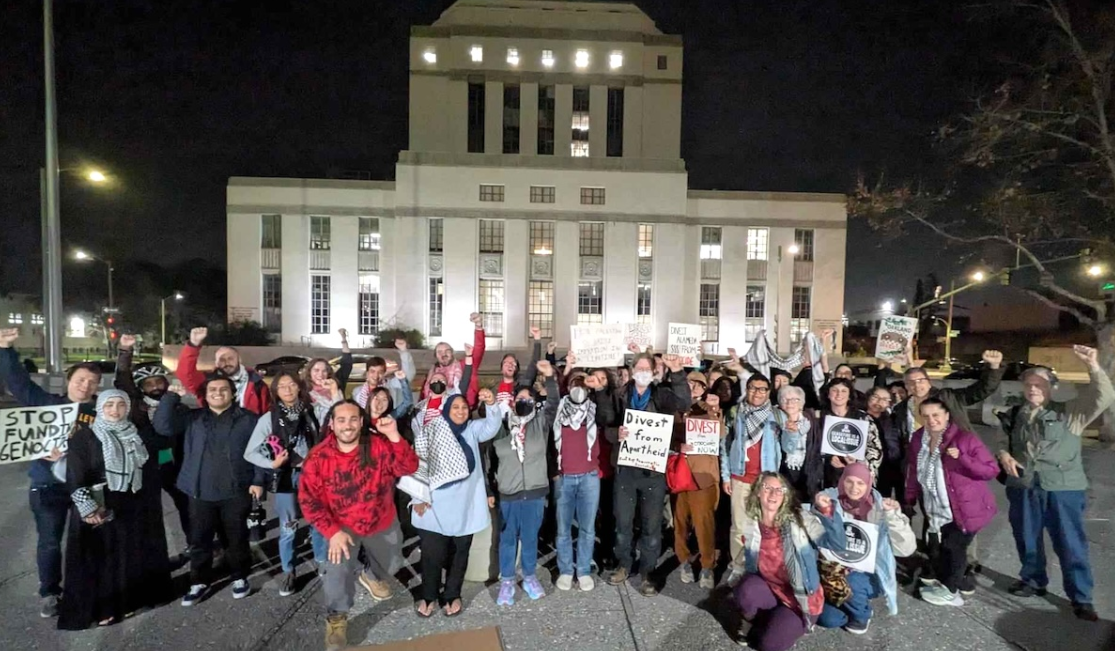
How East Bay DSA, Community Members, and Workers Won Alameda County Divestment from Israeli Apartheid
By Andrew Basta, Vish Soroushian and Zach Weinstein
Democratic Left
In December of last year, the treasurer of Alameda County announced he was going to divest the $32 million in bonds issued by Caterpillar, a construction equipment manufacturer responsible for the violent displacement of Palestinians.
The county Board of Supervisors also voted to task him to prepare an ethical investment policy that could lead to a prohibition on investing public funds in companies that profit from serious human rights violations, including Israel’s crimes against the Palestinian people and land. East Bay DSA organizers played a major role in pushing for this transformation, one of the largest wins for the BDS Movement and the Palestine solidarity movement in the United States to date. East Bay DSA’s work with union members was of particular importance to this campaign’s victory.
Andrew Basta, a member of DSA’s International Committee’s steering committee interviews two East Bay DSA organizers, Zach Weinstein, one of the co-chairs of East Bay DSA, and Vish Soroushian, a campaign co-lead for East Bay DSA’s Divest from Apartheid campaign. This interview discusses how the chapter identified this target, the political terrain the chapter battled on, how they built a strong campaign, and what’s next for East Bay DSA. We hope that this interview can serve as a resource to chapters and activists interested in replicating municipal and county divestment across the country. East Bay DSA’s “Divest From Apartheid” campaign organizers can be reached at divest@eastbaydsa.org.
The interview has been edited for clarity and length.
Andrew: How did the campaign to pressure Alameda County to divest begin in both the Bay Area and within East Bay DSA? Was it connected to previous successful divestment efforts in the cities of Hayward and Richmond?
Zach: Alameda County has long been a hotbed of pro-Palestine organizing. For example, there are local Arab-led organizations like AROC (Arab Resource and Organizing Center) that have spent many years building relationships with the Longshoremen’s Union, ILWU (International Longshore and Warehouse Union), at the port of Oakland, and that has effectively meant that Israeli ships have been unable to dock in Oakland for many years. Famous left organizations that have emerged out of the Bay Area have also had a strong internationalist bent to them, like the Black Panthers. The Bay Area also has a large Palestinian American population. With all these factors in mind, when organizing around Palestine took on a new urgency after Oct. 7, it was inevitable that there would be a strong and renewed demand locally around divesting from Israel. The question for us was how can the chapter contribute to that.
For those who don’t know, Alameda County includes Oakland, which is its largest city, as well as several other large cities such as Berkeley, Fremont, and Hayward. East Bay DSA’s chapter jurisdiction includes all of Alameda County and also all of Contra Costa County, which is next door, and includes a lot of working-class cities like Richmond. Richmond has a socialist majority on their City Council, and they were the second city to divest in the country [after Hayward]. That effort was largely led by elected officials from the Richmond Progressive Alliance, most of whom are also members of East Bay DSA. In Richmond and Hayward [which had already divested], we had members who were highly involved including some electeds, but organizationally we hadn’t quite put the infrastructure in place where we, as a chapter, could drive major turnout or organize public support. We, of course, took a lot of inspiration from [both Hayward and Richmond’s] success.
By the time Richmond had voted to divest in May 2024, conversations had started in the chapter about making a local municipal divestment from Israel our chapter’s top priority campaign for the upcoming year. My recollection is that Vish came to me maybe in March or April of 2024, and asked what I thought about East Bay DSA starting a formal divestment campaign. I was really excited about it and encouraged him to talk to other chapter leaders. By our chapter convention in June of last year, we launched our Divest from Apartheid campaign and named it our top priority campaign for the next 12 months.
Vish: The city of Alameda (within Alameda County) also adopted a divestment resolution which divested them from weapons manufacturers and other things. Also, just to add to the richness and the history of the Bay Area in terms of supporting social justice and whatnot, back in the 70’s and the 80’s, there was a robust divestment movement in opposition to apartheid in South Africa, and there was also support throughout the Bay Area from divestment for Burma in the nineties. This is part of the local relevance Zach described.
I also want to give a big shout out to East Bay DSA’s Anti-imperialism Committee. We have a great committee here that has been focused on supporting the cause of Palestinian liberation locally since before Oct. 7, and the campaign plan was really born out of that committee.
Andrew: How did you land on Alameda County specifically?
Vish: Back in March on the 21st anniversary of the murder of Rachel Corrie by Caterpillar bulldozers while she was in Gaza, we had several SEIU members in our chapter who were honoring her legacy and commemorating her death. It was around that time when, with Alameda County’s investment portfolio available online for public view, I noticed that we had $32 million invested in Caterpillar bonds, amongst other problematic investments. That was really the catalyst for doing this work.
There were a couple of other factors that were on our radar: there was a [county] supervisor who was retiring. We figured that with his impending retirement he wouldn’t have the political pressures laying down on him that somebody seeking further office would. This individual was involved with divestment from South Africa and Burma as well, so they seemed like a natural ally. We also worked closely with a council member in Hayward, who made divestment happen over there. This council member had a relationship with Treasurer Henry Levy, so that gave the local divestment movement access to him. Those are all factors that we took into account and helped us shape the plan for East Bay’s Divest from Apartheid campaign.
Andrew: The campaign targeted both the county treasurer, Henry Levy, and the five members of the Board of Supervisors. Targeting the treasurer is a new model for the BDS Movement. How did you land on these targets, and what were your demands?
Vish: What we learned through our research is that the Board of Supervisors ultimately delegates its investment authority to the county treasurer. This means that it’s not really up to the Board of Supervisors to dump Caterpillar; it’s up to the treasurer. [We could, however,] target the Board of Supervisors with the goal of passing and adopting an ethical investment policy with a human rights screen, which essentially would mean that the county’s investment policy would include a prohibition on investing in companies that profit off of human rights violations such as apartheid and fossil fuel companies. So we targeted both the Board of Supervisors and the county treasurer. With the Board of Supervisors, we said, “We don’t want any of our public funds going towards this thing.” But, in the moment, we are invested in Caterpillar, we need to do something about that, and the county treasurer has the ability to make that decision.
Now, there were some challenges with [targeting the treasurer]. We were a little bit surprised that we got him to divest, and it’s really a testament to the amount of organizing that we did as East Bay DSA with our labor partners as well as other organizations and individuals’ work that came to convince him to take this action.
Zach: There are two things I would add that informed the campaign targeting and the structure. First, the county treasurer is elected. That meant he was more susceptible to the same sorts of pressures that any other elected official might be.
The other reason for the focus on the ethical investment angle, rather than specifically talking about BDS and Israel, is that there’s a soft anti-BDS law on the books in California that makes it so that you can’t target specific countries effectively. Doing something with a wider scope decreases the risk of a BDS action being overturned.
Vish: For Hayward, the divestment that they pursued was just dropping investments in certain companies. In Richmond, they passed an ethical investment policy. What we accomplished [in Alameda County] was the combination of the two, which is really the ideal.
Andrew: A large coalition of community faith, labor, and activist organizations came together to support this effort. How did you build this coalition and end up collaborating together?
Zach: In some ways, the coalition was already coming together because there are so many different organizations that have a history of working on this issue, and there are also a lot of Arab and Palestinian-led organizations in the Bay Area. Another group called Bay Area Divest! (BAD!) also formed not long before we launched the Divest from Apartheid campaign.
Part of what Vish and other leaders on the divestment campaign did in the early phases was meetings with different community groups to get them on board, as well as other groups that were already working on this in order to coordinate and collaborate. One of the mechanisms for getting folks on our side was a big letter that grew to over 80 organizations signing on. It was one of the main mechanisms for building the coalition.
Vish: I wrote that letter in conjunction with our labor allies at SEIU 1021 [pronounced “ten-two-one”], and we chose to highlight the intersecting harms that these companies produce and create broad-based support for divestment. We also tried to meet with environmental justice organizations, immigration justice organizations, and anti-police terror organizations because everybody understands that a company that is responsible for creating displacement and death in Palestine also causes harm in all these different areas as well.
Andrew: Inside the coalition, how did you work through different points of view from different organizations? Were there any strategies that were successful in building unity across these different groups?
Zach: One thing that we tried to do was respect that people were coming to this from a lot of different political backgrounds and organizational approaches.
Most of the organizations involved in this campaign weren’t socialist organizations. Very few of them have the kind of internal, robust member democracy that DSA has. Inherently, as a volunteer run organization, [DSA is] going to be less experienced and less focused on the internal game including staying on top of lobbying visits and setting the lobbying strategy. Vish and other leaders on the campaign did a really good job on that front, but there are other organizations that literally have people who do [inside work] for their full-time jobs.
When there were differences of opinion on tactics and strategy, we tried to model some flexibility: if you’re gonna try it that way, you can go ahead and try that. We’re gonna try this thing. When there were groups that were more focused on the inside strategy, we would try to do the outside strategy in a way that wouldn’t undermine or counter their work.
Andrew: In the treasurer’s long op-ed in Jewish News of North California, he cites some work of JVP (Jewish Voice for Peace) in convincing him to divest. Do you want to speak to the Jewish angle in organizing for divestment?
Zach: We sent a contingent of Jewish members from both East Bay DSA and Bay Area Labor for Palestine to advocate to Treasurer Levy ahead of the Board of Supervisors vote around the same time that JVP did. I think it’s understandable that he would emphasize his meeting with JVP more in a Jewish Weekly article than his meeting with East Bay DSA and lefty labor unionists, but I think that does highlight that it’s good for organizations with a variety of different constituencies and reputations to be involved in a campaign like this. Our meeting with him was overall really positive. I’d like to think that we shored up his support ahead of the meeting, and I’m sure JVP’s meeting was also very helpful for that as well.
Vish: I was part of the meetings with Treasurer Levy and the feedback that we got on his evolution, his comfort with this over time, really tracked with the engagement from the Jewish community. Like Zach said, the DSA Jewish contingent met with him, then people from JVP did, and during this whole process many Jewish constituents were contacting him. He brought that up time and time again.
I want to add that we were able to engage with the faith community in general, from all denominations, quite significantly in this campaign. That’s always an asset when you have faith leaders standing up for human rights. It’s really hard for politicians purporting to be legislating from a position of morality to refute demands directly coming from people in the faith community.
Andrew: Labor played an important role in this campaign. How did East Bay DSA work to bring labor unions specifically and workers generally into this campaign?
Zach: Yeah, I’m really excited to talk about this specifically because it is really essential to understanding why this campaign was successful.
Our chapter has a long tradition of prioritizing labor organizing, and our emphasis within that has always been on building relationships with the rank-and-file members of unions. Obviously, relationships with union staff and union leadership can be lovely, but, if you really want to understand what’s going on in a union, you need an abundance of relationships with rank-and-file members (and hopefully, those members are also comrades and are already in DSA or join DSA). Then you’re less reliant on your relationship with a given leader or staffer, but have your own relationship with the people who make the union work – the membership. That takes consistent time and focus.
On this campaign, we were building on years of work. We had a chapter jobs program that included Oakland Unified School District as a target to try to recruit our members to become teachers in Oakland. There was that DSA pamphlet on “Why Socialists Should become Teachers?” that was very influential in our chapter, and we have several dozen East Bay DSA members who are now public school teachers in Oakland, and Oakland Education Association (OEA), the teachers union for Oakland, is one of the most consistently pro-Palestine unions in the country.
To trace back the history a little bit on Palestine specifically, in late October or early November of 2023 our chapter decided to organize what at the time we were calling a ‘labor against the war’ rally. Even at that stage, we knew it was essential that the public demands went further than just a ceasefire. We were a little worried that going farther would cost some labor support, but it didn’t. We got over a dozen unions to sign on in support of a rally in December of 2023 that called for an end to US aid to Israel and an end to the Israeli occupation of Palestinian land, and thousands of people turned out to that. ...Read More
| | |
Jeffrey Sachs: This is Why China Has Become Unstoppable
Very knowledgeable, very conscientious and dares to express himself, Professor Jeffrey Sachs deserves the highest respects and admirations. It gives one a sense of hope for the world whenever listening to him speak. Hope Professor Jeffrey Sachs and other people like him can take charge of affairs relating the whole world.
| | |
Hip-hop Can Document Life In America
More Reliably Than History Books
By A.D. Carson, University of Virginia
The Conversation
April 8, 2025 - Describing my 2017 appointment as a faculty member, the University of Virginia dubbed me the school’s “first” hip-hop professor. Even if the job title and the historic nature of the appointment might have merited it, the word was misleading.
Kyra Gaunt, a Black woman who is a foundational figure in the study of hip-hop, worked as a professor of ethnomusicology at the University of Virginia from 1996 to 2002. Her book “The Games Black Girls Play,” which focuses on Black music practices, was published in 2006. I cited her in my work and in the interview I gave before accepting the job.
Also cited in my doctoral work, presented in my interview with the University of Virginia, was scholar Joe Schloss, who worked at the school from 2000-2001. In 2009, he wrote “Foundation: B-boys, B-girls, and Hip-Hop Culture in New York.” And in 2014 he wrote “Making Beats: The Art of Sample-Based Hip-Hop.”
After pushback from readers online, UVA Today amended its original headline documenting my appointment and added Gaunt’s contributions to the article.
As a rapper and scholar, I have experienced and seen misleading hip-hop stories that highlight an impulse to inaccurately document the genre’s history and present. I raised this issue recently in a TikTok “office hours” video – part of a series in which I respond to audience questions from the vantage of hip-hop art and research.
Misleading hip-hop stories
After Johns Hopkins University announced that Lupe Fiasco had been hired to teach rap there in fall 2025, some online platforms, including The Root, incorrectly reported on his assignment.
They described his upcoming job as the first instance of a rapper ever hired as a professor at a university.
This is obviously incorrect. I’m a rapper who since 2017 has worked as a professor of hip-hop while releasing music, which was part of the basis for my earning tenure in 2023. Besides this, I’m certain there were rappers with university teaching jobs before me.
The trend of misrepresenting hip-hop history isn’t unique to communications from places such as Johns Hopkins University or the University of Virginia.
In 2024, the publisher of musician Ahmir “Questlove” Thompson’s “Hip-Hop is History” described it as “the book only Questlove could write: a singular, definitive history” of hip-hop.
Questlove’s book is not, as the publisher claims, a definitive history. It might more accurately be described as Questlove’s take on hip-hop history, or a memoir. Without this necessary distinction, unknowing readers might misinterpret the publisher’s claims.
Questlove writes about finally coming to appreciate Southern rap in the 2000s. But Southern rap history predates Questlove’s appreciation by decades. It doesn’t begin when someone like him finally recognizes its importance.
Similarly, hip-hop doesn’t begin when it’s finally recognized by an exclusive institution or when someone gets a degree for it.
Making hip-hop history
I published these concerns as academic questions in 2017 in an album called “Owning My Masters: The Rhetorics of Rhymes & Revolutions.” The project served as my doctoral dissertation.
“Owning My Masters (Mastered)” is the next phase of the dissertation album project. Published in 2024, it contains new audio, video, images and historical context. It’s published with University of Michigan Press through the same process of an academic book.
“Owning My Masters (Mastered)” demonstrates how hip-hop resists the ways American history often excludes Black resistance, Black achievement, Black storytelling and, ultimately, Black people.
But the exclusion that my work highlights is muted when the seeming novelty of my job appointment or my dissertation album are the focus. When I’m asked if I’m the first person to earn a Ph.D. for making a rap album, I try to answer more expansively to avoid misleading anyone, or ignoring what might be more informative.
It’s also important to understand the barriers that might have made a project like mine impossible before 2017. These include technological barriers that made recording and releasing music prohibitively expensive. And, more specific to hip-hop, it involves a mistrust based on racist history that prevented students from even proposing such a project.
No such “first” happens without the unsung work of others creating the conditions to make it possible.
Learning from hip-hop
Hip-hop’s documentation should not repeat the same flaws of the recording of American history, which can omit important people and events, and which can misrepresent the legacies of racism and systemic violence.
Undeniably, I believe important hip-hop texts, albums and moments should be studied and documented with academic rigor. But this should not solely focus on “firsts,” record sales or prestigious awards.
Such stories fail to accurately illustrate that hip-hop is as much about how people live day to day as it is about how institutions use it to bolster credibility or how companies make money off it.
Important aspects of hip-hop’s diverse culture are excluded when the ordinary is overlooked. ... ...Read More
| | |
Photo: Protesters attend a "Hands Off" rally to demonstrate against President Donald Trump on the National Mall on April 5, 2025, in Washington, D.C. Anna Moneymaker/Getty Images
We Have a Moral Imperative To Reclaim
America From the Extremists in Power
By William J. Barber II and Tope Folarin
Newsweek
The United States is the wealthiest, most powerful country the world has ever seen. And we've always had a moral tug-of-war between those who want to hoard wealth and power and those who honor the dignity of every person.
What's happening now is that the wealthy and powerful are working to divide the people—and keep the wealth and power for themselves.
President Donald Trump and his loyal followers in Congress have begun the process of pulling back help and basic services for all Americans, especially poor and low-income people, and engaging in ongoing war and oppression. And they're doing it all to consolidate wealth and power for themselves and their friends.
We know this not because of what the president and his allies say, but because of what they do. As faith leaders and scholars, we recently released a report that lays bare the realities of the president and Congress' actions, especially with regard to the upcoming reconciliation process through which Congress will decide budget priorities for the next 10 years.
We found that members of Congress, with President Trump's encouragement, have taken the first steps toward a budget that would take Medicaid coverage away from as many as 36 million people and force closures of rural medical facilities. Their plan would literally take food from the mouths of children, cutting food stamps for as many as 40 million people at a time of unprecedented food prices.
All told, their plan cuts $2 trillion in services for ordinary people.
Meanwhile, the president—with help from Elon Musk, the world's richest man—is firing thousands of government workers, often illegally. They tell the workers to go find work in the private sector. But at their own companies, Elon Musk and his fellow business titans are more interested in cutting jobs than creating them. And private business will never replicate the good but profitless work of keeping our air and water clean, providing free health care to veterans, or finding cures for rare diseases.
The real tell is where they're putting the money from all those cuts.
The president's plan, as passed by his supporters in Congress, would cut $4.5 trillion in taxes, mostly for the wealthy and corporations. For the bottom half of families, savings from the president's tax cuts would amount to less than $1 per day, while the richest 0.1 percent would enjoy windfalls of $314,266 per year. And administration officials have sided with corporations against workers by refusing to support raising the minimum wage, which has been stuck at $7.25 since 2009.
Meanwhile, for a war-weary and dangerously divided nation, the president and his allies in Congress want to invest at least $300 billion more in the war machine and indiscriminate mass deportations. Continuing decades of war, the president has already bombed Somalia and Yemen, and has suggested the possibility of military takeovers in the Gaza Strip, Greenland, and Panama.
And we are once again seeing the devastating and cruel effects of family separation for immigrants. The Trump administration has begun deporting parents of the 4.4 million U.S. citizen children with an undocumented parent—even stripping legal status in order to justify the deportation.
All of this serves to divide us—the wealthy against the poor, immigrants against the U.S.-born, job-seeker against fellow job-seeker, Black against brown against white, straight against gay, cisgender against transgender. Nothing makes this clearer than the administration's anti-DEI obsession, which denies that diversity is a strength and a blessing.
Those divisions clear the way for them to take the spoils.
We say this not as Democrats or Republicans, but as faith leaders and scholars who know from our communities and our studies that our common life depends on shared moral commitments.
We call on all people of conscience—faith leaders, religious, and nonreligious folk alike—to join us in a season of nonviolent moral dissent. With millions of Americans turning out for the recent "Hands Off" rallies across the country, it may already be beginning.
Our national hymn says, "America! America! God mend thine every flaw." We began our own season of dissent by calling hundreds of faith leaders to rally at the U.S. Capitol this March to stand together in prayer and moral resistance and tell Congress to stop the extremism, bullying, and corruption. We will gather there the first Wednesday of every month.
We oppose the immoral budget priorities of this president and his allies in Congress. We invite other faith leaders and all people to study our report on the true state of our nation, and to assemble on the town square, at city hall, or on the state house lawn in communities across this land. It's time for a new season of moral action to mend this country and reclaim the dignity of every person.
Bishop William J. Barber is the founder of Repairers of the Breach and national co-chair of the Poor People's Campaign.
Tope Folarin is the executive director of the Institute for Policy Studies. Repairers and IPS, along with the Economic Policy Institute, recently released the report, The High Moral Stakes of the Policy Battles Raging in Washington. ...Read More
| | Rachel Maddow: Breaking News, Trump Facing Protestd...15.0 min | | Digging Deeper into the Current Conjuncture: | | |
Why Movements Need To Learn To Fly Like Bees And Thread Like Spiders
For insights into building a broad-based pro-democracy movement take inspiration from nature.
By John Paul Lederach
Waging Nonviolence
July 1, 2025 - The first months of the Trump administration — with its rapid and sweeping turn toward autocratic rule — have rightly led to calls for collective and national resistance.
Leading civil resistance scholars Erica Chenoweth and Zoe Marks have described the need for a “large-scale, multiracial, cross-class, pro-democracy front.” And Maria Stephan, writing for Just Security, called this a critical moment for taking up the “journey from individual angst to collective action, from siloed work to big-tent formations.” Creating such a collective response, however, requires a great deal of creativity and focus, particularly — as these authors suggest — when it comes to relating to different groups and building unexpected connections.
This current moment, with all its challenges in the United States, feels like familiar territory. Over my four decades of work in international peacebuilding — especially accompanying local communities seeking to end cycles of armed violence while building dignity and justice in a context of historic protracted conflict — rarely did I see a singular movement take shape. The challenge always sits with how unlikely alliances and improbable partners thread together coordinated action.
The challenge of creating this collective response reminded me of the evocative question entomologists in the 1950s called the Paradox of Coordination, or how whole collectives achieve common purpose without centralized control. Their discoveries — despite being focused on the insect world — provided a catalyst for innovations in how to navigate deep and paralyzing divides in international settings. Much of the insight starts with a simple idea: Learn to strategically travel around different, divided, even highly polarized settings while rebuilding a broken circulatory system.
The practices of circulation
Let’s start with insights entomologists unveiled about coordination without centralized control by examining how bees pollinate, termites construct a home, or a spider makes an orb web. Three pivotal practices seem most relevant.
First, these insects circulate around the landscape. They do not expend energy convening meetings; they literally travel and navigate through a given geography.
Second, as they travel, they communicate and serve. Termites, for example, have found how to discover resources and communicate with others about their findings as they travel. Entomologists say these insects stitch a wider purpose by gathering and leaving a scent in the landscape. The orb spider, another example, is a genius at covering space by traveling and leaving threads that connect far-off but key anchor points, creating hubs and forging a wider web. Meanwhile, bees gather pollen and nectar, serving both their needs and the health of the wider ecosystem.
Lastly, these insects iterate — that is, they circulate over and again, continuously feeding places they travel while stitching together resources that also serve a wider common purpose.
But how might these practices make sense in settings of protracted conflict? Nepal’s Natural Resource Conflict Transformation, or NRCT movement, offers one example. ...Read More
| | | |
Trans People and the New World that Struggles to be Born
Building the power of the multi-racial, multi-national, multi-gendered working class
By Loan Tran
Z-Net
“The old world is dying, and the new world struggles to be born; now is the time of monsters.” — Antonio Gramsci
July 1 , 2025 - Crisis after crisis unfolds as our communities seek pathways to power, if not simple survival. The authoritarian playbook is in motion, seeking to redefine the foundations of society—politically, economically and culturally—to prioritize the lives and interests of the few at the expense of the many. This is a time of tremendous instability.
It almost goes without saying, but it is no coincidence that a major target of these authoritarian attacks are trans people. A community who are largely misunderstood and kept at the margins of society—except, of course, for those who choose to assimilate, or “pass,” presenting themselves as non-trans to avoid structural oppression or interpersonal violence. But even this exception is changing: in many places, it is no longer possible to use even limited institutional levers to document with the state the gender with which one lives. And the kicker is that it is not just trans people who are being pulled into this authoritarian agenda. People of all genders are being expected to get in line or be subject to violence and ostracization.
As Gramsci said, now is the time of monsters. The political right will make examples first of those who are easiest to attack, those whose very existence raises too many contradictions for them to bear. In the face of this, the left has both an opportunity and a revolutionary duty to update our understanding of what constitutes the multi-racial, multi-national and multi-gendered working class. This is both a theoretical and a practical task.
Theoretically, periods of heightened crisis are a time to return to basics and deepen our understanding to prepare for the monumental shifts to come. It is not a given that we will pull the balance of history in our direction, but we should train ourselves well for that possibility. Among other things, this means gender liberation must be a core principle of our left power-building agenda.
Practically, every sector of our movement, including the trans liberation sector, must recommit to material struggle. Trans people are too often sidelined or coopted by the mainstream as a “cultural niche,” the question of our identities and experiences limited to debates about pronouns and gender markers. While these are critical components of the material realities lived by trans people, they are but one facet of a much broader set of interpersonal, structural, institutional and systemic issues that our communities face. Ignoring those broader material challenges traps us in an ethereal space where names matter more than whether we live or die.
Trans people are far more likely to be homeless and denied employment in “above-ground” jobs; far more likely to lack access to medical care while being most at risk for HIV/AIDS; and far more likely to experience violence in the streets—both from intimate partners and from the police. These are not new problems. But given the current direction of U.S. politics they are bound to grow worse unless the left takes meaningful action. Anti-trans legislation at the state level has increased suicide rates among trans and non-binary youth by as much as 72%. ...Read More
| | | |
New Journals and Books for Radical Education...
Use Changemaker for Your Holiday Gifts,
Thus Lending Us a Hand, Too!
| | |
From Upton
Sinclair's 'Goose Step' to the Neoliberal University
Essays on the Ongoing Transformation of Higher Education
By Daniel Morris
and Harry Targ
Paperback USD 17.00
This is a unique collection of 15 essays by two Purdue University professors who use their institution as a case-in-point study of the changing nature of the American 'multiversity.' They take a book from an earlier time, Upton Sinclair's 'The Goose-Step A Study of American Education' from 1923, which exposed the capitalist corruption of the ivory tower back then and brought it up to date with more far-reaching changes today. time. They also include, as an appendix, a 1967 essay by SDS leader Carl Davidson, who broke some of the original ground on the subject.
Click HERE to Purchase
| |
The Man Who Changed Colors
By Bill Fletcher, Jr.
When a dockworker falls to his death under strange circumstances, investigative journalist David Gomes is on the case. His dogged pursuit of the truth puts his life in danger and upends the scrappy Cape Cod newspaper he works for.
Spend a season on the Cape with this gripping, provocative tale that delves into the
complicated relationships between Cape Verdean Americans and African Americans, Portuguese fascist gangs, and abusive shipyard working conditions. From the author of The Man Who Fell From The Sky.
“Bill Fletcher is a truth seeker and a truth teller – even when he’s writing fiction. Not unlike Bill, his character David Gomes is willing to put his life and career in peril to expose the truth. A thrilling read!” − Tavis Smiley, Broadcaster & NY TIMES Bestselling Author
| | |
New Studies on the Left, May 2025
Paperback $14.95
...is a journal of socialist theory and practice. It is the successor to ‘Dialogue and Initiative, published as an annual journal of the Committees of Correspondence for Democracy and Socialism in book form from 2012 to 2022. It will continue the CCDS policy of left unity, including articles with a variety of left perspectives, including debates.
This issue contains a dozen articles grouped under the headings of Analysis and Global Reach, Electoral campaigns, and Book Reviews. Some are reprinted from other sources, but many appear here for the first time.
Among the authors are C.J. Atkins, Carl Davidson, Steve Early, Bill Fletcher, Jr., Suzanne Gordon, Jerry Harris, Jay Jurie, Paul Krehbiel, Matthew Scott, Rod Such, Harry Targ, and Janet Tucker and Steve Willett.
Table of Contents
Click HERE to purchase
| |
A China Reader
Edited by Duncan McFarland
A project of the CCDS Socialist Education Project & Online University of the Left
244 pages, $20 (discounts available for quantity orders from carld717@gmail.com), or order at :
The book is a selection of essays offering keen insight into the nature of China and its social system, its internal debates, and its history. It includes several articles on the US and China and the growing efforts of friendship between the Chinese and American peoples.
| | | |
Digging Deeper into the Meaning
of Palestine
By Rod Such
Author's note: My initial decision to begin reviewing books on Palestine and the Palestinian liberation struggle was to write for political activists, rather than academics or the general public. This book, which collects dozens of reviews over a decade, might also be regarded then as a kind of wide-ranging primer or introduction to Palestine that will lead hopefully to an ongoing learning experience.
316 pages, $19.00 (discounts available for quantity), order at:
Changemaker Publications
https://www.lulu.com/spotlight/changemaker
| | | |
It can happen to you. (Photo: Getty)
Welcome to the Age of Disappearance
America's new era of secret police
By Hamilton Nolan
July 02, 2025
In the HBO drama “The Leftovers,” two percent of the world’s population suddenly disappears. This is cast as a fantastical and mysterious occurrence, setting the stage for a surreal tale of science fiction. You should never underestimate American ingenuity, though. We are on the verge of our own age of mass disappearance. It will be all too real. And it will not be fun.
Trump’s big budget bill passed the Senate yesterday. It will now go back the House, and there is more haggling to be done to appease various factions of the Republican Party, but it is a safe bet that it will pass with its biggest priorities intact. That means that an avalanche of new funding for the Department of Homeland Security, ICE, and anti-immigration measures is, in fact, coming. This is going to spill well past the bounds of what any sane person would consider to be “immigration enforcement.” It is going to create a lavishly funded, unaccountable, quasi-secret police force that will transform our nation for the worse. Very soon.
A couple of weeks ago, I wrote about the terrifying scale of this new funding. This bill contains enough money to build a new system of immigration detention centers far bigger than the entire federal prison system. The American Immigration Council says that it will be enough to facilitate the “daily detention of at least 116,000 non-citizens.” It will let ICE hire more field agents than the FBI. Its $170 billion in funding for Stephen Miller’s rabid campaign to purge America of brown people is comparable to the total annual funding for the United States Army.
Donald Trump envisions himself as an all-powerful leader whose will is equal to law. He is bent on revenge against his political enemies. He has installed extreme loyalists in the Justice Department, the FBI, the Defense Department, the Department of Homeland Security, and all other security departments. The courts have declined to meaningfully restrain his abuses of these departments. This budget will give him the final piece of the puzzle that he needs to achieve his fever dream: a nationwide army of masked, unaccountable armed agents empowered to snatch anyone they like off the streets, and the physical infrastructure to imprison or deport those people at will. Thousands of men with guns, unrestrained by judges or local police, who do not answer to Congress, who point guns at the press, who arrest whoever they want, for reasons they do not share, and do whatever they wish with those people. The implications of this are going to make America a much darker place.
One year ago, if a Congressman on the lunatic fringe of the Republican Party had called for the forcible deportation of the man who just won the New York City Democratic mayoral primary, it could have been dismissed as posturing and delusion. Today, after what has happened over the past six months, you would be delusional not to consider this a serious threat. ICE has already arrested a number of Democratic elected officials, including mayors and members of Congress and a judge. In this environment, it is a trivial matter for Trump and his loyalists to concoct reasons to arrest almost anyone. People can be arrested if they are immigrants, if they look like they might be immigrants, if they illegally harbored or assisted immigrants, or if they somehow impeded ICE’s quest to arrest immigrants. The mission can and will be scaled up from “deport immigrants” to “punish those who want to stand in the way of our mission.” This is already happening, and soon will happen much more, in more places, to a greater degree. We must recognize that we are dealing with people for whom the intellectual justifications are unimportant secondary concerns, made up hastily to pave the way for them to do what they want to do.
This week, the White House told the Justice Department to “prioritize and maximally pursue denaturalization proceedings in all cases permitted by law and supported by evidence.” Thus we will begin to see some of the 25 million naturalized US citizens who the White House considers to be its enemies have their citizenship revoked. They will be exiled. What sort of criteria might be used to choose these targets? According to the memo, among those prioritized for denaturalization will be “Cases against individuals who pose a potential danger to national security, including those with a nexus to terrorism.” Because “national security” and “terrorism” both mean nothing and everything, this category alone is large enough to cover just about anyone that the administration wants to get rid of. Been to a protest? Written a left-wing op-ed? Shared a meme of JD Vance? You can and will be ejected from America.
Yesterday, JD Vance wrote that everything in Trump’s budget bill “is immaterial compared to the ICE money and immigration enforcement provisions.” This statement is false, particularly for the millions of people who will soon be losing their health insurance, but it does illustrate the extent to which Republicans are willing to whip up hatred of immigrants and use it as a smokescreen for their grand class war. It also reminds me that it is impossible for me to put into words my contempt for JD Vance. Men like Stephen Miller are, at least, genuine Nazis to the core, driven by a deep reservoir of hate. Vance, on the other hand, is a lotion-drenched, amoral careerist, a professional ass kisser of monsters, sitting in air conditioned rooms with his fellow Yale graduates dreaming up justifications for racist policies as a way to amuse himself, as a beloved PTA mom who has spent 47 years in America is snatched out of her Louisiana home and separated from her family. If Trump and Miller are the arsonists of American democracy, Vance is the accomplice pointing the firefighters in the wrong direction, to ensure that things burn as completely as his boss wishes.
It is astonishing how many times we are forced to relearn the Martin Niemoller poem. But here we are! Every few generations, those who lived through the last round of this stuff die off, and a new generation must repeat the same atrocities, and suffer the same indignities, before at least redrawing the same conclusions. America is about to fund and build a huge secret police force that will, I promise you, be used to attack and imprison and exile the president’s enemies, of all sorts. Better to look this fact square in the face than to continue to kid ourselves as long as possible as we march down the road to the gulags.
This state of affairs is the fault of those who are now carrying it out—the White House, the Trump loyalists, the Republican cowards in Congress, the political supporters of fascism. But, if we want to be completely honest, there is a certain level of responsibility that a much broader slice of America must bear. The things that most Americans long countenanced for others are now being turned on us. The surveillance systems, the heavily armed police, the “anti-terrorism” measures, the vast intelligence apparatus—all these things, we imagined, would be used only for “criminals” of the sort that were not us. Now we are surprised to find that we have been defined as the criminals. Turns out we should not have built the systems of injustice in the first place. This is one of morality’s oldest lessons. We relearn, and relearn, and relearn, the hard way.
Getting through the period of American history that is now descending upon us will require all of us to practice radical empathy. A strange quality of even the worst totalitarian fascist states is that very bad things might happen to the person next to you, and your life can still continue as normal. More and more Americans are going to find that their neighbor or their friend or their employee or their colleague was just snatched up by armed men and taken somewhere. And meanwhile, all of us who were not snatched up can still go to McDonald’s and go to the beach and watch TV. The urge to retreat into the comforting security of the idea “it’s not me” will be strong. Yet navigating our way out of this means having a collective heart. You do not know whether they will come for you, or your neighbor, or your friend, or your colleague, and if they come for any one of us, they come for all of us. We must nurture the outrage that fuels the resistance to what is going to happen. We must hit the streets for our neighbors in the same way that our neighbors would hit the streets for us. It is an illusion to think that you are exempt from the gaze of the secret police. That’s not how it works. Believe that they can come for any one of us, and it will give you the conviction that this cannot be allowed to persist. Some bad things are coming. Luckily, we have something that Trump and Vance and Miller and all of the ICE agents never will. All the money and guns and masks and prisons in the world can’t make up for a coward’s weak heart.
Two good causes for you to support today. First, in Philadelphia, more than 9,000 unionized municipal workers are now on strike. If you’d like to assist them either in person, virtually, or financially, sign up at this link. Second, the activists who were arrested and hit with insane charges for protesting Cop City in Atlanta are still suffering as their cases drag on. To help an activist and single mother with housing costs, follow this link. We all take care of one another.
Thank you for reading How Things Work. This site is pure, uncut Independent media, at a time when independent media is (I’m biased, but) more important than ever. How is it that I am able to do this work? It is only possible because of support from readers just like you who choose to become paid subscribers because they want to help this site to continue to exist. That’s it! No corporate sponsors! Only you. (You can buy a How Things Work t-shirt, also). If you enjoy reading How Things Work, you can click the “Subscribe” button below and support us for just six bucks a month or sixty dollars for the full year. I believe this funding model—with no paywall—can work. And so far it has, with your help. I appreciate you all. ...Read More
| |
CHANGEMAKER PUBLICATIONS: Recent works on new paths to socialism and the solidarity economy
Remember Us for Gift Giving and Study Groups
Interested in Studying Gramsci? In a Serious way? We have a group that meets Sundays via Zoom, 11am-12:30pm, facilitated by Piruz Alemi. We go paragraph by paragraph, even line by line, reading aloud, then discussing, through The Prison Notebooks, using an online PDF. If you are interested contact Carl Davidson at carld717@gmail.com
HERE'S ONE OF THE LATEST FROM CHANGEMAKER:
| | |
HOLIDAY SALE ON EVERY TITLE BEGINS TODAY!
Hard Ball & Little Heroes Press is sharing the holiday spirit by offering a 25% discount on ALL TITLES from November 15-December 25. Enter SOLIDARITY in the discount box when you order a book, 25% will be automatically taken off your cost.
Happy holidays! Tim Sheard, editor
For the children...
Good Guy Jake...An inspiring Children’s Christmas story for Labor!
Imagine young children reading a book about a union that wins back the job of a sanitation worker unfairly fired for taking toys out of the trash. That’s what they will discover in Good Guy Jake.
For years Jake has repaired and painted broken toys he pulled from the trash on his rounds and given them to the children in the local shelter at Christmas. But when an angry motorist reports Jake to the sanitation company, Jake is fired for breaking city regulations.
His union takes the case to arbitration. There, the union brings in a crowd of children, who show the judge the toys Jake gave them and tell her that he taught them the true meaning of Christmas.
| | |
Photo: A German soldier sleeps in a railway wagon on his way to the Eastern Front, by Franz Grasser, 1943. Deutsche Fotothek. Public Domain.
History Lesson of the Week: ‘Hitler’s Deserters’
Hitler’s Deserters: Breaking Ranks with the Wehrmacht by Douglas Carl Peifer surfaces the stories of those who sought to sit out the Second World War.
by Douglas Carl Peifer
In 1989, as the Berlin Wall was about to fall, Turkish sculptor Mehmet Aksoy was completing his ‘Memorial for the Unknown Deserter’. Originally designed for Freedom Square in the West German capital Bonn it was placed, instead, at Unity Square in Potsdam, formerly in East Germany, in 2001. The sculpture, carved from Carrara marble, depicts an absence: in the centre of a large, rock-like formation is a human-figure-shaped hole outlining the space where a soldier might have stood. Douglas Carl Peifer’s work, Hitler’s Deserters, tells the story of men who similarly absented themselves from active duty in the German Wehrmacht during the Second World War. Since the precise number of those who committed this ‘crime’ cannot be known, Peifer’s focus is on those who were prosecuted for it. Military courts and tribunals sentenced an estimated 18-20,000 German soldiers, sailors, and airmen to death for desertion, ‘subversion of the military spirit’, and treason. Peifer recounts their possible motivations for evading military service and the paths taken to do so. It is a well-told tale, one that manages to humanise the victims of Nazi military justice and embed their individual narratives in a thorough examination of the world at war. ...Read More
| | |
The Power of Peace to End Violence
Mexico Solidarity Project from June 27, 2025
| | |
Asking for peace is dangerous, especially if it’s for a peace that means ending the violence enforcing injustice and exploitation. If you dare to speak out against that violence, you yourself will be subject to threat, attack, arrest — even murder. Maria Elena Valdivia found that out at an early age.
Business as usual, whether in an autocracy or a western “democracy,” requires force to maintain the social and economic hierarchy; the sacred business of making money will not tolerate any challenge. And the use of violence trickles down. Poor people — parents, pimps, gangs — sometimes resort to inflicting pain on their own families and neighbors in order to survive themselves.
But there are always those who risk their own safety to protect others, as Maria Elena did in Mexico and Florida. Her kind of courage, when multiplied, can counter the possibility of violence being used against us. We witnessed it when millions of US residents marched in the "No Kings" protest to end ICE's brutal abduction of immigrants and all other abuses of power. Wannabe tough guy Trump threatened “big force” against protesters, and he had the Marines, the National Guard, ICE and the police gussied up in full military gear, ready to beat the public into submission. But to violently attack joyful, creative crowds who showed up unarmed (except for signs that hit him where it hurts — in his ego) would have been a public relations disaster.
That peaceful demonstration of people power deserves celebrating. But we must also celebrate the changemakers who take risks, who extend their hands with compassion and love to oppressed people, who organize for an end to violence. Like Maria Elena. ...Read More
| | |
Adelante #4 is out! A special on immigration for the closing days of the election. Use it everywhere!
Get it here: http://ouleft.org/Adelante-4.pdf
By Bill Gallegos, excerpted from our new fall issue of “¡Adelante!”
U.S. GOP presidential candidate Donald Trump demonized Mexicans and immigrants as a central part of his 2016 presidential campaign. In 2024, he has doubled down. If elected, he promises to unleash an ethnic cleansing campaign to deport the 12 million undocumented immigrants in the U.S. This is horrible enough as a complete violation of human rights. But this pogrom is only one piece of the larger anti-democratic ‘Project 2025’ of the Heritage Foundation. They are coming for all of us. While singling out Mexican immigrants, Trump aims at all immigrant communities, including growing communities in the South, Midwest, and East.
Thankfully the political energy has shifted since President Biden dropped out of the presidential race. Vice-President Kamala Harris is now the Democratic Party candidate, and the polls show a significant shift in her direction. More than a million new volunteers have signed up for Harris, and hundreds of millions of new dollars have been contributed to her campaign.
The Biden-Harris Administration has been mixed on immigration: on one hand, it continues to support the legalization of Dreamers (DACA) and pushes for a path to legalization for the spouses of immigrants with legal residency. On the other hand, it has denied asylum protections for refugees crossing the southern border and supported legislation for increased militarization as well as new administrative hurdles. While our most important fight is against the MAGA right, the fight for full rights and protections for immigrants is a long-term struggle beyond the November elections.
The Biden dropout also creates significant opportunities for the left and progressives to advance the fight against the fascist threat, to advance a progressive platform, and to put new pressure on both Biden and the Harris campaign to demand a ceasefire in Gaza. It enables us to push back strongly against Trump’s racist threats against immigrants while advancing a positive program for immigrant rights.
| | |
|
Our Amazing Resource for Radical Education
CURRENT FEATURE: In the 'Study Guides' Section
A 4-PART STUDY OF THE SHAPING OF THE
RUST BELT WORKING CLASS.
From the settlers to the present, and how its consciousness is conflicted. Prepared by Carl Davidson and Rebecca Tarlau,
with some help from the DSA Rust Belt group.
| |
There are hundreds of video courses here, along with study guides, downloadable books and links to hundreds of other resources for study groups or individuals.
Nearly 10,000 people have signed on to the OUL for daily updates, and more than 150,000 have visited us at least once.
Karl Marx's ideas are a common touchstone for many people working for change. His historical materialism, his many contributions to political economy and class analysis, all continue to serve his core values--the self-emancipation of the working class and a vision of a classless society. There are naturally many trends in Marxism that have developed over the years, and new ones are on the rise today. All of them and others who want to see this project succeed are welcome here.
NEW UPDATES...May 29 2025
New additions:
–Why Malcolm X Said More White People Should Be Like Abolitionist John Brown: Now on our blog page
League of Revolutionary Black Workers Archive, organized by Abdul Alkalimat, with links for all the RUM groups and leading individuals. Now in our Archives Section
Marxism and the Black Experience. All references by Marx, Lenin and others on African Americans, compiled by Abdul Alkalimat. Now in our Archives section.
David Schweickart: Collected Articles on Political Philosophy in the 21st Century. Now in our Philosophy Dept.
Sex Redefined: The Idea of 2 Sexes Is Overly Simplistic. By Claire Ainsworth & Nature magazine, Scientific American, 2018. Now in our Gender Studies Dept.
And finally, Donald Trump, The Treasonous Confederate Army's Last General, now on our home page, New Text material
To visit the OUL, go here: http://ouleft.org
Read More
|
| | |
Video for Learning:
James Earl Jones Reads Frederick Douglass Speech "What to the Slave Is the Fourth of July?" - 6 min.
| |
Harry Targ's 'Diary of a Heartland Radical' | |
This week's topic:
Click the picture to access the blog.
| | Tune of the Week: Rising Appalachia - Cumberland Gap 3.21 min | | |
Book Review: A New History of the Western Hemisphere
A recent book suggests that Latin American democracy may hold lessons for the current U.S. political moment
By Carolina A. Miranda
The Atlantic
Two overlapping world maps of the Western Hemisphere with five stars, four of them green and one red.
Illustration by Akshita Chandra / The Atlantic. Source: Smith Collection / Gado / Getty.
June 30, 2025 - Imagine a couple of bros recording a video podcast in which they get together to swap compliments while casually chatting about vaporizing due process. This is roughly what it felt like to tune in to President Donald Trump’s joint press conference with Salvadoran President Nayib Bukele in the Oval Office in April. First came the mutual praise. “I want to just say hello to the people of El Salvador and say they have one hell of a president,” Trump started. Bukele expressed delight at meeting “the leader of the free world.” Later in the conversation, Trump told Bukele, “You sort of look like a teenager,” playfully slapping his arm.
The pair then turned their attention to the extrajudicial transfer of dozens of Venezuelan migrants held in the United States to the notorious Salvadoran mega-prison known as CECOT (Centro de Confinamiento del Terrorismo), as well as the case of Kilmar Abrego Garcia, the Maryland man who had been mistakenly deported to El Salvador by U.S. authorities. Asked by a reporter if he would facilitate Abrego Garcia’s return, as mandated by the U.S. Supreme Court, Bukele asked coyly, “How can I smuggle a terrorist into the United States?” Trump bobbed his head approvingly. (Abrego Garcia was ultimately returned to the U.S. earlier this month.)
This confab was the latest brutish two-step in a decades-long political dance between the U.S. and El Salvador. In the 1980s, the U.S. gave billions of dollars to murderous right-wing factions during the Central American nation’s civil war, fueling the conflict and destabilizing the country. In the ’90s, the Clinton administration began deporting Salvadoran immigrants convicted of crimes in the U.S. back to their homeland, a move that helped propel the rise of powerful gangs in a country that was institutionally weak after years of war. ...Read More
| | |
TV Review: 'Smoke'
Taron Egerton and Denis Lehane Re-Team for Another Satisfying True Crime Series With Arson
By Alison Herman
Variety
SPOILER ALERT: The following piece contains plot details from the first two episodes of “Smoke,” now streaming on Apple TV+.
Three years ago, crime writer Dennis Lehane and actor Taron Egerton teamed up for “Black Bird,” an Apple TV+ series that adapted the true story of undercover informant James Keene into a disturbing-yet-tender take on masculinity. “Black Bird” was well-received, earning critical praise and a trio of Emmy acting nominations, including a posthumous nod for Ray Liotta as Keene’s father. But while Egerton was excellent as a career criminal brought face-to-face with the ugly extreme of his own unquestioned machismo, the showier role went to Paul Walter Hauser, who played a serial killer slowly goaded into a confession and ultimately took home the trophy for outstanding supporting actor.
Egerton and Lehane have now reunited for “Smoke,” another true crime show that explores criminal psychology with an eerie atmosphere and a star-studded cast. As the title suggests, “Smoke” shifts Lehane’s focus to the world of arson, spinning a nine-episode yarn about an arson investigator (Egerton) and a police detective (Jurnee Smollett) who pair up to catch a couple of firebugs in the Pacific Northwest. The fictional city of Umberland, a kind of Seattle surrogate with cutesy neighborhood names like “Trolleytown,” is played by the real city of Vancouver, a frequent filming hub whose lush forests are recast here as dangerous fuel.
“Smoke” is intriguing enough throughout the first couple episodes. Egerton’s Dave Gudsen is a former firefighter and aspiring novelist, allowing Lehane to gently poke fun at tropes (thin female characters, clunky prose) rife in his chosen field. Smollett’s Michelle Calderon is a steely, focused presence, if predictably saddled with both a fire-related trauma and an ill-advised affair with her boss, police captain Steven Burke (Rafe Spall). But it’s a twist at the end of the second episode that kicks “Smoke” into high gear and reveals what the show is really up to.
I’ve included a spoiler alert at the top of this review, and I’ll reiterate the same sentiment here. The reveal in question is more of a delayed premise than a late-breaking rug pull, and with the first two parts of the nine-episode season freely available to stream, it’s technically fair game to discuss. (A cursory Google of the “Firebug” podcast already reveals the concept that clearly drew Lehane to the material.) The twist is also a delightful surprise to experience in the moment, so I’ll allow readers to decide for themselves just how much they’d like to know going in. Ready? Proceed! ...Read More
| | |
Initiated by CCDS
522 Valencia St.
San Francisco, CA 94110
415 863-6637
| | | | | |