|
President's Message
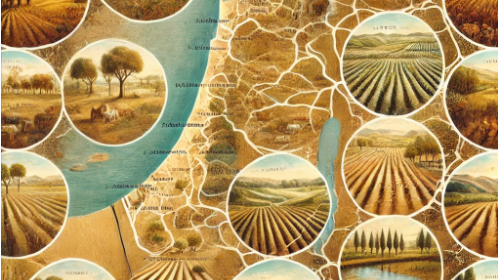
The Division of the Land Among the Twelve Tribes (Joshua 13–21)
"So the Lord gave Israel all the land he had sworn to give their ancestors, and they took possession of it and settled there. The Lord gave them rest on every side, just as he had sworn to their ancestors. Not one of their enemies withstood them; the Lord gave all their enemies into their hands."
(Joshua 21:43–44)
In the first half of the Book of Joshua, God is portrayed as a warrior fighting for Israel. In the latter half, however, God is depicted as the owner of the land, distributing it as an inheritance to His people, Israel. God had promised Abraham, the ancestor of Israel, the land of Canaan, yet at that time Abraham’s total possession was the cave of Machpelah in Hebron, which he purchased for four hundred silver shekels to bury his wife. Yet God promised to give Abraham countless descendants, like the stars of the sky, and to give the land of Canaan to his offspring.
The children and the land promised to Abraham are inseparably linked: the children inherit from the father, and the father bequeaths a legacy to the children. During the Exodus, God referred to Israel as “my son” and promised to give them the land of Canaan as an inheritance. God giving the land to Israel serves as a tangible sign that He has adopted Israel as His son.
God Commands the Division of the Land (13:1–7)
The land God intended to give Joshua was far larger and more extensive than the territory Joshua had already conquered and occupied. Therefore, further battles were still required. However, the pressing matter was that Joshua was old. Distributing the land was even more important than conquering it. This task involved many variables, and disputes could arise that might threaten Israel’s unity. Therefore, only a servant of God with absolute divine authority, like Moses or Joshua, could undertake such a task. Moreover, God’s gift of the land was not merely a simple present but an inheritance reflecting the deep, inseparable relationship between father and son.
The Land East of the Jordan and the Boundaries of the Two-and-a-Half Tribes (13:8–33)
The land captured from Sihon and Og by Moses was assigned as an inheritance to the tribes of Reuben, Gad, and the half-tribe of Manasseh. This territory, from the Golan Heights to Mount Hebron, corresponds to the present-day Jordan region and was well-suited for grazing livestock. The two-and-a-half tribes faithfully fulfilled their promise: although they settled in this land first, they actively participated in the conquest west of the Jordan and only returned to their inheritance after the other tribes had received and settled their portions.
The Division of the Land West of the Jordan (14:1–5)
The distribution of the land west of the Jordan began. This land is a gift from God to His people. It is divided by casting lots, according to God’s will, not by human calculation or the law of the strong. Even within each tribe, clans received their own allotted portion—an inheritance that could not be sold or transferred.
The text also suggests that individual merit and personal effort could influence the assignment of land to some extent. The story begins with Caleb receiving his inheritance and concludes with Joshua receiving a town in the territory of Ephraim. Joshua is later buried in this town, which he acquired in recognition of his faithful service, based on God’s instructions.
Designation and Purpose of the Cities of Refuge (20:1–9)
God established the cities of refuge to protect human life. If a person killed someone intentionally or out of personal anger, the victim’s avenger had the right to demand justice. However, if the killing was accidental, the person could seek protection and a fair trial. Ultimately, the cities of refuge were designed to preserve life according to God’s will.
Six cities were designated: three east of the Jordan and three west, each accessible within a day’s journey from anywhere in Israel. Those who fled to a city of refuge could live there safely until the death of the high priest, after which they could return to their home. This provision foreshadows Christ’s atoning work, by which our sins are forgiven, and we can enter the eternal homeland of God’s kingdom.
Reflection: Promise Fulfilled and Israel’s Rest (21:43–45)
Looking back on the Book of Joshua, we see that God fulfilled the promises He made to the ancestors of Israel. He granted His people the land He promised and gave them victory over all their enemies. By possessing the land, the Israelites experienced rest. God continues to offer rest to His people, a concept expanded in the New Testament to include the ultimate salvation at the end of time.
The message of Joshua remains deeply relevant today. Just as God gave Israel their inheritance, we too can discover our purpose and identity through our relationship with God. In our respective callings, we should use the gifts and responsibilities God has entrusted to us, participating as members of a community. Furthermore, we must recognize the value and significance of what God gives, passing on both material and spiritual inheritance to the next generation. As our lives reflect God’s promises and we cultivate a supportive community, our relationship with God deepens, allowing us to experience a fuller, more abundant life.
|