Rail & Labor News from RWU
| | Weekly Digest Number 33 - August 12, 2025 | | Welcome to the RWU Rail & Labor News! This news bulletin is produced and emailed out each Tuesday morning. We hope you find each week's news and information useful. If so, please share with co-workers, friends, and colleagues. If you like, you can sign them up to get all the news from RWU HERE. Or forward them the link. Got a hot tip? Please forward the article and a link to raillabornews@gmail.com. Note: If you read over this news bulletin each week, you will be sure to never miss the important news of what is going on in the railroad world from a worker's perspective! | | THIS WEEK'S RAIL AND LABOR NEWS | | Editor's Note: Not surprisingly, Railroad Workers United has officially taken a strong position against the proposed merger of corporate rail giants Union Pacific and Norfolk Southern. While some rail unions have issued statements, most union officials have simply stated their "concerns" rather than condemn the merger. RWU hopes to galvanize a movement of unions, shippers, passengers and others to stop this merger. | |
Railroad Workers United / August 11th
The group Railroad Workers United (RWU) has issued a formal Resolution and statement opposing any and all mega-rail mergers such as the one under question in recent weeks between rail giants Union Pacific and Norfolk Southern. Should that merger move forward and be condoned by the U.S. government, RWU notes that the remaining two Class One railroads, BNSF and CSX, would in effect be forced to amalgamate as well, resulting in just four major rail corporations controlling not just the industry, but the infrastructure as well. Upwards of 90% of the rail traffic of North America will be controlled by these four corporations.
According to RWU General Secretary Nick Wurst, “In no other countries in the world outside of North America do huge rail corporations not just run the trains, but own the tracks, yards, signals, shops and other infrastructure. Allowing a handful of privately held, extremely wealthy and powerful corporations, unaccountable to no one but the shareholders is not in the interest of railroad workers, passengers, shippers, trackside communities nor the nation as a whole.”
| | Editor's Note: As with most complex proposals, details like this are starting to emerge that might just create a complex web of snafus for the proposed merger of UP and NS. Look for more behind-the-scenes issues to come up as time goes by. | |
Freight Waves / August 4th
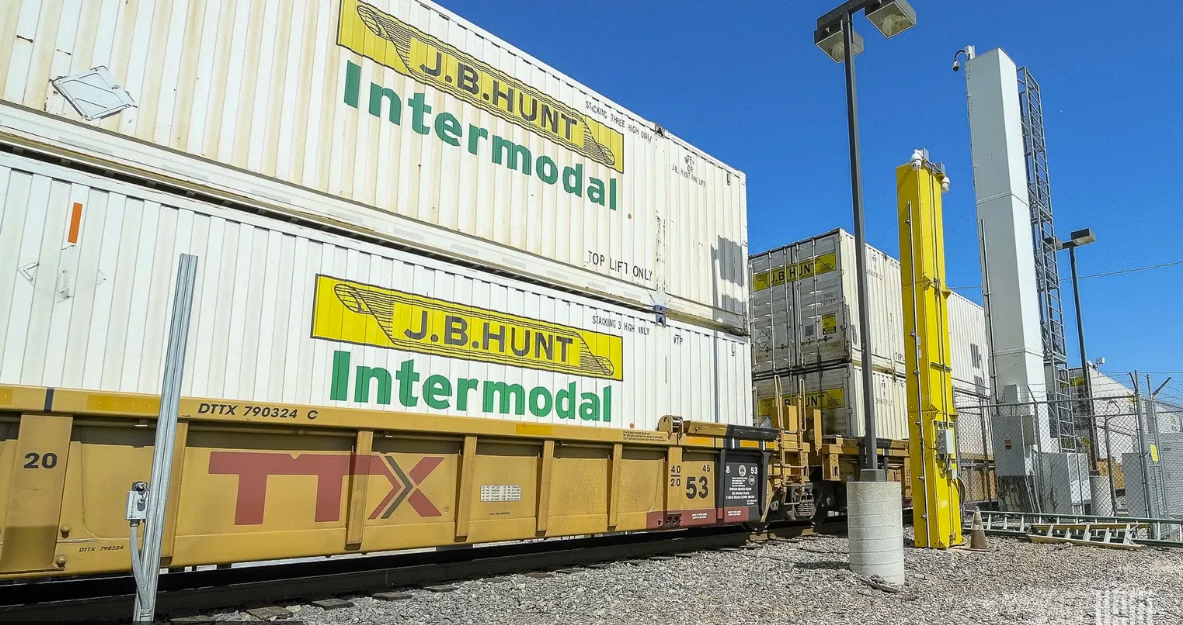
The proposed Union Pacific-Norfolk Southern merger leaves three major intermodal customers — J.B. Hunt, Schneider, and STG Logistics — in the awkward position of having their tents pitched in the wrong railroad camps.
J.B. Hunt, the largest domestic truckload intermodal operator, uses BNSF Railway in the west and relies primarily on Norfolk Southern (NYSE: NSC) in the east. Containers for third-ranked Schneider and number four STG Logistics ride Union Pacific (NYSE: UNP) and CSX (NASDAQ: CSX) trains.
This leaves the companies unable to tap the benefits of coast-to-coast single-line service should the merger receive regulatory approval. Rival and second-place Hub Group (NASDAQ: HUB) sits in the sweet-spot, using UP and NS.
| | Editor's Note: It appears at this point that most shipper groups are either very concerned about the proposed merger or have come out officially against it. | |
Trains Magazine / August 6th
The Freight Rail Customer Alliance today said that it’s opposed to the Union Pacific-Norfolk Southern merger, arguing that the transcontinental combination would lead to higher costs and unreliable service.
The umbrella group, which represents more than 3,500 electric utility, agricultural, chemical, and alternative fuel companies, called for “guaranteed competitive solutions” for carload and unit train shippers.
“In the end, shippers, particularly captive shippers, need guaranteed competitive solutions that are workable, effective, and enforced by the STB,” Emily Regis, the group’s president, said in a statement. “Even if this imperative can be achieved in a transcontinental merger, there are concerns about how long it would take for the improvements to be successfully implemented and whether the integration problems and service meltdowns of past mergers can be avoided."
|
| Editor's Note: As we do not have many details at this point it is hard to comment on this tragic situation. We hope to have more details soon. | |
Trains Magazine / August 6th
A BNSF worker was seriously injured in a derailment at the company’s Globemaster Yard in Denver today (Aug. 5, 2025), KMGH-TV reports. The injury led to amputation of his right leg.
The National Transportation Safety Board announced it will investigate the incident.
The Denver Fire Department reported on social media that the worker was injured when trapped by the derailed car; firefighters freed the individual and prepared for transport with severe injuries. The incident occurred about 12:13 a.m. A representative of the Association of Sheet Metal, Air, Rail, and Transportation Workers-Transportation Division (SMART-TD), the union representing conductors, confirmed to the TV station that the worker had undergone an amputation.
| | Editor's Note: At this point it is not clear if the speed restricted territory had anything to do with this wreck. Was the speed not reduced enough for the defect found? Was the autonomous track inspection vehicle in error? Would a live human being been better able to detect the track defect that might have led to this derailment? | |
Trains Magazine / August 5th
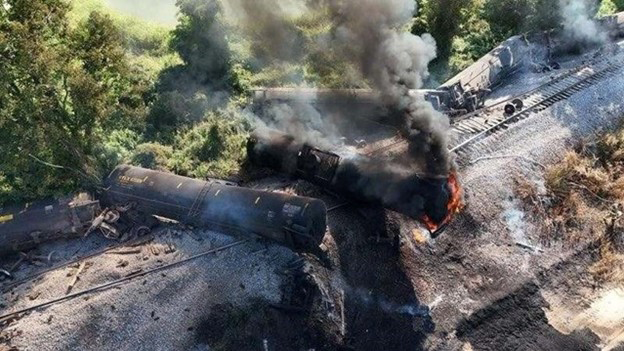
The location where a Canadian National train derailed in Glendora, Miss., was under a 30-mph speed restriction following work to address track defects found by an autonomous track inspection vehicle, according to the National Transportation Safety Board’s preliminary report on the July 5, 2025, incident issued today (Aug. 5, 2025).
A tank car of benzene, among 22 cars that derailed, caught fire, forcing the evacuation of about 160 residents in a 1-mile radius [see “CN derailment in Mississippi …,” Trains.com, July 5, 2025]. The derailment occurred about 2:26 p.m.; the evacuation order was lifted shortly after the fire was extinguished about 11:30 p.m. No injuries or fatalities were reported; CN estimated damages at about $1.5 million.
The train involved was en route from Memphis, Tenn., to Baton Rouge when it derailed at milepost 97.63 of CN’s Yazoo Subdivision. Twenty-three of its 139 cars carried hazardous materials. The train was traveling about 29 mph at the time of the derailment, which involved cars 29 through 50.
| | Editor's Note: Great to see that OSHA is still able to levy big fines against rail corporations who violate the law and rail workers rights. Tragically however, once a rail worker wins a case such as this, the carrier generally appeals to the courts and drags the case out, sometimes for years. We will try to keep tabs on what happens to this one. | |
Department of Labor / August 6th
A federal whistleblower investigation found that Union Pacific Railroad Co. violated the Federal Railroad Safety Act by terminating a railroad engineer after the employee reported and sought medical care for a work-related injury.
The department’s Occupational Safety and Health Administration has ordered Union Pacific to reinstate the employee, and pay back wages, interest, compensatory and punitive damages, and attorney’s fees, totaling over $300,000.
OSHA’s Whistleblower Protection Program enforces 25 whistleblower statutes that protect employees from retaliation for reporting violations of various workplace safety and health, airline, anti-money laundering, commercial motor carrier, consumer product, criminal antitrust, environmental, financial reform, food safety, health insurance reform, maritime, motor vehicle safety, nuclear, pipeline, public transportation agency, railroad, safety and health, securities, and tax laws.
| | Editor's Note: The Wheeling & Lake Erie Railway is one of the biggest regional railroads in the U.S. Our main concern with this corporate takeover is how the new company will relate to the union. BLET #292 has waged one of the more gallant fights in recent years, staving off management's endless attempts to run trains with a single person crew. The members have been steadfast in their opposition to management's attempts, and they deserve the full support of all rail labor. RWU will keep our ear to the rail and stand ready to aid in any way we can should the new owners make any attempt to implement single person train operations. | |
Freight Waves / August 6th
The Wheeling & Lake Erie Railway — at 840 miles the largest independent regional railroad in the U.S. — is being acquired by FTAI Infrastructure in a billion-dollar deal, the companies announced today.
FTAI ( NYSE: FIP), which owns short line and terminal switching operator Transtar, will pay The Wheeling Corp. $1.05 billion to acquire the regional railroad created from lines that Norfolk Southern spun off in 1990. FTAI is managed by an affiliate of Fortress Investment Group.
The Class II W&LE serves more than 250 customers in Ohio, Pennsylvania, West Virginia, and Maryland. The W&LE connects to Transtar’s Union Railroad in the Pittsburgh area.
| | Editor's Note: A number of passenger rail advocacy groups such as Virginians for High Speed Rail present various webinars explaining how passenger rail can be developed and improved. Well worth watching! | |
Virginians for High Speed Rail / August 21st (12pm CT)
Our 2025 VHSR Virtual Town Hall Series will bring together an influential collection of presenters to give you an update on how passenger rail is doing across Virginia and the nation.
August 21 2025: Unlocking the Northeast Corridor with Jim Short, Acting Senior Vice President of Capital Delivery, Amtrak
| | Editor's Note: The National Industrial Transportation League has come out opposed to any further rail company mergers, including the recent UP-NS merger announced last week. They - just like us rail workers - have a lot to be skeptical of given the morbid record of Class One mergers of the last three or more de | |
Trains Magazine / July 31st
The National Industrial Transportation League said today that rail shippers will not support a transcontinental railroad merger unless it’s accompanied by improvements in service, pricing, and competition.
“Despite the promises that rail customers would benefit from mergers through more efficient service, in reality captive rail customers must pay increasingly higher prices for unreliable and inadequate service,” the organization said in a statement issued just two days after Union Pacific announced an $85 billion deal to acquire Norfolk Southern.
‘Further consolidation of the industry will boost railroad profits and benefit Wall Street at the expense of shippers, especially captive rail customers,” the group said.
| | Editor's Note: Sen. Markey (and staff) has been a leader on rail electrification and this bill at least keeps the conversation alive in spite of AAR's hostility to the shift in motive power. The high-speed aspect is a sideshow but regardless step one is electrification. | |
Office of Sen. Markey / July 31st
Senator Edward J. Markey (D-Mass.), member of the Committee on Commerce, Science, and Transportation, and Representative Chris Deluzio (PA-17), member of the Committee on Transportation and Infrastructure, today reintroduced the All Aboard Act, legislation that would dedicate $200 billion over five years to build high-speed rail, expand existing passenger rail service, and electrify the most heavily polluting railyards and corridors. The legislation includes critical labor protections for the existing union labor workforce and creates a rail personnel training grant program for rail workers. The investments made under the All Aboard Act would make Massachusetts’ rail dreams a reality by turbocharging West-East Rail and revolutionizing the Northeast Corridor.
“The All Aboard Act would build the high-speed transportation system of the future and do it with union labor,” said Senator Markey. “By investing billions in America’s rail network, we can drive down emissions, make our communities more connected, and create union jobs. That is a future all Americans are on board with.”
| | Editor's Note: Many rail Train and Engine (T&E) crews work daily, concerned that their train will hit pedestrians and/or motorists, with nothing they can do except throw the train into emergency, say a prayer, and then deal with the aftermath. It should be the responsibility of the employer to do what they can do prevent these collisions and ensure the health, safety and well-being of their employees. | |
LA Times / August 1st
About 10 times each day, giant freight trains pass along a narrow section of track along the Sacramento River in far northern California where engineers on the locomotives regularly tense up with stress.
“Every single time, it’s a near miss” of a train hitting a person, said Ryan Snow, the California state chairman of the Brotherhood of Locomotive Engineers and Trainmen. “Multiple near misses, every single run. My nightmare is that a family that isn’t paying attention gets hit.”
This particular stretch of track, which wends north from the town of Dunsmuir, is a renegade route for hikers to one of northern California’s most enchanting natural sights, Mossbrae Falls. Fed from glaciers on Mt. Shasta, the water pours out of lava tubes and down mossy cliffs, forming a verdant and ethereal cascade into a calm, shaded swimming hole.
| | Editor's Note: Build it and they will come. There are a number of successful "corridors" in the U.S. where passenger trains have been revived and been extremely successful at getting people out of their cars and onto the rail. Check out this upcoming webinar. | |
High Speed Rail Alliance / September 12th (1pm CT)
Amtrak Cascades Intercity Passenger Rail is part of the Federal Corridor Identification & Development Program, with potential for vastly improved service linking Vancouver BC, Seattle, Portland, and Eugene, Oregon. In this talk, you can hear from local passenger rail advocates about the Cascades service and their campaign to accelerate the work to increase frequency, reliability and faster trip times. Advocates will also discuss how a robust Amtrak Cascades regional service fits in with concurrent planning for high-speed service. Join us to learn how rail service in the Northwest corridor could rival the Northeast corridor in its popularity and efficiency and how advocates for the Cascades service can work with other transportation leaders to accelerate much needed mode shift across the region in both passenger and freight rail.
| | Editor's Note: Chicago is the rail capital of the U.S. and in fact the world. But it has been a tangled inefficient mess for years. The big question for decades has been what to do to make rail traffic from east to west more streamlined. Would the UP-NS merger assist here? Or make things worse? | |
Railway Age / August 1st
According to recently published statements made by Union Pacific CEO Jim Vena, we need a transcontinental rail merger to dramatically improve rail service by eliminating what Vena claims are the allegedly “inefficient and time-consuming interchanges (or hand-offs) that occur in Chicago between east and west networks.” Vena’s merger solution would (in his words) “eliminate the inefficient and time-consuming interchanges that occur at Chicago between Eastern and Western railroads.” He subsequently defined the problem as one of taking “24 to 36 hours to hand off freight cars in Chicago,” which is down somewhat from his original estimate of 2-3 days.
However, for the sake of clarity, it should be noted that the current figure of 31 hours terminal transit time has been officially endorsed by the Chicago Metropolitan Agency for Planning (CMAP) for use in its 2050 Comprehensive Long-Range Plan (originally released in 2018). According to CMAP, “The Plan’s targets reflect a return to 2016 conditions by 2025, and cutting the remaining transit time, less yard dwell time, in half by 2050. The amount of time trains spend in classification yards is beyond the control of any CMAP policy recommendations, so the targets focus solely on decreasing the time spent traveling to and from them. 2025: 27.0 hours or shorter carload transit time; 2050: 24.5 hours or shorter carload transit times.”
| | NEWS FROM AROUND THE LABOR MOVEMENT | | Each week, RWU includes a few articles about advances and developments in the larger labor movement that are of interest to railroad workers. Got an artcile to submit for possible inclusion next week? Email it along to raillabornews@gmail.com. Thank you! | | Editor's Note: The Steering Committee of Railroad Workers United (RWU) voted at the August monthly meeting to formally endorse the efforts of the May Day Strong Coalition. We encourage all rail workers to take part in your local Labor Day events this year! | | |
Our Demands to Build the Society We Deserve:
- Stop the billionaire takeover corrupting our government.
- Protect and defend Medicaid, Social Security, and other programs for working people.
- Fully funded schools, and healthcare and housing for all.
- Stop the attacks on immigrants, Black, indigenous, trans people, and all our communities.
- Invest in people not wars.
| | Editor's Note: The group Truckers Movement for Justice featured in this article is an ally of Railroad Workers United. | |
Liberation News / August 2nd
Last month, Trump’s executive order intensifying English language requirements for truck drivers went into effect. The process for how truckers will now have to prove their proficiency in English is unclear and non-standardized, leaving the interpretation of these new requirements up to the individuals who assess the drivers. Some truckers who have hauled freight for decades will be subjected to these tests, and may be put out of service because they have a more pronounced accent, or are not “fluent enough” in the subjective opinion of the individual inspecting their language skills.
English language requirements for truckers are not new. The Interstate Commerce Commission introduced core regulations in 1936 and 1937; and in 1970 English language proficiency requirements were refocused towards reading and writing. Towards the end of Obama’s second term, the Federal Motor Carrier Safety Administration once again refined the language requirements, with safety-critical communication taking precedence over conversational fluency.
| | Editor's Note: Not since President Ronald Regan broke the air traffic controllers union more than 40 years ago have we seen anything like this. Hundreds of thousands of union workers - many who work at Veterans Hospitals around the country - stand to lose their union rights and working conditions. | | |
Common Dreams / August 7th
Days after the Trump administration said in federal court that it would not move ahead with its plan to end collective bargaining agreements for more than 400,000 government employees until litigation on the issue concluded, the largest federal employees union on Wednesday pledged to fight back against the secretary of veterans affairs' decision to move forward with slashing labor protections.
Secretary of Veterans Affairs Doug Collins notified the American Federation of Government Employees (AFGE) and several other unions that he was implementing an executive order signed by President Donald Trump, which required the termination of collective bargaining agreements for agencies whose missions are related to national security.
Labor protections, including those that ensure work disputes can be resolved by a neutral party and that union leaders can take part in contract negotiations, would be eliminated for more than 400,000 employees at the Department of Veterans Affairs (VA) under the executive order.
| | WEEKLY DERAILMENT DEPARTMENT | | Each Tuesday in this news bulletin, RWU does our best to present a picture of what has been happening over the course of the previous week in terms of derailments in North America, and investigation determinations of previous accidents. NOTE: This list is by no means comprehensive. Smaller and less consequential mishaps are generally not reported here. If the wreck results in injury or fatality, or is especially damaging/extreme, a full article will appear as a feature in the dozen or so rail articles above. Know of a train wreck? Please feel free to forward a link to raillabornews@gmail.com for possible inclusion next week. Thanks! | | | | |