View as Webpage

If you’ve ever participated in the special education eligibility process, you know the team must determine if a student requires specially designed instruction (SDI). After a student is found eligible, the collaborative process of determining and designing SDI begins. An Individualized Education Program (IEP) is created and reviewed at least annually to meet their individual needs. Annual goals are written to address areas where a student requires SDI and service minutes are determined to support the attainment of these goals. Once the IEP is agreed upon, teachers and related service providers begin designing and delivering SDI. As reviewed in the September issue of Link Lines, there are many players who help plan and deliver SDI. But with all the instructional practices and interventions happening during the school day, how do teachers ensure their instruction is SDI?

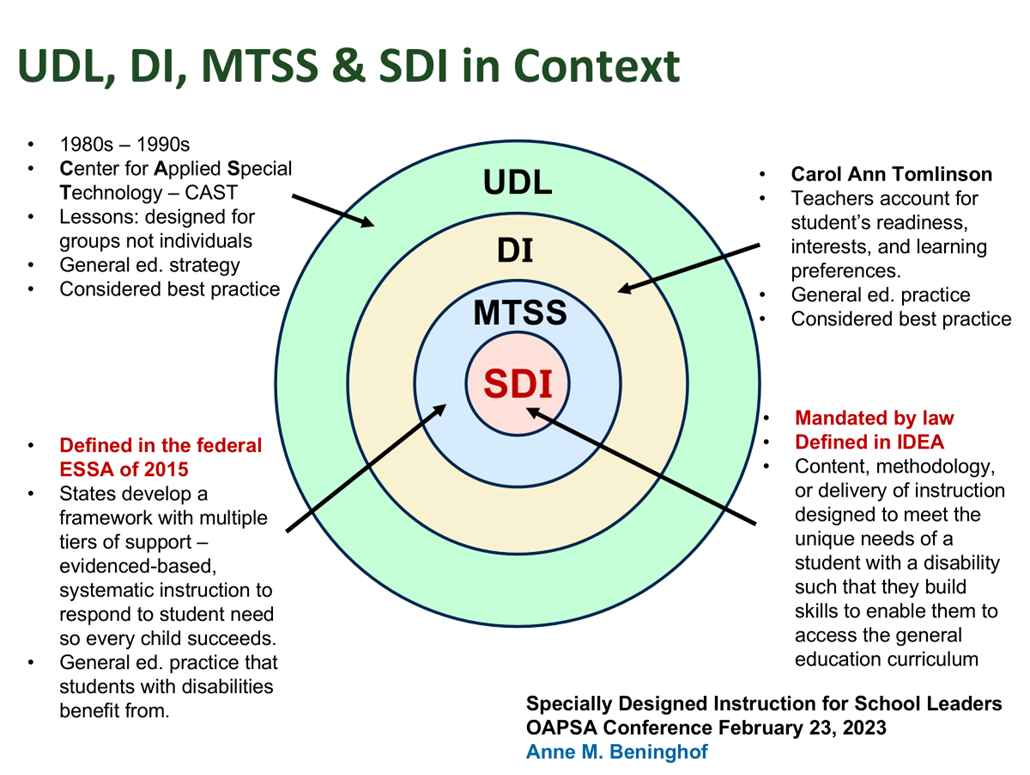
There are a variety of frameworks (and acronyms) involved with instructional design. Students with disabilities are general education students first and benefit from practices such as Universal Design for Learning (UDL) and Differentiated Instruction (DI). Students with disabilities may also receive support under a school’s Multi-Tiered System of Support (MTSS) even after they have qualified for special education services. Qualifying for special education opens another layer of instructional support, one that is required for them to access the curriculum. The concentric circle diagram below illustrates how SDI fits within these other frameworks.

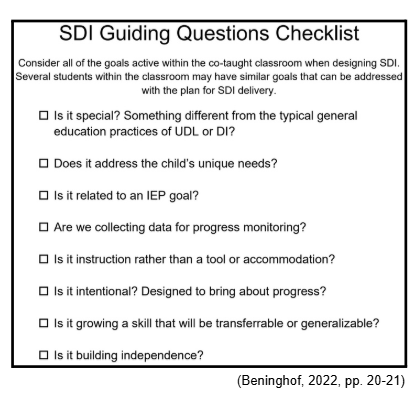
When general and special education teachers meet to plan a lesson, they will need to determine when SDI is necessary and then design the SDI that will be implemented during the lesson. To help give clarity to that process, teams may want to consider a tool like the SDI Guiding Questions Checklist. This tool provides a set of questions to consider during instructional planning to make sure the instruction being designed is SDI and not one of the other instructional frameworks. It can be used in a variety of ways during the planning process.

Teachers may want to have a copy available during in-person co-planning time to guide conversations while brainstorming a new lesson. If teachers do not have regular common planning time, they may want to use the checklist to adapt a lesson plan on a shared virtual planning document. However it is implemented, this checklist can help add clarity and focus to ensure that teaching teams are designing SDI that is appropriate for their students. 


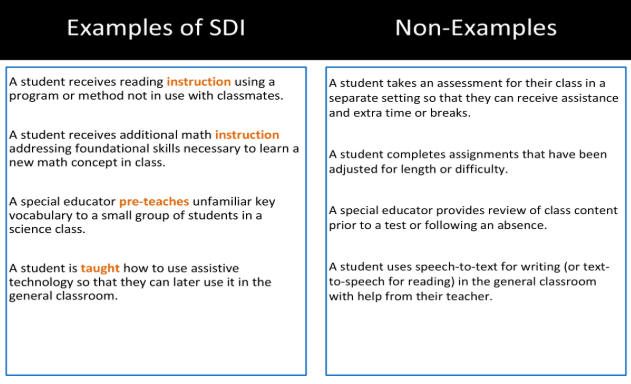
Using a tool like this can also help teachers avoid common misunderstandings about SDI. For example, providing a graphic organizer to a student may be an appropriate accommodation during a writing assignment. However, there are more steps to consider for this to qualify for SDI. Teachers need to consider what instruction the student requires in order to use that graphic organizer and if it is related to an IEP goal. The chart below outlines a few more examples and non-examples of SDI to consider. 

Students with disabilities require SDI in order to make progress but, with all the other instructional frameworks available, it can be challenging to determine when a lesson plan includes SDI. Using a tool like the SDI checklist can ensure that students are able to participate in the general education curriculum and are getting the instruction they need to make meaningful progress (Lee, n.d.). To further your understanding of SDI, consider viewing the recording of the SDI training provided by Anne Beningof and exploring the resources provided. 

Resources:


References:

Beninghof, A. M. (2022). Specially designed instruction: Increasing success for students with disabilities. Routledge.


Lee, A. M. I. (n.d.) Endrew F. case decided: Supreme court rules on how much benefit IEPs must provide. Understood. https://www.understood.org/articles/endrew-f-case-decided-supreme-court-rules-on-how-much-benefit-ieps-must-provide

Facebook  Twitter