You are receiving this newsletter because you are enrolled in the WECA Food Program. | |
November 2025
Stay connected: Check out our current staff directory here.
| | Your Monthly News & Updates | | |
Food Program Anniversaries in November
5 years: Latrice Higgins, Stephanie Kummer
15 years: Courtney Beth Zielinski
20 years: Tonya Eagan
35 Years: Joan Marciniak
We applaud your commitment to serving nutritious meals and snacks to the children in your care!
| |
Welcome to the Food Program Office Team!
Stephanie Robers is joining the Food Program’s office team! She was raised in Kenosha and currently resides in Racine. She's a huge baseball fan – especially the Cubs and the Yankees. Stephanie loves all things FALL, and yes, that means pumpkin spice and New Orleans Saints football! In her free time, she spends a lot of time watching her niece and nephew play sports, fixing up a 100-year-old house and traveling to Disney parks as often as possible.
Stephanie has worked at WECA since May 2022. She loves talking with people, hearing about their journeys in early childhood, and cannot wait to meet everyone!
| | |
Ask the Food Program
Question:
With days off of school coming up, I expect to have my school-aged child care children in care all day. I think I need to document when they are present during the time they would usually be in school. How do I do this?
Answer:
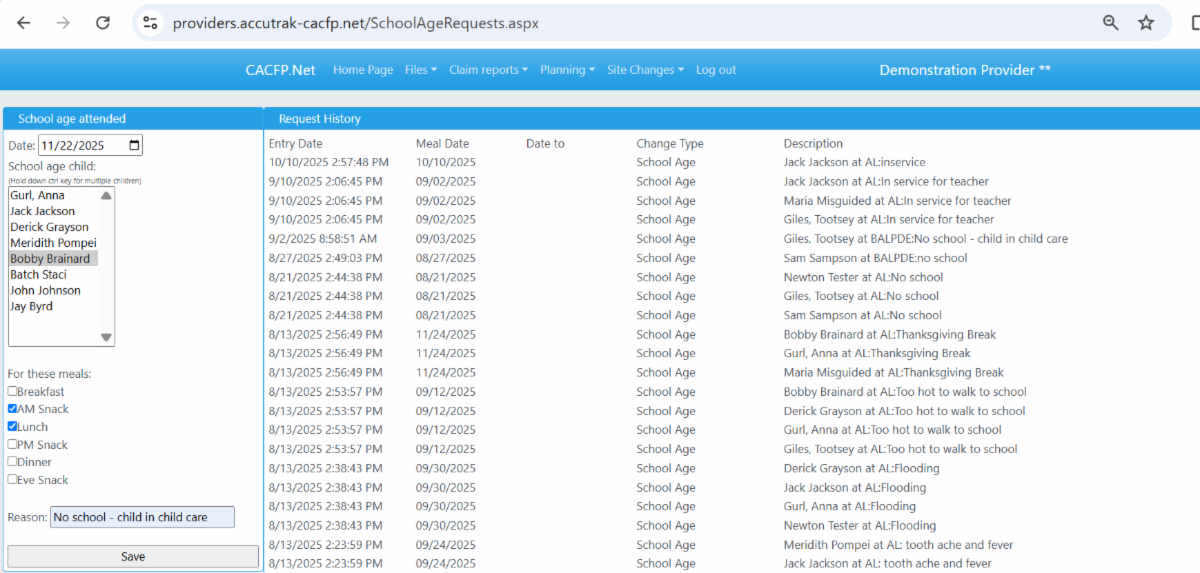
When you claim meals or snacks for school-aged children who typically are served during their school hours, such as A.M. Snack or Lunch, you must let the Food Program know why they are in child care. Log into CACFP.Net https://providers.accutrak-cacfp.net/Login.aspx?ReturnUrl=%2f
Under Site Changes select School Age Requests:
| | Select the date, the name of the child from those enrolled in care and click the meals and snacks. Add a statement about why the child is in care, such as “No school,” as shown below. Be sure to save changes. | | |
This information will be sent electronically to the Food Program.
You must be logged into the current version of CACFP.Net to access this feature. All menu and attendance information should be recorded in this version of CACFP.net.
Without this information on file, meals and snacks served to school-aged children during school hours from September through May could be disallowed. Note that school-aged means 5 years and older.
| | |
Grain-Based Desserts
Baking for the holiday season? Remember that grain-based desserts are not creditable on the Food Program. Find out the difference between a grain-based dessert and other foods, like muffins and breads, which are creditable on the Food Program.
| | |
Milk on CACFP: Test Your Knowledge
Must be served at all mealtimes:
_____ True _____ False
Must be pasteurized:
_____ True _____ False
Non creditable when used in cooking:
_____ True _____ False
Children 2 – 5 years must be served unflavored skim of low fat (1%) milk:
_____ True _____ False
Families may request nutritionally equivalent non-dairy substitutes in replacement for cow’s milk for disability or non-disability-reasons:
_____ True _____ False
Must be served as a beverage, poured over cereal, or a combination:
_____ True _____ False
Did you know?
Fluid milk used in smoothies can credit toward the milk requirement. A portion of smoothie must contain at least ¼ C of daily milk of the proper fat content.
For more information about milk on the CACFP, consult the Crediting Handbook for the Child and Adult Care Food Program. For answers: Scroll to the bottom of this month's newsletter!
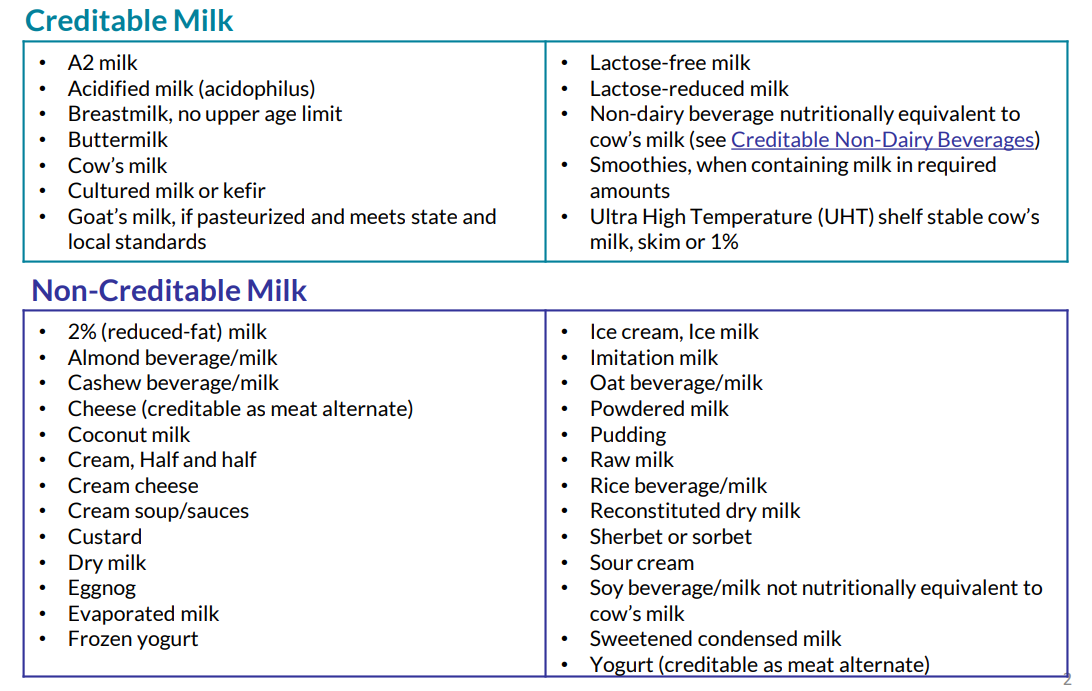
| Source: CACFP Creditable and Non-Creditable Foods Guide 1-18 Year Olds and Adult Participants in Adult Daycare Centers. (https://dpi.wi.gov/sites/default/files/imce/community nutrition/pdf/creditable_non_creditable_foods_guide.pdf) | | |
Creditable and Non-Creditable Cheeses
Natural cheese, cheese food, cheese product: What’s the difference? This handout from DPI is a handy guide to creditable and non-creditable cheeses.
Remember: Cheese food and cheese spread are not creditable for infants.
| |
|
Food Program Open Office Hours
Have Food Program questions? We’re ready with answers! We recently launched office hours to help you with your CACFP-focused questions! Each virtual session has a topic for discussion, which is followed by an open forum for any questions you have. Held the first and second Wednesday of the month from 1-2 p.m. on Microsoft Teams, which is a platform similar to Zoom. Virtual meeting details are below!
Office Hours Offered in English
Second Wednesday of every month | 1-2 p.m.
Meeting ID: 266 968 289 946 6
Passcode: Kg3x4MJ6
Dial in by phone
+1 715-598-9883,,702555838# United States, Eau Claire
Phone conference ID: 702 555 838#
| |
Office Hours with Spanish Interpretation
First Wednesday of every month | 1-2 p.m.
Registration is not required, and this link will stay the same every month.
Meeting ID: 234 627 533 377 6
Passcode: wJ75Di2D
Dial in by phone
+1 715-598-9883,,592087910# United States, Eau Claire
Phone conference ID: 592 087 910#
| | | | |
Documenting a Child’s Special Diet
Special Diet forms are required whenever a child in your care can’t be fed according to CACFP guidelines.
Documents to Complete for Disability Related Special Dietary Needs Requests: “A physical or mental impairment that substantially limits one or more ‘major life activities’ including care for oneself, performing manual tasks, eating, breathing, digestive, bowel and bladder, neurological, respiratory, circulatory, and endocrine functions.”
- Special Dietary Needs Tracking Form Section 1: Disability (For Providers to Complete)
- Medical Statement (For Licensed Health Care Professionals to Complete: Physician, Physician Assistant, Nurse Practitioner (APNP), Dentist, Registered Dietician, Optometrist, Podiatrist)
Documents to Complete for Non-Disability Related Special Dietary Needs Requests: i.e., for preference, including religious or ethnic preferences, or lifestyle reasons.
- Special Dietary Needs Tracking Form Section II. Non-disability Special Dietary Need (SDN) Request (For Providers to Complete)
- SPECIAL DIET FORM (For Providers to Complete)
-
When a parent requests an alternate milk due to preference, consult the Creditable Non-Dairy Beverages (Fluid Milk Substitute) for beverages that are nutritionally equivalent to cow’s milk.
YOU MUST REPORT EVERY SPECIAL DIET required for a child, whether Disability-Related or Non-Disability Related. It does not matter whether the meals are reimbursable or not.
- Work with the parent/guardian to obtain the appropriate documentation so appropriate and safe meals and snacks can be served to the child.
-
Submit the forms to jgiles@wisconsinearlychildhood.org for review and possible approval.
NOTE: Meals and snacks served to a child with a Special Diet between the date of discovery of the Special Diet and approval of the Special Diet (if it can be*) may be disallowed.
*NOT EVERY SPECIAL DIET CAN BE REIMBURSED.
| |
Foods On-Hand and Manufacturer’s Packaging
- During Home Visits, Area Coordinators verify food served to children in care meets CACFP requirements. Coordinators look in the refrigerator, in the freezer, and in the pantry to check for foods on hand, including whole grain-rich sources, iron-fortified infant formula and infant foods, proper fat content of dairy milk, and sugar content of yogurt and cereal.
- To do that, the foods offered must be kept in the original manufacturer’s packaging and cannot be decanted from that packaging to alternative storage such as plastic storage bags, store bins, or glass bottles. This includes foods or beverages provided by parents, such as iron-fortified infant formula per a Parent Provider Formula Agreement (but does not include breast milk) .
- Per guidance from DPI, when providers are found not to have foods on-hand from their reviewed menus during Home Visits, and there are repeated occurrences of that issue on subsequent Home Visits, the consequences for each occurrence will escalate. If unaddressed by the provider, this will result in disallowances of meals and snacks, either back to the first of the prior month or to the date of the previous Home Visit. This can eventually result in the provider being made Seriously Deficient.
Milk on CACFP quiz answers: All answers are true!
| | |
This institution is an equal opportunity provider.
The Provider Connection is published by the WECA Food Program.
Any Questions: Call 608-240-9880 or visit our website.
| | | | |