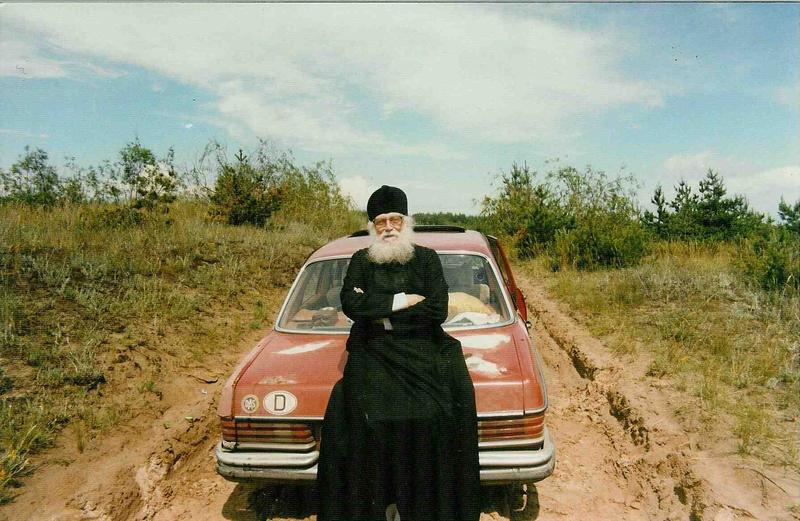
Remembering Bishop Basil
This Sunday we remember Bishop Basil (Rodzianko) who fell asleep in the Lord on September 17th, 1999.
Bishop Basil came to the United States from England in 1978 as bishop of Washington and of the Orthodox Church in America.
In January 1980, Bishop Basil was the first bishop to be consecrated at St. Nicholas Cathedral. He served briefly as Bishop of Washington and auxiliary to Metropolitan Theodosius. At that time, St. Nicholas became the National Cathedral of the Orthodox Church in America and Metropolitan Theodosius became Archbishop of Washington. The following year, Bishop Basil was confirmed as Bishop of San Francisco and the West. Following his retirement in 1984, he returned to Washington, continuing his special mission of religious broadcasting to Russia until his death in 1999. Reaching millions of listeners, these broadcasts played an important role in the rebirth of Christianity in the last decades of the Soviet Union. Bishop Basil served at St. Nicholas Cathedral, where his sermons would be recorded for broadcasting.
The grandson of Michael Rodzianko, who was president of the Russian Duma in the last years of the czarist regime, Bishop Basil was born in 1915 on a family estate at Ekaterinoslav in what is now Ukraine. He fled Russia with his family in 1920 after the Bolshevik revolution. They settled in Yugoslavia, where Bishop Basil, who was christened Vladimir, received a degree in theology from the University of Belgrade in 1937. Later, he did graduate study in theology at the University of London in connection with the Church of England.
Early in World War II, he returned to Yugoslavia, where in April of 1941 he was ordained a priest in the Serbian Orthodox Church. As he was performing one of his first liturgies, Nazi troops were invading Yugoslavia, and in the early period of the Nazi occupation he witnessed a massacre of Yugoslav civilians by Nazi soldiers on the banks of the Danube River.
For most of the war, he was a parish priest in a country village, where he also gave religious instruction to children and did volunteer work with the Red Cross. But in 1949, as he was leading a celebration of the Feast of St. Peter and St. Paul, he was arrested on charges of "illegal religious propaganda" by communist authorities who then ruled Yugoslavia.
He was sentenced to eight years at hard labor. But from his theology studies in London, he had friends in the Church of England who persuaded the archbishop of Canterbury to intercede on his behalf. After two years, he was released from his sentence. On the advice of the Serbian Orthodox bishop, he left Yugoslavia and moved to London.
When Nobel Prize-winning author Alexander Solzhenitsyn left the Soviet Union in 1974 after having been charged with treason against the state, he complimented Bishop Basil on his broadcasts.
In 1978, after the death of his wife, Maria, Bishop Basil took monastic vows. It was then that he received the name of Basil and was invited to come to the United States as bishop of the Orthodox Church in America.
He was known for the broadcasts on religious topics that he made from Britain and the United States to what is now Russia for more than three decades. The broadcasts by the Bishop, whose first name was originally Vladimir, were initially transmitted by the British Broadcasting Corporation during the cold war. His broadcasts had many listeners during the Soviet period and significantly contributed to the re-emergence of Orthodoxy in Russia.
He had a warm personality and an easy demeanor that made conversation easy with people from all walks of life.
In retirement he was author of a book on cosmology and theology (The theory of the Big Bang and the Faith of the Holy Fathers) in Russia, exploring what he believed to be the links between science and religion, and he continued to work in the fields of religious education and pastoral care in the United States and Russia.
In the latter part of his broadcasting career, his radio talks were transmitted by the Voice of America and Radio Vatican.
The prayerful remembrance of Bishop Basil will never run dry in those to whom the Lord gave the joy to see and hear him. One hopes that his spiritual exploit will become known, through books and films, to those who had not met him in his earthly life, and that this meeting with Bishop Basil will give them comfort and strengthen their faith and will ultimately lead to an increase in love.
May his memory be eternal!