Volume 20261122| November 22, 2026

Putting AI, People, and Engineering Evidence to Work. Plus a Free Black Friday Workshop.


Table of Contents:

  • From the MotorDoc: Who Checks the Answer?
  • Good Gosh Black Friday Workshop on AI
  • Tech Tip: Motor Load and ESA/MCSA
  • Evidence from the Case-Study Desk
  • EMPOWER and EMPATH
  • Chaos and Caffeine
  • One Useful Question for Your Next Team Meeting
  • Help a Colleague find MotorDoc

.


Adventures of the Week


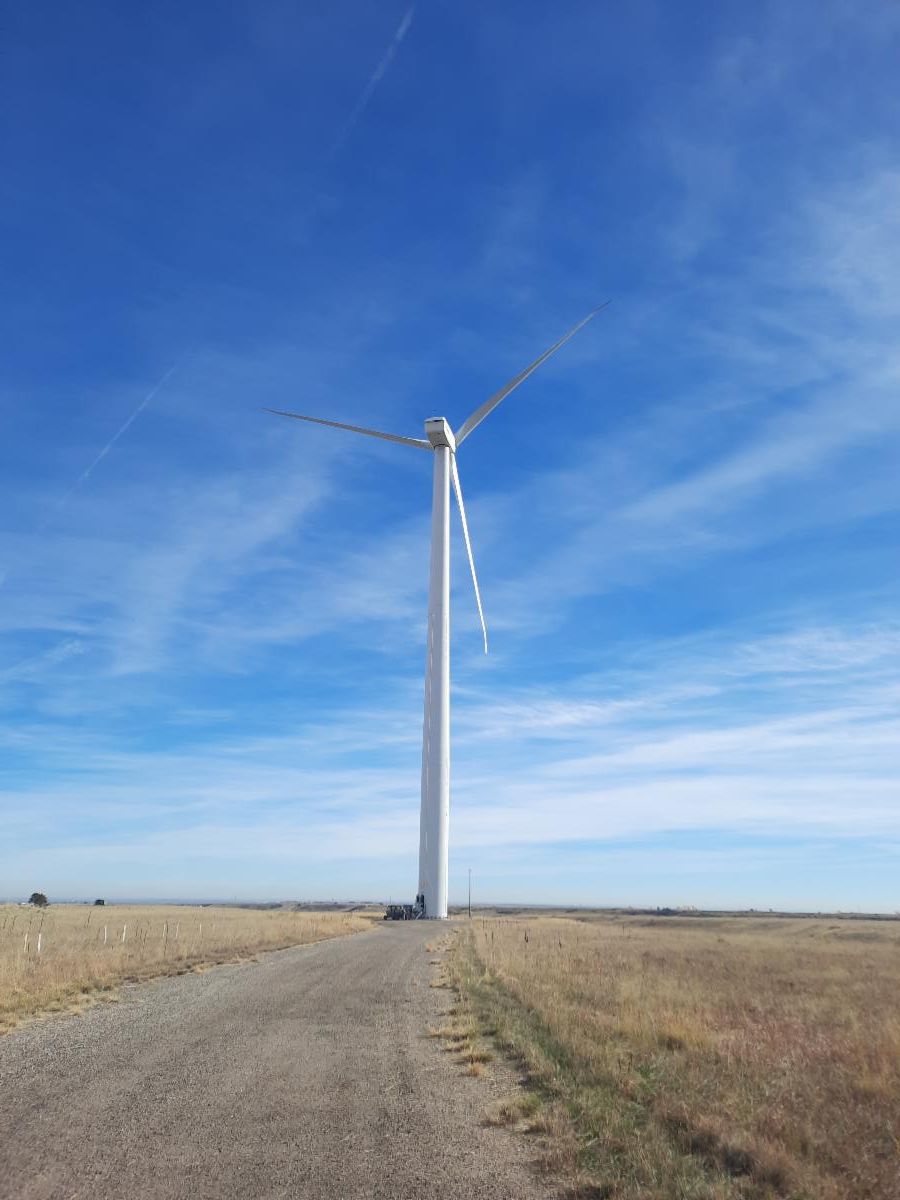
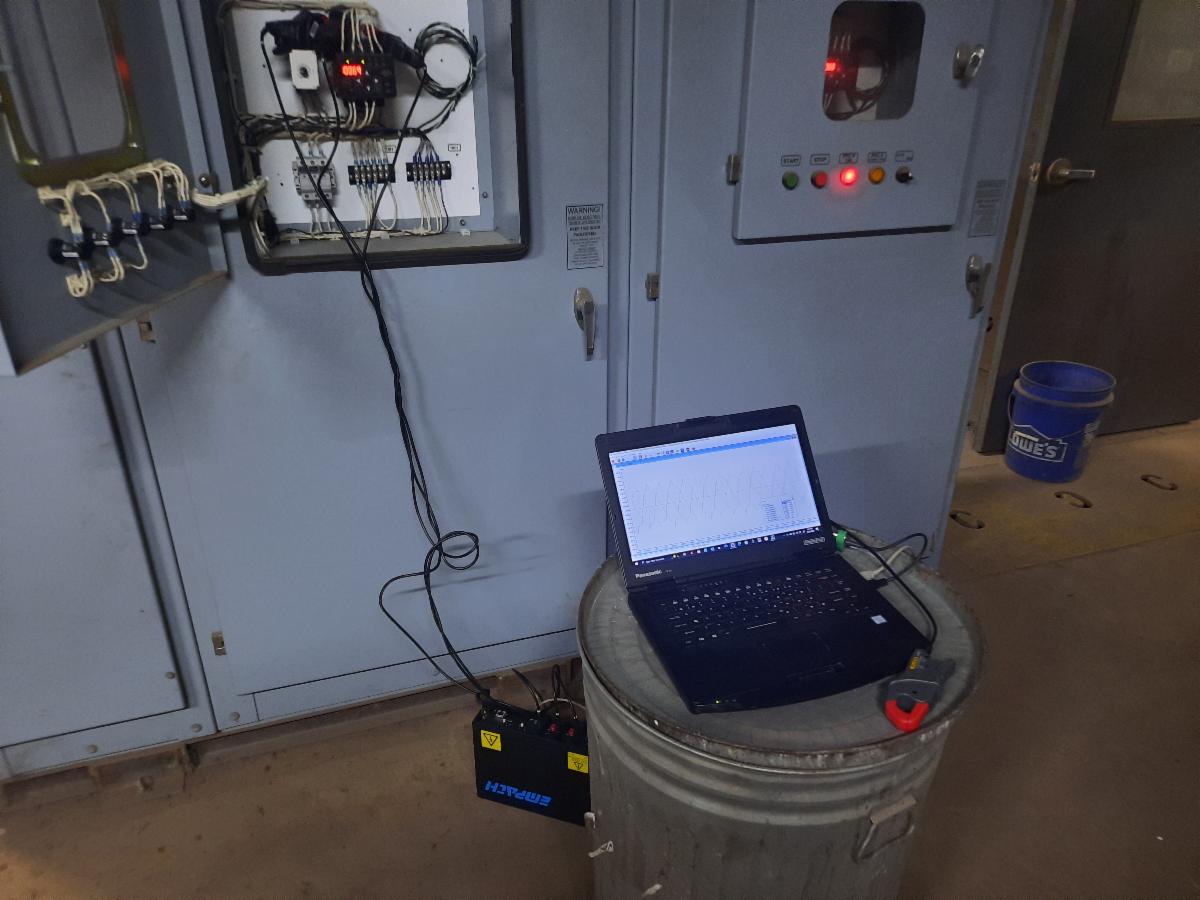
We had an excellent visit to the National Labs of the Rockies for the next stage in ESA/MCSA industry studies of wind in both utility scale and distributed energy (small) turbines. There was a lot of interesting results that we are continuing to complete before releasing them. This was a joint funded project (grant plus MotorDoc cost participation). The results were groundbreaking and potentially will shatter a few illusions related to impacts on the grid. Yeah. From field work versus opinion, we now have the evidence that we were right and not competing with bloggers and 'news' editorials in what should be engineering environments.


Stay tuned.


For this edition, however, it has been a VERY eventful few weeks, and not just by our industry. For one, the industry magazine article that some of the IoT industry had removed that was originally published in 2016 was prophetic. I get to tell them I told you so, and I still have the original. Yep, bypassing IT/OT in order to get a sale is a really bad thing. Asking the questions for cybersecurity is a really good thing. Shutting down government relations because it didn't fit the narrative of a few IoT companies, and pricing the 'give a crap' companies out of involvement, that provided support for members on ethics and governance in cybersecurity of our industries. Well a solid 'F**k you.' The results are clear - although the first thing done is blame the technicians who had no way of being informed. Well, that's politics too.


So, enough of the I told you so. We have changed our time investment for 2027 as we are involved in writing the actual standards regardless of the 'best practices' efforts to bypass any consensus and go straight to how to select their technologies. LOL. We will be here for the companies and industries that care. Expect to see us involved in organizations that have ANSI standards and not marketing driven best practices in 2027. Sorry if we disappoint a few, but we have standards (pun intended) that we live by. We also have international reliability, government and related organizations where our efforts are better spent.


Hello World. Meet the Real World.


“Hello World” is a familiar first step in programming: get the computer to produce a simple output. It is an encouraging moment. The program runs, something appears on the screen, and suddenly the possibilities become interesting.


With today’s AI tools, that first output might be an entire report, a maintenance plan, a software routine, or a rather convincing explanation of why your motor is doing something expensive. Apparently, we have moved beyond saying hello. Now the computer would like to join the maintenance meeting.


Welcome to the real world. Here, the equipment has an operating history, the data may be incomplete, the people have limited time, and a confident answer can become somebody else’s work order. This is where the next question matters: what evidence supports the output, and who checks it?


If this is your first Motor Diagnostics and Motor Health News, hello—and welcome. At MotorDoc, our work connects electric machines, diagnostics, software, training, and the people making maintenance decisions. This edition brings those subjects together with a practical AI workshop and new Chaos & Caffeine episodes.


A recent technical support discussion brought the evidence question into focus. Does a motor have to operate at a particular percentage of load before electrical or current signature analysis becomes useful? The conversation had picked up statements from online material. What was missing was the connection between those statements, the actual instrument, and the measurement method.


Before accepting a rule, ask what it describes. Which machine? Which operating condition? Which fault mechanism? Which acquisition and analysis method? A limitation of one test arrangement does not automatically describe every ESA or MCSA system. The tech tip below explains why resolution deserves a place in that conversation.


The broader concern is familiar to people trying to make maintenance technology useful. In recent public discussions, practitioners have questioned who owns an AI program, how incomplete maintenance records affect it, and whether automation removes work or creates another queue. These are individual experiences, not an industry survey. They are still useful questions to bring into our own plants.


My starting point is simple: define the decision before selecting the tool. If an alarm appears, who evaluates it? What evidence changes its priority? What happens after the repair? If nobody can answer those questions, another sensor may provide additional information without improving the result.


The work we have been organizing into case studies makes that point rather well. A pump investigation becomes useful when electrical signatures, observed movement, and physical inspection lead to a specific mounting correction. A generator bearing investigation becomes more useful when the connected drivetrain is considered and a repeat test documents the response. That is the path from an indication to maintenance work that can be explained.


Cybersecurity belongs in the same discussion. On November 6, Singapore’s Cyber Security Agency issued an advisory following reported attacks on remotely accessible refrigeration systems in Europe. For the public, refrigeration failures can affect food and other temperature-sensitive supplies. For maintenance, the lesson is that access to equipment settings is an operational responsibility. The application of monitoring tools to the cloud puts you at the mercy of the capabilities of that vendor. As mentioned in the beginning of this editorial, you can see the interest of some those organizations in protection over sales.


Before connecting another tool to the internet, establish who can read, change, approve, and recover. Keep necessary remote access controlled and remove access that is no longer needed. Apply the same discipline to AI agents: permission to read a report should not quietly become permission to change a work order or send the customer an answer. The real question: in order to accomplish your equipment CBM goals, is it necessary to connect? Is it more expensive to utilize trained personnel or outsource with all the potential that implies?


At MotorDoc we take this seriously, and have. Our CBM and troubleshooting technologies provide options for on-premises, cloud, hybrid, you monitor, third party monitor or other variations as needed.


People also ask whether increasingly capable AI will replace their judgment or their jobs. Whether a product is described as AI, SI, or agentic, ask what it actually does, what evidence supports it, and what authority it has. Today we can check sources, protect information, preserve learning opportunities, and require a qualified person to approve consequential actions.


We use AI at MotorDoc because useful tools should help us do useful work. But a generated explanation needs an evidence trail, and a maintenance decision needs an accountable owner. That is what we will practice in the free Black Friday workshop.


So, hello world. Bring your questions, bring your skepticism, and bring a colleague who is figuring this out too. The coffee is optional; checking the answer is part of the job.


Want to keep up in advance, make sure to follow us on LinkedIn, which is the only social media we're using.


MotorDoc: https://www.linkedin.com/company/motordoc


My linkedin: (4) Howard W Penrose, PhD, CMRP, CEM, CMVP | LinkedIn. The link is: Subscribe on LinkedIn https://www.linkedin.com/build-relation/newsletter-follow?entityUrn=7362131366408278016 . You may want to follow MotorDoc while you’re at it!


For more information see us at https://motordoc.com or https://motordocai.io or contact us at info@motordoc.com, or by replying to this newsletter.


Sincerely,


Howard W. Penrose, Ph.D., CEM, CMVP

President, MotorDoc LLC – A Registered Veteran Owned Small Business

Founder, Human Reliability Intelligence Labs LLC

IEEE CertifAIEd™ AI Ethics Certified Professional

Good Gosh, Black Friday!


Free workshop: Use of AI, LLMs, and Agents — Ethics and Governance


Friday, November 27, 2026 | 10 a.m.–noon Central Standard Time | Online


A convincing answer can still be wrong. An AI agent can also do more than answer: connected tools may let it change records, send messages, or take other actions. Learn how to make these tools useful while keeping responsibility where it belongs.


Join Howard W. Penrose for a two-hour presentation and hands-on workshop covering prompts, context, source checking, privacy, misleading content, and practical limits on agent permissions. Work through public or fictional examples involving maintenance planning, troubleshooting support, technical communication, business administration, and everyday productivity.


You will practice improving an unclear prompt, checking an unsupported claim, and defining an agent task with explicit boundaries. No programming experience is necessary.


Register for the free Black Friday workshop


Bring a colleague who uses AI—or who is expected to review its work.


Tech Tip: Does ESA/MCSA Need a Minimum Motor Load?


Do not apply a blanket “40–60% load” rule to every instrument and fault. A recent support question raised that claim; MotorDoc’s response pointed back to the measurement method and published load/resolution examples.


This was information published by a few companies that have specific resolution issues and not by the industry at large. We have actively worked on and have had some new standards and best practices changed to represent the industry.


At least one competing technology has publicly used this and several professional societies have spread the claims through best practices. In the standards organizations this has been stopped as evidence was required and only a few such companies were found to have published such results, for that very reason. What is interesting is that the very vibration companies that have made such claims (I just sat in a presentation where the false information was presented as fact - but they only had experience with one of the companies that has such a limit) actually do have a minimum load to detect issues. Something we will address from an engineering standpoint in the near future. Fair play, after all.


For an induction motor, lighter load brings speed closer to synchronous speed. Slip-related features can sit closer to the supply-frequency peak. An acquisition that cannot separate those features may hide useful information. The amplitude in dB is not an issue, although load is an issue with some variations of machine learning (AI based) models.


For an unsegmented FFT, nominal bin spacing is approximately 1/T, where T is the record duration. A 30-second record gives about 0.033 Hz; 110 seconds gives about 0.0091 Hz. Windowing, averaging, signal quality, and changing speed also affect what can actually be distinguished. Increasing sample rate alone does not improve bin spacing when duration stays the same.


Record speed, drive frequency, operating state, sensor configuration, and acquisition settings. Compare equivalent conditions and investigate an indication before calling it a confirmed defect. For changing loads, use a suitable operating-state or transient-analysis approach rather than treating every spectrum as directly comparable.


Related MotorDoc case: rotor-bar indication or false positive?


From the Case Study Desk: Show the Physical Evidence

We have been organizing MotorDoc investigations into concise, illustrated case studies. Two examples show why the complete system matters:


·        Hospital chilled-water pump: electrical signatures and motion amplification focused attention on the base. Inspection found loose fasteners and damaged grout. Tightening the bolts reduced vibration during the evaluation, and the maintenance direction included regrouting and further balance/rotor checks.


·        Wind generator: bearing inspection and thrust-related signatures prompted review of coupling spacing as well as the bearing. Following bearing replacement and spacing correction, a repeat test at the reported same load documented a change in the associated diagnostic indicators.


The practical lesson: retain the original recording, document what was found, describe the work performed, and repeat the measurement. That is more useful than a success story with the inconvenient details removed.


Hospital Chilled-Water Pump: Connecting the Signal to the Structure - ReliaSquatch


Wind Generator Bearings: The Bearing Was Only Part of the Problem - ReliaSquatch


Put Motor Current to Work for Your Maintenance Team

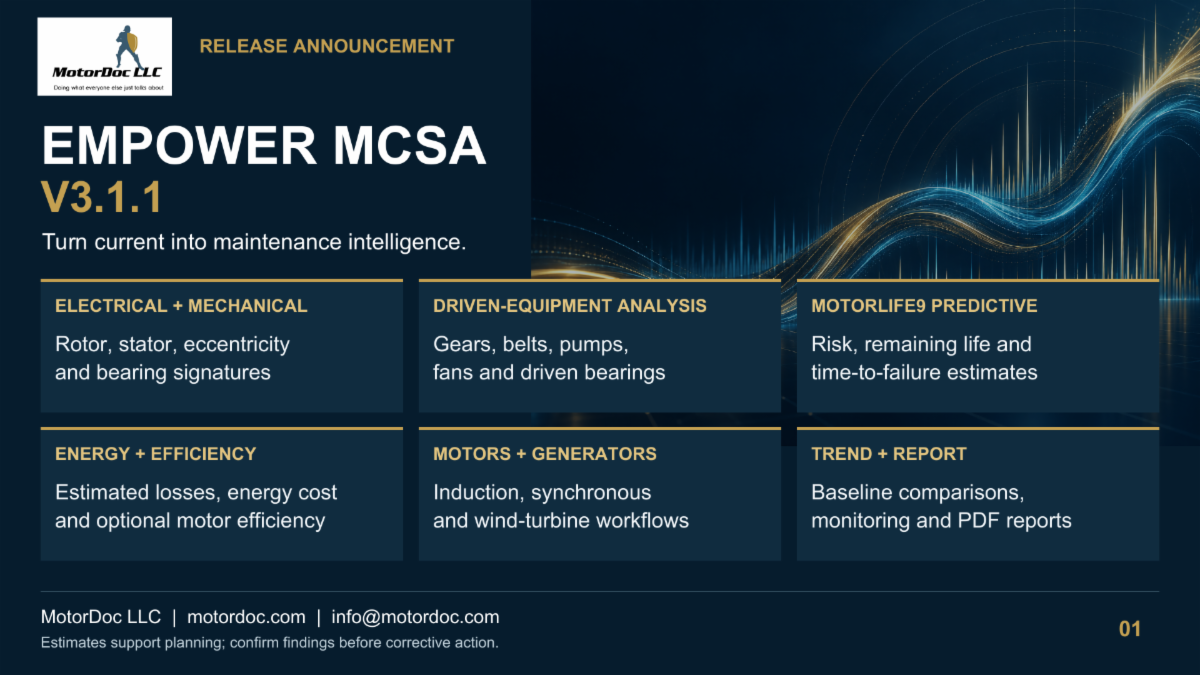
EMPOWER MCSA 3.1.1 connects current recordings, equipment setup, spectra, baseline comparisons, and reporting in a practical investigation workflow. It supports motor and driven-equipment assessment, including configured synchronous-machine and wind-drivetrain applications. Findings still depend on the asset information, recording quality, and operating conditions.


Choosing between route-based testing and continuous monitoring? Ask MotorDoc about EMPOWER MCSA, EMPOWER CMS2, and EMPATH ESA options. We will help define the configuration, installation responsibilities, recorded learning resources, and delivery requirements for your application. Additional live training and new engineering projects are being scoped for Q1 2027.


Request an equipment configuration and quotation


Continuous Monitoring Under Your Control


EMPOWER CMS2 can operate locally without a required cloud connection. Ask how current-based monitoring fits your assets and how installation, network access, data retention, and follow-up review will be handled. Local operation supports deployment choice; security still depends on the complete installation and its management.


Discuss your continuous-monitoring application


Chaos and Caffeine: Start with the Problem, Stay for the Coffee


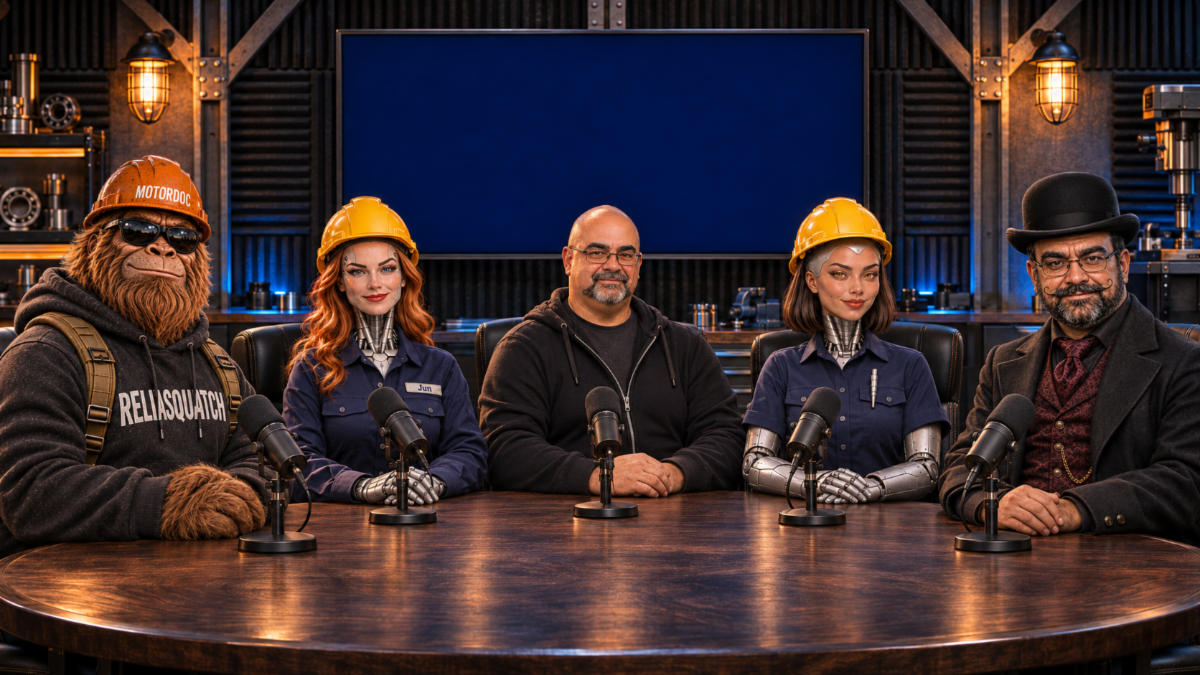
New to MotorDoc’s podcast? Chaos & Caffeine uses engineering discussion and industry humor to explore maintenance, reliability, technology, and the people doing the work. AI characters and voices are part of the presentation.


Now available: “AI Took Over My Podcast. Can I Have It Back?” Episode 72’s “Host Held for Parts” special brings together “Less Work. More Work Orders.” and “Who Keeps the Future Running?” While the real MotorDoc deals with a tire replacement, the fictional AI-host takeover explores workload, practical skills, and the people who keep equipment running.


Watch Episode 72 on ReliaSquatch


Also newly posted: Episode 71, “Microsoft and FAA Outages: Cyberattack or Systemic Failure?” Start with the question in the title: how do we distinguish a security incident from another kind of system failure before choosing a response?


Watch Episode 71 on ReliaSquatch


Prefer a musical introduction? “MotorDoc Music 2026: All About the Trades” brings the music collection into one place. Share it with a colleague who might connect with the people and stories before opening a technical report.


Explore MotorDoc Music on ReliaSquatch


One Useful Question for Your Next Team Meeting


Which alarm, report, or automated task creates work without changing a maintenance decision—and what would we need to change to make it useful? Reply with the question you would like us to tackle in a future tech tip. Keep customer and equipment records out of the initial message; we can arrange an appropriate way to review them.

Help a Colleague find MotorDoc

If this issue helped you ask a better question, forward it to one colleague. New readers can join the email newsletter and follow MotorDoc on LinkedIn for workshops, field lessons, and future editions.


Join Motor Diagnostics and Motor Health News


Follow MotorDoc on LinkedIn


Register for Good Gosh, Black Friday!


Background: MotorDoc technical publications; NIST AI 600-1; Singapore CSA’s November 6 OT advisory; and recent practitioner discussions.


Find MotorDoc articles, podcasts, and related reading


About MotorDoc LLC

MotorDoc® LLC is an approved small business federal contractor through SAM.gov. Contact us with any questions.


MotorDoc® LLC is a specialized motor systems consultant and field testing. MotorDoc® LLC provides the EMPATH and EmpathCMS electrical signature data collection and continuous monitoring systems and is the manufacturer of the EMPOWER system.


Predictive maintenance, machine learning and AI, root cause analysis and electrical reliability programs.


Other Resources