|
This month, our newsletter is all about parking. Accessible parking is not a privilege; it’s a necessity for people with disabilities to live full, active lives in their communities. Lately, I’ve received many complaints about the lack of available accessible parking, inconsistent police enforcement, and confusion around Florida’s new law that allows expectant mothers to request a one-year permit to park in accessible spaces without having a disability.
It felt like the right time to take a closer look at parking, what the laws say, how enforcement works, and how these issues impact people with disabilities who rely on accessible parking to work, shop, and participate in community life.
Right now, the laws simply don’t provide enough accessible spaces. Allowing people without disabilities to use those limited spots feels wrong and unfair to those who truly need them. It reminds me of something Judy Heumann wrote in Being Heumann:
“I was lucky that Mary and Arlene lived on my side of the street because I never could have gotten my chair off my sidewalk, across the street, and up the curb on the other side, no matter how many inclines there were in between. For me, a curb was the Great Wall of China.”
Judy’s words remind us that accessibility is not about convenience; it’s about basic freedom and equal access to community life.
| | |
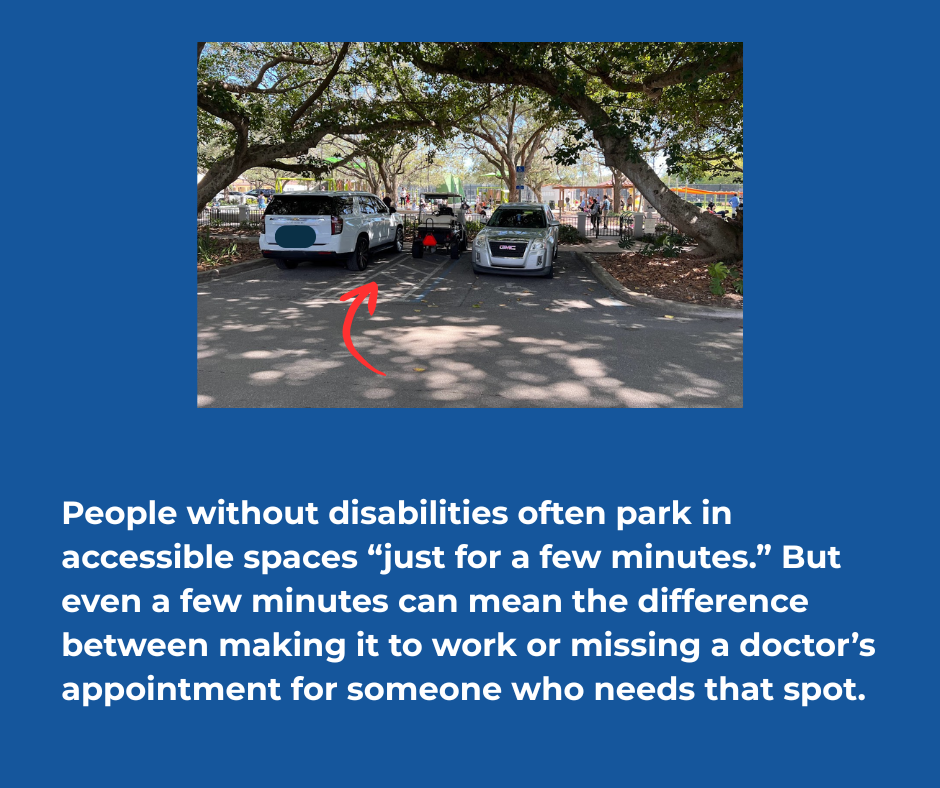
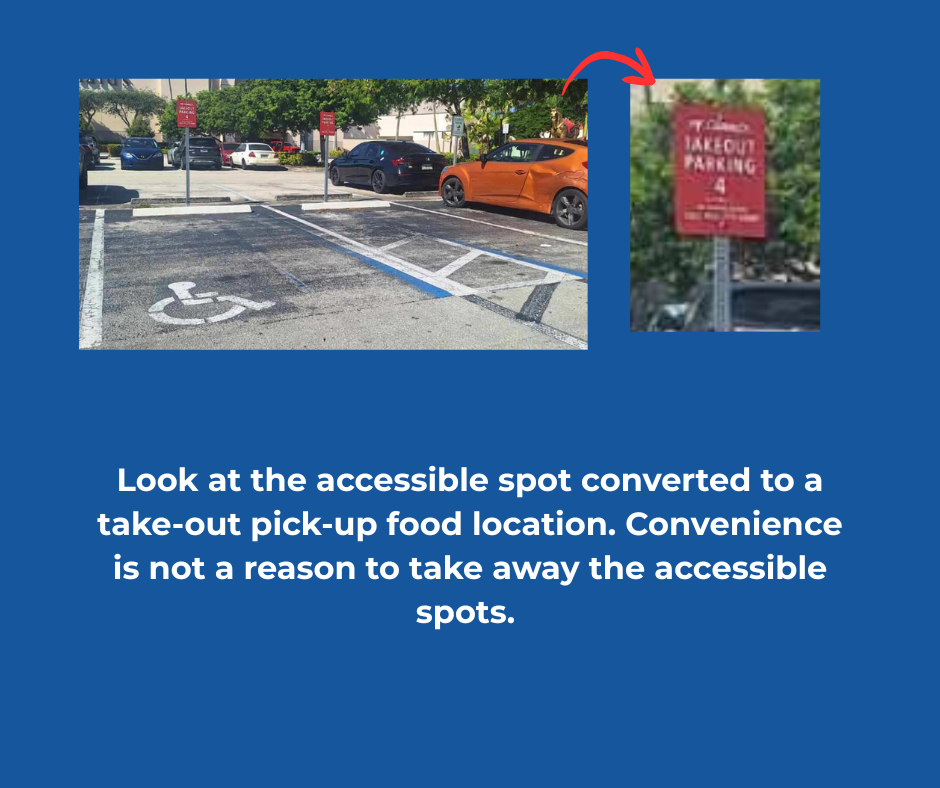
Matt and I are obsessed with accessible parking (bathrooms, too), but this article is about parking spaces. We can’t help ourselves; every time we are in a parking lot, we check to make sure there are accessible parking spaces, they are placed correctly, the access aisles are painted, the curb cuts are aligned correctly, and then we count how many spots we see. Our obsession even has us taking pictures every time we see something that is wrong. Since this month's newsletter theme is parking, I thought I would share some of the most outrageous pictures we have taken.
These are the top five issues:
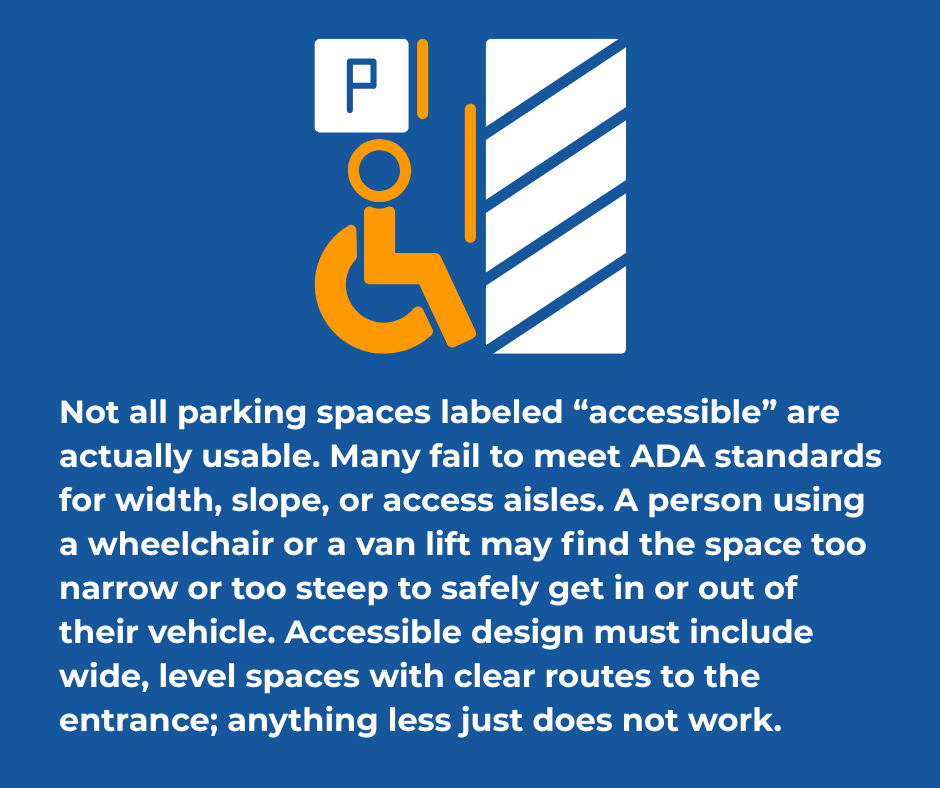
1. Inaccessible Design - Many parking lots still don’t meet ADA standards for width, slope, or access aisles. Narrow spaces or steep ramps make it impossible for someone using a wheelchair or van lift to enter or exit safely.
| | 2. Improper Use - People too often take accessible spaces without a valid permit or by those who “just park for a minute.” This misuse deprives people who truly need it of access. | | 3. Incomplete Enforcement - Even with laws in place, many areas lack consistent monitoring or ticketing for violations. Without enforcement, rules lose their impact, and accessibility loses its meaning. | | |
4. Inconvenient Placement - Some “accessible” spaces are placed far from entrances, on rough pavement, or next to obstacles like shopping carts or poles. A space isn’t truly accessible unless it’s usable.
5. Insufficient Availability - The number of accessible spaces required by law often doesn’t match real-world demand. Finding an open space, especially one accessible to vans, can take significant time and effort.
| | |
Accessible Parking in Florida
Accessible parking ensures that people with disabilities can safely and easily enter buildings and participate in community life. In Florida, both state and federal laws require businesses, governments, and organizations to provide properly marked and maintained accessible parking spaces.
Who Can Use Accessible Parking
- People who have a mobility impairment or are legally blind may qualify for a disabled parking permit or license plate.
- The person with the disability must be in the vehicle when it parks in the space.
- It is illegal for anyone else to use the permit or park in the space.
Types of Permits
- Permanent permits or plates: For long-term disabilities; valid for four years.
- Temporary permits: For short-term conditions (up to six months).
- Expectant Mother Permit: Florida now allows a temporary parking permit for pregnant women with a doctor’s note.
Fraudulent use or lending a permit to someone else is a crime.
Design and Marking of Accessible Parking Spaces
Florida’s building code and the Americans with Disabilities Act (ADA) set specific design rules:
- Accessible spaces must be next to the shortest route to the building entrance.
- Each space must have a clear access aisle so a ramp or lift can be used safely.
- The space and access aisle together must be at least 17 feet wide (12-foot parking space plus 5-foot aisle).
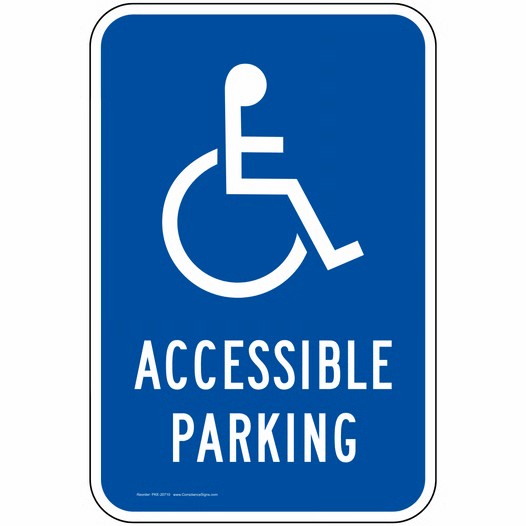
- The space must be outlined in blue paint and marked with the international symbol of accessibility.
- A permanent sign at least 60 inches above the ground must say “PARKING BY DISABLED PERMIT ONLY.”
- Van-accessible spaces need extra width and height clearance.
Use and Enforcement
- Only vehicles with a valid disabled permit or plate can park in these spaces.
- No one may park or block the access aisle next to an accessible space.
- Drivers dropping off or picking up a person with a disability may stand in a space only while loading or unloading.
- People with valid disabled permits do not have to pay parking meters, but time limits still apply.
- Fines for illegal use can include tickets, towing, and loss of the permit.
- Florida recognizes disabled parking permits/plates issued by other states (and even other countries), provided they display the international symbol of accessibility; if not, visitors must apply for a Florida temporary permit.
Maintenance Responsibilities
- Property owners and businesses must keep spaces clearly marked and free of obstacles such as carts, cones, or debris.
- Faded paint or missing signs must be replaced so the space is visible and safe.
- The route from parking to the entrance must stay clear and accessible for wheelchairs, walkers, and other mobility devices.
Why It Matters
Accessible parking is about more than compliance; it’s about equal access and safety. Every properly designed and respected space helps people with disabilities live, work, and participate in their community without barriers.
| | |
Know Your Rights and How to Protect Them: Accessible Parking in Florida
Accessible parking exists so that people with disabilities can park safely and reach buildings, stores, jobs, and public spaces with ease. Florida law protects your right to use these spaces and prevents others from misusing them.
Who Can Get an Accessible Parking Permit
You may qualify for a disabled parking permit or license plate if you are a disabled person with a permanent disability(ties) that limits or impairs his/her ability to walk 200 feet without stopping to rest. Here are several types of disabilities that would qualify:
- Have a mobility impairment that makes it difficult to walk long distances, or
- The inability to walk without the use of an assistive device, or
- The need to permanently use a wheelchair, or
- Use of portable oxygen, or
- Have a cardiac condition, or
- Have a restrictive lung disease, or
- Have a short-term medical condition that affects your ability to walk (such as after surgery), or
- Are legally blind.
Your doctor must fill out a form to confirm your eligibility. Permanent permits last four years; temporary permits last up to six months.
Using Your Permit the Right Way
- You can use the permit only when you are in the vehicle (as a driver or passenger).
- Hang the permit from the rearview mirror when parked and remove it when driving.
- Do not lend your permit to anyone else.
- Misusing a permit is against the law and can result in a fine or losing the permit.
What Accessible Parking Spaces Must Look Like
- Marked with the international symbol of accessibility (the wheelchair symbol).
- Outlined in blue paint with a striped access aisle next to it.
- Must have a posted sign that says “PARKING BY DISABLED PERMIT ONLY.”
- Van-accessible spaces are wider and taller to fit vehicles with ramps or lifts.
- The space should connect to a clear path to the building entrance — without curbs, steps, or obstacles.
Your Rights When You Park
- You can park in any marked accessible space if your vehicle has a valid disabled permit or plate.
- You do not have to pay parking meters anywhere in Florida, but you must still follow time limits (usually up to four hours).
- Others cannot block the access aisle, even for a few minutes. That space is needed for ramps and wheelchairs.
- If someone blocks your space or is parked illegally, you can report it to local law enforcement or parking enforcement.
Tips for Staying Safe and Confident
- Keep your permit up to date and visible.
- Avoid arguments with people misusing parking spaces; instead, contact the authorities.
- Take pictures (if safe to do so) of blocked spaces or missing signs to share with law enforcement or property managers.
- If you notice the paint or signs are faded, report it to the building owner or city.
Remember
Accessible parking is a right, not a privilege. Using and protecting these spaces ensures everyone who needs them can park safely and live independently.
| |
|
The Wallet Card Project focuses on helping people with disabilities and first responders communicate with each other.
The Wallet Card Project is an initiative designed to improve communication during interactions between individuals with intellectual/developmental disabilities or autism spectrum disorder (ASD) and law enforcement.
Whether you’re a caregiver, teacher, community organization, or part of law enforcement, visit our newly updated Wallet Card Project Page for more information on how to access these resources and apply for a wallet card.
| | | | |
How Can a PASS Plan Help You?
By: Lesly Quintanilla Lopez
A PASS (Plan to Achieve Self-Support) allows you to set aside other income besides your Supplemental Security Income (SSI) and/or resources for a specified period of time so that you may pursue a work goal that will reduce or eliminate the SSI or Social Security Disability Insurance (SSDI) benefits you currently receive.
Who can have a PASS?
If you receive SSI or could qualify for SSI after setting aside income or resources so that you may pursue a work goal, you could benefit from a PASS.
Requirements for a PASS:
- Be designed especially for you;
-
Be in writing. Using the form, the SSA-545-BK.You can get copies of the PASS form from https://www.ssa.gov/forms/ssa-545.html
- Have a specific work goal that you are capable of performing;
- Have a specific timeframe for reaching your goal;
- Show what income you receive (other than your SSI payments) and/or resources you have that you will use to reach your goal;
- Show how you will use your income and resources to reach your work goal;
- Show how the money you set aside will be kept separate from other funds;
- Be approved by SSA; and
- Be reviewed periodically by SSA to assure your plan is actually helping you make progress towards your work goal.
Read More Here
| | |
Keller v. Florida Agency for Highway Safety and Motor Vehicles
The Keller case challenges Florida’s recently enacted law granting pregnancy parking permits that allow non-disabled pregnant individuals to use disability-designated parking spaces. The plaintiff, Olivia Keller, was born without arms and uses a motorized wheelchair. She argues that the statute violates Title II of the ADA by diluting federally mandated accessibility protections. The lawsuit seeks injunctive relief against the state agency director under the Ex Parte Young doctrine, asserting that state law cannot override federal disability rights standards.
| |
| | |
Be Sure to Check out Our DIG Blog
for Much More
Important Information and Resources!
| | | | |
Do you have suggestions for future content or articles for our monthly newsletter?
If so, email your ideas and suggestions to our newsletter editor,
Justine Chichester.
| | Follow DIG on Social Media | | | | |