|
Regulatory False Starts: A Form of Health Care Waste
In a recent Health Affairs article, David Tyson and Morgan Calhoun ask "what about the cost of compliance with rules that never become effective or never fully work as originally intended?" They explore how to account for the burden of not just statutory and regulatory enforcement, but also non-enforcement or significantly delayed enforcement.
Administrative complexity is the cost of compliance with rules that are in effect and requirements that practically, if not optimally, function.
Regulatory false starts are different from ordinary administrative burden and complexity. Each delay triggers organizational mobilization, de-escalation, and subsequent remobilization. These cycles multiply the direct and indirect costs, as organizations effectively pay multiple times for the same compliance objective.
| | |
National Health Spending
Authors in a recent Health Affairs article project that by 2034, national health spending will be nearly $9 trillion and represent 20.6% of the economy, compared with $5.3 trillion and 18% in 2024.
The rate of national health spending growth during this period is influenced by:
- Continued elevated use of medical services and goods through 2026
- Major legislative changes that affect insurance coverage and spending through 2028
- Continued demographic shifts toward public programs, mainly Medicare
The insured share of the population is expected to be 90.5% in 2034, compared with 91.8% in 2024.
| | |
HIPAA Rule Release Popstponned
Federal regulators have delayed a major overhaul of the Health Insurance Portability and Accountability Act (HIPAA) Security Rule. The Department of Health and Human Services (HHS) had proposed a May 2026 release for a final rule with significant changes to the HIPAA Security Rule. The U.S. Office of Management and Budget (OMB) website indicates the final rule will be released in July 2027.
| | SCHOOLS & EARLY CHILDHOOD | | | | |
|
Safeguarding Youth Mental Health in AI Technologies
Artificial intelligence (AI) is rapidly reshaping how young people learn, connect, express themselves, manage stress, launch careers, and seek support. From personalized learning tools and algorithm-driven content recommendations, to AI companions and mental health chatbots, AI is a present and accelerating force in their lives.
But AI systems are not neutral. They are introducing new, large-scale risks to youth mental health — often without transparency, safeguards, or accountability. AI is already affecting youth development and how young people experience identity, relationships, community, stress, and help-seeking. Learn more about the risks of AI and the protective actions needed to help protect youth mental health.
| | |
Community Engagement/Work Requirement Resources
On July 6th, the Indiana Family and Social Services Administration (FSSA) released a partner toolkit and information for Healthy Indiana Plan (HIP) members on FSSA: Home regarding the community engagement/ work reporting requirements. Updates are expected as FSSA moves into full implementation in January 2027.
Items of note include:
-
Members are encouraged to create Benefits Portal Accounts to manage notices in a timely manner and submit required documentation. Information for members can be found on FSSA: Home.
-
Copies of the notices that HIP members are receiving can be found on HIP: Information for HIP Members.
- Short informational videos and FAQs are linked throughout the new web pages.
- The HIP: HIP Work Requirements Partner Toolkit offers:
- Flyers and posters in English and Spanish
- Social media images and posts
- FSSA’s presentation for upcoming Town Halls
| | |
Work reporting requirements are a BIG change to the Medicaid expansion program. Keep an eye here for resources compiled by CKF.
| |
|
Compliance Through Income
The Interim Final Rule on community engagement/work reporting requirements provided some clarity on “deemed compliance”. Under the statute, applicable individuals are deemed complainant with work requirements if they have a minimum income of $580 per month. However, the statute did not provide further details on how to calculate the $580. The Interim Final Rule clarifies that monthly income must be calculated as an applicable individual’s household income based on existing MAGI-based methodologies.
This information was shared as part of the National Health Law Program’s Timely Tips to Safeguard Medicaid blog series.
| | |
Marketplace Training
Annually, Assister Certification training on the Marketplace Learning Management System (MLMS) goes dark as the Centers for Medicare & Medicaid Services (CMS) prepares to release the updated training. This year, the training will go offline at 6 pm EST on August 12th. CMS anticipates that the Plan Year 2027 Assister Certification Training will be available early this fall.
| | |
Medicaid Households and Unaffordable Rent
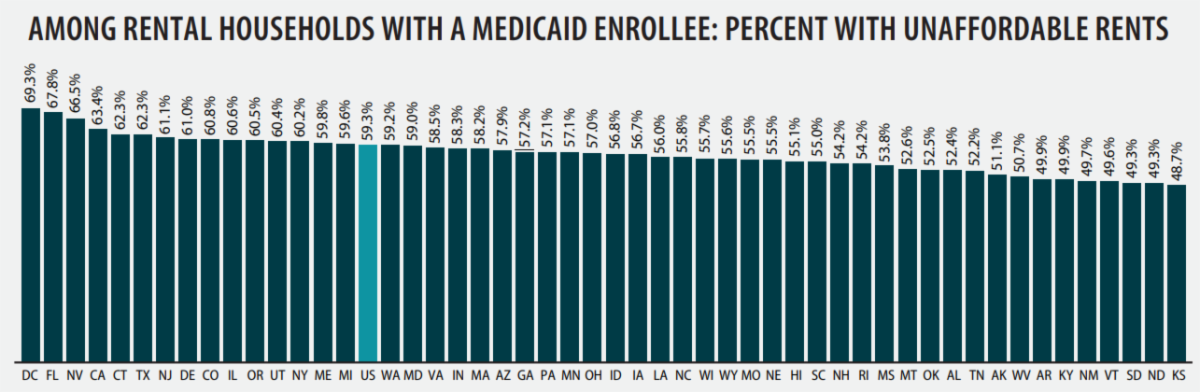
Data from the State Health Access Data Assistance Center (SHADAC) shows that in most states, including Indiana, over 50% of households with a Medicaid member have unaffordable rent.
States have the flexibility to use Medicaid funds to help provide housing support services for individuals with disabilities, older adults needing long-term services and supports, and individuals experiencing chronic homelessness. Medicaid can be used to provide services to support individuals’ housing transitions, to help individuals sustain their tenancy, and to develop strategic housing collaboratives. These services can be reimbursed through Medicaid demonstration waivers and Medicaid state plans.
| | |
Appeals Resource
The Indiana Justice Project released a Guide for Navigating SNAP & Medicaid Appeals. The guide outlines key steps, strategies and resources.
| |  | |
State Abortion
Coverage Map
The National Health Law Program released a State Abortion Coverage Map that provides an overview of state policies and insurance regulations of abortion coverage for Medicaid, Marketplace and private insurance.
| |
|
Dual-Eligible Individuals
People who are enrolled in both Medicare and Medicaid are often referred to as dual-eligible individuals. See below two new reports about this special group.
One analysis finds that dual-eligible individuals are more likely to report being in fair or poor health and need help with activities of daily living. Dual-eligible individuals are more likely to be younger, have lower incomes, and be people of color.
The second analysis finds that dual-eligible individuals comprise disproportionately high shares of spending in Medicare and Medicaid relative to their enrollment.
| | The Emotional Health of Boys and Young Men | | |
Boys do not always show emotional distress in ways adults recognize. Among 10-34 year-old males, the suicide rate is about 3.5x higher than it is for females.
To help address the issue, JED released a report, The Emotional Lives of Boys and Young Men: A Guide for Families and Communities, which examines the pressures and mental health challenges boys and young men face, how they show and cope with emotions, and how caring adults can help boys and young men thrive in a time when they are feeling socially disconnected, pessimistic about the future, and pushed towards the “manosphere.”
| | Watch a webinar, Understanding Boys and Young Men: A Webinar for Caretakers and Educators, to discuss the challenges and solutions outlined in the report. | | |
Wednesday, July 22nd 2pm ET
Justice in Aging is presenting Understanding New Medicaid Work Requirements Rules, which will include an overview of the updated federal rules and major Medicaid eligibility changes introduced by H.R. 1.
Register here.
| | |
Wednesday, July 29th 12pm ET
The Indiana Coalition for Human Services is offering a practical, compliance-focused session on how nonprofits can support civic participation. Participants will learn:
-
What nonprofits can do around elections, and how to stay compliant
- Key advocacy do’s and don’ts
- Current voter-focused initiatives in Indiana
- Tools for voter registration and education, including Vote411
- Insights into voter rights efforts
Register here.
| | |
3rd Tuesday of the month at 2pm ET
The Georgetown Center for Children and Families is hosting a Medicaid Connections webinar series.
July 21, 2026 - Maternal and Infant Health & Justice
August 18, 2026 - Children and Youth with Special Health Care Needs: Health & Justice
September 15, 2026 - Substance Use: Health & Justice
October 20, 2026 - Immigration: Health and Justice
December 15, 2026 - Mental Health and Well-being
January 19, 2027 - Family Preservation: Health & Justice
Register here for the series.
| | |
Wednesday, August 5 from 9:50am - 12pm ET
Indiana Cancer Consortium and Covering Kids & Families are presenting HPV in Indiana: Prevention, Protection, and Progress, a free webinar offering CEs for nursing and social work. Why attend?
- Demystify the science behind the human papillomavirus (HPV), its connection to cancer, and vaccination guidelines.
- Discover research-tested strategies to address vaccine questions and effectively discuss prevention with students and their parents.
- Gain practical tools you can immediately integrate into your daily work to support adolescent health.
Register here.
| |
|
Tuesday, August 11 from 11am - 12:15pm ET
Justice in Aging is hosting Medicaid 101: Basics and Recent Changes. This webinar provides a basic primer on the Medicaid program from funding to eligibility and how Medicaid interacts with Medicare and will be most suited to aging or disability advocates, legal aid advocates, and anyone new to Medicaid.
Register here.
| | |
August 12 from 1:00 – 2:30pm ET
The Alliance for Health Policy is offering a webinar, Health Insurance Fundamentals: How the U.S. System Really Works. This webinar is designed as a foundational primer and will also include audience Q & A.
Register here.
| | TOBACCO PREVENTION & CESSATION | | |
Tobacco, Baseball, and Zyn?
The Truth Initiative examines the long-standing relationship between tobacco and Major League Baseball, noting that cigarettes and smokeless tobacco were once deeply ingrained in the sport. Newer nicotine products such as ZYN nicotine pouches are becoming increasingly visible among players and fans. Although nicotine pouches do not contain tobacco leaf, they still deliver highly addictive nicotine and may contribute to the normalization of nicotine use. It raises concerns that the growing popularity of these products could reverse decades of progress in reducing tobacco use in sports and reinforces the need for continued education and prevention efforts to discourage nicotine addiction in all forms.
| | | |
|
IHCP Membership
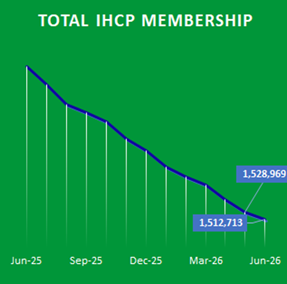
Total Membership decreased
in June.
With 1,512,713 members, there were 16,256, or 1.06%, less members in June 2026 than in May 2026. Membership has dropped for fourteen months straight.
| | | | | |