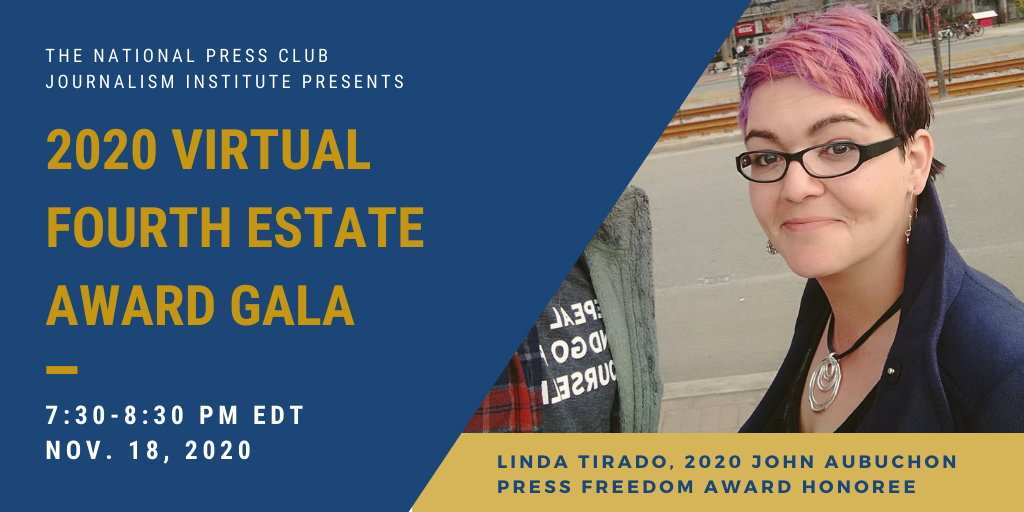
The 2020 Virtual Fourth Estate Award Gala will be the first of its kind, historic in the evening’s long tradition of honoring journalists who have made significant contributions to the field. This year’s gala will present the elegant face-to-face experience you expect but from the comfort and safety of your own home.
Linda Tirado, an author and freelance photographer, is the domestic honoree of the John Aubuchon Press Freedom Award. Named for a former Club president who fervently advocated for press freedom, this award is given each year to one journalist in the U.S. and one journalist overseas who bravely pushes to disclose the truth in trying circumstances. Tirado was taking pictures of a street protest in Minneapolis on May 30 when a policeman’s foam bullet hit her left eye, costing Tirado most of her sight in that eye. Tirado is among the journalists around the country who were injured, harassed or arrested while covering protests that took place nationwide after the death of George Floyd in Minneapolis.
Join us on Nov. 18 at 7:30 p.m. to celebrate Tirado and Fourth Estate honoree Susan Zirinsky (President of CBS News), Aubuchon press freedom international honoree Maria Ressa (executive editor of Rappler), and Neil and Susan Sheehan award for investigative journalism honoree Ed Yong (staff writer at the Atlantic). Tickets are available for purchase.
|
|
Bill Plante Chair in Leadership & Media Integrity, Loyola University Chicago
Freedom Forum Fellow in Women’s Leadership
News managers, I’m sure you’ve thanked your crews by now. You’ve sent people off to get some rest. You’ve taken note of every smart thing you’ve done in covering this year’s election. You’re doing an after-action review of lessons learned.
I’m here to nudge you further into the future.
Start working right now as though it is January 20. The possibilities for deeper, richer, contextual coverage are profound.
Let me offer some guiding thoughts for news managers.
-
The term “fake news” has jumped the shark. It’s tired, toothless, and the new leader of the country won’t be larding his lexicon with it. Neither will the powerful voices in his administration. Think of it as so “last term,” and get too busy doing high quality work on the changes underway.
-
There’s a treasure trove of big, important stories to be covered. The Biden-Harris transition site has listed the administration’s priorities: COVID-19, economic recovery, racial inequity, and climate change. What will this mean to residents, businesses, industries and universities in your community? Who on your team is going to own the many stories within those categories?
-
Expertise will be the coin of the realm. The new administration has made clear that it will be science- and data-driven. As you report on the administration’s moves, make certain you are gathering the top research minds in your area as sources and expert interviewees. Get past the “false equivalency” stories that elevate rumors, conspiracy fantasies, and junk science. Give voice to facts, make data interesting, and let your community know that the experts you cite have credentials that stand up to scrutiny.
-
Keep investing in investigative journalism. When administrations change, sunlight shines in dark places. Your investigative reporting can ferret out damage done, money misspent, and deals made improperly by a previous regime. People who have been afraid to talk may now be eager. Documents may now become available. At the same time, keep a watchful eye on how the new sheriffs in town are deploying their power, plans and resources.
-
Continue fact-checking. As I watched election results come in, I wondered for a moment what would happen to CNN’s Daniel Dale and The Washington Post’s Glenn Kessler. Without the mendacity of President Trump, could they still have full employment as fact checkers? The answer is yes. We need them – and all journalists – to apply the skills they’ve honed over the past years to everyone in power. Some powerful people lie blatantly. Others mislead more creatively. The departure of a non-stop prevaricator shouldn’t lull journalists into being any less skeptical of public pronouncements.
-
Say their names. Once a day, whether quietly or out loud, speak the name of George Floyd or Breonna Taylor or a person tragically, wrongfully lost to your community. Speak those names in conversations about health care, education, employment, public safety, or even entertainment. Their names should give you pause and remind you, whatever the topic, to dig deeper for possibilities and realities of systemic inequity, injustice, and intolerance. The new administration and many news organizations have made public commitments to racial equity; your job is to hold them all (including yourself) accountable.
Even as you read this column, the President-elect is introducing his pandemic response team. He’s not waiting until January to get a plan rolling.
Neither should you.
|
|
|
No matter who you — or your audience — voted for in the presidential election, now is a good time to talk about winning and losing with grace.
When you win…
-
Be kind and humble. While you may be tempted to boast, practice empathy for those who don’t feel the same. Your relationships will grow stronger.
-
Focus on what comes next. Yes, you can celebrate your victory, but channel this emotion into achieving your next goal.
-
Take a cue from on the field: Practice good sportsmanship.
When you lose…
|
|
This newsletter is written & edited by the National Press Club Journalism Institute staff: Beth Francesco, Holly Butcher Grant, and Julie Moos. Send us your questions and suggestions for topics to cover.
|
|
|
|
|
|
|