March 9, 2023

Top stories

■ Politico’s executive editor steps down after a year in the job (New York Times) / ‘I've decided to step down as Executive Editor of POLITICO after a remarkable year of remarkable journalism. Couldn't be more proud of the accomplishments. More to come.’ (Dafna Linzer) / Linzer to exit over clash with editor-in-chief Matt Kaminski (The Wrap) / ICYMI: Linzer publicly dressed down a congressional reporter who was leaving to join a rival publication (Daily Beast) / Read today’s memos (Washingtonian)


■ ’I think no regular person could read this and look at Fox like a news organization at this point,’ a Fox News source told Justin Baragona and Diana Falzone. (Daily Beast) / ‘I was talking to one senior Fox News staffer this week about how the network can no longer claim to be a news organization at its core. "You're not wrong," the staffer candidly replied, "and I think you should keep saying it." ’ (Oliver Darcy/Reliable Sources) 


■ Fox CEO says Dominion’s lawsuit is ‘noise’ – not about ‘law’ or ‘journalism’ (The Wrap) / Court records show political pressure behind Fox programming (Associated Press)


■ What Tucker Carlson said about Trump in private texts vs. on Fox News (Washington Post) / Records show Fox and G.O.P.’s shared quandary: Trump (New York Times) 


■ Michel Martin named host of Morning Edition (NPR) / Martin heads to ‘Morning Edition’ with a focus on ‘the stories that we don’t want to talk about’ (The 19th)


■ Morning Brew lays off 40 people (Axios) / ‘... This is the second round of layoffs since November, when they laid off 14% of staff’ (Sara Fischer)


■ The scale of local news destruction in Gannett’s markets is astonishing (Nieman Lab)


■ Blavity rises to most popular Black website; targeting millennials, platform displaces BET.com (Journal-isms)


■ ‘In the Dark’ the acclaimed investigative podcast, joins the New Yorker and Condé Nast Entertainment (New Yorker)


■ Inside the cancellation of WNYC’s ‘The Takeaway’ (HellGate)


■ ‘How will I pump?’: When your first work trip after maternity leave is to Ukraine with President Biden (Wall Street Journal)


■ My mom died while I was covering COVID. It changed my views on grief. (Washington Post) 


■ Where have all the magazines gone? (Poynter) 


Press freedom 


■ A student journalist’s plea: Stop censoring us (and our advisers) (Education Week)


■ ‘Weaponization’ subcommittee members spar over ‘Twitter Files’ (The Hill)


■ Erdogan pushes back against quake response reporting as elections loom (VOA)


■ Chinese journalist held for reporting on Wuhan COVID outbreak wishes he’d done more (CPJ)


■ War, coups, rollbacks of civil liberties test democracies, media worldwide (VOA)

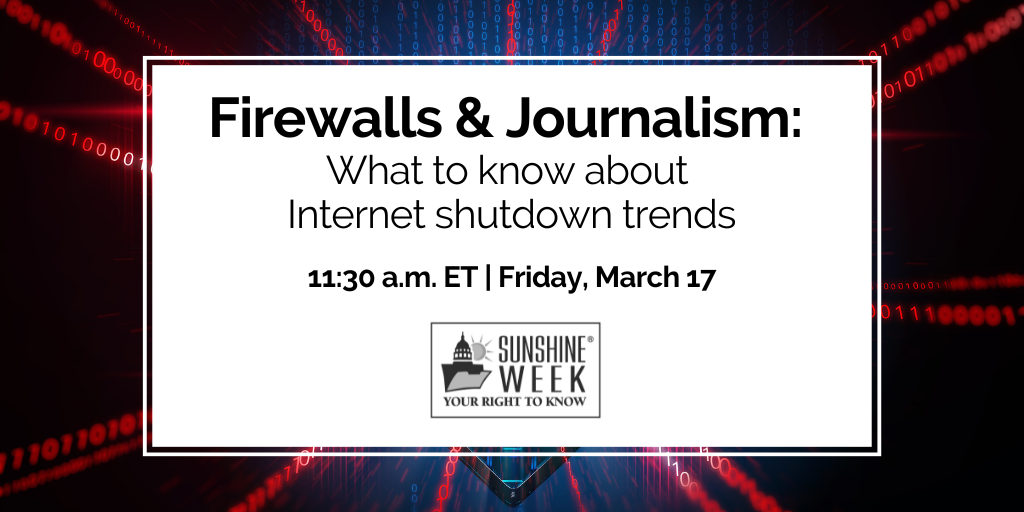
Firewalls & Journalism: What to know about Internet shutdown trends

An open and free Internet is widely seen as essential to journalists to both conduct their reporting and to disseminate their work. But a worsening trend of authoritarian and illiberal governments moving to erect digital firewalls and cut off Internet access, particularly during times of natural disaster or political crisis, is imperiling the ability of large swaths of the global population to stay informed and for journalists to track critical news developments.


More countries than ever in 2022 saw Internet shutdowns, with at least 187 incidents documented across 35 countries, according to the digital rights group Access Now. 


Join us from 11:30 a.m. to 12:30 p.m. ET on Friday, March 17, for a virtual panel discussion that will delve deep into the worrying spread of Internet kill switches and what it specifically means for a free press. The program is being produced by the National Press Club’s Press Freedom Committee and nonprofit affiliate Journalism Institute in honor of Sunshine Week.

REGISTER NOW

The panel will discuss:


  • Regional and national trends in the use of Internet shutdowns in places as diverse as India, Iran, Myanmar, and Turkey;
  • How Internet shutdowns differ from the more comprehensive control of firewalls favored by China and more recently Russia; and
  • What privately and publicly funded digital tools are available to help journalists and the general public circumvent Internet controls such as throttling and filters.


Confirmed panelists include:


  • Ksenia Ermoshina, a senior researcher at the Center for Internet and Society and Citizen Lab at the University of Toronto
  • Nat Kretchun, senior vice president for programs at the Open Technology Fund, part of the U.S. taxpayer-funded U.S. Agency for Global Media


More panelists to be announced soon.

"The first step to stop doing work that’s not worthwhile is to ask your staff regularly and often: What are you doing that you don’t think is a good use of your time, and why? ... Shedding low-impact work is just as much an accomplishment — and cause for celebration — as, say, launching a new product or reporting series, or winning an award. Giving up certain work doesn’t mean it was poorly done or never important, but that your audience’s needs are evolving. Doing this helps everyone become more aligned on mission-critical work."


-- American Press Institute report “A simple framework for deciding what to stop doing”

Resources

This newsletter is written & edited by the National Press Club Journalism Institute staff: Beth Francesco and Holly Butcher Grant. Send us your questions and suggestions for topics to cover.


Get this from a friend? Subscribe, and view the archives.


If you value this newsletter, consider supporting The Latest with a tax-deductible, recurring gift to the Institute: Even $5 a month will help fund the technology and time it takes to provide this important service.  

Facebook  Twitter  Linkedin  Youtube  

The National Press Club Journalism Institute promotes an engaged global citizenry through an independent and free press, and equips journalists with skills and standards to inform the public in ways that inspire a more representative democracy. As the non-profit affiliate of the National Press Club, the Institute powers journalism in the public interest.