|
Travel Ban. Reports indicate the Trump Administration plans to issue a travel ban based on a government review that followed one of the first executive orders which called for an increased vetting and screening of visa applicants. According to news reports, the restrictions will apply to a broader list of countries beyond those affected by previous versions of the ban during the first Trump administration.
News reports have described three tiers of countries, including a “red” list of countries whose citizens would be barred from entering the U.S., and could include Afghanistan and Pakistan and potentially countries previously banned under the first Trump administration, such as Cuba, Iran, Libya, North Korea, Somalia, Sudan, Syria, Venezuela, and Yemen. An “orange” list of countries where access would be restricted for certain visas, and a “yellow” list where countries would have 60 days to address issues identified by the government to avoid being partially or fully barred.
However, the scope of the travel ban is unclear. The reports have not specified which groups of visa applicants are likely to be impacted by the restrictions and whether there will be any exceptions. The Presidents’ Alliance is tracking this closely.
Targeting Protesters for Deportation. The Administration began to take steps in line with its executive order seeking to curb demonstrations on college campuses, particularly those relating to the conflict in Gaza. On March 9, 2025, the U.S. Immigration and Customs Enforcement (ICE) arrested Mahmoud Khalil, a former university student who helped to lead demonstrations related to the Israeli-Palestinian conflict. This followed previous reports indicating the State Department began to use AI to identify noncitizen students who have engaged in issues related to the demonstrations based on the content of their social media accounts. According to sources, the results of this review may serve as evidence to revoke visas of certain noncitizen students.
As noted in our February explainer on the EO and webinar, the scope of non-citizens targeted and the questions it raised about protected free speech and related participation in protests are highly concerning. As a reminder, the First Amendment protects political speech, including noncitizens present at campuses across the United States. Any attempt to remove individuals based on their speech or peaceful protest activity would raise serious constitutional concerns and could be challenged in court as a violation of free speech rights.
Social Media Notice. The news came on the heels of the opening of USCIS’s 60-day period for public comments on its notice regarding collection of visa applicants’ social media “handles” or “identifiers” through immigration forms. This new requirement would affect over 3.5 million applicants, seeking a variety of immigration protections from asylum to citizenship, every year. The Department of Homeland Security will base the decision whether to implement the proposed change based on the collected public comments.
Registration Requirement. USCIS released the Interim Final Rule (IFR) on the registration requirement for non-citizens, which is expected to be formally published in the Federal Register today, March 12, with a 30-day comment period. The IFR lists forms that would be considered proof of registration, as well as the form (specified as "revised form G-325R”) for registration.
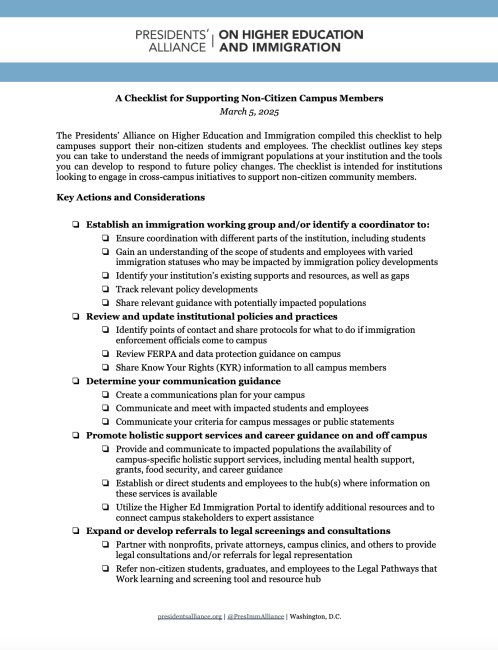
The registration requirement and process raises grave questions and concerns. The Presidents’ Alliance is working with partners to prepare a fact sheet and other resources for campuses, including guidance for campuses and higher education stakeholders who wish to submit comments.
Humanitarian Parole. The Administration plans to soon roll back the temporary protections for Ukrainians, who entered the United States through the humanitarian parole program launched by former President Biden. Such an effort could impact about 240,000 Ukrainians, who have fled their country since the onset of war with Russia. If their visas got rescinded, these individuals would potentially become subject to deportation.
Revoking the protections for Ukrainians follows the Trump Administration’s January 20th executive order calling for termination of categorical parole programs. Together with termination of the CHNV program that provided protections to some 530,000 parolees from Cuba, Haiti, Nicaragua and Venezuela, the plan to roll back the parole for Ukrainians spurs uncertainty around the Afghan parole program which is not accepting new applications but still allows current holders to re-parole.
|