Federal officials and health-industry executives Tuesday said they were racing to help hospitals and health-care providers that are at risk of running out of cash after a cyberattack knocked out the nation’s largest processor of medical claims and put pressure on patient care.
The Department of Health and Human Services unveiled a strategy that encouraged private health plans to advance funding to the hardest-hit organizations and relax requirements that often slow the billing process, among other steps. The Centers for Medicare and Medicaid Services (CMS) said it would consider individual requests for accelerated payments, akin to those made during the coronavirus pandemic, recognizing that “hospitals may face significant cash flow problems from the unusual circumstances impacting hospitals’ operations.”
Aledade, the nation’s largest network of independent primary care practices, also announced that it would advance up to $100 million to its physician practices across the country.
Read More
| |
Join the AMA or Renew your Membership Today!
As of now, ASIPP has two positions available in the House of Delegates and all of the other memberships where they are available, even for the other societies within AMA. The American Medical Association (AMA) requires all societies to requalify for membership in the AMA House of Delegates (HOD) every five years. To keep and hopefully increase ASIPP's membership in these committees, we have to keep at a minimum 20% AMA membership, otherwise, ASIPP will lose the AMA membership with all the available advantages.
We encourage you to join or renew your membership in the AMA. Joining the AMA will further strengthen our specialty’s representation at the national level through the AMA House of Delegates, the AMA’s policymaking body, and strengthen our ability to meet the challenges in health care today with thoughtful, well-organized responses.
As a member of the AMA, you become part of the organization that unites physicians nationwide to tackle the major issues we all face: 47 million uninsured Americans, looming Medicare payment cuts, and the need for medical liability reform. Membership also gives you access to a broad range of practice management resources and award-winning publications such as the Journal of the American Medical Association, AMNews, AMA Morning Rounds, and the Archives journals.
Please take this opportunity to support the critical activities of ASIPP by joining the AMA today. To join or renew the AMA, we encourage you to visit www.ama-assn.org or call (800) 262-3211.
| |
|
A current lawsuit in Florida offers an alarming case study
"It becomes your worst nightmare."
Those were the words of Stephanie Liskowitz, the wife of John Liskowitz, who died last March. John, who divided his time between New Jersey and Florida, had a medical procedure in Florida and never made it home.
Stephanie and Ashley Liskowitz, the daughter of John and Stephanie, filed a lawsuit recently, on what would have been John's 59th birthday, in the Hillsborough County, Florida court. The suit names as defendants: Gary Clayman, MD; Norman Clayman Endocrine Institute, LLC; Dung-Anh Ung, MD; and PM West Florida Division. All parties have admitted liability of the allegations during the pre-suit period, according to Tim Groves, JD, the lawyer representing the Liskowitz family.
Read More
| |
|
Virtual
March 16, & April 30
Click here for the complete list of upcoming exams.
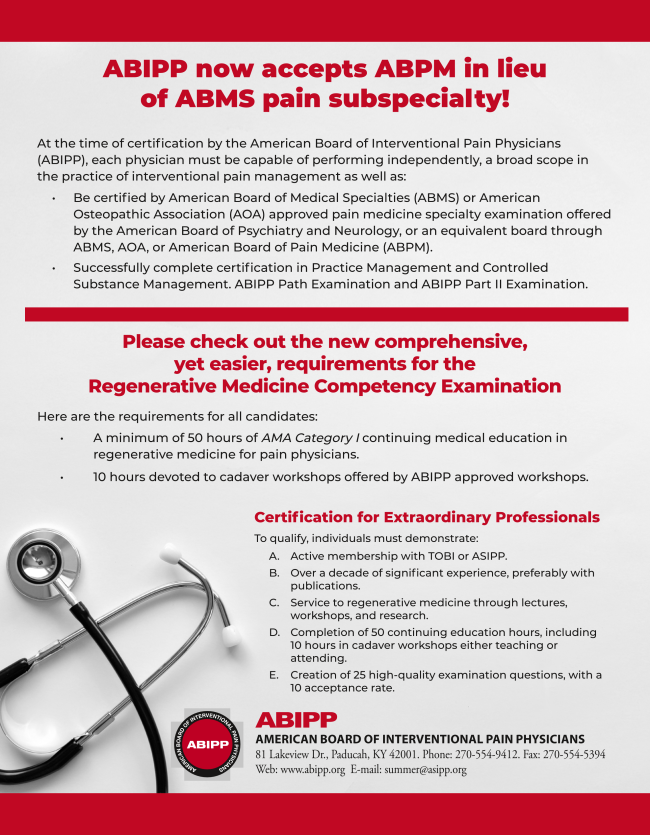
ABIPP Part I; ABIPP Path - Combined DCCPM/CSM virtual exam;
ABIPP Competency Exam in IPM; ABIPP Competency Exam in Regenerative Medicine;
CSM Competency Exam; DCCPM Competency Exam
In Person
October 18, 2024
ABIPP Part II - Practical Examination
Lab Venue: MERI, 44 S. Cleveland Street, Memphis, TN 38104
| |
|
Reflections on medical policy, DEA permits, and the fentanyl crisis
by Edwin Leap, MD
Board-certified ER physician
When I was in my residency training, from 1990 to 1993, we were in the nascent phase of the "pain is a vital sign" madness. We were told, over and over, that we should treat pain aggressively and should not be afraid to give narcotics to patients in pain. Who were we to judge someone's pain, after all? The young man who fell onto his knees at work, with a normal blood pressure and heart rate, looking about the room, might well categorize his pain a "10/10," and we should honor that, respect it, and treat it.
As the years went on, drug reps actually gave physicians samples of opioids for their patients. (Talk about a good investment in reaching your market!) We had them in our hospitals in cabinets, before the days of computerized pharmacy systems. It was apparently no big deal.
Thanks to academic institutional policies and brilliant pharmaceutical marketing, pain pills such as hydrocodone and oxycodone (Oxycontin) were well known and much desired. Many a patient concocted elaborate tales of horrible pain, undocumented cancers, physicians out of the country, pills inexplicably eaten by dogs or spilled down the toilet. (This was before we had searchable registries for opioid prescriptions, which have been a wonderful thing.)
Read More
| |
People testing positive for COVID no longer need to stay in isolation for 5 days
Americans who test positive for COVID-19 no longer need to stay in isolation for 5 days, CDC officials announced on Friday.
The CDC changed its longstanding guidance, saying that people can return to work or regular activities if their symptoms are mild and improving and it's been a day since they've had a fever.
The change comes at a time when COVID-19 is no longer the public health menace it once was. It dropped from being the nation's third leading cause of death early in the pandemic to 10th last year.
Read More
| |
|
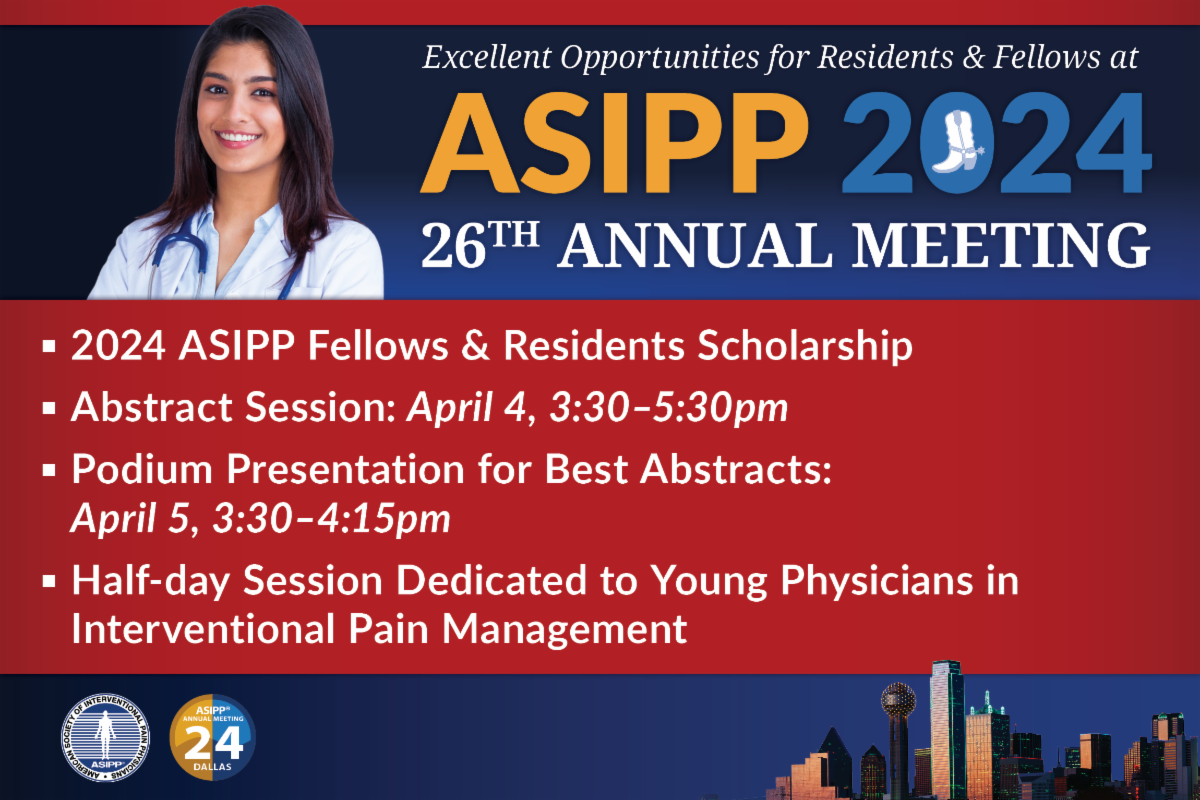
Excellent opportunities for Residents & Fellows
at ASIPP's 2024 Annual Meeting:
-
Resident & Fellow Scholarship — Limited to 100!
- Abstract Session (April 4, 3:30–5:30pm) and Podium Presentation for Best Abstracts during General Session (April 5, 3:30–4:15pm)
- Half-Day Session dedicated to Young Physicians in Interventional Pain Management
| |
Sleep significantly bolsters our brain’s ability to consolidate complex associations within episodic memories. The research demonstrates that sleep not only strengthens weak connections between different elements of an event but also fosters new links among previously unconnected aspects, enhancing the process known as pattern completion.
This enhancement is closely tied to sleep spindles, bursts of brain activity during sleep associated with memory consolidation. These findings highlight sleep’s critical role in weaving together multifaceted memories, suggesting an evolutionary advantage in our ability to construct a coherent understanding of our experiences and predict future occurrences.
Key Facts:
- Sleep’s Role in Memory: Sleep specifically improves memory by consolidating weak associations and creating new connections between elements of complex events.
- Importance of Sleep Spindles: The study links the memory consolidation process to sleep spindles, indicating their crucial role in integrating complex associations.
- Evolutionary Advantage of Sleep: The research suggests that the ability to integrate and complete memories of complex events provides an evolutionary advantage in understanding our environment and predicting future events.
Read More
| |
|
Atrial fibrillation risk associated with drinks made with added sugar or artificial sweetener
Overconsumption of beverages with added sugar or artificial sweetener, already associated with several cardiometabolic diseases, showed new links to atrial fibrillation (Afib or AF) in a prospective cohort study.
Within the U.K. Biobank, people who drank more than an estimated 2 L (~8.5 cups) of sugar-sweetened beverages (adjusted HR 1.10, 95% CI 1.01-1.20) or artificially sweetened beverages (adjusted HR 1.20, 95% CI 1.10-1.31) weekly had a greater risk of incident Afib within 10 years compared with nonconsumers.
Consuming 1 L or less of pure fruit juice, on the other hand, showed no such relationship and in fact appeared mildly protective against this established risk factor for stroke (adjusted HR 0.92, 95% CI 0.87-0.97), reported Ningjian Wang, MD, PhD, of Shanghai Ninth People's Hospital and Shanghai Jiao Tong University in China, and colleagues in Circulation: Arrhythmia and Electrophysiology.
Read More
| |
ASIPP State Society Meetings | |
|
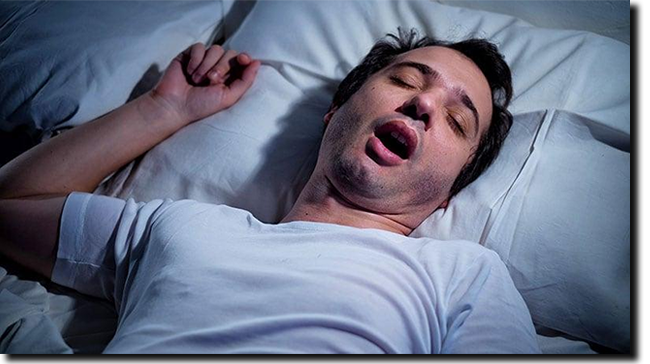
Symptoms of sleep apnea, including snorting, gasping, or paused breathing during sleep, are associated with a significantly greater risk for problems with cognitive and memory problems, results from a large study showed.
Data from a representative sample of US adults show that those who reported sleep apnea symptoms were about 50% more likely to also report cognitive issues vs their counterparts without such symptoms.
"For clinicians, these findings suggest a potential benefit of considering sleep apnea as a possible contributing or exacerbating factor in individuals experiencing memory or cognitive problems. This could prompt further evaluation for sleep apnea, particularly in at-risk individuals," study investigator Dominique Low, MD, MPH, Department of Neurology, Boston Medical Center, Boston, Massachusetts, told Medscape Medical News.
Read More
| |
- ASIPP Members Only Site Information - | |
-
To log in for the first time you will need to click “forgot password” at the bottom of the login window.
- Check your email and then log in as directed.
-
If you have problems logging into your account, click here.
| |
Pain Medicine Case Reports (PMCR) and Editor-in-Chief Alaa Abd-Elsayed, MD, PhD would like to invite you to submit case reports and case series to the PMCR journal. Your article will be published free of charge.
Open access journals are freely available online for immediate worldwide open access to the full text of published articles. There is no subscription fee for open access journals. Open access journals are no different from traditional subscription-based journals: they undergo the same peer-review and quality control as any other scholarly journal.
Interested in becoming a member of the PMCR Editorial Board?
Editorial board members are asked to review 2-6 manuscripts per year. Please submit your most up-to-date CV to sgold@asipp.org for consideration.
For more information or to submit your articles, click here.
| |
|
Dawood Sayed, MD, Blake Evans, MD, Vivek Velagapudi, BS, and Susheel Govindan, MD
Abstract
BACKGROUND: Sacral insufficiency fractures can be a debilitating cause of low back pain in the elderly population. While sacroplasty is recommended for the treatment of persistent pain from sacral insufficiency fractures, the anatomical location of Zone III fractures can put patients at a higher risk of neurological complications during repair.
CASE REPORT: We present a case of a 71-year-old woman with a Denis Zone III sacral insufficiency fracture who underwent percutaneous sacroplasty. The procedure was performed by utilizing an articulating osteotome in the long-axis approach along the curvature of the sacrum. The use of an articulating osteotome allowed for small trajectory adjustments, thereby lowering the procedural risks of cement extravasation and erroneous cannulation.
CONCLUSIONS: The patient reported significant pain relief and no immediate complications following the procedure. Fluoroscopically guided percutaneous sacroplasty using an articulating osteotome is a safe and effective method for treating sacral insufficiency fractures.
KEY WORDS: Sacrum, bone fracture, sacroplasty, back pain, case report
Read More
| |
|
Ye Tong, MD, Xiao-Qing Zhang, MD, and Hao-Yuan Zhou, MD
Abstract
BACKGROUND: Chronic low back pain (CLBP) is a significant health challenge with a high prevalence rate. Sleep disorders, which are prevalent among adults, have been linked with CLBP. However, the intricate relationship between sleep and pain adds complexity to our understanding of CLBP.
OBJECTIVES: To investigate the association between CLBP and sleep disorders, with a focus on the potential role of sleep disorders as a risk factor for CLBP.
STUDY DESIGN: Cross-sectional study based on publicly available data from the National Health and Nutrition Examination Survey (NHANES) for one cycle (2009-2010).
SETTING: The NHANES employs a complex, multistage probability sampling design to select a nationally representative sample.
METHODS: In this study, we included patients aged 20 to 69 years from the NHANES 2009-2010 cycle. After eliminating cases with missing data, a total of 863 patients remained. Baseline characteristics were analyzed by stratifying patients based on their CLBP status to assess initial inter-group disparities. Due to age imbalances between groups, we employed a 1:1 propensity score matching (PSM) method, reducing the sample to 508 patients. The association between CLBP and trouble sleeping was investigated following this calibration using a multivariate logistic regression analysis.
RESULTS: Upon categorizing the baseline characteristics of 863 patients based on CLBP, we identified that those within the CLBP group tended to be older and had a greater prevalence of health conditions, including cancer, hypertension, and cardiovascular disease (CVD). Notably, the prevalence of sleep disorders was higher in the CLBP group than in the non-CLBP group (P < 0.001). After implementing an age-based PSM for the 2 groups, 508 patients were selected from the initial 863 patients. After adjusting for various confounders using multivariate logistic regression, our analysis revealed a strong association between sleep disorders and an increased risk of CLBP.
LIMITATIONS: This is a cross-sectional study, and therefore causality cannot be established.
CONCLUSIONS: This study underscores the significant association between sleep disorders and an elevated risk of CLBP, highlighting the need for comprehensive management strategies that consider the role of sleep disorders in CLBP.
KEY WORDS: NHANES, chronic low back pain, sleep disturbance
Read More
| |
|
John Maclean, BS, Skylar Remick, Jin Woo Shim, MD, Anil Chakravorty, BS, and Chong Kim, MD
Abstract
BACKGROUND: Since electronic cigarettes (E-Cigs) were introduced to the United States (US) in 2007 its use has increased. Like other tobacco products, E-Cigs too pose health risks. Studies have shown a correlation between pain and tobacco use, with the association being bidirectional. However, there is limited data on the effect of E-Cig use on chronic pain, as well as its association with opioid use.
OBJECTIVES: To evaluate the use of tobacco products, including E-Cigs in a chronic pain population.
STUDY DESIGN: This study was designed as a cross sectional survey.
SETTING: This study was set in an urban academic teaching center.
METHODS: After IRB approval, surveys of established chronic pain patients were conducted over 4 months. The survey and results were anonymous, without the collection of any identifiable information. The adult patients who had been treated in the pain practice for over 3 months were included in this study. The survey collected the patients’ age, gender, history of tobacco usage, cigarette smoking, E-Cig and opioid use.
RESULTS: A total of 312 patients were surveyed. 198 women (63.5%) and 114 men (36.5%). The average age was 58.2; ~59 years for men and ~58 years for women. Eighty-four patients (26.9%) were managing pain using chronic opioids; 46 women and 38 men. Nine women (4.5%) had tried E-Cigs in the past, but none (0%) were active users. Eighteen men (15.8%) had tried E-Cigs in the past with 9 (7.8%) being active users. Among the opioid managed patients, 6 (9.1%) had and were active users of E-Cigs and all 6 were men (20%).
LIMITATIONS: The anonymous results collected through the survey may not be accurate as they cannot be validated. In addition to the small sample size, the entire study population is from an urban academic center which may not be generalizable to all chronic pain patients. Finally, the study does not evaluate the impact of tobacco or E-Cig use on pain level or functional status.
CONCLUSION: In this study of chronic pain patients, cigarette smoking and E-Cig use was similar to the reported use in the general adult population in the US. The study showed a strong correlation between tobacco use, especially cigarettes and E-Cigs, and opioid use. As the use of E-Cigs becomes more mainstream, the association between E-Cig use, chronic pain, and opioid use should be monitored.
KEY WORDS: Tobacco use, electronic cigarettes, E-Cig, E-cigarette, opioid use, chronic pain
Read More
| |
|
ASIPP is now in collaboration with Curi Medical Liability Program
| |
|
Since this malpractice insurance program officially launched in November 2018, ASIPP has signed up hundreds of providers with an average savings of 30%. This is professional liability insurance tailored to our specialty and will stand up for us and defend our practices.
Curi is a full-service advisory firm that serves physicians and their practices. Their valued advice is grounded in your priorities and elevated in your outcomes. They are driven by a deep understanding of your specific circumstances in medicine, business, and life. To read a few important points to keep in mind about the program, including discounts, administrative defense, cyber coverage, aggressive claims handling, and complimentary risk management CME activities, visit our website.
| | |
|
Group Purchasing Organization Offer Better Pricing and Creates Added Value
ASIPP has formed a partnership with Henry Schein and PedsPal, a national GPO that has a successful history of negotiating better prices on medical supplies and creating value-added services for independent physicians. Working with MedAssets, PedsPal provides excellent pricing on products like contrast media that alleviate some of the financial pressures you experience today.
Learn More
| |  |
|
ASIPP, Fedora Billing,
and Revenue Cycle Management Partnership
ASIPP is now offering our members the benefit of a unique revenue cycle management/ billing service.
We have received a tremendous amount of interest in the ASIPP® billing and coding program.
Click here to learn more about the negotiated rate for practices and more!
| |
|
Like and follow ASIPP® on Facebook, X, and LinkedIn for the most
up-to-date news related to you, your practice, and your patients!
| | | | |