Volume 7 Issue 8 | August 2026 | | The Root of It newsletter ends with our monthly quotation. If you find your newsletter has been clipped by your email provider please click HERE for a webpage version of the newsletter. | | |
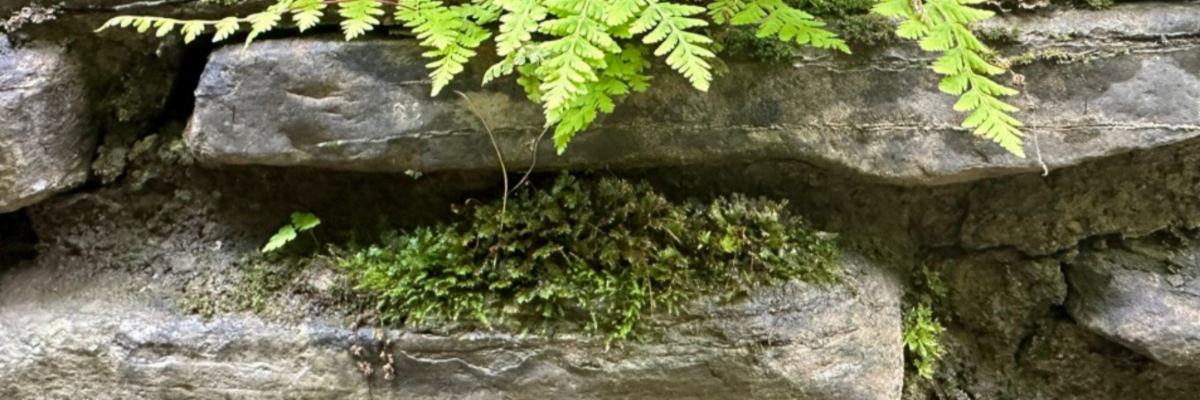
Moss covered stone creates ahhhh moments.
photo by E Barth-Elias
| | |
It’s a matter of perspective. Is moss a nuisance or serene and soothing? Rooftop moss traps moisture, causing curling, cracking and leaking. Moss in the garden or on the path brings a sense of tranquility and mediates the interplay of colors and textures.
Fossil records indicate that mosses (which belong to the plant division Bryophyta) were among the first land plants. These small, simple plants are non-vascular—conducting food, water, and waste cell-to-cell rather than through a system of tubes. Typically very small, most moss leaves are one cell thick, which allows them to absorb water and nutrients efficiently along their entire surface. Flowerless, they reproduce by wind-born spores. Aggregating into groups, or clumps, they anchor themselves to the ground or surface via root-like structures called rhizoids.
Mosses are not aggressive, but are adaptable and opportunistic. With over 12,000 species worldwide, they find a home in nearly all ecosystems (saltwater is an exception). Incredibly hardy, they survive extreme heat (fire) and cold, thriving under blankets of snow. During periods of drought, mosses turn brown and go dormant, ready to rehydrate and green up when rains return. Mosses can be found on most solid surfaces—rocks, fences, the forest or garden floor, lawns, and even underwater at the bottom of ponds and streams. The moss requirement: moisture must be available at least part of the year.
Not harmful to lawns or gardens, moss growth can be an indicator of too much shade, poor drainage, or soil compaction. Because moss acquires its nutrients directly from the atmosphere, it absorbs and retains air pollutants and can be monitored to assess air pollution risks to ecosystems.
An abundance of wildlife interacts with moss. Bacteria and fungi thrive in moss, and insects call it home, feeding reptiles, amphibians, and birds. Moss makes comfortable, insulated nest material for squirrels and birds.
Moss’s ability to retain water and stabilize soils make it an ecosystem work horse, helping prevent floods and landslides. Like all plants, moss sequesters carbon in its cells, reducing carbon dioxide in the air.
So, is moss a nuisance plant, an insignificant bystander? Moss matters. Look around!
K Edgington
| | |
LEAF BRIEF
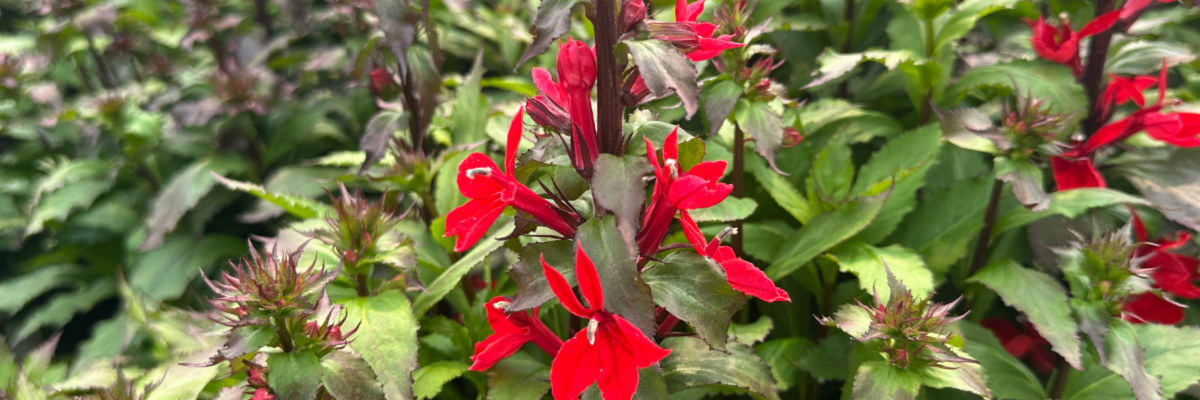
The Charismatic Cardinal Flower
| | |
August gardens can look a bit tired. It’s been a long hot summer and both plants and gardeners are running out of steam. Just when you’re ready to throw in the towel, a spike of vibrant red blooms emerges in the distance—the cardinal flower has arrived.
The cardinal flower (Lobelia cardinalis) is a native perennial of the bellflower family and is widely distributed in the eastern US and Canada, extending into northern South America. Hardy in zones 3-9 it will bloom in August through mid-fall in Ohio.
Moisture is a must for the cardinal flower and it will find a home on stream banks, marshlands, swamps and wet open bottom lands in full to part sun (as long as there's moisture). It grows to a robust 2-4 feet tall (even taller in ideal conditions) and 1-2 feet wide. The home gardener will find it useful at the back of the perennial border, in native gardens and in water gardens.
Lobelia cardinalis made its way to Europe in the 1600’s where it was given the common name cardinal flower after the bright red vestments worn by Roman Catholic cardinals. The five-lobed flowers (two upper, three lower) are found on showy spikes that quickly garner attention, even from a distance. The lanceolate leaves are bronze or purple tinged, adding more unexpected color.
The brilliant red flower stalks open from bottom to top as the season progresses. Hummingbirds, naturally drawn to red, are the primary pollinators but bees and butterflies are also attracted to its nectar. Cardinal flower is relatively pest free (including deer) though occasionally slugs can be an issue.
Cardinal flower and moss have similar habitat requirements and will frequently be seen growing together. You’ll know you’ve got a great location for cardinal flower if moss has already established itself. Moss acts as a living mulch, keeping the soil cool and retaining moisture. As an added bonus, bright green mosses provide a striking contrast to the brilliant red flowers. Other plants that pair well include ferns, great blue lobelia, swamp milkweed, white turtlehead, and blue flag iris, providing contrasting color and sharing the same moisture requirements.
Since cardinal flower does not spread via rhizomes or runners, it is propagated by seed or by dividing existing rosettes and replanting. After flowers die off in the fall, they are replaced by seed capsules which disperse and germinate in the spring. The plant is relatively short-lived (3-5 years) so it’s important that it self-seeds in wet, open soil. The seeds must make soil contact and be exposed to light to germinate. The cardinal flower rosettes are evergreen and if they are covered with falling leaves the viability of the plant is impacted.
Don’t give up on August gardening but plan ahead to keep the party going. Take advantage of any low, moist areas for this show-stopper. Watering might be necessary during prolonged dry spells but otherwise, just sit back and enjoy the brilliant display and let the hummingbirds announce that summer isn’t over yet!
LOBELIA CARDINALIS: NC State Extension
J Gramlich
| |
|
CREATURE FEATURE
Bad, Bad Bagworms
| |
This is not a pleasant topic. If you decide to skip this article and go on to the next, I wouldn’t blame you. But be forewarned—of all the creatures we’ve explored, this may be the sneakiest and most dastardly. Bagworms can cause major damage—even death—before you know it. So stay with me…we’ll get through this together.
Psychidae (bagworms) are a family of moths with over 1,300 species in the Lepidoptera order (butterflies and moths). The native evergreen bagworm is the most common bagworm species in Ohio (also called the common bagworm, unsurprisingly). This is bad because it is the most destructive of bagworms.
Let’s start at the beginning with the egg—eggs actually, as females lay between 500-1,000 each season. And here’s where bad turns sad. The eggs overwinter inside their mom’s dead body. Talk about a dysfunctional childhood…
The teensy larvae (1/25 of an inch!) hatch in May able to create strands of silk from their salivary glands. Some may send out strands to catch the wind and disperse, ballooning to new locations. This is how they appear where they’ve never been seen before.
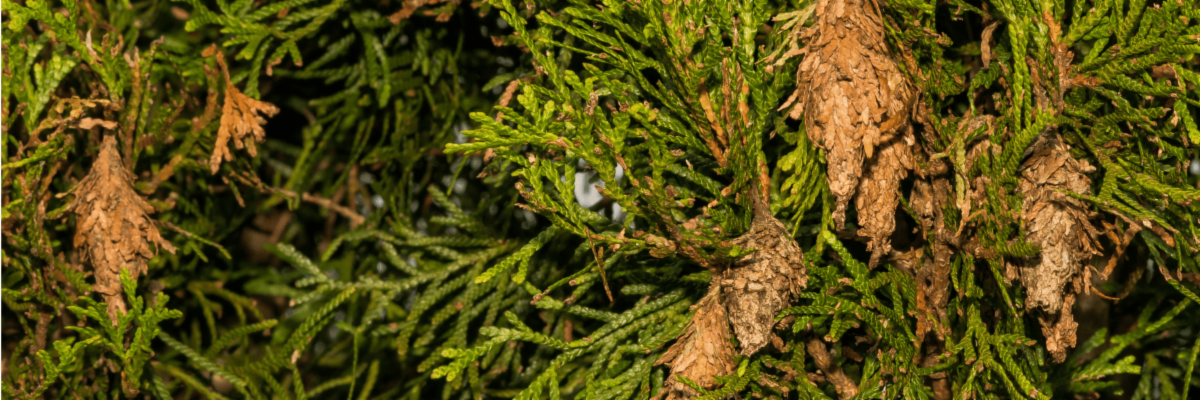
Most larvae stay put and use their silk to spin their namesake “bags”—cocoons initially about ¼ inch long. They attach these tiny homes to branches with silk, but will pack up and move if the local food supply runs dry. The bags have two exits—one at the top they poke out to feed from, and one at the bottom to get rid of their frass (poop pellets). The ultimate porta-potty.
Then the worms eat, eat, and eat some more. Needles, leaves, buds. Named for their fondness for evergreens such as arborvitae, spruce and juniper, they also feast on over 125 species of plants, including deciduous trees and shrubs like maple, oak and roses. (Infestations are generally most harmful to evergreens because needles don’t regenerate as easily as leaves.)
The foliage is gone—does that stop our bagworm? Oh no...that’s when they strip the bark off twigs and branches and feed on the sugary phloem underneath. These guys mean business.
The really scary part is you may not know this is happening. Sneaky bagworms, even as tiny larvae, are masters of camouflage. Initially covering their bags with pieces of frass, they later add bits of plant material. Predators and humans alike have a hard time spotting their cocoons, which resemble bunches of pine needles or cones hanging from a branch or leaf. New bags are greenish brown, turning grey as they age.
Over the next 10-12 weeks the larvae go through 7 instars. As they grow, they add to their bags until they’re 1-2 inches long. By late summer, larvae secure their bags to a branch and spin them shut, with themselves inside. The good news—they’ve stopped eating your tree. The bad news—the silk tying the bag to the tree may last for years and girdle the branch, killing it. There’s never really good news with these guys…
Inside the bags, larvae turn into pupae and then adults over a period of several weeks. Adult males emerge as small, hairy, black moths looking for love. And here’s where it gets really sad. Females never emerge. Wingless, and without working eyes or legs, they never leave the bag! They emit pheromones to bring love to them, and mate inside the bag. They lay their eggs and die—all in the bag. Males die shortly after mating. Geez. Makes Love Story look like a comedy.
I’d be sad if I never left that bag. And mad. And probably bad.
So now you understand the situation. What to do? First—a sharp eye is your best defense. Manually removing bags is a good (and past the larval stage is the only) option. Dump bags in soapy water or crush to destroy the eggs. See THIS. Check other woody plants besides evergreens, and don’t forget to snip the silk strands tying bags to branches. During the larval stage, insecticides are an option. Watch THIS.
Make nature your ally. There are many parasitoids, such as wasps and hornets, that feed on bagworms. Attract these and other predators by planting nectar-rich flowers nearby.
Who cares if those bagworms are bad, sad, or mad? You know what to do—so you are GLAD!
C Christian
| | |
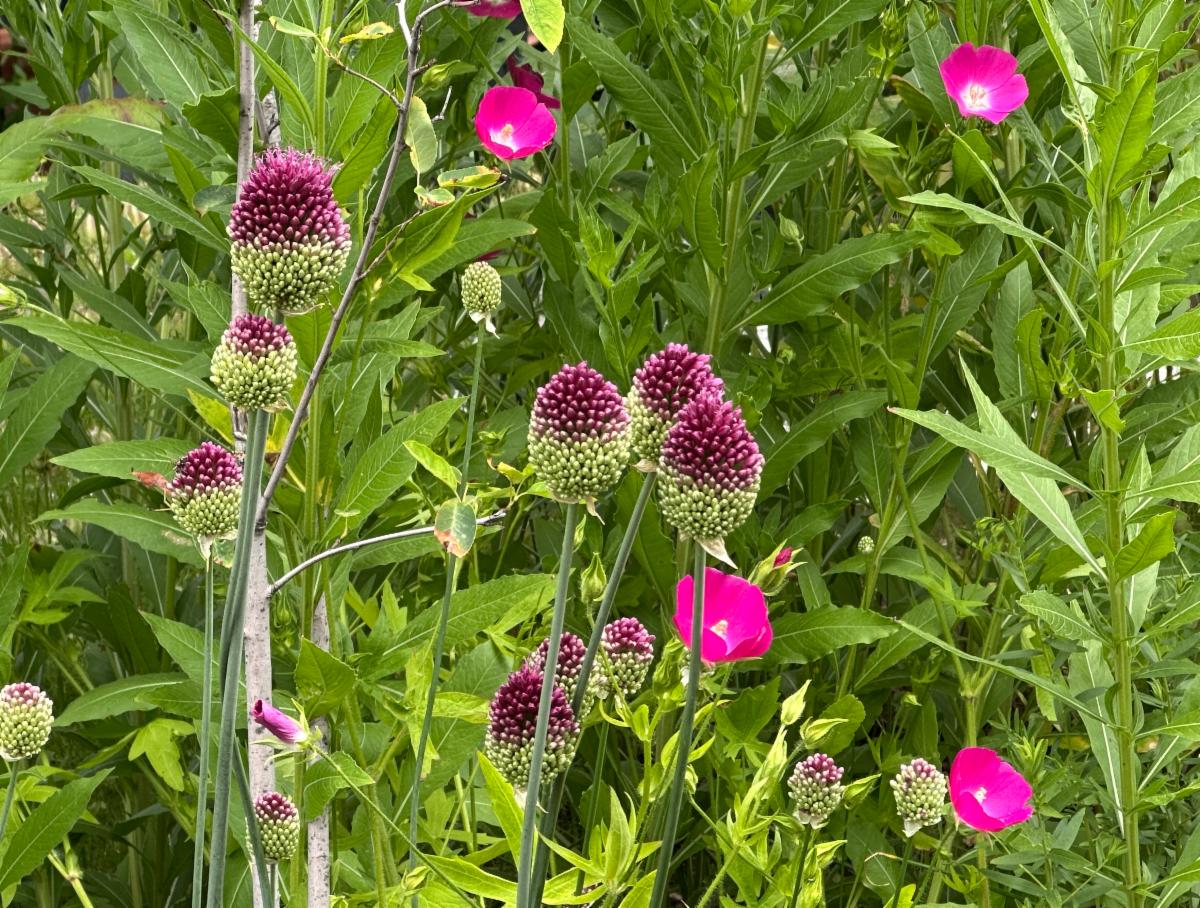
Drumstick allium plays nicely with poppy mallow.
photo by E Barth-Elias
| | |
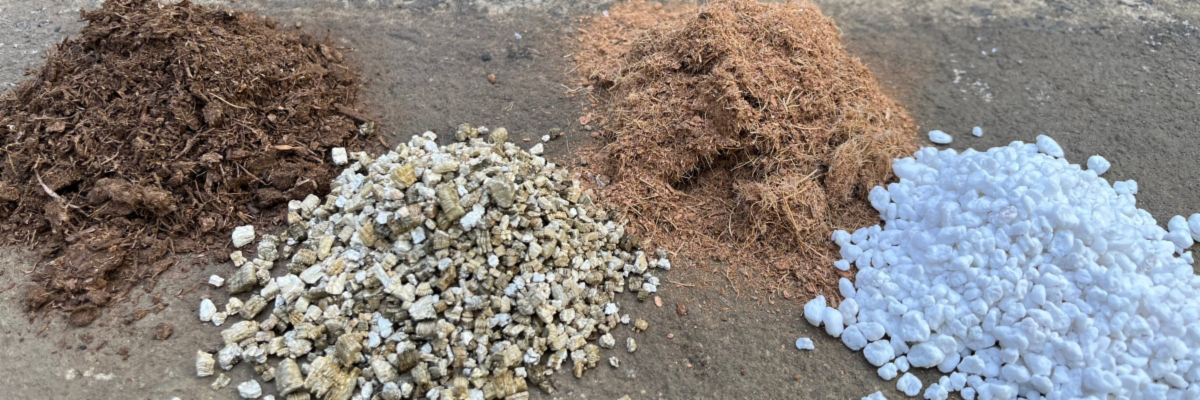
Left to right: Peat moss, vermiculite, coir, perlite
photo by K Edgington
| |
Rubber tires weren’t the only products that made Akron famous. Children’s books, farming equipment and fishing tackle were among other key industries underpinning Akron’s early economy. As Akron grew, so did its need for drainpipes. The area’s rich clay deposits made Akron a natural site for manufacturing clay products.
While this gift of the earth was instrumental in Akron’s early prosperity, clay soil has made local gardeners pull their hair out. This solid, malleable substance, from which so many useful products were fashioned, makes gardening difficult. Clay soil can be impermeable, requiring amendments for a garden to flourish. While searching for ways to break up the clay and create more drainage, gardeners found that adding peat moss seemed the perfect remedy.
Indeed, humans have used peat a variety of ways. Since Roman times, peat bricks have been cut and dried and used for heat. Indigenous peoples used it to dress wounds because of its anti-bacterial properties. It has also been used as dyes, to preserve food and as insulation for houses. It’s hard to beat peat.
Except for the downsides. Peat bogs are the result of thousands of years of compression and are terribly slow to regenerate. Harvesting peat releases trapped carbon dioxide into the atmosphere. It destroys wetland habitats and degrades water quality. Carbon stored in permafrost releases methane, a potent contributor to global climate change.
What’s a poor gardener to do? Luckily, there are excellent alternatives. Coco coir is the fibrous residue from the outer layer of a coconut. A waste product of the coconut industry, coir solves its disposal problem. It has excellent moisture retention, swelling to 8 to 10 times its weight. It also aerates the soil, giving roots air pockets to grow. Unlike peat, which is acidic, coir is pH neutral.
Compost is another alternative to peat. Already well-known as an excellent medium for seed starting and soil enhancement, compost provides the nutrients coir lacks. Using both compost and coir provides porous soil structure while feeding the plants. In some cases, people cover potting soil with rice hulls.
Other alternatives to peat are perlite and vermiculite. Perlite is a volcanic mineral that helps with soil drainage and doesn’t break down over time. It is so light it often floats during watering. It is sterile and pH neutral. Vermiculite is a naturally occurring mineral that expands when wet into accordion-like pellets. It is valued for moisture retention, soil aeration and insulation. However, vermiculite deposits are often found embedded in asbestos, creating yet another dilemma.
Many countries are beginning to ban peat harvesting because of its environmental impact. Luckily, there are decent alternatives. Go ahead and use up the peat moss you still have in your garage. Then switch to better alternatives. No sense wasting it, for peat’s sake.
NAVIGATING THE PEAT MOSS DEBATE: SUSTAINABLE GARDENING CHOICES: We Teach
PEAT MOSS AND SUSTAINABILITY: Cornell Extension
S Vradenburg
| | |
August Checklist:
- Keep deadheading perennials and annuals to promote blooms. Some annuals like alyssum and petunias can be pruned by half to rejuvenate.
- Reseed turf by late August so it has time to establish before cold weather.
- Water the garden if there has not been an inch of rain in the previous week.
- Fertilize roses for the last time.
- Keep weeding before plants go to seed.
- Clean up and deadhead perennials to prolong bloom time.
- Maximize your garden’s bounty by freezing or canning fruits and vegetables and drying herbs.
-
Sow leftover lettuce, radish, kale, turnip and carrot seeds for a fall harvest. FALL PLANTING FOR THE VEGETABLE GARDEN: Cornell Cooperative Extension
J Gramlich
| | |
And when thou art weary I'll find thee a bed of mosses and flowers to pillow thy head.
John Keats
| | |
More learning opportunities:
| | We invite you to share The Root of It with your friends and family. If you would like to subscribe to our mailing list please visit our website, scroll to the bottom, and click on the subscribe link. | | The Root of It staff: Karen Edgington (Editor), Emma Barth-Elias (Photo Editor), Carolyn Christian, Jennifer Gramlich, Sarah Vradenburg, and Geoff Kennedy (Technical Advisor) | |
We Would Like your Feedback
Contact us at: newsletterscmg@gmail.com
To discontinue receiving this newsletter please click on the UPDATE YOUR PROFILE link below. You may then choose what types of information you would like to receive from us.
| | | | |