|
|
Happy New Year from the Alliance!
As we say goodbye to 2023, The Alliance is reflective of our impressive accomplishments over the past 12 months. It was an exceptional year for the September 11th National Memorial Trail Alliance, thanks to all of you – our steadfast and generous supporters.
From the 9/11 Trail PA State Caucus, developing our partnership with the National Parks Service, to the 9/11 Trail itself, 2023 has truly been a remarkable year. The September 11th National Memorial Trail Alliance is looking forward to a year filled with new aspirations, new achievements, and new memories in 2024!
|
|
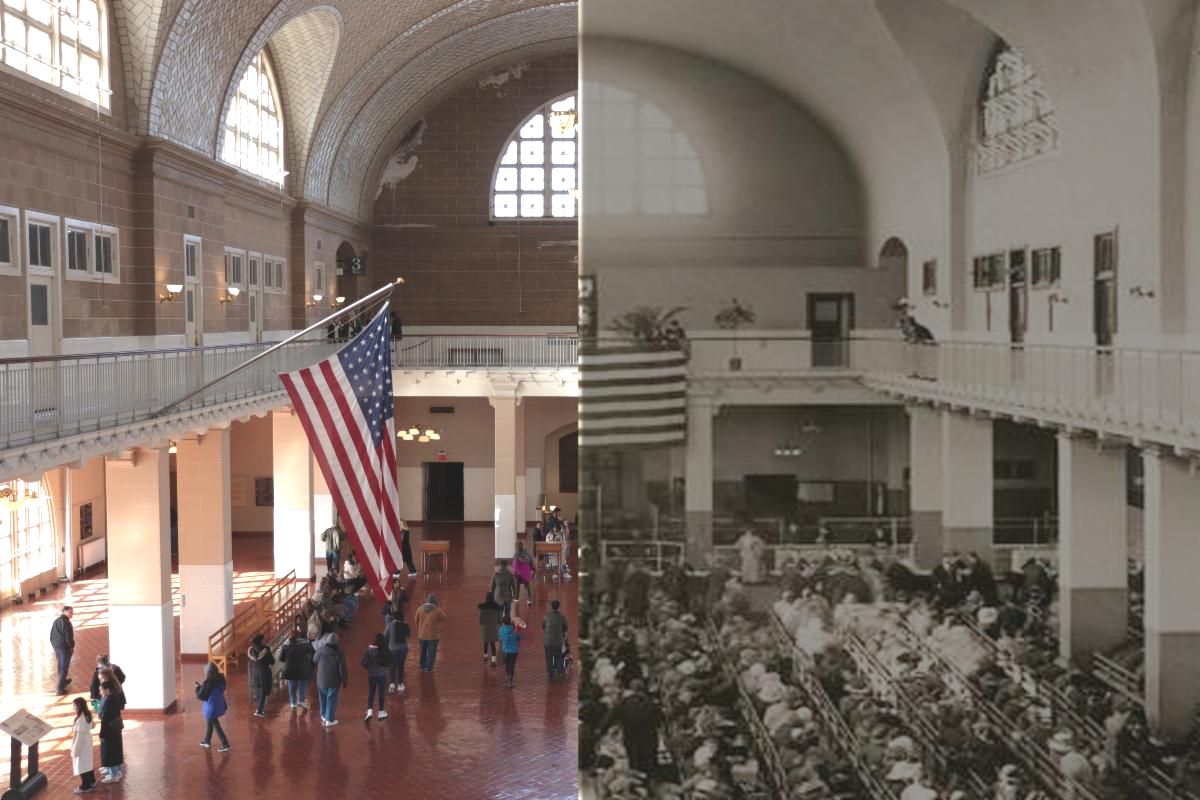
A Then and Now glance of Ellis Island's registry room in the main building. Photo on the left courtesy of Megan Bongiovanni. |
|
|
|
|
Then and Now: Ellis Island
Ellis Island, situated in New York Harbor and shared by the states of New Jersey and New York, is a federally-owned island. Functioning as the busiest immigrant inspection and processing station in the United States from 1892 to 1954, it processed nearly 12 million immigrants arriving at the Port of New York and New Jersey under federal law. Today, it forms part of the Statue of Liberty National Monument and is accessible to the public only by ferry. The north side hosts the main building, now a national immigration museum, while the south side, including the Ellis Island Immigrant Hospital, is open to the public only through guided tours.
During the 19th century, Ellis Island served as the location for Fort Gibson before later transforming into a naval magazine. The inaugural inspection station commenced operations in 1892 but suffered destruction from a fire in 1897. Subsequently, a second station was established in 1900, functioning as a facility for both medical quarantines and the processing of immigrants. After 1924, Ellis Island primarily functioned as a detention center for incoming immigrants, and during both World War I and World War II, the site was utilized by the U.S. military to detain prisoners of war. Following the closure of the immigration station, the structures experienced a period of neglect until a partial reopening in 1976. A bridge to Liberty State Park was built in 1986 for transporting materials and personnel during the island's late-1980s restoration. Originally slated to be torn down in 1992, it remained after construction was complete. The bridge is not open to the public. It wasn't until 1990 that the main building and adjacent structures underwent comprehensive renovation.
Located in Upper New York Bay, east of Liberty State Park, and north of Liberty Island, Ellis Island encompasses a unique geographical arrangement. While the majority of the island falls within Jersey City, New Jersey, a small segment functions as an exclave of New York City. Spanning a land area of 27.5 acres, a significant portion results from land reclamation. The natural island, along with contiguous areas totaling 4.68 acres, is positioned in the northern section of the current island and falls within New York jurisdiction, while the artificially created land is integrated into New Jersey. Since 1808, the island has been owned and administered by the Federal Government of the United States, with operational oversight transferred to the National Park Service in 1965.
The featured photographs depict the "Then and Now" comparison of Ellis Island's registry room in the main building. Positioned just north of Ellis Island, the September 11th Memorial Trail adds profound significance to the area. To enhance your experience, Liberty State Park provides access to the Liberty Landing Ferry, offering convenient transportation to Vesey Street, just a few blocks away from the 9/11 National Memorial and Museum in New York City. As the Alliance coordinates events throughout the year, supporters will have the opportunity this year to explore NYC and the surrounding area via the 9/11 National Memorial Trail in June. Stay tuned for more information including how to register in the next few weeks.
|
|
A beautiful sunset on the Potomac. Photo courtesy of The Potomac Heritage National Scenic Trail. |
|
|
|
|
Potomac Heritage National Scenic Trail
Welcome to our new 2024 monthly TrailBlazer series, where each month the Alliance will spotlight one of the National Parks along the 9/11 National Memorial Trail. We kick off the series with the Potomac Heritage National Scenic Trail.
The Potomac Heritage National Scenic Trail forms a developing network of locally managed land and water trails spanning from the mouth of the Potomac River to the Allegheny Highlands. Established in 1983 through an amendment to the National Trails System Act, the trail holds a significant place in the national trails system. Covering portions of five regions across three states, the District of Columbia, and 20 administrative units of the national park system, the designated trail corridors showcase distinct physical features and landscapes.
Despite existing gaps, collaborative efforts are underway among partners to create a continuous 929-mile trail. Presently, around 822 miles are in place, with the possibility of additional mileage as future water trails receive designation. The 1983 amendment permits the designation of trail "segments" beyond federally managed lands through formal agreements. This approach combines outdoor recreation with educational opportunities, creating a braided network of locally managed trails catering to various non-motorized experiences, including hiking, bicycling, fishing, backpacking, camping, horseback riding, paddling, and cross-country skiing.
The trail emphasizes accessibility, aspiring to provide equitable access for all visitors. As the population along the trail corridor grows and land use evolves the trail designation establishes an institutional framework involving communities, volunteers, government agencies, nonprofits, and business interests. This collaborative effort aims to conserve and develop exceptional education and outdoor recreation experiences along different trail segments. Recognized as vital contributors to local, regional, state, and national economies, outdoor recreation opportunities like the Potomac Heritage National Scenic Trail also play a crucial role in fostering healthy communities. Residents and visitors alike can explore diverse and historic natural landscapes and stories within the trail corridor. Explore today via the 9/11 National Memorial Trail!
See you on the Trail!
|
|
|
|
The September 11th National Memorial Trail Alliance in the News:
|
|
THANK YOU TO OUR COMMUNITY PARTNER
|
|
"As a major employer, landowner and member of many communities across the Greater Mid-Atlantic region, WM continues to work for a more sustainable tomorrow. We are committed to making positive social impacts through environmental education and conservation. This allows us to dedicate resources to fund programs that make a difference in people’s lives," Chris Farley – WM Area Vice President.
|
|
|
|
|
|
|