The Importance of
Play in Education
By Judge Margaret E. Pickard
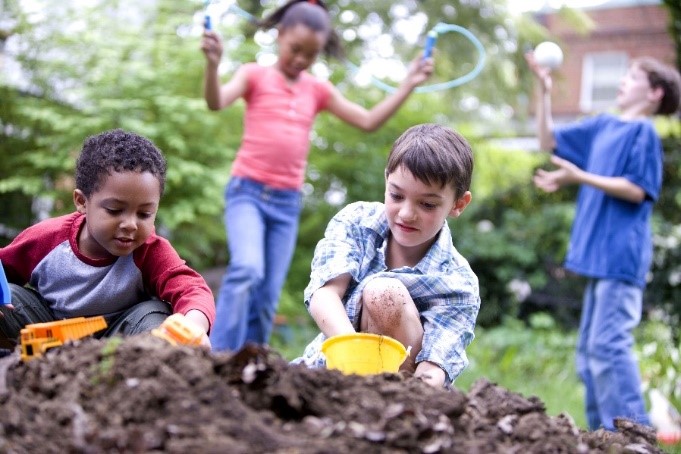
Play is vital for children’s cognitive, physical, social, and emotional well-being. The American Academy of Pediatrics reports that play is crucial for children to develop the executive functioning necessary for young children and youth to succeed in school and develop prosocial brains that allow them to interact positively with peers.[i] Unfortunately, children who come into the child welfare system often lack a supportive and nurturing caregiver who plays with them or interacts with them in a consistently positive way. This can lead to a variety of challenges that can and do impact a child’s ability to succeed in school, including an inability to self-regulate (e.g. sitting still in class, keeping their hands to themselves), difficulty interacting with peers (e.g., taking turns, sharing, controlling aggression), as well as challenges with structure and authority (e.g., listening to instructions, showing respect for teachers and administrators). CASA Volunteers can intervene and break this cycle by providing children an outlet to play and interact with mentors who can help mold positive behaviors in children and youth.
Play impacts brain development by promoting executive functioning, including the ability to plan, set goals, exhibit self-control, follow multi-step directions, and stay focused, just a fraction of the skills needed to succeed in a classroom. Play helps children and youth learn skills they need for school, work and relationships. This includes building confidence, self-esteem, resilience, social skills, independence, and curiosity.
While adversity can help children develop a host of positive characteristics such as persistence, self-control, conscientiousness, self-confidence and curiosity, adversity inhibits a child’s opportunity to safely explore their environment and play unencumbered by the stressors of their daily life. In fact, when children do not regularly engage in play, toxic stress builds in their brains and bodies and can impair their ability to succeed in school.
While it is easy to dismiss the importance of play in our busy lives, the reality is that play is how children learn about their environment, learn from their mistakes, understand their limits and boundaries, and gain self-confidence. A high school athlete who experiences success in their sport often has an over-abundance of self-confidence, while a child who struggles with having clean clothes for school, a jacket in the winter, or safety at home, often lacks self-confidence and feelings of self-worth. Unfortunately, children who come into the child welfare system are dealing with parental mental health or substance abuse issues, housing and/or food insecurity, violence in the home, or a myriad of other challenges, and have little time to play unhampered by the stresses of living in often chaotic, unstable, and even violent environments.
Children in the child welfare system need opportunities to play. The National Institute for Play defines play as the “state of mind that one has when absorbed in an activity that provides enjoyment and a suspension of time.” Play helps all of us, young and old, to explore feelings, develop self-discipline, express themselves, and deal with emotions. In 1909, the first recorded use of play therapy occurred when Sigmund Freud worked with “Little Hans,” a five-year-old boy suffering from phobic symptoms. Since that time, the importance of play therapy in working with young children has expanded dramatically. CASA Volunteers can take the first step by finding things that their children and youth enjoy doing and make a plan. It doesn’t have to be expensive, because play is as much about bonding with the people who you are with as it is about the activity itself.
And a reminder…. Play is not just for young children; it is also vital for pre-teens, teens and even adults! Play improves the ability to interact positively with others in a variety of situations, including sports, family, and even in the work place. Learning to share increases cooperation, taking turns allows us to acknowledge the needs of others, and losing gracefully helps us to become better individuals. CASA Volunteers can help children in the child welfare system to have opportunities to play and engage positively with others to allow them to develop the positive skills necessary to succeed in school and in life.
So, go out and play!
[i] Yogman, M. et al., The Power of Play: A Pediatric Role in Enhancing Development in Young Children, 142 PEDIATRICS 3 (September 2018).
|
|
LOCAL CASA VOLUNTEER IS MRS NEVADA
Tomilynn Clark, Mrs. Nevada America 2023, brings something special to pageant competition; she is a CASA volunteer who advocates for abused and neglected children. She won the title of Mrs. Nevada 2023, earlier this year. Her platform for the pageant called Ceilings, promotes the CASA Program.
Tomilynn became a CASA volunteer nearly two years ago, and has been pouring her heart and her energy into the program ever since. She has made it her mission to talk about the CASA program and recruit new volunteers at every given opportunity. She is also working toward becoming a volunteer peer coordinator, which is a coach/mentor for newly trained volunteers.
“I have chosen pageantry to lift my voice for what is important to me,” said Tomilynn Clark. “As a result of me being raised in foster care for the first seven years of my life, and living in 16 different homes, I personally understand what it feels like to be disposable and abandoned. Because I have been so fortunate to beat the odds, I feel it’s my obligation to prevent children from going through that type of trauma or to at least minimize the harm.”
On August 26, Tomilynn competed for the national crown of Mrs. America and was chosen by the other contestants as Ms. Congeniality. The Mrs. Nevada competition is the pageant that selects the representative for the state of Nevada in the Mrs. America competition. Tomilynn is using her platform to help children in need and the hope is that she will take it to the next level as Mrs. America – CASA volunteer.
|
|
BEST OF LAS VEGAS:
VOTE FOR CASA LAS VEGAS
Best Place to Volunteer
|
|
CHAMPIONS FOR CASA, Inc.
Champions for CASA, Inc. is a 501c3 non-profit and is the Auxiliary of the Eighth Judicial District Court’s CASA Program effective June 16, 2022.
Our Mission: Promote and support the work of the CASA Las Vegas program through recruitment, training, recognition of, and retention of CASA Las Vegas volunteers, so that every child in foster care in Clark County, NV can be represented.
|
|
Become a CASA Volunteer!
Are you interested in becoming a CASA volunteer? Maybe you know someone who would be a terrific child advocate. Court Appointed Special Advocate (CASA) volunteers are assigned by the Judge to advocate for the best interest of a child in foster care. Free informational meetings are scheduled (virtually) four times every month.
|
|
CASA Program of the Eighth Judicial District Court | 702.455.CASA (2272)
601 North Pecos Road, Las Vegas, NV 89101
|
|
|
|
|
|
|