e-Newsletter | February 12, 2021 |
|
Newburyport's Elbow Alley: A Fresh Look
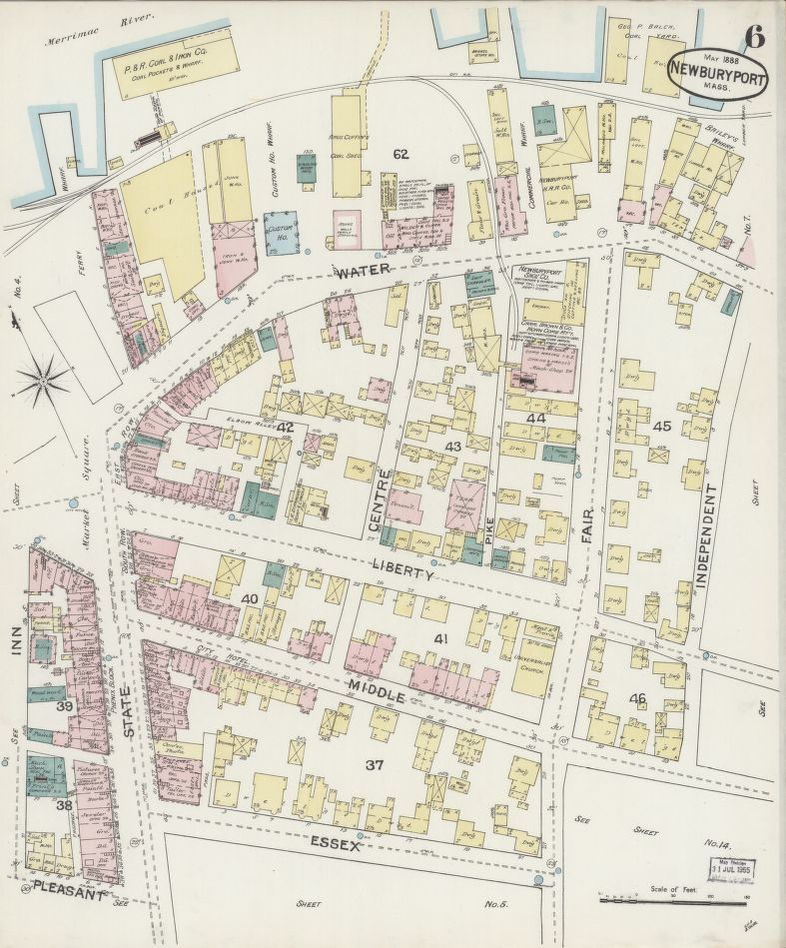
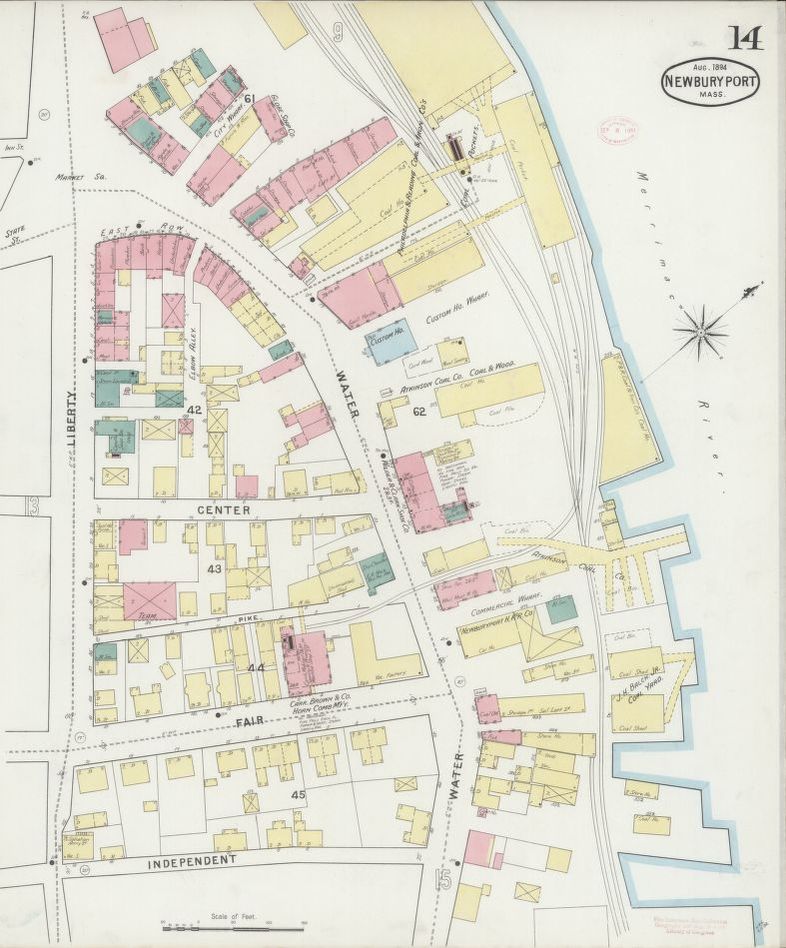
Elbow Alley is a road that has been lost to history, but at one time it was at the very center of Newburyport’s bustling business district. Sometimes called Elbow Lane, this small pathway connected Liberty Street to Water Street and was crooked at a severe right angle.
First recorded in 1764 and previously known as Cross Street, it served as a convenient shortcut from Market Square to the waterfront. During the late 19th century, Market Square hosted a number of successful Black-owned businesses with their proprietors' residences on Elbow Alley.
|
|
Elbow Alley, 1888 and 1894, Sanborn Fire Insurance Maps. Though it was lost in the mid-20th century, Elbow Alley would have run through today’s Daily News parking lots and behind Souffles. |
|
After the practice of slavery was abolished in 1783 in Massachusetts, the small African American community in Newburyport had to fight harder than any other to establish itself. Despite being free men and women, these Black citizens were still considered the lowest social class.
The merchants and ship captains of Newburyport continued to profit from the unpaid labor of enslaved people in the Caribbean, and the United States would not see the abolition of slavery for another 80-plus years. Even with fervent local Abolitionist zeal, led by impassioned people such as William Lloyd Garrison, upward mobility was by no means assured.
Despite these extreme social and economic barriers, the Black community held firm and slowly made gains. Many from this group worked in generalized positions as housekeepers, laborers and mariners. They formed a community around the intersection of today’s Low, Pond and Auburn Streets, known colloquially as Guinea Village in reference to the ancestral African homeland of some of the residents.
By the mid-19th century, the United States census shows that residents noted as “black or “mulatto” (those of mixed-race heritage), were moving into more specialized trades.
|
|
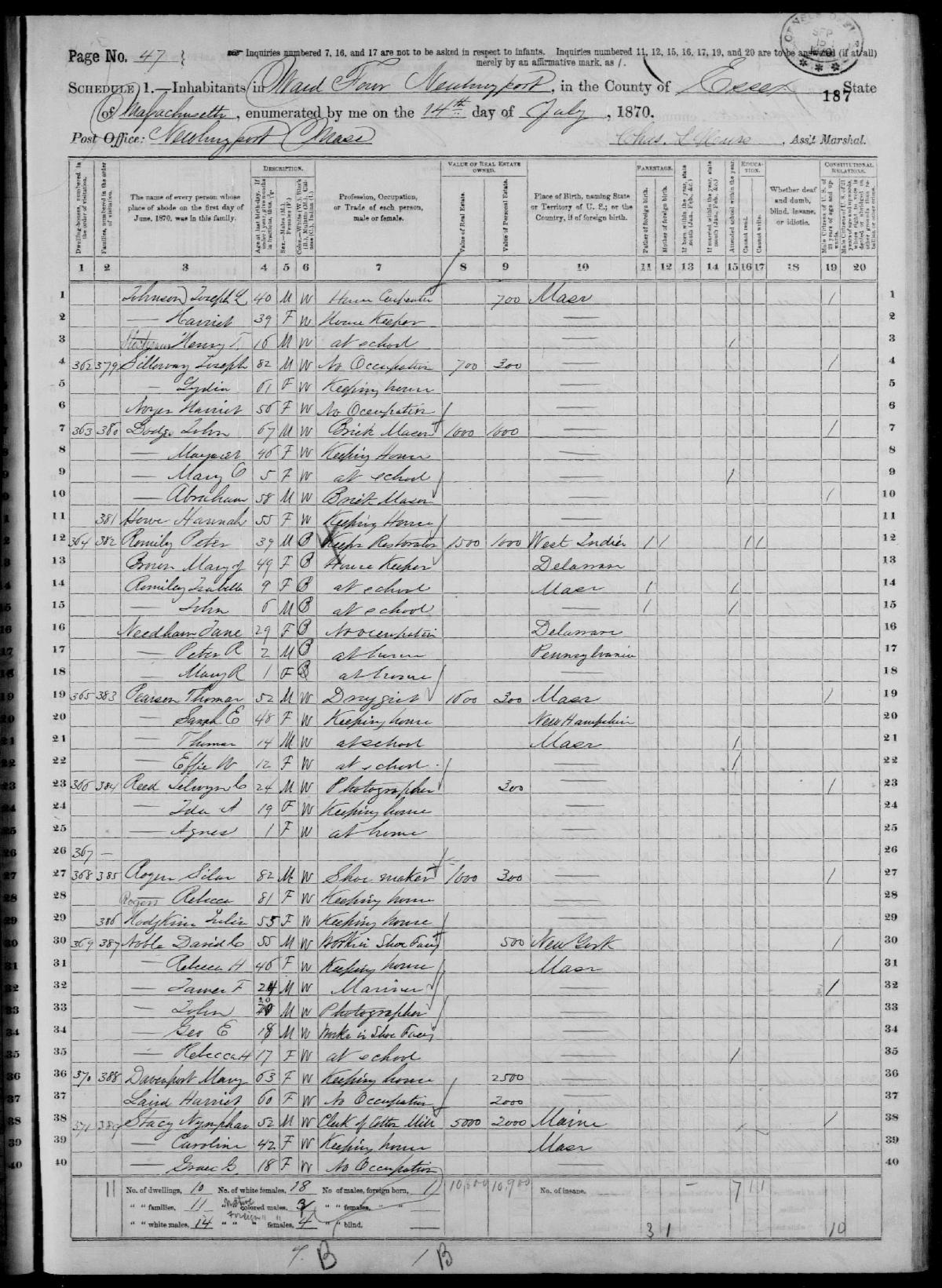
United States Census, 1870, Newburyport. |
|
Peter Romily, for example, was a native of the Caribbean who arrived in Newburyport on a vessel owned by Captain Robert Bayley. As a cook on board ships, his natural progression to “victualer” (or a person who sells food and provisions) by 1860 shows his hard-fought socio-economic ascent. The 1870 census records the 39-year-old’s occupation as “keeps restaurant” with real estate owed at the value of $1500. His business stood at the corner of Elbow Alley.
He was not alone, as there were other Black-owned businesses in the downtown area by the late 19th century. Andrew Raymond owned a barber shop in Market Square. John Young, whose residence was on Elbow Alley, also conducted a hairdressing and barber shop at 31 Merrimack Street. And James Law, a resident of Elbow Alley, was recorded as a mariner and cook, while his wife Lucinda was a laundress.
While the Black community was small, its presence in Newburyport’s business-district is significant. These individuals were overcoming the barriers and stigmas associated with enslavement and immigration and starting from the very bottom. Some were outsiders who came looking for opportunity, while others were building a life for themselves alongside the very families that enslaved their parents and ancestors.
There are many more stories of success trapped in the census records and city directories and with more research, we hope to bring them to light.
Editor's note: Inconsistencies in spelling of names, etc., are from the historical record and not a typographical error.
|
|
Behind the Scenes:
History Happenings
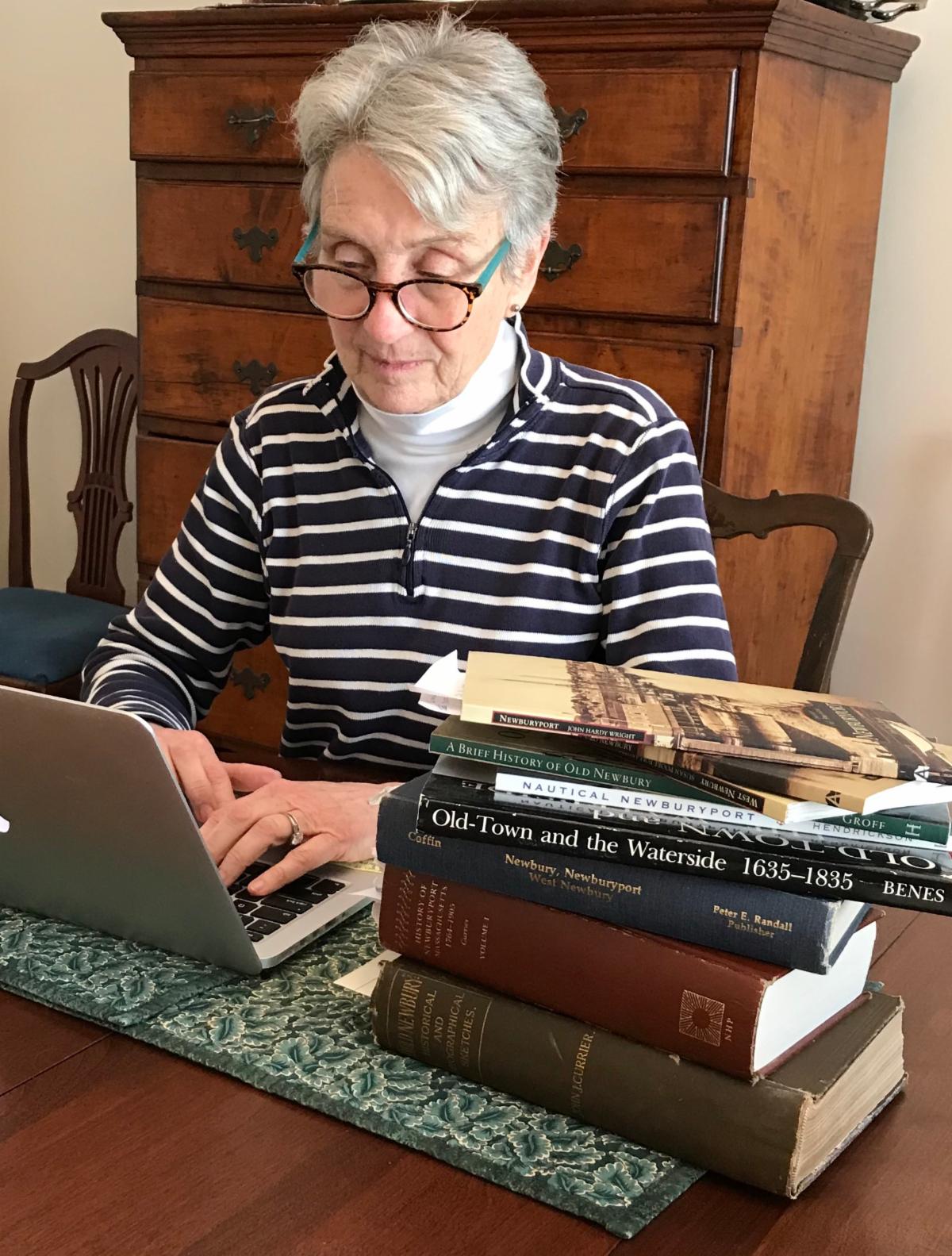
Meet Kate Carr. She is the dedicated volunteer behind Monday through Saturday's "History Happenings" found in the Newburyport Daily News and posted to social media ( Facebook, Instagram & Twitter).
Richard Lodge, editor of the Daily News, shares, "In the 4 1/2 years I've been here, I've received good feedback from readers who enjoy seeing a new historical tidbit every day about the city and neighboring communities. It's one of those little 'surprises' that are nice to see in the local newspaper, as well as online. From day one, I've appreciated how staff at the museum have compiled and crafted them for us to share."
With options for these tidbits that date as far back as the 17th century to the mid-20th century, Kate approaches each month by first looking at notable dates. For example, in this month of February she has Lincoln and Washington's birthdays, in addition to Valentine's Day. "If, like this year, Valentine's falls on a Sunday, I don't use it. [The Daily News is not published on Sundays.] I first check the Newburyport Public Library's online historical newspapers, looking not so much at obvious years, say that of birth or death. With so many online resources, I'm able to enter a name and research all the interesting events that have occurred over the centuries."
Her go-to tomes include Old Newbury: Historical And Biographical Sketches (1896) and both volumes of The History of Newburyport, Massachusetts, 1764-1905 (1906/1909), all three by John James Currier. She also taps Joshua Coffin's A Sketch of the History of Newbury, Newburyport and West Newbury from 1635 to 1845 (1845), as well as numerous other publications.
Every History Happening Kate creates includes the source name, original date, hyperlink and page number so the team at the museum can double check.
A graduate of Trinity College, Kate explains, "History is in my blood, by family and marriage. I grew up in Concord, Mass., learned to swim in Walden Pond and am married to a direct descendant of ferryman, George Carr (1599-1682)."
When not teasing out historical curiosities about our Newbury area, the mother of two adult sons runs the Concord Business Partnership and volunteers at the Newbury Food Pantry.
She continues, "I have so much fun doing these. The only challenge is to stop myself from falling in the proverbial rabbit hole. I get so caught up, then one thing leads to another and suddenly, I'm so immersed in the information, I forget to create the 'happening!''
As Kate completes her first calendar year of the production of History Happenings, the museum extends its heartfelt thanks for her creativity, enthusiasm and wit.
|
|
Learn about upcoming programs, register, find Zoom links and catch up on previous presentations here. |
|
Miss a Recent MOON Program? Watch here. |
|
Thanks to the wonder of the Zoom platform, all of our programs are recorded and available online shortly after presentation. Visit our website for upcoming events, previous recordings, including the four 2020 Virtual Garden Tours, our Annual Meeting, children's and holiday programs, as well as all episodes of "Yeat Yeat, Don't Tell Me!"
In lieu of a printed program book, we will be featuring monthly events here, as well as maintaining a complete list on our website: www.NewburyHistory.org.
All of our virtual programs are free, however donations are gratefully accepted to help defray speaker fees.
|
|
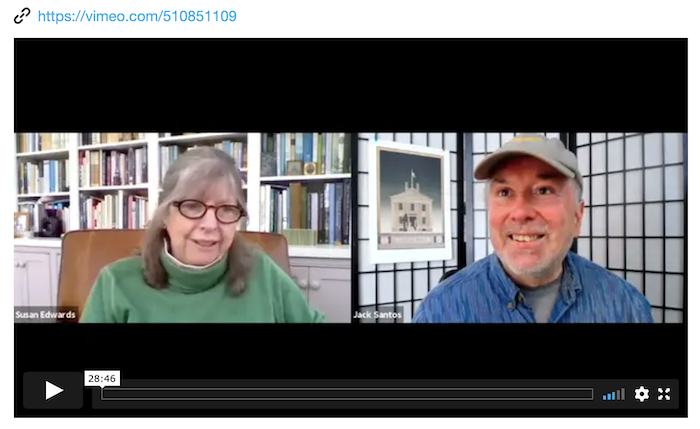
Jack Santos, Custom House Maritime Museum, is joined by special guest, Susan C.S. Edwards, executive director, Museum of Old Newbury, entertained viewers on February 5, 2021's episode of "Yeat Yeat, Don't Tell Me!" Watch here.
Mark your calendars and Zoom in on Friday, February 19, 2021, when Edward Carson, historian, community activist and Dean of Multicultural Education, the Governor's Academy, joins Jack and Colleen. Yeat Yeat, you don't want to miss this! |
|
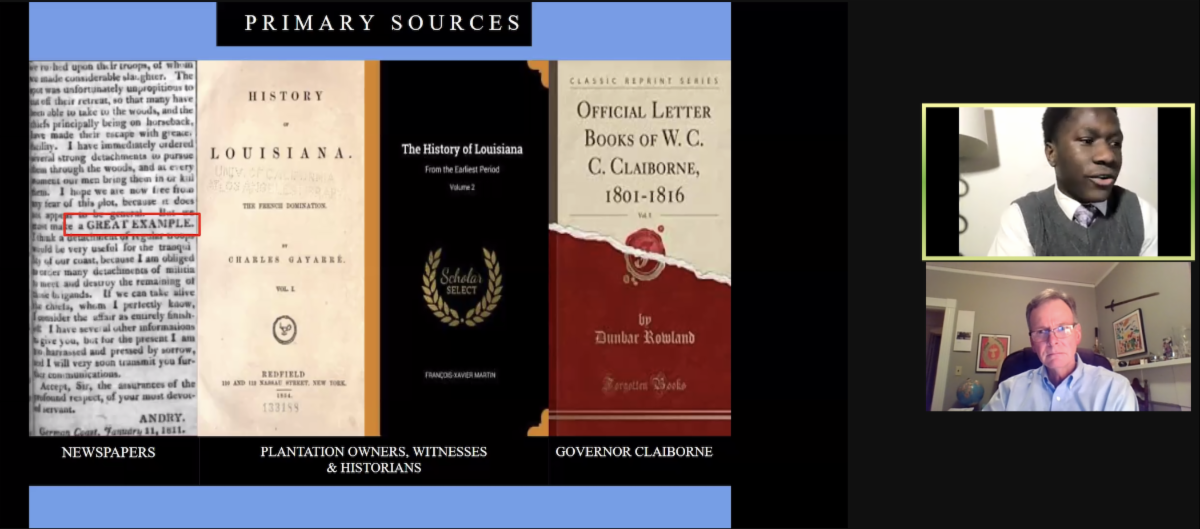
With a technical assist from mentor, advisor, teacher and friend, Bill Quigley, member of the history faculty at The Governor's Academy, as well as the founding director of the Academy's Writing Center, Bejunior Fallon, '21, kicks off the 8th season of student-lead symposia, held in partnership with the Museum of Old Newbury. His topic: "The German Coast Slave Rebellion of 1811." |
|
Bejunior Fallon, '21, school president in his senior year at The Governor's Academy, kicked off this year's student symposium presenting a dynamic and fascinating historiographic analysis about the largest, bloodiest slave revolt in American history that is lost in history. Nothing stands to mark it but a shabby slave cabin converted into a makeshift museum and a neglected marker on a lonely roadside.
With fearful savagery, authorities crushed the uprising and buried it in falsehoods. Watch here as Fallon digs into that false history, exposing distortions of the truth caused by the deep-seated American construct of race. Over 75 people attended the Zoom program. Watch here.
|
|
It's not too late to Register!
February 25, 2021: Newbury and Warfare on the New England Frontier, 1689-1748. Presented by Dr. Steven C. Eames, director of history and interdisciplinary studies at Mount Ida College. His research will focus on the effect of war on soldiers and civilians, with a focus on early American history. He is the author of Rustic Warriors: Warfare and the Provincial Soldier on the New England Frontier, 1689-1748 (New York University Press). Register here.
|
|
March Programs...Register Now! |
|
REGISTER: Thursday, March 11, 2021
More than a Tea Party: Tea's Social & Political Symbolism. Talia Jachimowicz, '21, The Governor's Academy, takes a look at tea, taxes and the American Revolution.
|
|
REGISTER: Thursday, March 25, 2021
Naomi Wade: A British Woman in 18th Century New England. Meet an 18th century woman from London who became a camp follower with a British Regiment during the American War for Independence.
|
|
Puzzle Me This...
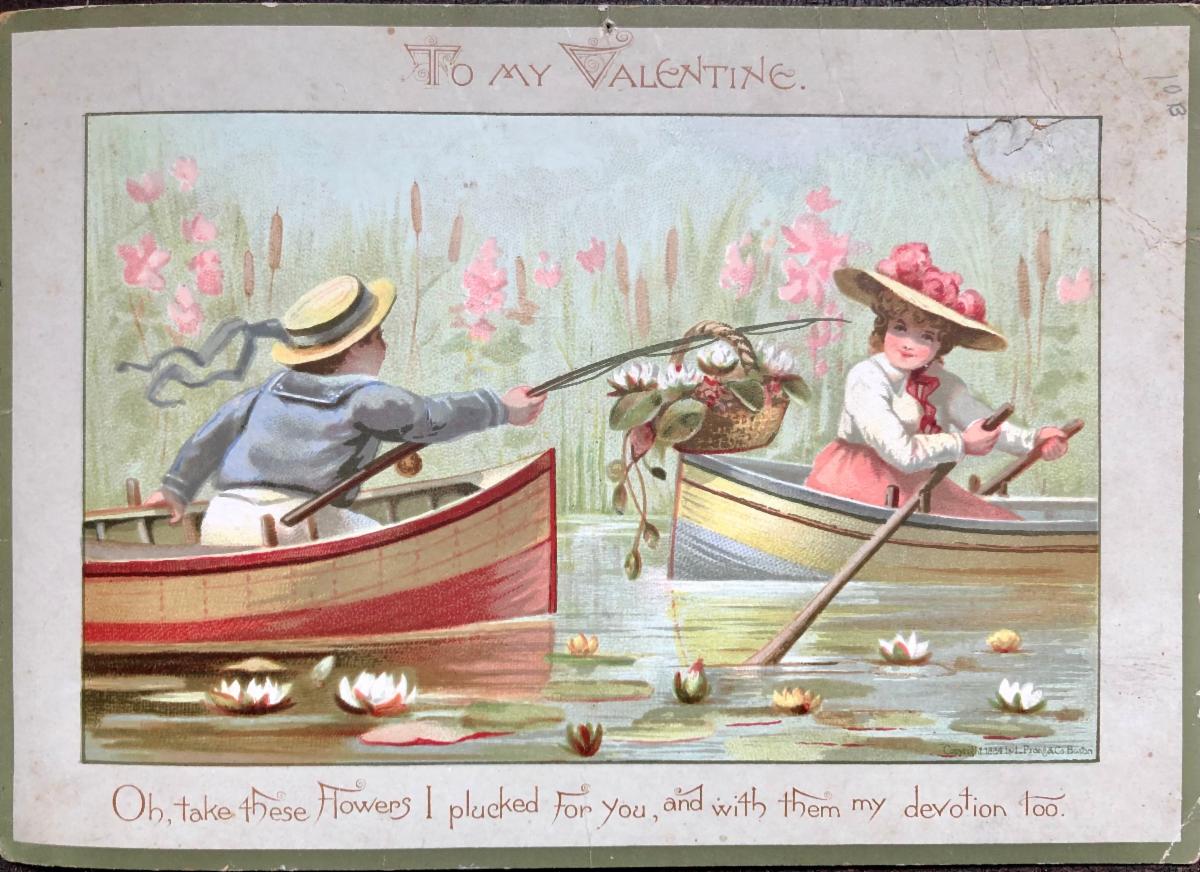
A postcard that reads, "To my Valentine. Oh, take these flowers I plucked for you, and with them my devotion too." Copyright 1884 by L. Prang & Co. Boston. From the collections of the Museum of Old Newbury.
Click on the image to begin.
|
|
Something is Always Cooking at the Museum
Nothing says Valentine's Day like a scrumptious chocolate treat. Elizabeth Dix shares her traditional silk pie with us. If trying to save calories, serve the filling only in fancy stemware. NOTE: one square unsweetened chocolate equals one ounce.
French Chocolate Pie
Crust
1 1/2 cups crumbled corn flakes
3 tablespoons melted butter
2 tablespoons sugar
Mix together and press into a pie plate. Bake 10 minutes at 350ºF.
Filling
1/4 pound butter, softened
3/4 cup sugar
2 squares unsweetened chocolate, melted
1 teaspoon vanilla
3 eggs
Using an electric mixer, beat butter and sugar until smooth. Add the melted chocolate, vanilla and 1 egg and beat for 5 minutes. Add the second egg and beat for 5 minutes. Add the third egg and beat for 5 minutes. Pour filling into the baked pie crust and refrigerate for a least 4 hours.
|
|
During this difficult period of COVID-19, we rely on your support more than ever. We are working to reschedule many of the programs that we have had to postpone, as well as develop new, online programs for you to enjoy and keep us connected. We hope, if you are able, that you will consider a donation to the museum. Thank you for your continued support.
|
|
Museum e-Newsletter made possible through the
generosity of our sponsors:
|
|
|
Museum of Old Newbury
98 High Street
Newburyport, MA 01950
978-462-2681
|
|
|
|
|
|
|
|