PacIOOS Tools and Instruments |
|
Water Quality Data Interpretation |
|
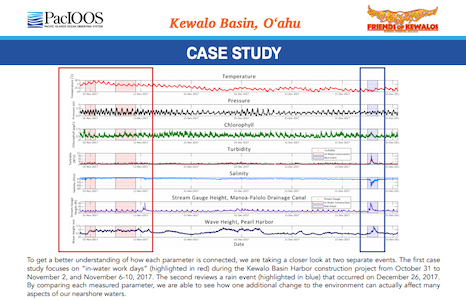
Data interpretation of two PacIOOS Water Quality Sensor Partnership Program projects are now available on the PacIOOS website. The Friends of Kewalos utilized a nearshore sensor to monitor water quality during the Kewalo Basin Pier Repair-Improvement and Boat Slip Addition. Mālama Maunalua utilized the sensor to monitor sediment loads and water input at Wai‘alae Beach Park towards the western end of Maunalua Bay, O‘ahu. The data interpretations include discussions of the collected data and case studies. The information can also be downloaded as a handy summary sheet for Kewalo Basin and Maunalua Bay. [Photo: The informational summary sheets include a case study to further examine the data set.] |
|
Tracking Three New Tiger Shark Ladies |
|
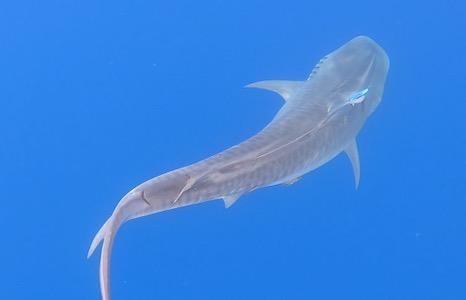
Researchers from the Hawai‘i Institute of Marine Biology Shark Research Lab tagged three female 9-10 foot tiger sharks around O‘ahu. The satellite tags record GPS locations and also collect ocean temperature profile data while the tiger sharks swim through the water. The tags are attached to the dorsal fin and data are transmitted whenever the dorsal fin surfaces. So far, one of the sharks (#176025) has spent time at Penguin Banks near Moloka‘i and along the South Shore of O‘ahu, while the other two preferred areas on the windward side of O‘ahu. All tiger shark tracks are available on the PacIOOS website. Please note, this is not a warning system and data are not transmitted in real-time. [Photo: A female tiger shark swims off after being tagged with the latest generation of satellite tags. Credit: Julia Hartl] |
|
PacIOOS Executive Committee Meeting |
|
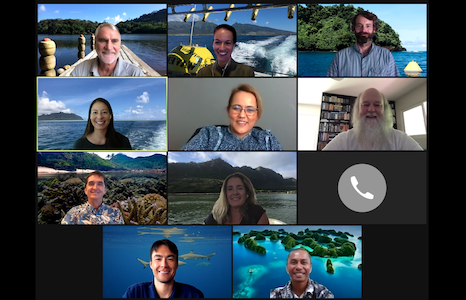
Members of the PacIOOS Governing Council Executive Committee came together virtually for their annual meeting. In a 2-session video conference, PacIOOS leadership provided the most recent programmatic updates and an overview of the anticipated budget. Committee members discussed examples on how to incorporate Indigenous knowledge and community-led conservation into ocean observing, and shared regional nuances of Justice, Equity, Diversity, and Inclusion (JEDI) within the Pacific Islands and how to advance it. [Photo: Executive Committee members and PacIOOS staff meet online.] |
|
Ocean Visions 2021 Summit |
|
Hosted by the Scripps Institution of Oceanography, the virtual Ocean Visions 2021 Summit brought together international researchers, innovators, decision-makers, funders and others to develop roadmaps for solving great ocean challenges. With the theme Towards a Global Ecosystem for Ocean Solutions, topics of discussion included ocean-based solutions to climate, equitable coastal solutions strategies for resilience and adaptation, marine circular economies, ocean and human health, and how to transform research from academia into sustainable businesses. PacIOOS contributed to America's Networking Session and provided a brief summary of the development of the West Maui wave run-up forecast. |
|
Exploring the Ocean from Different Angles |
|
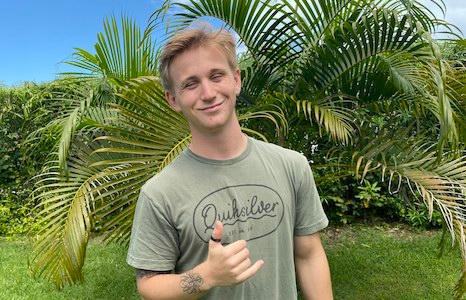
Nathaniel Greenwald has always had a curiosity for the ocean, its natural processes, and the animals that live in it. He currently is an undergraduate student in Marine Science at the University of Hawai‘i at Hilo ( UHH). Under the supervision of UHH professor and PacIOOS co-investigator Steven Colbert, Nathaniel supports the maintenance of the water quality buoys in Pelekane Bay and Hilo Bay, which includes preparing and trailering the boat, cleaning the buoys and sensors, and analyzing the data.
Nathaniel finds the field experiences very valuable to get a better understanding of the types of work to pursue after college. Being in the field requires thorough logistical thinking and developing creative problem solving skills when things don't go as planned. While Nathaniel spends a lot of his spare time in the water swimming, free diving, snorkeling, and SCUBA diving, working with the PacIOOS buoys allows him to learn additional on-boat, in-water, technical and maintenance skills. Combining his interest for photography, his passion for ocean science, and his drive for adventure in new places, Nathaniel is hoping to become a National Geographic marine photographer one day. |
|
|
|
|
|
|