March 13, 2020
The Out-of-Pocket Health News Digest
|
|
Below you will find briefs about recent health policy news stories. Our hope is for students to have an information outlet at their fingertips to keep up-to-date with the most pressing news stories in health policy.
This compilation is produced by the HPSA Education Committee: Sharoni Bandyopadhyay, Matthew Dunn, Payton Watt and Courtney Zott.
|
|
Court Blocks Michigan’s Medicaid Work Requirements
|
|
A federal district court struck down on March 4 new requirements that Michigan Medicaid enrollees be working or participating in other eligible activities.
The decision from the U.S. District Court for the District of Columbia comes after Michigan has already spent $30 million on implementation of the program since it took effect January 1, the director of Michigan’s Department of Health Human Services Robert Gordon
told The Detroit News
. The department had also been poised before the ruling to send notices to more than 80,000 residents that they had not met the requirements and were therefore at risk of losing their benefits.
Michigan’s program required enrollees to report 80 hours of work or other qualifying activities every three months. Those other activities could include going to school, participating in job training, searching for a job, volunteering at a nonprofit, and getting treated for alcohol or drug addiction.
In its ruling, the court emphasized the same argument that has been made to strike down other Medicaid work requirement programs in other states: Medicaid is an entitlement and cannot be conditioned on employment status. A Republican state lawmaker from Michigan told The Detroit News that the Trump administration plans to appeal the decision.
|
|
Delay in U.S. COVID-19 Testing Leads to Rapid Spread
|
|
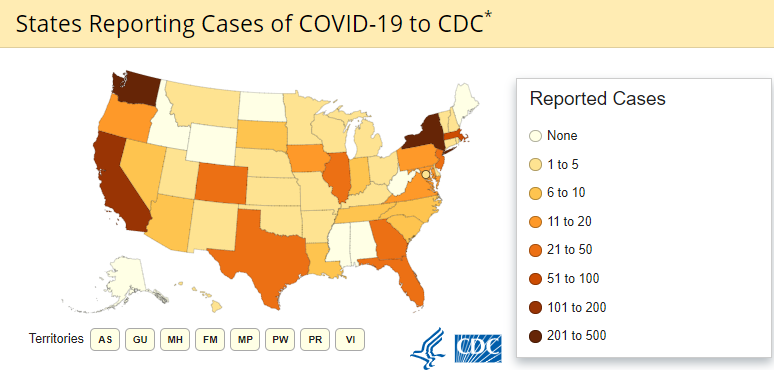
The U.S. lost a significant amount of time that could have been used for testing for various reasons. Firstly, when officials first heard of the virus spreading in China, they
focused efforts on keeping the virus outside
of the country, rather than assembling emergency preparedness teams. This could partly be due to
budget cuts to the National Security Council
in 2019. Secondly, the CDC
did not send test kits
to laboratories across the country until the beginning of February, a month after the spread of the virus throughout China. Thirdly, tests were originally administered
only to individuals who met specific criteria
, such as having traveled to China, and could not have been ordered based on physician discretion alone. Lastly, the CDC only allowed hospitals to use their own laboratories
after February 29th
-- before then, all samples had to be analyzed at the CDC.
The U.S. severely lags behind other countries in the
number
of administered tests as well. South Korea has completed
more than 140,000 tests
and has created a drive-through system where individuals swab on the spot and receive results within 30 minutes. In addition, at about the same time period from when the United Kingdom discovered their first case, they had already rolled out over 15,000 tests. The U.S. has completed
11,079
tests . Moving forward, the Trump administration has promised to send out 1.5 million tests by the end of this week, but the
reality is projected to be about 500,000
. In order to truly understand the extent of the problem to get it under control, efficient testing is a must.
|
|
Policy and Legal Responses to Coronavirus
|
|
As coronavirus continues to spread, there are a number of policy options under consideration. Last week, U.S. Congress approved a coronavirus funding bill that allocated
$8.3 billion
toward treating and preventing spread of the disease. This week, Congress is debating an stimulus bill that would ideally provide economic relief, but currently there is significant disagreement over what to include in the bill. House Democrats want the stimulus to emphasize expanding the safety net for those impacted by coronavirus, including
mandatory paid sick leave
. However, Trump and Senate Republicans
are blocking this provision
, and pushing for a general payroll tax instead. With the parties far apart on the details, an economic stimulus is not expected to pass this week.
There has also been response at the state level. Many states have made emergency declaration, which allows the government to
side-step certain laws
, typically with the purpose of making it easier to allocate resources to the crisis response. For instance, California’s declaration temporarily removes restrictions that would otherwise prevent out-of-state doctors and nurses from providing assistance. Colorado Gov. Jared Polis
just announced
an emergency rule to provide paid leave to hundreds of thousands of service and hospitality workers in the state.
Finally, the judiciary can also play a role in times of emergency. On Tuesday, March 10, the state of Missouri filed a lawsuit against televangelist Jim Bakker, who advertised a silver-containing product as a treatment for coronavirus -
an entirely false claim
. The state is requesting a permanent injunction to order Bakker to stop all advertising and sale of the fraudulent product.
|
|
- Health IT: HHS and CMS finalize data interoperability rules for health care, aiming to allow patients to own their health records and promote health data exchange between health care organizations. (Modern Healthcare)
- Women's Health: Senator Maggie Hassan inquired for information about guidelines surrounding educational procedures from the Association of American Medical Colleges and 5 other groups in response to reports of non-consensual pelvic exams performed by students on women under anesthesia for the purpose of medical education. (NYT)
- ACA: The Supreme Court has agreed to review the Texas vs. US case aiming to repeal the ACA this fall, with a decision expected in 2021. (Washington Post)
- Global Health: Thousands of women in Mexico participated in A Day without Women, protesting femicide and violence against women; gender-motivated killings have increased by 137% over the past 5 years, with most unsolved. (Reuters)
- Insurance Coverage: California joins other states in restricting the sale of “alternatives to health insurance,” which are unregulated plans that offer little to no coverage and do not comply with the ACA, but continue to be increasingly attractive to consumers due to their low cost and misleading marketing. (NYT)
|
|
|
|
|
|
|