Weekly update from the National Housing Conference | |
News from Washington | By Brittany Webb
| | |
President’s budget proposes unprecedented cuts, eliminates housing programs
The Trump administration released its FY26 “skinny” budget proposal and accompanying fact sheet proposing a nearly 44% cut to the Department of Housing and Urban Development’s (HUD), eliminating many vital housing programs. Overall, the proposal cuts non-defense spending by $163 billion (16.6%), while increasing defense spending by $119 billion (13.4%).
The proposal slashes HUD discretionary funding, targeting tenant-based rental assistance (TBRA) programs, including Housing Choice Vouchers (HCVs). It consolidates TBRA, Project-Based Rental Assistance (PBRA), Public Housing, Housing for the Elderly, and Housing for Persons with Disabilities into one State Rental Assistance Block Grant, cutting total funding from $62.6 billion in FY25 to $35.9 billion, a $26.7 billion reduction. The budget also proposes a two-year cap on rental assistance for able-bodied adults.
TBRA supports more than 2.3 million households, an estimated 5 million people, though only one in four eligible households receives assistance due to funding restrictions. Among HCV recipients, 75% are extremely low income, 36% have a head of household who has a disability, 25% are elderly, and 39% include children.
It would further eliminate the HOME Investment Partnerships (HOME) Program, Community Development Block Grants, and PRO Housing Grants, and make significant cuts and changes to Continuum of Care grants, HOPWA, and other programs including fair housing initiatives and Native American Programs.
Although the budget preserves and increases rental assistance grants linked to $9 billion in USDA-underwritten multifamily housing loans, it makes significant cuts to Rural Development programs including by eliminating single-family housing direct loans, self-help housing grants, and rural housing vouchers.
The budget also calls for eliminating NeighborWorks America, a nonprofit congressionally chartered to support community development. The administration cites government downsizing and waste reduction, despite NeighborWorks leveraging its FY24 federal appropriation at a 71:1 ratio. NHC recently issued a call to action in support of its continued funding.
Finally, the budget proposes eliminating the CDFI Fund Discretionary Awards ($291 million), targeting funds tied to racial equity, and establishing a new Rural Financial Award Program ($100 million) requiring 60% of CDFI lending and investments to rural areas.
| | | |
Partnering with NHC’s Housing Visionary Awards Gala and its distinguished honorees elevates your organization’s visibility, deepens engagement, and opens the door to valuable networking with over 500 influential housing leaders and stakeholders.
We offer sponsorship levels tailored to fit every organization’s needs – starting at $3,500 up to $50,000. Depending on your sponsorship level, benefits could include:
- Additional Gala tickets.
- A Gala Tribute Book ad.
- Listing in the Gala Tribute Book.
- Listing in printed and electronic marketing materials.
- Acknowledgement in opening and closing media presentations.
- Prominent listing of company logo, name, and website link on the event website.
- Recognition in Gala opening remarks.
- Recognition as a Networking Reception sponsor or as a Dessert Reception sponsor.
Tribute Book ads are available from $750 for a quarter-page to $2,500 for a full-page placement. Tickets are $1,000, but NHC members at or above the Full membership level receive half-price tickets.
For more information, please contact NHC's COO Amanda Mitchell at amitchell@nhc.org.
| | | |  | | |
AHCIA reintroduced in the Senate
Senators Todd Young (R-Ind.), Maria Cantwell (D-Wash.), Marsha Blackburn (R-Tenn.), and Ron Wyden (D-Ore.) have reintroduced the Affordable Housing Credit Improvement Act (AHCIA), legislation strongly supported by NHC that would help build 1.6 million new affordable homes over a decade. AHCIA would expand and strengthen the Low-Income Housing Tax Credit (LIHTC), the nation’s most successful affordable housing production tool that has already built or restored four million affordable housing units. The Senate version of the bill was introduced with 30 original cosponsors split evenly among Democrats and Republicans. An identical version (H.R. 2725) was reintroduced in the House several weeks earlier.
Key provisions of AHCIA would lower the so-called “50% test” for financing, make the 2018 12.5% allocation increase permanent, mitigate NIMBY opposition by removing outdated regulations, and strengthen the program to better serve specific populations such as veterans, victims of domestic violence, formerly homeless students, Native American communities, and rural Americans. The legislation has been introduced the last five consecutive congresses and built broad bipartisan and housing stakeholder support consistently through the years.
“The overwhelming bipartisan support for the Affordable Housing Credit Improvement Act of 2025 underscores the critical need to increase the supply of affordable rental homes,” said Affordable Housing Tax Credit Coalition Chief Executive Officer Emily Cadik.
A letter of support from local leaders is currently being circulated for signatures by the ACTION Campaign, with a deadline of May 6 for mayors, county executives, county board chairs, and other local elected officials to encourage Congress to pass the AHCIA.
“Housing inflation is up 4% over the past year nationally and 4.5% in the Pacific Northwest – and that was before homebuilders reported an additional 5.5% increase in costs due to tariffs this year,” said Sen. Cantwell. “We need to do more to lower housing costs for everyone. Expanding and improving the Low-Income Housing Tax Credit will do just that by making it more affordable to build homes and lower rents.”
| | | |
CFPB mass firings paused, GAO to investigate
The U.S. Government Accountability Office (GAO) has agreed to investigate actions being taken to shut down the Consumer Financial Protection Bureau (CFPB), following a request from more than 40 Democratic Senators. The request cites the flurry of terminations that has reduced the agency’s workforce from 1,700 to just 200 employees, who are now responsible for running all operations.
“On April 17, you tried to fire nearly all of the agency’s remaining 1,700 employees—the staff responsible for fulfilling the CFPB’s mission and statutory requirements to prevent Americans from getting scammed by big banks and giant corporations,” the letter reads. “Your hasty and unjustified mass firings are an illegal shutdown of the CFPB that will leave it unable to conduct agency actions that are required by law.” It goes on to request a detailed account of how each of the CFPB’s 80 statutory obligations will be fulfilled, including how many employees were assigned to each obligation before and after the rushed reduction.
A U.S. appeals court further restored a temporary block on mass layoffs at the CFPB, stating it was necessary in order to preserve the legal protections of employees while the case is open.
| | | |
FHA to again limit post-foreclosure sales to 15 days on REO properties
The Federal Housing Administration (FHA) is rescinding a Biden-era policy to boost nonprofit and government participation in post-foreclosure property sales. In a 2022 Mortgagee Letter (ML), FHA expanded the exclusive listing period from 15 to 30 days for owner-occupant buyers, HUD-approved nonprofits, government entities for both HUD real estate-owned properties, and properties in the FHA's Claims Without Conveyance of Title process (CWCOT). The 2022 ML noted that the properties “typically only require cosmetic repairs or non-structural repairs up to $10,000, which makes them more desirable for Owner-Occupants, Governmental Entities, and HUD-approved Nonprofits” and sought to increase housing available to first-time and low- and moderate-income buyers.
The new ML 2025-13 cites dissatisfactory and insubstantial results from the expanded listing period as the principal reason for the rescission.
“HUD data over the past several years show, at best, mixed results from these efforts,” the letter reads. “During the new CWCOT exclusive listing period, very few properties have sold to owner-occupant buyers and even fewer were purchased by HUD-approved nonprofits and government entities.”
The FHA will also update the Single Family Housing Policy Handbook 4000.1 to reflect these changes.
| | | |
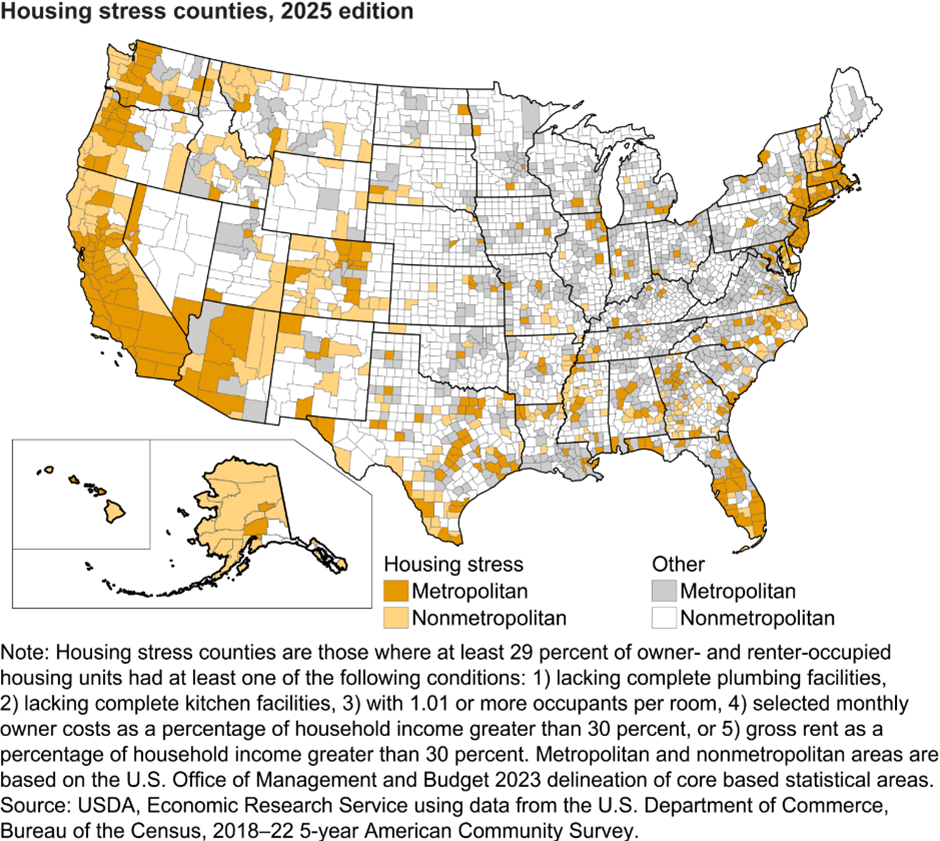
Widespread housing stress projected across U.S. counties in 2025
New findings from the Economic Research Service at the U.S. Department of Agriculture (USDA) identifies U.S. counties expected to face high housing stress in 2025. High housing stress is defined as areas where at least 29% of homes face serious challenges, including overcrowding, high costs, and lack of basic kitchen or plumbing facilities. The data reveals widespread housing stress in both metropolitan and non-metropolitan areas, with western states showing concentrated patterns of high stress. Prominent metro clusters include the Los Angeles, New York City, and Miami areas. High stress nonmetro counties are especially concentrated in California’s Central Valley, southern Texas, rural Mississippi, and Alabama.
| | |
The New York Times writes how housing developers and researchers are responding to the concept of utilizing federal land to build more housing, and what challenges remain with the proposal. Many federal lands lack necessary water and sewer infrastructure to support homes, and developers would contend with conservation efforts in many areas. However, the proposal could be impactful in certain states like California, New Mexico, Nevada, Arizona, Wyoming, Oregon, Idaho, and Colorado and is viewed as having potential by some housing groups.
An op-ed in The Hill penned by Reps. Mike Kelly (R-Penn.) and John Larson (D-Conn.) highlights how the cities of Erie, Penn. and Hartford, Conn. are experiencing similar challenges and argues for the need to enact the Neighborhood Homes Investment Act (NHIA). It discusses how older industrial cities often suffer from deterioration and underinvestment that contributes to the growing affordable housing crisis. NHIA would help address poor or unsound housing and overall blight at a time when housing is desperately needed and help bring 500,000 homes back into the market.
Fannie Mae reported a net income of $3.7 billion for the quarter, increasing its net worth to $98.3 billion by the end of March 2025. The GSE provided $76 billion in liquidity to the U.S. housing market, supporting the financing of approximately 287,000 home purchases, refinancings, and rental units. This included assisting about 74,000 first-time homebuyers and financing a significant amount of affordable multifamily housing. Leadership highlighted their focus on achieving operational efficiency to improve the business, increase earnings, and maintain safety and soundness, ultimately supporting housing affordability and stability.
| | Renew your NHC membership today! | | Watch this video to learn more about how NHC represents diverse leaders across the housing spectrum, including lenders, homebuilders, affordable housing advocates, real estate professionals, housing development corporations, housing finance agencies, and more, to address today's pressing housing issues. | | |
Your involvement is essential to addressing today’s housing challenges, and NHC relies on active members to maximize our impact and remain a leader in tackling today’s housing issues.
NHC membership offers exclusive networking opportunities, access to our weekly Member Brief, and other key housing resources such as our Housing Resource Center, Paycheck to Paycheck database, and Employer Assisted Housing Toolkit. We look forward to working with you to address America's housing challenges.
| | The National Housing Conference is a diverse continuum of affordable housing stakeholders that convene and collaborate through dialogue, advocacy, research, and education, to develop equitable solutions that serve our common interest. | | Defending Our American Home since 1931 | | Copyright © 2024. All Rights Reserved. | | | | |